

By Dr. Florian Smeritschnig, former McKinsey Senior Consultant · Updated October 15, 2026
The best Bain office to apply to is the one where your profile is scarce: where you have work rights, speak the local language, have roots, or bring experience in the industries that office serves. Bain & Company has offices in 67 cities across 40 countries, and Boston is both its headquarters and its largest office. Every office interviews to one standard, but Bain’s own job posting is blunt about the rest: eligibility and application deadlines vary by office.
Most candidates pick by where they want to live. They rank New York or London first, add two unrelated cities, and hope. When the rejection comes, they rarely learn whether the office choice played a part, or that their first choice required a language they don’t speak.
I spent 5 years at McKinsey, left as a Senior Consultant. Since founding StrategyCase in 2020, I have coached candidates into Bain offices across four continents. This guide puts the decision first: how Bain office selection works, the four questions that pick your office, and the rules each region adds. The full 2026 list of Bain office locations, with addresses for the main offices, follows after that.
Key Takeaways
- Bain has offices in 67 cities across 40 countries. Boston is its headquarters and, in Bain’s words, “the firm’s oldest and largest office.”
- Each office adds its own requirements to Bain’s standard application: deadlines, language fluency, and work rights. The requirements of your main office apply to you.
- In the US, all 13 consulting offices share one Associate Consultant deadline (October 11 in the 2026 cycle), list no extra language or visa requirements, and pay first-year Associate Consultants the same $120,000 base.
- The “easiest” Bain office is the one where you clear filters most applicants fail: the local language, work rights, roots in the region, or experience in the industries the office serves.
- Bain has no office in Miami, New Jersey, or San Diego. The nearest offices for those markets are Atlanta, New York, and Los Angeles.
How Bain Office Selection Works
Bain office selection: the step in Bain’s online application where you choose the office you want to join. Bain asks for its standard materials “plus any additional requirements for the main office you wish to join,” so that office’s deadlines, language rules, and work-permit rules apply to you. Once you’re hired, it becomes your home office: where you are staffed, reviewed, and promoted.
Bain doesn’t publish its office rules in one FAQ. They are spread across its role pages and job postings. Here is what Bain says, checked October 15, 2026, and what it means for you:
| Rule | What Bain says | What it means for you |
|---|---|---|
| Main office | Applicants submit the standard materials “plus any additional requirements for the main office you wish to join” (Associate Consultant page) | Read your first-choice office’s requirements before you apply |
| Eligibility and deadlines | “Eligibility and application deadlines vary by office” (Associate Consultant posting) | One office can be closed while another reviews applications year-round |
| Language | Candidates need “fluency in English, along with additional language requirements for the office you’re applying to” | English alone won’t get you into Paris, Tokyo, or Seoul |
| Online test | You learn by email whether you take Sova or TestGorilla. If you already completed one for another Bain application, you won’t take it again | A second Bain application doesn’t mean a second test |
| Response time | After the assessment, “applicants can expect to hear within 60 days,” with timelines varying by role and office | Plan your other applications around a two-month wait |
| Number of offices | Not stated publicly. The application asks for office preferences, and in most regions you can rank up to three | Treat every office you list as a real choice |
Behind the form, the office is where your candidacy lives. Its recruiting team screens your resume, its consultants interview you, and once you join, it becomes your home office.
That matters more at Bain than at the other two MBB firms. Of the three, Bain runs the most localized staffing model: you’ll be staffed mostly on local projects, which means less travel than at McKinsey or BCG, but also less flexibility. Day to day, Bain describes a hybrid setup: “We work in the office or remotely as suits the situation.”
Same Bar, Different Odds: Why Your Bain Office Choice Matters
Bain holds every candidate for a role to one standard. Its interviewing page says it gives “all candidates the same questions for each role to reduce bias,” and its hiring process page says feedback is “based on an objective scoring system.” A Bain case in Denver is built to the same standard as one in New York.
What changes is supply and demand. A candidate strong enough for one office can miss in another, because three things differ:
- Applicants per seat. New York and London draw the most applications, and Boston’s weight as headquarters makes it nearly as competitive. In those offices, you compete against more strong profiles for each offer.
- Hard filters. Paris requires French at C1. Tokyo expects JLPT N1 from non-native Japanese speakers. Sydney, Melbourne, and Perth require at least three years of independent Australian work rights for Associate Consultants. Every filter shrinks the pool for the people who clear it.
- What the office sells. Bain’s office pages describe very different client bases: energy and natural resources in Houston, media and entertainment in Los Angeles, financial services in Frankfurt. If your background matches the office’s clients, you look like an obvious hire. Bring the same background to an office that rarely does that work, and it becomes a nice extra.
From the recruiting side, the office choice also reads as a signal. Three random cities read as “I’ll take any Bain offer.” Offices that line up with your background, languages, and industry interest read as “this person thought about where they’d add value.” Bain’s interviewing page adds that it looks for people “who can explain why they want to join us specifically.” Your office choice is the first place that explanation shows.
How to Choose a Bain Office: 4 Questions to Answer in Order
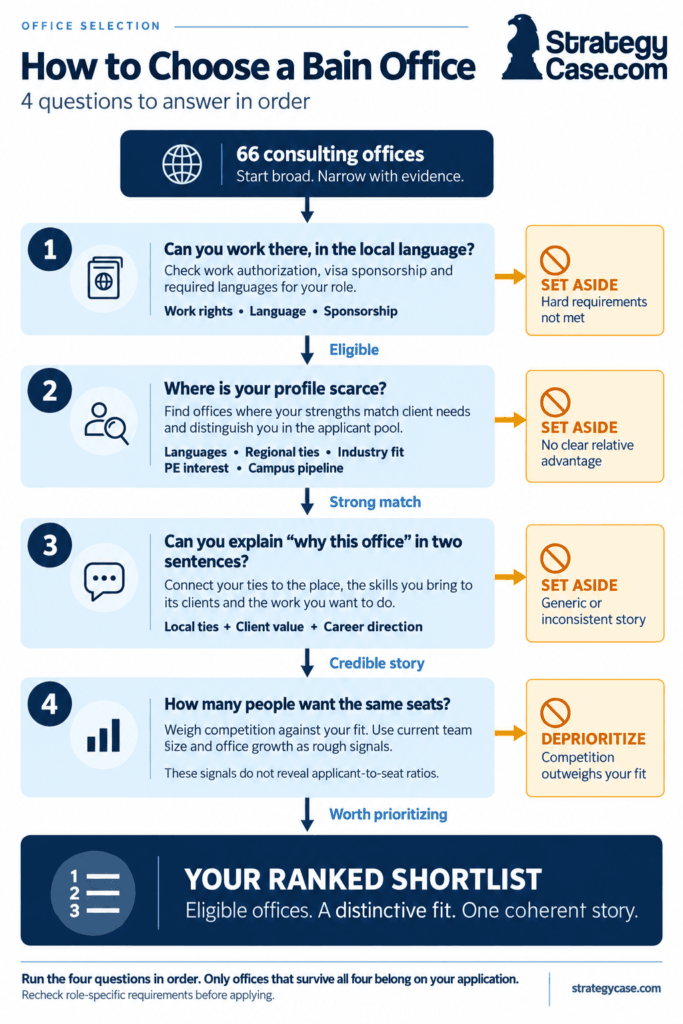
1. Can you work there, in the local language?
Start with eligibility, because no story overcomes a hard filter. Bain’s 13 US consulting offices, London, and Amsterdam list no extra language or visa requirements for the Associate Consultant role. Most other offices add at least one:
- English at C1, the local language a plus: the German-speaking and Nordic offices. The Middle East offices make English mandatory and call Arabic “advantageous.”
- The local language required: Paris, Montreal, Latin America, Madrid and Lisbon, Milan and Rome, Athens, Istanbul, Warsaw, Kyiv, Greater China, Tokyo, and Seoul.
- Work rights: the German-speaking offices require a European work permit and Bain Italy doesn’t sponsor visas, while the Nordic offices, Paris, Madrid, Lisbon, and Mexico City sponsor successful candidates.
Check your shortlist against the requirements table further down before anything else.
2. Where is your profile scarce?
List what makes you unusual in the applicant pool, then find the office that needs it:
- A language beyond English. Bain’s German offices serve mainly large and midsize German companies, so German that Bain calls “beneficial” is a real edge with clients. Singapore lists six regional languages as optional, a hint at what its clients speak.
- Roots in a region. Bain’s offices sell to their regions: Atlanta to the Southeast, Chicago to the Midwest, Seattle to the Pacific Northwest. Local ties make your “why this office” answer credible.
- Industry experience that matches the office. Houston centers on energy, Frankfurt on financial services, and Silicon Valley on technology. The goals table further down has the full match-up.
- An interest in private equity. Bain says it works with about 80% of the world’s largest private equity firms (bain.com), and offices such as Atlanta, Austin, Chicago, Los Angeles, Mumbai, and Vienna name it as a core line of work.
- A campus pipeline. Search your school on Bain’s students page to see the events and deadlines for your campus.
3. Can you explain “why this office” in two sentences?
Expect the question, whether from a recruiter, in a coffee chat, or in your Bain fit interview. “I’d love to live in Los Angeles” is a preference, not a reason. A real answer links three things: your ties to the place, the skills you bring to its clients, and the work you want to do there.
Your ranked offices should tell the same story. If Boston is your first choice, a logical second is New York, another Northeast office, not San Francisco. The recruiter should see one candidate with one plan, and your consulting resume should point the same way.
4. How many people want the same seats?
The famous offices attract the biggest pools. That doesn’t make them wrong for you, but it raises the price of a weak “why this office” answer.
Bain publishes no headcount by office beyond calling Boston its largest. To compare the rest, filter LinkedIn for current Bain associate consultants and consultants in each city. It’s rough, but it beats a number copied from a forum. Growth matters too: Bain counts both Austin and Dubai among its fastest-growing offices, and Denver, Montreal, and Ho Chi Minh City are new. A growing office has seats to fill.
How to Rank Your Bain Office Preferences
Bain doesn’t publish how recruiters read your ranking. Treat this as my rule of thumb, not a formula:
| Your situation | How to rank | Why |
|---|---|---|
| One office fits on all four questions | That office first, then only offices you would accept | A short, focused list reads as commitment |
| A clear first choice plus a real backup in the same region | First choice, then the same-region office | Keeps a second door open without blurring your story |
| Two offices fit equally, such as Dallas and Houston | The one whose clients match your background goes first | Industry fit is the tiebreaker a recruiter can see |
| An office where you lack the language or the work rights | Leave it off | Its own requirements screen you out |
| You want to work abroad later in your career | Rank where you want to start | Moves come after a track record, not on day one |
Three rankings I would talk any candidate out of:
- New York, Los Angeles, Singapore. Three unrelated markets tell Bain you have no plan, and none of the three sees a candidate built for it.
- A famous office first “to try your luck.” Your first choice is the office whose requirements apply and whose story you have to defend. If your fit is in Chicago, lead with Chicago.
- A ranking built on a planned transfer. Applying to one office while intending to move to another within months is not a strategy. Pick the office you want to start in.
Which Bain Office Is Easiest to Get Into?
No Bain office has a lower bar. Bain holds every candidate for a role to the same interview standard, so the case is as demanding in Denver as in New York. The easiest office for you is the one where few applicants clear the same filters you do.
In practice, that means three patterns:
- Local-language offices, if you speak the language natively. A native Italian speaker applying to Milan competes only against other fluent Italian speakers. In London, the same candidate competes with applicants from across Europe and beyond.
- Offices outside the headline cities in your own country. In the US, New York draws the most applications and Boston is nearly as competitive. Chicago, Los Angeles, and San Francisco see fewer applications but look harder for something specific: Midwest roots in Chicago, industry depth in Los Angeles and San Francisco.
- Offices whose core industry is your industry. If you come from energy, Houston’s client base makes you immediately useful. In most other offices, the same background is a side note.
Lower competition only helps if your story for that office is real. A forced “why Chicago” falls apart at the first follow-up question, and a candidate whose heart is in New York reads as a flight risk anywhere else.
Which Bain Office Is the Biggest, the Best, or the Most Prestigious?
Boston is Bain’s biggest office. Bill Bain founded the firm there in 1973, many of the firm’s leaders work there, and Bain calls it “the firm’s oldest and largest office.” Bain doesn’t publish headcounts for its other offices, so treat any precise office size you read online as an estimate.
No office is the best across the board. Every Bain office carries the same name on your resume. What differs is the work: your exit options follow the industries you build expertise in, and those depend on your office’s clients. Because Bain staffs most projects locally, the office’s client base shapes your first years more than it would at McKinsey or BCG. So the best Bain office is the one whose clients you want to know in five years.
Use Bain’s own office pages to match offices to goals:
| If you want… | Look at | What Bain says |
|---|---|---|
| Technology | Silicon Valley, Austin, Seattle | Silicon Valley is “a focal point for its worldwide technology initiative” |
| Energy and the energy transition | Houston, Abu Dhabi, Doha | Houston calls itself “at the forefront of the Energy and Natural Resources sector” |
| Media and entertainment | Los Angeles | Bain LA works from “the entertainment and media capital of the world” |
| Financial services | Frankfurt, Zurich | Frankfurt is “particularly renowned” for financial services; Zurich lists financial services and insurance first |
| Private equity | Atlanta, Austin, Chicago, Los Angeles, Mumbai, Vienna | Each names private equity as a core line of work |
| Government and national transformation | Riyadh, Abu Dhabi, Doha | Riyadh’s growth reflects “the unprecedented pace of transformation” in Saudi Arabia |
| Nonprofits, education, and global development | Washington, DC | Serves nonprofits in education and global development, but doesn’t work directly with US government agencies |
The Main Bain Offices at a Glance
These cover the offices most StrategyCase coaching clients apply to, plus the German-speaking offices, since German is my native language. Addresses, opening years, and focus areas come from each office’s page on Bain’s offices site, checked October 15, 2026. The “best fit” lines are my read.
Bain Boston (Headquarters)
- Address: 350 Boylston Street, Boston, MA 02116
- What the office serves: founded by Bill Bain in 1973, Boston is “the firm’s oldest and largest office” and home to many of its leaders. It serves companies from mid-cap to Fortune 100, with a focus on the northeastern US.
- Best fit: candidates who want Bain specifically, not any MBB firm, and can say why; Boston-area roots or ties to Harvard, MIT, and other New England schools.
- Good to know: older guides list 131 Dartmouth Street, Bain’s previous headquarters. The firm leased eight floors at 350 Boylston Street in 2022.
Bain New York
- Address: 335 Madison Avenue, New York, NY 10017. The tower was rebranded as 22 Vanderbilt in 2022, so you’ll see both addresses for the same building next to Grand Central.
- What the office serves: opened in 2000, it serves clients “across the Tri-state area,” and Bain counts it among its most diverse offices.
- Best fit: candidates with ties to New York schools or the region’s industries who want a broad client mix. Expect one of the largest applicant pools in the Americas.
Bain Chicago
- Address: 190 South LaSalle Street, Suite 3400, Chicago, IL 60603
- What the office serves: since 1992, “small and midsize companies in the Midwest to Fortune 1000 firms,” across consumer products, retail, healthcare, technology, industrials, financial services, and private equity. Bain also calls it a hub for firm leaders.
- Best fit: Midwest roots or Kellogg, Booth, or Big Ten ties, plus a real plan to build a career in the Midwest. Treating Chicago as a backup to New York reads poorly.
Bain San Francisco and Silicon Valley
- Addresses: 415 Mission Street, Suite 4800, San Francisco, CA 94105; 525 University Avenue, Suite 23, Palo Alto, CA 94301 (Silicon Valley)
- What the offices serve: San Francisco (since 1978) works with start-ups through Fortune 500 companies. Silicon Valley serves tech start-ups, established firms, and buyout and venture groups, and anchors Bain’s worldwide technology work. They are separate choices on the application.
- Best fit: engineers, product managers, and data scientists from tech, and candidates with Stanford or Berkeley ties. The engineer-to-consulting guide shows how to position that background.
Bain Los Angeles
- Address: 1999 Avenue of the Stars, Suite 3900, Los Angeles, CA 90067 (Century City)
- What the office serves: media and entertainment, utilities, technology, healthcare, and private equity, “with a particular focus on Southern California.”
- Best fit: media, entertainment, or West Coast consumer backgrounds; UCLA or USC ties; and a “why LA” that goes beyond the weather.
Bain Washington, DC
- Address: 1101 16th St NW, Suite 700, Washington, DC 20036
- What the office serves: Fortune 500 companies, private equity firms, and nonprofits in education and global development. Bain states that the office doesn’t work directly with US government agencies.
- Best fit: candidates drawn to aerospace and defense, education, or development work with private and nonprofit clients. If you want to advise federal agencies directly, Bain DC is not that office.
Bain London
- Address: 40 Strand, London WC2N 5RW
- What the office serves: “the firm’s first office established beyond US borders,” which Bain describes as a hub of international activity.
- Best fit: UK or EU candidates, especially with a second business language, who want a broad international client mix.
- Good to know: Associate Consultant applications for graduates and candidates with under two years of experience close October 15, 2026. If you need sponsorship, the Skilled Worker visa requires a job offer from a licensed sponsor, so raise it early.
Bain Germany, Austria, and Switzerland
- Offices: Berlin (Potsdamer Platz 11), Düsseldorf (Speditionstraße 21), Frankfurt (Neue Mainzer Straße 80), Munich (Karlsplatz 1), Vienna (Mariahilfer Straße 17), and Zurich (Sihlporte 3)
- What the offices serve: one Austrian, German, and Swiss cluster, which began with Munich in 1982. The German offices serve large and midsize German companies and DAX firms. Frankfurt is known for financial services, Zurich for financial services and insurance, and Vienna for institutional investors and private equity.
- Best fit: fluent German and EU work rights. Applications run year-round, ideally about six months before your start date. For native speakers, these offices are often the strongest first choice on the application.
Bain Middle East: Dubai, Abu Dhabi, Doha, and Riyadh
- Addresses: Dubai: One Central, The Offices 4, Dubai World Trade Centre. Abu Dhabi: Capital Plaza Tower, Corniche Road. Doha: Tornado Tower, West Bay. Riyadh: King Abdullah Financial District (KAFD).
- What the offices serve: Bain runs them as one team, Bain Middle East. Dubai counts more than 60 nationalities. Abu Dhabi works on sovereign investment, the energy transition, and AI. Doha serves Qatar, Oman, and Kuwait, and Riyadh has grown with Saudi Arabia’s transformation.
- Best fit: Gulf ties or Arabic, which Bain calls “advantageous.” All four offices share one Associate Consultant deadline, October 30, 2026. The UAE doesn’t levy income tax on individuals, which changes the net-pay comparison with the US or UK.
Bain Singapore and Southeast Asia
- Address: 38 Beach Road, South Beach Tower, Level 28, Singapore 189767
- What the office serves: opened in 1993, Singapore works with Bangkok, Ho Chi Minh City, Jakarta, Kuala Lumpur, and Manila as Bain Southeast Asia, serving financial services, consumer, retail, private equity, healthcare, and technology clients.
- Best fit: Singapore work rights (required for Associate Consultants), regional roots, or a regional language.
Other US Bain Offices
| Office | Address | What Bain says about it |
|---|---|---|
| Atlanta | 1180 Peachtree Street NE, Suite 2700 | 20+ years serving clients “primarily in the southeastern United States”; names private equity among its strengths |
| Austin | 405 Colorado St, Suite 2000 | Technology, private equity, healthcare, and advanced manufacturing; one of Bain’s fastest-growing offices |
| Dallas | 1717 McKinney Avenue, Suite 1600 | Since 1990; Fortune 500 companies to nonprofits across the Southwest |
| Denver | 675 15th St | Newly launched; healthcare, retail, technology, supply chain, private equity, and energy |
| Houston | 845 Texas Ave, Suite 3700 | Energy and natural resources and the energy transition, for clients across the Southwest and Latin America |
| Seattle | 1001 4th Ave, Floor 46 | The Pacific Northwest; retail, technology, telecommunications, and industrials |
| Minneapolis | 800 N Washington Avenue, Suite 300 | Specialist teams, including FRWD (digital marketing) and the Advanced Analytics Group. Not an option on Bain’s consulting application pages |
Does Bain Have an Office in Miami, New Jersey, or San Diego?
No. As of October 9, 2026, Bain’s offices page lists no office in Miami, New Jersey, or San Diego, even though candidates search for all three. Each market sits in the region of a nearby office:
| You searched for | Nearest Bain office | What Bain says about that office’s region |
|---|---|---|
| Miami or Florida | Atlanta | Serves clients “primarily in the southeastern United States” |
| New Jersey | New York | Serves clients “across the Tri-state area” |
| San Diego | Los Angeles | Serves the western US “with a particular focus on Southern California” |
Bain hires into offices, not metro areas, so apply to the office whose region you want to serve. McKinsey, for comparison, does have offices in Miami and New Jersey.
What Changes Between Bain Offices, and What Doesn’t
Office choice changes the setting of your recruiting process, not the test itself.
| The same in every office | Can differ by office |
|---|---|
| One interview standard per role, scored on an objective system | Deadlines: fixed dates, annual rounds, or rolling review |
| A digital assessment for consulting roles (Sova or TestGorilla), taken once across Bain applications | Required languages and work rights |
| Case interviews for consulting roles | Which roles an office hires for: the Associate Consultant role isn’t offered in Mumbai, New Delhi, Bengaluru, Johannesburg, or Rio de Janeiro |
| In the US, one $120,000 base salary for first-year Associate Consultants | Extra steps, like a written case and a behavioral interview in Shanghai and Hong Kong |
Bain’s what-to-expect page confirms the core sequence for consulting roles: “a digital assessment and then case interview(s).” Where an office page names the test, it’s TestGorilla: the Middle East, South America, Shanghai and Hong Kong, and Singapore and Bangkok for Consultant hires. Everywhere else, Bain tells you by email which test you’ll take.
Our guides cover each step: the Bain TestGorilla and Bain Sova tests, Bain’s answer-first case style, and the Bain AI interview format. For dates across firms, see the consulting recruiting timeline. Experienced hires with 4 to 7 years of experience (or 1 to 3 years after an MBA) apply as Consultants. In the US and Canada, industry applications for Q1 2027 starts close October 18, 2026, and the experienced hire guide explains how that track works.
One more thing changes: case topics can lean toward the office’s client base, since interviewers bring business problems they know. Don’t respond by memorizing “Houston energy cases” or “LA media cases.” That’s the template thinking Bain itself rules out: its hiring page says “we’ll never ask you to memorize and recite material.” Train structuring, analysis, and judgment, then read up on your target office’s industries as a bonus, never a substitute.
Bain Office Requirements by Region (2026)
Here is what each office lists for the Associate Consultant role (the entry-level job for undergraduates, master’s students, and early-career professionals) on Bain’s Associate Consultant page, checked October 9, 2026:
| Offices | Languages | Work rights and visas | Associate Consultant timing |
|---|---|---|---|
| 13 US offices | English | No extra requirements listed | One deadline for students graduating December 2026 to June 2027 and for candidates with up to 3 years of experience: October 11 in 2026 |
| Toronto | English | Canadian work authorization | Early career (up to 2 years): October 11, 2026. Undergraduates: next cycle in summer 2027 |
| Montreal | French and English (assessment in French) | Canadian work authorization | October 11, 2026 |
| Mexico City, Monterrey | Spanish | Visa sponsorship for qualified candidates | Two cycles a year: February to March and August to September |
| Bogotá, Buenos Aires, Santiago, São Paulo | Spanish (São Paulo: Portuguese) | Santiago sponsors visas; São Paulo asks candidates from outside South America for 1+ year of experience | Selection rounds for penultimate- and final-year students: TestGorilla, then two rounds of two case interviews |
| London | English | No extra requirements listed | Graduates and under 2 years of experience: October 15, 2026. Experienced: year-round |
| Berlin, Düsseldorf, Frankfurt, Munich, Vienna, Zurich | English at C1; German beneficial | European work permit | Year-round; apply about 6 months before your start date |
| Amsterdam, Brussels | English (Brussels: French or Dutch optional) | No extra requirements listed in Amsterdam | Year-round; Brussels requires a cover letter |
| Copenhagen, Helsinki, Oslo, Stockholm | English at C1 | Visa sponsorship for successful candidates | Rolling review, several start dates a year |
| Paris | French at C1 and English | Visa sponsorship available | Master’s students only; three application windows a year |
| Madrid, Lisbon | Spanish or Portuguese, plus English at C1 | Visa sponsorship available | October 25, 2026 (January 2027 start) and April 18, 2027 (September 2027 start) |
| Milan, Rome | Italian and English | Non-EU candidates need their own work permit; Bain Italy doesn’t sponsor | Rolling |
| Athens | Greek and English | Sponsorship for qualified non-EU candidates | Rolling |
| Warsaw | Polish or another Central and Eastern European language | Work permit if you’re not an EU citizen | Rolling, year-round |
| Istanbul | Turkish and English | Work permit for non-Turkish citizens | November 1, 2026, for June 2027 graduates |
| Kyiv | Ukrainian and English | Right to work in Ukraine | Annual deadline (September 30 in 2026) |
| Abu Dhabi, Doha, Dubai, Riyadh | English; Arabic advantageous | Not specified | October 30, 2026, plus TestGorilla |
| Singapore, Bangkok, Ho Chi Minh City, Jakarta, Kuala Lumpur, Manila | English; regional languages optional | Work authorization required | Deadline depends on your school’s location; experienced hires apply year-round |
| Beijing, Shanghai, Hong Kong | Mandarin and English (Cantonese optional) | Beijing and Shanghai: 2+ years of work experience without Chinese permanent residency | Shanghai and Hong Kong: rolling. Beijing: to be confirmed |
| Tokyo | Japanese and English (JLPT N1 if non-native) | Eligible for a Japanese work visa | Tokyo’s own recruiting sites |
| Seoul | Korean | F4 visa or above for foreign nationals | Annual deadline (May 10 in 2026) |
| Sydney, Melbourne, Perth | English | 3+ years of independent Australian work rights | Annual round in February and March; rolling outside it |
| Mumbai, New Delhi, Bengaluru, Johannesburg, Rio de Janeiro | n/a | n/a | No Associate Consultant role on Bain’s page |
Dates change every cycle, and some office pages still show last cycle’s dates, so confirm on Bain’s page before you plan around them. MBA graduates and experienced professionals apply for the Consultant role instead. MBA students follow their school’s on-campus calendar, and most offices in Europe, Asia, and Australia review experienced Consultant applications year-round. If you’re looking for a summer internship rather than a full-time job, know that Bain’s internship runs in fewer offices than the full-time role.
All Bain Office Locations by Region (2026 List)
The list below shows every location on Bain’s offices page on October 9, 2026: 68 entries. Bain’s own headline count is 67 cities in 40 countries.
Bain offices in the United States
Atlanta, Austin, Boston (headquarters), Chicago, Dallas, Denver, Houston, Los Angeles, Minneapolis, New York, San Francisco, Seattle, Silicon Valley (Palo Alto), and Washington, DC. Minneapolis hosts specialist teams and isn’t an option on Bain’s consulting application pages, which list the other 13.
Bain offices in Canada and Latin America
- Canada: Montreal, Toronto
- Mexico: Mexico City, Monterrey
- South America: Bogotá, Buenos Aires, Rio de Janeiro, Santiago, São Paulo
Bain offices in Europe and Africa
- United Kingdom: London
- Germany: Berlin, Düsseldorf, Frankfurt, Munich
- Austria and Switzerland: Vienna, Zurich
- France: Paris
- Italy: Milan, Rome
- Spain and Portugal: Madrid, Lisbon
- Belgium and the Netherlands: Brussels, Amsterdam
- Nordics: Copenhagen, Helsinki, Oslo, Stockholm
- Elsewhere in Europe: Athens, Istanbul, Kyiv, Warsaw
- Africa: Johannesburg
Bain offices in the Middle East
Abu Dhabi, Doha, Dubai, Riyadh
Bain offices in Asia and Australia
- Greater China: Beijing, Hong Kong, Shanghai
- India: Bengaluru, Mumbai, New Delhi (the office is in Gurgaon)
- Southeast Asia: Bangkok, Ho Chi Minh City, Jakarta, Kuala Lumpur, Manila, Singapore
- Japan and Korea: Tokyo, Seoul
- Australia: Brisbane, Melbourne, Perth, Sydney (Brisbane isn’t listed on Bain’s consulting application pages)
Frequently Asked Questions About Bain Offices
How many offices does Bain have?
Bain & Company has offices in 67 cities across 40 countries, according to its own site. Its offices page lists 68 locations, including Minneapolis, which hosts specialist teams. For consulting roles, Bain’s application pages let you choose from 66 offices.
Where is Bain’s headquarters?
Bain’s headquarters is in Boston, at 350 Boylston Street. Bill Bain founded the firm there in 1973, and Bain calls Boston its oldest and largest office. Older sources list 131 Dartmouth Street, the firm’s previous Boston address.
Can I apply to more than one Bain office?
Yes, within one application. Bain asks for your office preferences, and in most regions you can rank up to three. The requirements of your main office apply, so list only offices whose language and work-permit rules you meet, and make sure your choices tell one coherent story.
Do Bain offices pay differently?
Within the US, no. Bain’s Associate Consultant posting gives one figure for the whole country: a $120,000 annualized base salary for first-year Associate Consultants. Outside the US, pay follows the local market. The same posting lists €45,000 for Italy, plus a performance bonus of up to 22% of base. Our Bain salary guide has the figures by level.
Is Bain & Company the same as Bain Capital?
No. Bain Capital is a separate investment firm, founded as a private partnership in 1984, with its own offices and its own hiring. It shares a name and origins with Bain & Company, but every office on this page belongs to Bain & Company, the consulting firm.
Can I transfer between Bain offices later?
Yes, but plan to start where you apply. Moves between offices happen, usually after 18 to 24 months in your first office, once you have built a track record. Applying to one office while planning to move to another within months is not a plan the firm will support.
Related Guides
- McKinsey office locations: how McKinsey’s three-choice, 60-point office selection works
- BCG office locations: BCG’s offices and how its application differs
- McKinsey vs BCG vs Bain: choose the firm before you choose the office
- A day in the life of a Bain consultant: what the job looks like once you join an office
- How to get into consulting: the full application playbook across firms
Choose Your Bain Office, Then Prepare for the Interview That Never Changes
The office decision takes an afternoon, and it shapes everything that follows:
- Bain offices share one interview standard per role. Your odds differ because applicants per seat, languages, and work rights differ.
- Answer the four questions in order: eligibility, scarcity, story, competition.
- Read your first-choice office’s requirements on Bain’s role pages before you apply. They apply to your whole application.
- Use the full list above to find offices you hadn’t considered, especially outside the headline cities.
Once your office is set, the work is the same in every one of them: a case and a fit interview judged on how you think, not on which city you picked. Start with StrategyCase’s free Case Interview Foundations course to build the structuring and analysis every Bain office tests. For structured practice on case structuring, exhibit interpretation, and case math, the Case Interview Academy has video lessons and thousands of drills. And if you want an expert read on which office fits your profile and where your preparation stands, a coaching session with me starts with a baseline and a plan.
About the author: Dr. Florian Smeritschnig is the founder of StrategyCase.com and a former McKinsey Senior Consultant. Since 2020 he has delivered 2,200+ mock interviews and coaching sessions, and his clients have secured 700+ consulting offers, 340 of them at McKinsey, BCG, and Bain. He is the author of three books on consulting interviews and careers, including The 1%: Conquer Your Consulting Case Interview.
