
Last Updated on July 17, 2026
The top cybersecurity consulting firms in 2026 are Accenture, Deloitte, IBM, PwC, EY, and KPMG among the global integrators; McKinsey and BCG Platinion for cyber strategy; and Mandiant, Unit 42, CrowdStrike, and Booz Allen Hamilton for specialist defense and incident response. Which one is “best” depends entirely on the problem: transformation programs go to the integrators, board-level strategy goes to the strategy firms, and active breaches go to the specialists.
I spent 5 years at McKinsey as a Senior Consultant, where I watched cybersecurity move from the IT basement onto CEO agendas, and I have since coached candidates to 700+ consulting offers through StrategyCase. This guide compares the 12 firms that lead the market, explains which type to hire for which situation, and covers the part almost no other ranking touches: what it takes to get hired by one of them.
Key Takeaways
- The market splits into three groups: global integrators (Accenture, IBM, the Big 4), strategy firms (McKinsey, BCG Platinion), and specialists (Mandiant, Unit 42, CrowdStrike, Booz Allen).
- The money is real: organizations will spend $213 billion on information security in 2025 per Gartner, while IBM puts the average US data breach at a record $10.22 million.
- Match the firm type to the problem: integrators for multi-year security transformations, strategy firms for board-level cyber risk decisions, specialists for incident response and threat intelligence.
- In Europe and the UK, regulation (DORA, NIS2) is driving demand toward firms with strong compliance and operational-resilience practices: the Big 4, Atos/Eviden, and NCC Group.
- For candidates, cybersecurity consulting is one of the strongest entry points into the industry: ISC2 estimates a global cyber workforce gap of 4.8 million people, and US information security roles are projected to grow 29% through 2034.
What Does a Cybersecurity Consulting Firm Do?
A cybersecurity consulting firm advises organizations on identifying cyber risk, designing and implementing security programs, meeting security regulation, and responding to attacks. Engagements range from board-level risk strategy and compliance readiness to hands-on penetration testing, security architecture, and 24/7 incident response.
In practice, the work falls into five buckets: cyber risk assessment, security strategy and governance, cloud and identity security, incident response, and multi-year security transformation programs. No single firm is the best at all five, which is exactly why the market has split into distinct groups.
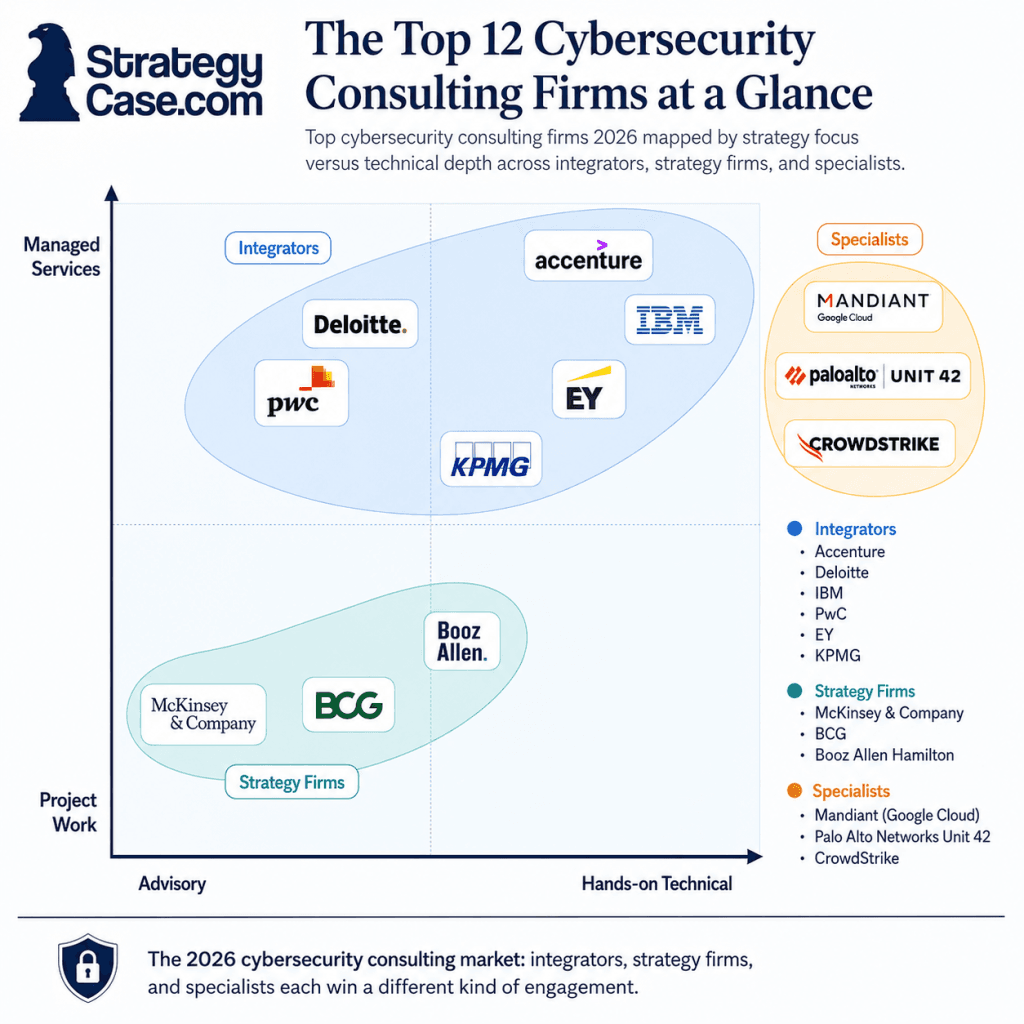
The Top 12 Cybersecurity Consulting Firms at a Glance
Here are the 12 leaders, grouped by what they actually sell:
| Firm | Cyber unit | Known for | Best for |
|---|---|---|---|
| Accenture | Accenture Security | Largest end-to-end security services operation | Enterprise security transformation at global scale |
| Deloitte | Deloitte Cyber | Cyber strategy tied to enterprise risk and regulation | Regulated industries, board-level governance |
| IBM | IBM Cybersecurity Services / X-Force | Threat intelligence plus technology depth | Managed detection, AI-driven security operations |
| PwC | Cybersecurity, Risk & Regulatory | Privacy and cross-border compliance | Multinationals facing regulatory complexity |
| EY | EY Cybersecurity | Identity and access management, cloud security | IAM programs, digital-trust initiatives |
| KPMG | KPMG Cyber | Third-party risk, financial services | Banks, insurers, cyber maturity assessments |
| McKinsey | Risk & Resilience practice | Cyber risk quantification for boards | CEO-level cyber strategy and investment decisions |
| BCG | BCG Platinion | Cyber architecture inside strategy work | Tech due diligence, security by design |
| Booz Allen Hamilton | Booz Allen Cyber | US federal and defense cyber | Government, national security, critical infrastructure |
| Mandiant | Google Cloud Security | Nation-state breach investigation | Major incident response, threat intelligence |
| Palo Alto Networks | Unit 42 | Threat research plus incident response | Breach response tied to platform telemetry |
| CrowdStrike | CrowdStrike Services | Endpoint telemetry at scale | Compromise assessments, IR retainers |
How I Picked These 12 Firms
Three criteria decided the list: depth of the security practice (not just a security-flavored slide deck), breadth of services across the five buckets above, and independent standing in the market (who gets called first, by whom, and for what).
One observation from inside the industry shaped this ranking more than any analyst report. During my McKinsey years, I saw how cyber engagements were actually staffed: the client-facing strategy work and the deep technical delivery were almost never done by the same people.
The firms below are grouped by which side of that divide they live on, because that divide, not brand prestige, determines what you get as a client and what your job looks like as a consultant.
The Global Integrators: Accenture, IBM, and the Big 4
These six firms run the largest cybersecurity consulting practices in the world. They combine advisory work with implementation and managed security services, which is why they dominate multi-year transformation programs.
Accenture Security
Accenture runs the largest end-to-end security services operation among the integrators, built organically and through a long string of security acquisitions. It covers strategy, implementation, and managed security operations in one delivery model.
Its sweet spot is scale: securing a cloud migration across 40 countries, modernizing a security operations center, or rolling out zero-trust architecture for a workforce of 100,000. If you are considering working there, note that security consultants sit in a dedicated practice with its own career track; my Accenture salary guide breaks down how the compensation ladders compare.
Deloitte Cyber
Deloitte pairs one of the largest cyber practices in the world with its audit-heritage strength: enterprise risk, controls, and regulation. It is the default shortlist entry when the buyer is a chief risk officer rather than a chief information security officer.
Deloitte is strongest where cyber meets governance: security program design, regulatory readiness, and cyber risk quantification for boards. For candidates, it hires the broadest range of profiles in this list, from technical testers to pure risk consultants; the Deloitte consulting salary guide covers what those roles pay.
IBM Cybersecurity Services
IBM is the most technology-led of the integrators. Its X-Force research unit feeds live threat intelligence into consulting engagements, and IBM publishes the annual Cost of a Data Breach study, the most cited benchmark in the industry ($4.44 million global average in 2025, the first decline in five years, against a record $10.22 million in the US).
Clients hire IBM for managed detection and response, AI-driven security operations, and anything where consulting needs to end in running technology rather than a report.
PwC Cybersecurity, Risk & Regulatory
PwC’s cyber practice is anchored in privacy, data protection, and cross-border compliance. It is a common pick for multinationals that must reconcile GDPR, sector rules, and diverging national regimes in one program.
Expect strength in regulatory strategy, privacy engineering, and compliance readiness, with implementation muscle behind it.
EY Cybersecurity
EY has built its cyber reputation on identity and access management and cloud security, two of the fastest-growing problem areas as credentials, not firewalls, become the main way attackers get in.
EY positions security work inside its broader digital-trust agenda, which makes it a frequent partner on transformation programs where security has to enable the change rather than veto it.
KPMG Cyber
KPMG’s differentiators are third-party risk management and financial services depth. Banks and insurers use it heavily for cyber maturity assessments, regulatory remediation, and vendor risk programs.
Among the Big 4 it is often the most pragmatic choice for mid-sized regulated firms that need Big 4 credibility without a mega-program price tag. If you want the full picture of how these four networks differ beyond cyber, start with my guide to the Big 4.
The Strategy Firms: Where McKinsey, BCG, and Bain Fit In
Most rankings skip the strategy firms entirely, which is a mistake. The Big 3 strategy firms rarely compete for technical delivery, but they increasingly own the most consequential cyber decisions: how much to spend, what to protect first, and how to organize security across a global business.
McKinsey & Company
McKinsey treats cybersecurity as a board-level risk and investment problem, run out of its Risk & Resilience practice. The work is cyber risk quantification, security operating models, and post-breach strategic response, not penetration testing.
Its research arm also frames how the market thinks about the opportunity: McKinsey estimates the fully addressed cybersecurity market at $1.5 to 2 trillion, roughly ten times what providers actually capture today. When a CEO needs to decide whether cyber spend should double, this is the kind of firm that gets the call.
BCG Platinion
BCG runs its hands-on technology work through Platinion, a dedicated unit that includes cybersecurity architecture, incident response support, and security due diligence. It is the most technically credible cyber offering among the Big 3, and it frequently rides along on private equity deals to assess a target’s security posture before signing.
Bain
Bain, the third of the Big 3, takes a partnership-led approach: cyber strategy and vendor diligence delivered by generalist teams working with specialist alliance partners rather than a large in-house technical bench.
The Specialists: Mandiant, Unit 42, CrowdStrike, and Booz Allen
When the question is “we are being attacked right now” or “who did this,” the specialists win. Their consulting arms are built on threat intelligence that integrators cannot match.
Mandiant (Google Cloud)
Mandiant is the most respected name in breach investigation. It exposed a Chinese military hacking unit in its landmark APT1 report and has led the response to many of the largest intrusions on record. Google completed its $5.4 billion acquisition of Mandiant in 2022, folding it into Google Cloud Security while keeping the consulting brand.
Organizations bring in Mandiant for major incident response, proactive compromise assessments, and its M-Trends threat intelligence. When a breach makes headlines, Mandiant is very often the firm named in the disclosure.
Palo Alto Networks Unit 42
Unit 42 combines Palo Alto Networks’ threat research with a consulting arm focused on incident response, cloud security assessments, and attack surface reviews. Its edge is telemetry: consultants work with live data from one of the largest installed security platforms in the world.
CrowdStrike Services
CrowdStrike Services runs incident response, compromise assessments, and IR retainers on top of the Falcon endpoint platform. Like Unit 42, its consultants see attacker behavior across millions of monitored endpoints in real time, which shows up in the speed of its investigations.
Booz Allen Hamilton
Booz Allen is the anchor firm for US federal and defense cybersecurity and positions itself as the largest provider of cyber services to the US government. Its consultants work on national security systems, critical infrastructure defense, and offensive-adjacent research that commercial firms rarely touch.
For candidates interested in public-sector cyber at scale, it is the clearest single destination in this list, with the caveat that many roles require US security clearance.
Other Cybersecurity Consulting Providers Worth Knowing
Five more cybersecurity consulting providers matter in specific situations, even if they did not make the core 12:
- Optiv (US): the largest pure-play security solutions integrator in North America, strong in governance, risk, and compliance programs.
- NCC Group (UK): a leading UK and European name for penetration testing, assurance, and escrow services.
- Kroll: forensics-led cyber risk work, often engaged through law firms after an incident.
- FTI Consulting: cybersecurity in crisis contexts, where breach response meets litigation, disputes, and regulatory exposure.
- Atos / Eviden (France): a major European managed security and consulting player, especially in public sector and critical infrastructure.
Big 4 vs Specialists vs Strategy Firms: Which Should You Hire?
The verdict, in one paragraph: hire an integrator when you need a large security program designed and delivered; hire a specialist when you need attackers found, removed, or understood; hire a strategy firm when the board needs to decide what cyber is worth and how to organize it. Getting this match wrong is the single most common buying mistake in this market.
A more precise way to choose:
- Active breach or suspected compromise: go straight to Mandiant, Unit 42, or CrowdStrike. Speed and forensic depth beat everything else.
- Multi-year security transformation (cloud migration, zero trust, new SOC): shortlist Accenture, IBM, and Deloitte. Ask each who actually staffs years two and three.
- Regulatory pressure (DORA, NIS2, SEC disclosure rules): the Big 4 lead here, with PwC and KPMG strongest on compliance-heavy programs.
- Board-level strategy and spend decisions: McKinsey or BCG, ideally with a technical firm validating the implementation plan.
- Mid-market budget: consider Optiv, NCC Group, or a strong regional boutique before defaulting to a global name; you will often get more senior attention per dollar.
Many organizations end up with a hybrid: a strategy or Big 4 firm setting direction and an integrator or specialist delivering the technical work. That is not indecision; it mirrors how the capabilities are genuinely distributed.
Best Cybersecurity Consulting Firms by Region and Specialization
Search behavior shows buyers increasingly qualify this question by geography and specialty, so here is the honest mapping:
- Europe and the UK: the Big 4 dominate regulated-industry work, with Atos/Eviden strong in France and public sector, and NCC Group the UK reference for technical assurance. DORA, in force for EU financial firms since January 2025, and the NIS2 directive have made operational resilience the fastest-growing engagement type in the region.
- US federal and defense: Booz Allen Hamilton first, with Deloitte and Accenture Federal Services close behind. Clearance requirements shape who can even bid.
- Critical national infrastructure: Booz Allen in the US; in Europe, Atos/Eviden and the Big 4 lead, typically under national cyber agency frameworks. Operational technology depth is the differentiator to probe.
- Cyber resilience and operational risk: Deloitte and McKinsey for enterprise-wide resilience programs that tie cyber to business continuity and board risk appetite; IBM for the recovery technology underneath.
- Incident response: Mandiant, Unit 42, and CrowdStrike, in that order of brand weight, with Kroll and FTI when litigation is likely.
Cybersecurity Consulting Trends That Matter in 2026
Four shifts are redrawing the market this year, and they explain most of the hiring these firms are doing.
AI sits on both sides of the fight. Attackers use it for convincing phishing and faster vulnerability discovery; defenders use it to cut detection and response times. IBM’s 2025 breach data shows organizations with extensive AI-driven security saved close to $1.9 million per breach and shortened the breach lifecycle by 80 days. Every firm on this list is rebuilding its offerings around AI-assisted security operations, and AI governance work is following the same curve I describe in my analysis of AI’s impact on consulting careers and hiring.
Regulation became the demand engine. DORA and NIS2 in Europe and the SEC’s four-business-day incident disclosure rule in the US turned cyber from discretionary spend into compliance spend. That favors the Big 4 and explains their aggressive cyber hiring.
Resilience replaced prevention as the goal. Boards stopped asking “can we prevent every attack” and started asking “how fast do we recover.” Consulting demand followed, toward continuity planning, recovery architecture, and crisis simulation.
Spending keeps compounding. Gartner’s $213 billion 2025 forecast comes with double-digit growth expected into 2026, and security services remain the largest slice. This is why cybersecurity consulting practices keep hiring through consulting downturns.
How to Break Into Cybersecurity Consulting
This is the section the buyer guides skip, and it matters to more of my readers than the buying advice does. The supply-demand math is unusually favorable: ISC2 counts a global workforce of 5.5 million against a 4.8 million person gap, and the US Bureau of Labor Statistics projects 29% growth for information security roles through 2034, with a median wage of $124,910. Consulting salaries at the firms above generally start near that level and scale well past it with seniority.
There are two doors in, and they lead to different jobs:
- The technical door: penetration testing, incident response, cloud security, and security architecture roles at the specialists, IBM, Accenture, and Big 4 technical teams. Here certifications and demonstrable skills (OSCP-style practicals, cloud security credentials, CTF track records) carry real weight.
- The consulting door: cyber strategy, risk, and GRC roles at the Big 4, McKinsey, and BCG Platinion. Here you are evaluated as a consultant first: structured problem solving, client communication, and business judgment, with cyber as the content area.
From coaching candidates into these practices through StrategyCase, the pattern I see is consistent: technical candidates underestimate the consulting bar. A stack of certifications gets you the first conversation at a Big 4 cyber practice, but the offer is decided in case-style discussions and behavioral rounds, the same way it is for generalist consultants.
At McKinsey, specialist candidates additionally face the Technical Expertise Interview on top of the standard case and personal experience rounds. And if you are coming from industry rather than campus, the experienced-hire route into McKinsey, BCG, and Bain has its own rules worth understanding before you apply.
If you are preparing for these interviews, build the consulting skillset deliberately: case interview preparation for the problem-solving rounds and fit interview training for the behavioral rounds that technical candidates most often fail.
FAQ: Top Cybersecurity Consulting Firms
What is the largest cybersecurity consulting firm?
Accenture runs the largest security services operation among consulting firms, spanning advisory, implementation, and managed security. Deloitte operates the largest cyber practice among the Big 4. Size is segment-specific, though: Mandiant leads incident response and Booz Allen leads US government cyber, despite both being far smaller overall.
Do McKinsey, BCG, and Bain do cybersecurity consulting?
Yes, but at the strategy layer. McKinsey advises boards on cyber risk quantification and security operating models through its Risk & Resilience practice, BCG delivers technical security work through Platinion, and Bain pairs generalist teams with specialist partners. None of the three competes for hands-on delivery at integrator scale.
Should my company hire a Big 4 firm or a cybersecurity specialist?
Hire a specialist for breach response, threat hunting, and technical testing; hire a Big 4 firm when cyber must connect to regulation, enterprise risk, and multi-year change. Many organizations use both: a Big 4 or strategy firm to set direction, a specialist for technical depth. Budget-constrained mid-market buyers should also price Optiv or NCC Group.
Which cybersecurity consulting firms lead in Europe?
The Big 4 lead regulated-industry cyber work across Europe, with PwC and KPMG especially strong on DORA and NIS2 compliance programs. Atos/Eviden is the major European-headquartered player, NCC Group leads UK technical assurance, and Mandiant and Accenture handle much of the region’s high-profile incident response.
How much do cybersecurity consultants make?
US information security roles carry a median wage of $124,910 per the Bureau of Labor Statistics, and consulting roles typically start in that range. Big 4 cyber consultants generally earn $85K to $130K early on, specialists pay competitively for technical depth, and MBB consultants working cyber strategy earn standard strategy-consulting packages, roughly $110K to $200K+ depending on level and region.
Do I need a case interview to get into cybersecurity consulting?
At McKinsey and BCG, yes: cyber-focused candidates go through the standard case interview process, plus technical rounds. At the Big 4 and Accenture, expect case-style discussions and scenario questions even for technical roles. Only deeply technical specialist roles (forensics, red teaming) usually skip cases in favor of practical assessments.
Related Guides
- The 4 types of management consulting firms explains how strategy firms, the Big 4, and boutiques differ across every practice area, not just cyber
- How to get into consulting covers the full application playbook once you have picked your target firms
- Switching from the Big 4 to MBB maps the upgrade path many cyber consultants take after 2-3 years
- The comprehensive case interview guide is the starting point for the problem-solving rounds every consulting-track cyber role includes
The Bottom Line
The top cybersecurity consulting firms in 2026 are not one list but three: integrators (Accenture, IBM, the Big 4) for scale, strategy firms (McKinsey, BCG Platinion) for board-level decisions, and specialists (Mandiant, Unit 42, CrowdStrike, Booz Allen) for the sharp end of defense. Buyers get the best results by matching firm type to problem, and candidates get the best odds by picking the door, technical or consulting, that fits their profile.
If the career side is why you are here, that is exactly what StrategyCase is built for. The interview formats these firms use are learnable systems, and a 1-on-1 coaching session will show you precisely where you stand and what to fix first.
The workforce gap is 4.8 million people. The firms are hiring. The only question is whether you walk in prepared.
About the author: Florian Smeritschnig is a former McKinsey Senior Consultant who evaluated candidates at the firm and has delivered 2,200+ mock interviews and coaching sessions. He founded StrategyCase.com and through coaching has helped candidates secure 700+ offers at McKinsey, BCG, Bain, and other top firms.
