

Last Updated on July 17, 2026
Updated July 2026. By Florian Smeritschnig, former McKinsey Senior Consultant.
Consulting vs investment banking is the classic two-offer dilemma, and here is the short answer: choose consulting if you want broader exit options, more varied work, and a schedule you can mostly live with; choose investment banking if you want maximum pay in your first years and the fastest route into private equity.
Both careers recruit the same profile, then shape it into completely different professionals. Pick the wrong one and you will grind through brutal weeks toward a goal you never actually had.
When I was at McKinsey, the offers we lost rarely went to BCG or Bain. They went to Goldman Sachs, JP Morgan, and big tech. Since then I have coached hundreds of candidates through this exact decision, including many holding offers from both sides of the fence. This guide compares the two careers where it actually matters: the work, the pay, the hours, the interviews, and the doors each one opens.
Key Takeaways
- Investment banking pays roughly 30 to 50% more than consulting in year one (about $170,000 to $250,000 all-in at a US bulge bracket vs $140,000 to $160,000 at MBB), at the cost of 15 to 25 more hours per week.
- Consulting sells advice and analysis; banking sells transactions. Consultants answer “should we do this,” bankers get the deal priced, financed, and closed.
- If you want private equity, banking is the feeder. If you want corporate leadership, strategy roles, or wide optionality, consulting opens more doors.
- M&A consulting and investment banking work the same deals in different roles: consultants run due diligence and integration, bankers run execution and financing.
- Getting in is a near 1% game on both sides, but the filters differ: consulting tests live problem-solving in case interviews, banking tests technical fluency, networking, and stamina.
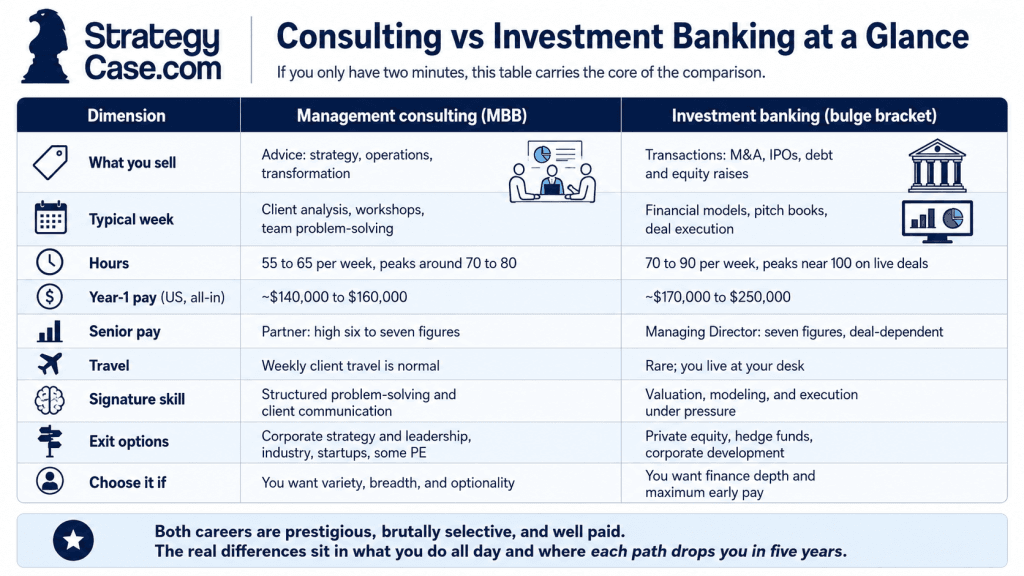
Consulting vs Investment Banking at a Glance
If you only have two minutes, this table carries the core of the comparison. Every row gets its own section below.
| Dimension | Management consulting (MBB) | Investment banking (bulge bracket) |
|---|---|---|
| What you sell | Advice: strategy, operations, transformation | Transactions: M&A, IPOs, debt and equity raises |
| Typical week | Client analysis, workshops, team problem-solving | Financial models, pitch books, deal execution |
| Hours | 55 to 65 per week, peaks around 70 to 80 | 70 to 90 per week, peaks near 100 on live deals |
| Year-1 pay (US, all-in) | ~$140,000 to $160,000 | ~$170,000 to $250,000 |
| Senior pay | Partner: high six to seven figures | Managing Director: seven figures, deal-dependent |
| Travel | Weekly client travel is normal | Rare; you live at your desk |
| Signature skill | Structured problem-solving and client communication | Valuation, modeling, and execution under pressure |
| Exit options | Corporate strategy and leadership, industry, startups, some PE | Private equity, hedge funds, corporate development |
| Choose it if | You want variety, breadth, and optionality | You want finance depth and maximum early pay |
Both careers are prestigious, brutally selective, and well paid. The real differences sit in what you do all day and where each path drops you in five years.
What You Actually Do: Advice vs Deals
Management consulting is the business of advising organizations on their hardest strategy and operations problems: where to grow, how to cut costs, whether to enter a market, how to reorganize. Consultants analyze, recommend, and increasingly help implement. The product is a defensible answer.
Investment banking is the business of executing financial transactions for corporations, investors, and governments: mergers and acquisitions, IPOs, and debt or equity financing. Bankers value companies, market deals, and manage the process to closing. The product is a completed transaction.
That difference drives everything else. A consultant’s Monday might be interviewing a client’s plant manager about production bottlenecks; three months later the same consultant is pricing a telecom product in another industry. A first-year banking analyst’s Monday is more predictable: update the model, refresh the comparable-company analysis, turn the pitch book by morning, and answer whichever fire drill the deal team sends at 11 pm.
Candidates often assume the two jobs need different raw material. They do not. The firms fish in the same talent pool, which is exactly why MBB and the top banks compete for the same offer letters. The difference is the edge each career sharpens: consulting builds breadth, first-principles structuring, and boardroom communication; banking builds technical depth, speed, and precision under deadline pressure.
I saw the contrast up close on private equity due diligence projects. We tested whether the target’s market, margins, and growth story were real. The bankers on the same deal built the model, ran the auction, and priced the financing. Same transaction, completely different jobs.
Consulting vs Investment Banking Salary in 2026
Banking pays more, sooner. That has been true for a decade and remains true in 2026. The gap is largest in the first years, narrows over time, and converges near the top.
| Level | Consulting (MBB, US) | Investment banking (US) |
|---|---|---|
| Entry after undergrad | $120,000 base; $140,000 to $160,000 all-in | $110,000 to $125,000 base; $170,000 to $250,000 all-in |
| Entry after MBA | $192,000 base; up to ~$270,000 all-in | $175,000 to $225,000 base; $300,000 to $450,000 all-in |
| Mid-level (year 4 to 6) | Engagement Manager: ~$300,000 to $400,000 all-in | Vice President: ~$400,000 to $700,000 all-in |
| Senior (Partner / MD) | Partner: ~$800,000 to well past $1M | Managing Director: $1M to $3M+, deal-dependent |
Three things the headline numbers hide:
- The bonus structure differs. Consulting bonuses are moderate and fairly predictable. Banking bonuses are 50 to 100% of base for strong analysts and swing with deal flow, which is why compensation consultancy Johnson Associates tracks them season by season like weather.
- Per hour, the gap shrinks. A banker earning 40% more while working 30% longer weeks is not winning by much per hour worked. Factor in weekends lost to deal turns before you anchor on the all-in number.
- Elite boutiques out-pay everyone early. Evercore, Centerview, and their peers pay first-year analysts above bulge-bracket levels. On the consulting side, the equivalent premium comes later, in the partner track rather than the analyst seat.
Numbers above are US figures; European packages run 30 to 50% lower on both sides, with the same relative gap between the two careers. For exact firm-by-firm consulting figures, see our McKinsey salary data, BCG salary data, and Bain salary data.
Hours and Lifestyle: The Honest Comparison
Neither career is a lifestyle job. The question is which kind of hard you can sustain.
Consultants at MBB average 55 to 65 hours per week, with spikes to 70 or more before a steering committee or final presentation. Weekends are mostly protected, and firms have gotten more serious about predictable time off. The tax you pay instead is travel: staffing on a client two time zones away can mean four flights a week. We break down the real numbers in our guide to how much consultants work.
Banking analysts routinely work 70 to 90 hours, and live deals push past that. When a leaked internal survey of Goldman Sachs first-year analysts reported averages around 95 hours per week, the surprise inside the industry was not the number, it was that someone wrote it down. Banks have since added protected Saturdays and faster promotion tracks, but deal work remains deadline tyranny: when a client calls at 9 pm, the pitch book moves before sunrise.
The lifestyle trade in one line: consultants trade home weeks for variety and sane-ish hours; bankers trade their twenties’ evenings for pay and deal reps. Which trade feels acceptable is personal, and you should be honest with yourself before either firm forces the answer.
M&A Consulting vs Investment Banking: Same Deal, Two Different Jobs
This comparison confuses more people than any other, because both professions show up on the same transaction. Here is the clean split.
M&A consultants answer whether the deal should happen and how to make it pay. They run commercial due diligence (is the target’s market and margin story real), size synergies, plan post-merger integration, and design carve-outs. This work lives in MBB transaction and private equity practices, Big 4 deal advisory, and specialists like Alvarez & Marsal. Bain is the loudest example: its private equity practice is several times larger than the next consulting firm’s and anchors a large share of the firm’s business.
Investment bankers get the deal done. They value the target, pitch and market the transaction, run the auction or negotiation, arrange financing, and manage the mechanics through closing. Their fee depends on the deal signing, which shapes the incentives and the hours.
| M&A consulting | Investment banking (M&A) | |
|---|---|---|
| Core question | Should this deal happen, and will it create value? | How do we price, finance, and close this deal? |
| Typical output | Due diligence report, synergy case, integration plan | Valuation model, pitch book, deal documents |
| Paid by | Advisory fees, deal-independent | Success fees, mostly deal-dependent |
| Employers | MBB, Big 4 deal advisory, specialist firms | Bulge brackets, elite boutiques |
Junior pay in M&A consulting matches the consulting column above (Big 4 deal advisory pays notably less than MBB); banking M&A pay matches the banking column. If deals excite you but you care about the “is this a good business” question more than the “get it closed” race, M&A consulting is the better home, and the M&A case interview will likely show up in your recruiting process.
Getting In: Case Interviews vs Technicals and Superdays
Both industries reject far more than 90% of applicants; at McKinsey, BCG, and Bain, fewer than 1 in 100 applicants gets an offer. What differs is what the filter tests.
Consulting screens for structured thinking you can perform live. Expect an online assessment (McKinsey Solve, BCG Casey, Bain SOVA), then two rounds of interviews where each session pairs a fit conversation with a case: a business problem you structure, quantify, and solve out loud. Our case interview guide covers the full format.
Banking screens for technical fluency, commitment, and stamina. Expect networking that starts a year early (in US recruiting, coffee chats function as an informal first round), a HireVue video screen, technical questions on accounting, valuation, DCF, and LBO mechanics, then a superday of four to six back-to-back interviews.
Having interviewed across jobs and coached 700+ people to consulting offers at StrategyCase, including plenty who held MBB and bulge-bracket offers at the same time, my observation is this: banking interviews reward memorized preparation more, consulting interviews punish it more.
You can drill technicals into competence in weeks. A case interview exposes how you think the moment the question leaves the script, which is why candidates who template their way through cases fail them. If you are targeting the consulting side, our Case Interview Academy builds the skill itself rather than the templates.
One timing note: banking recruiting runs absurdly early in the US (sophomore year for many internships), while consulting timelines are somewhat saner. If you are a junior already, banking’s early train may have left; consulting’s has not.
Exit Opportunities: Broad Doors vs the Finance Track
Both careers are famous as launchpads. They launch you in different directions.
Consulting exits are broad. Alumni land in corporate strategy and leadership roles, industry operating jobs, startups, venture capital, nonprofits, and occasionally private equity portfolio and operations roles. The skill you carry is transferable problem-solving plus executive communication, which nearly every employer buys. The full map is in our guide to consulting exit opportunities.
Banking exits are deep. The classic ladder runs two analyst years, then private equity, hedge funds, or corporate development. Those investing seats overwhelmingly recruit from banking analyst classes because the job is applied deal work. The doors are fewer, but they lead to the highest-paying corner of the economy.
The honest rule I give coaching clients: if you already know you want to invest for a living, take banking; the PE recruiting machine is built to pull from it. If you want to run businesses, shape strategy, or keep your options open while you figure it out, consulting’s breadth compounds better. Consultants do reach private equity, most often through due-diligence-heavy practices, but it is the exception rather than the pipeline.
Which Should You Choose? 5 Questions That Decide It
Prestige and pay will not separate these careers for you; they tie. These five questions will. I use them with coaching clients weighing double offers.
- Do you want to end up in private equity or public-markets investing? Yes: banking, full stop. No or unsure: consulting protects more paths.
- Do you want to be paid for advice or for deals? Advice means influence without control and constant new problems. Deals mean execution adrenaline and a scoreboard. Pick the one that sounds like energy rather than drain.
- How much does pay in years one to three matter versus options in years five to fifteen? If early cash is the priority (debt, family, visa math), banking’s premium is real. If long-run optionality matters more, consulting’s breadth wins.
- Variety or mastery? Consulting rotates you across industries and problem types every few months. Banking makes you world-class at one craft: valuing and transacting companies. Both are valuable; they suit different minds.
- Which pain can you sustain: ambiguity plus travel, or hours plus fire drills? Consulting’s stress is open-ended problems, client politics, and airports. Banking’s stress is volume, deadlines, and lost weekends. You will meet one of them daily, so choose the one you tolerate best.
If your answers split three-to-two, weight questions 1 and 5 double. Exit direction and pain tolerance decide long-term happiness far more than a $40,000 year-one gap.
For undergrads deciding between internship offers: the internship is a cheap trial of exactly these trade-offs, and switching after a summer is normal. For MBA candidates the stakes are higher, because post-MBA associates are expected to commit to the track.
Can You Switch Between Consulting and Banking Later?
Yes, and one direction is far more traveled. Bankers move into consulting regularly: firms value the modeling depth and deal exposure, and the transition is well mapped. If that is your situation, our dedicated guide on moving from investment banking to consulting covers which practices want you and how to position the switch.
The reverse, consulting into banking, is rarer. Banks hire for technical execution, and consultants typically re-enter through an MBA, a corporate development detour, or an industry-coverage seat where sector insight outweighs modeling mileage. Possible, but plan on it costing a step. The practical takeaway for the undecided: starting in banking keeps the consulting door open more cheaply than the other way around, but only if you survive the analyst years without burning out.
Frequently Asked Questions
Which pays more, consulting or investment banking?
Investment banking, especially early. A US bulge-bracket analyst clears roughly $170,000 to $250,000 all-in in year one versus $140,000 to $160,000 at McKinsey, BCG, or Bain. The gap narrows per hour worked and converges at the top, where both partners and MDs earn seven figures.
Is consulting or investment banking harder to get into?
Both run near or below a 1 to 2% offer rate at the top firms. The difficulty differs in kind: consulting turns on live case interview performance, banking turns on technical preparation, early networking, and surviving a superday. Most candidates find whichever filter they have not trained for harder.
Which is better if I want to work in private equity?
Investment banking. PE funds recruit overwhelmingly from banking analyst programs because the job is applied deal execution. Consultants reach PE too, usually via due-diligence-heavy practices and more often into portfolio or operations roles than investing seats.
Is M&A consulting the same as investment banking?
No. M&A consultants advise on whether a deal creates value: due diligence, synergies, and integration. Investment bankers execute the deal: valuation, marketing, financing, and closing. They work the same transactions in different roles, with different pay and hours.
Which has better work-life balance, consulting or banking?
Consulting, by a clear margin at the junior level: 55 to 65 hours with mostly protected weekends versus 70 to 90 plus in banking, with 100-hour stretches on live deals. Consulting charges you in travel instead; bankers rarely leave their desks.
Should I pick McKinsey over Goldman Sachs or JP Morgan?
Pick by career direction, not brand: all three names open doors for life. Choose McKinsey (or BCG or Bain) if you want strategy work, breadth, and corporate exits; choose Goldman Sachs or JP Morgan if you want markets, deals, and the private equity track.
Related Guides
- The Big 3 consulting firms: McKinsey, BCG, and Bain: how the consulting side’s top employers compare.
- The pros and cons of a consulting career: the full trade-off list beyond this comparison.
- Why management consultants are paid so much: the economics behind the salary table.
- Experienced hires at McKinsey, BCG, and Bain: entry levels and tracks if you are past graduate recruiting.
- How to get into consulting: the application playbook if this comparison lands you on the consulting side.
The Bottom Line
Consulting vs investment banking is not a prestige contest; it is a fork between two different products, two different pains, and two different five-year destinations. Banking buys you the highest early pay in the graduate market and the cleanest line into private equity, priced in hours. Consulting buys you variety, a more livable week, and exits that stay open in every direction, priced in travel and a smaller year-one paycheck.
Decide with the five questions, not the salary table. Then commit to winning the filter you chose.
If that filter is consulting, this is exactly what StrategyCase exists for: I spent five years at McKinsey, evaluated candidates on the other side of the table, and have helped 700+ people turn double-offer dilemmas into signed MBB offers. Start with 1-on-1 coaching with a former McKinsey Senior Consultant and walk into either interview room knowing you prepared for the right career.
The video below offers another angle on the comparison; watch it knowing every banker and consultant on YouTube argues for their own side.
About the author: Florian Smeritschnig is a former McKinsey Senior Consultant who evaluated candidates at the firm and has delivered 2,200+ mock interviews and coaching sessions. He founded StrategyCase.com and through coaching has helped candidates secure 700+ offers at McKinsey, BCG, Bain, and other top firms.
