
Updated June 2026 · By Florian Smeritschnig, former McKinsey Senior Consultant
An M&A case interview asks you to advise a company on whether to acquire, merge with, or sell a business. There is no single M&A framework that works: the client’s objective, whether that is growth, cost, a new capability, or a financial return, decides the right structure, so you build it case by case. Start with a memorized checklist and you will solve the wrong problem perfectly. Start with the objective and you can structure any deal case you are handed.
I evaluated candidates on these exact cases, and I have since coached hundreds into McKinsey, BCG, and Bain. The most common way a strong candidate blows an M&A case is to open with a memorized list of “strategic fit, synergies, financials, risks” and then march through it regardless of what the client actually wants. It looks structured. It is the fastest way to underperform, because an M&A case is not one problem type. It is a family of very different business questions that happen to involve a transaction.
This guide gives you the method I teach instead: how to read the objective in the first 90 seconds, the deal archetypes you will actually face, how industry changes the analysis, the synergy traps that cost candidates credibility, and how McKinsey, BCG, and Bain run these cases differently. Worked prompts and an FAQ are at the end.
Key Takeaways
- There is no universal M&A framework. The client’s objective (growth, cost, capability, financial return, or defense) determines your structure, and misreading it derails the entire case.
- M&A cases come in five archetypes: target search, deal evaluation, valuation-heavy, strategic, and post-merger integration. Each is scored on a different dimension.
- Synergies are where most candidates lose credibility. McKinsey research shows over 60% of deals miss their synergy targets, so quantify and discount them rather than waving at them.
- Industry context changes everything: a pharma deal hinges on the drug pipeline, a SaaS deal on product fit and retention, an industrials deal on cost synergies.
- Firms differ. McKinsey runs interviewer-led deal cases, BCG leans on exhibits, and Bain wants an answer-first hypothesis up front. Prepare for the format, not just the content.
What Is an M&A Case Interview?
An M&A case interview is a case where you advise a client on a merger, acquisition, or divestiture: typically whether to buy a specific company, which company to buy, or why a past deal failed. Interviewers test whether you can connect strategy, numbers, and risk into a clear recommendation, not whether you can recall a valuation formula.
M&A stands for mergers and acquisitions, and the cases cover the full range of corporate deals: acquisitions, mergers, divestitures, joint ventures, and private equity investments. The prompt can be as open as “Our client is considering an acquisition. Should they go ahead?” or as pointed as “Two of our competitors just merged. How should we respond?”
What unites them is the decision: should capital change hands, and on what terms? What separates them is everything else. The right analysis for a pharmaceutical company buying a biotech for its drug pipeline looks nothing like a private equity firm buying a manufacturer to improve its margins. That is why a fixed template fails here more visibly than in almost any other case type.
These cases reward the same skill consultants use on live deal work: take an ambiguous transaction, figure out what actually drives value, and reach a defensible answer. If you want the foundation first, start with the case interview guide and come back to the M&A specifics here.
Why There Is No Single M&A Framework
Candidates love the idea of an M&A framework because it promises safety: memorize four buckets, apply them every time, never freeze. The problem is that real M&A questions move the goalposts. The objective changes, the decision criteria change, and the data that matters changes with them.
Here is the evidence that one-size-fits-all thinking fails in the real world too. Companies spend more than $2 trillion on acquisitions every year, yet studies reviewed by Harvard Business Review put the failure rate of these deals between 70% and 90%. Deals do not fail because acquirers forgot a framework bucket. They fail because the acquirer was unclear on what the deal was actually for, overpaid, or could not capture the value afterward. Your case answer has to show you understand that.
So the caveat on every memorized framework is the same: it will get you partial credit on a generic prompt and sink you on a specific one. A candidate who recites “market, synergies, financials, risks” on a capability-acquisition case, where the entire point is whether buying a team is faster than building one, has missed the question.
Strong candidates do the opposite. They clarify the objective, then build a structure that fits it.
The Core Principle: Objective Drives Structure
The objective is the single most important thing to nail in the first few minutes. Get it right and your structure almost writes itself. Get it wrong and every clean bucket after that is pointed at the wrong target.
From the other side of the table, the opening 90 seconds told me most of what I needed to know. The candidates who scored well did not reach for a framework. They asked one or two sharp questions to pin down what the client wanted, then tailored their structure to it. Below is the mapping I teach: read the objective, then change the structure to match.
| If the client’s objective is… | What matters most | How your structure changes |
|---|---|---|
| Growth (revenue, new markets, customers) | Market attractiveness, customer overlap, revenue synergies, growth runway | Lead with the market and the growth thesis, then test whether the target actually delivers it |
| Cost / scale | Cost synergies, overlapping functions, integration feasibility | Lead with the combined cost base and where the two companies overlap |
| Capability (tech, IP, talent) | The specific asset, build-versus-buy, talent retention | Lead with the capability gap and whether buying beats building |
| Financial return (PE, investor) | Entry price, cash flows, debt load, exit and multiple expansion | Lead with the value-creation and exit thesis, not strategic fit |
| Defensive / consolidation | Competitive dynamics, the cost of a rival buying it first | Lead with the competitive picture and the cost of doing nothing |
Notice that “synergies” and “financials” appear in several rows but never in the same position. That is the whole point. The components are not wrong; applying them in a fixed order is. Once you know the objective, you know which lever leads.
The 5 Core M&A Case Archetypes
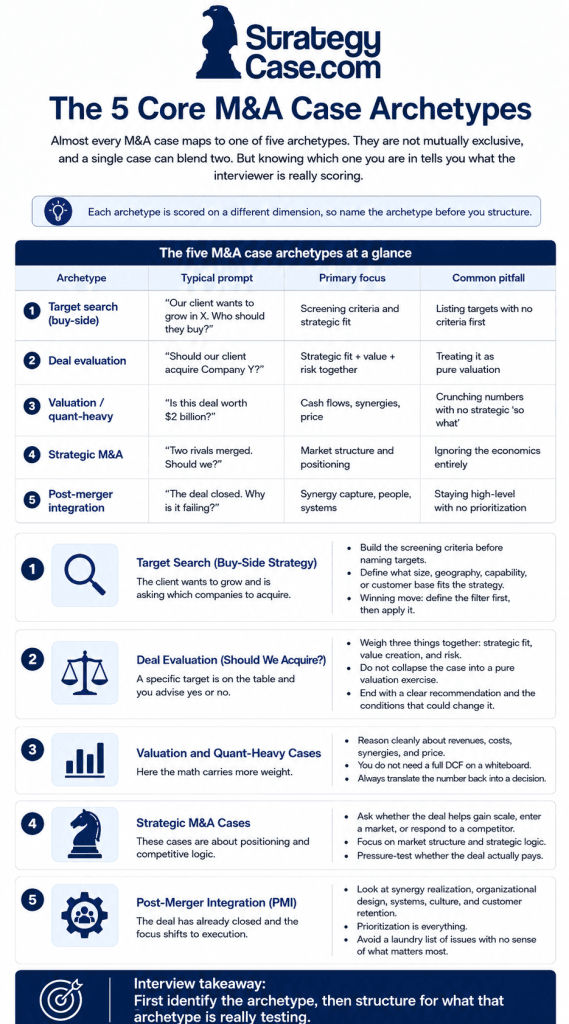
Almost every M&A case maps to one of five archetypes. They are not mutually exclusive, a single case can blend two, but knowing which one you are in tells you what the interviewer is really scoring.
| Archetype | Typical prompt | Primary focus | Common pitfall |
|---|---|---|---|
| Target search (buy-side) | “Our client wants to grow in X. Who should they buy?” | Screening criteria and strategic fit | Listing targets with no criteria first |
| Deal evaluation | “Should our client acquire Company Y?” | Strategic fit + value + risk together | Treating it as pure valuation |
| Valuation / quant-heavy | “Is this deal worth $2 billion?” | Cash flows, synergies, price | Crunching numbers with no strategic “so what” |
| Strategic M&A | “Two rivals merged. Should we?” | Market structure and positioning | Ignoring the economics entirely |
| Post-merger integration | “The deal closed. Why is it failing?” | Synergy capture, people, systems | Staying high-level with no prioritization |
Target Search (Buy-Side Strategy)
The client wants to grow and is asking which companies to acquire. The work is building the screening criteria before you name a single target: what size, geography, capability, or customer base would make a target attractive given the strategy? Candidates who blurt out company names lose. Candidates who define the filter, then apply it, win.
Deal Evaluation (Should We Acquire?)
The most common archetype: a specific target is on the table and you advise yes or no. The trap is collapsing it into a valuation exercise. A good structure weighs three things together, strategic fit, value creation, and risk, and ends with a clear recommendation plus the conditions that would change it.
Valuation and Quant-Heavy Cases
Here the math carries more weight: estimate the value of the target, the synergies, or the return. You will not run a full discounted cash flow on a whiteboard, but you should reason cleanly about revenue, costs, synergies, and a sensible price. Keep the case interview math tight and always translate the number back into a decision.
Strategic M&A Cases
These are about positioning: should the client merge to gain scale, enter a market, or respond to a competitor’s deal? The numbers matter less than the market structure and the competitive logic. The failure mode is the mirror image of valuation cases, candidates get so deep in strategy that they never pressure-test whether the deal pays.
Post-Merger Integration (PMI)
The deal already closed and something is wrong, or the client wants to capture the value they paid for. The focus shifts to execution: synergy realization, organizational design, systems, culture, and customer retention. Prioritization is everything here. A laundry list of integration issues with no sense of what matters most reads as junior.
How Industry Changes an M&A Case
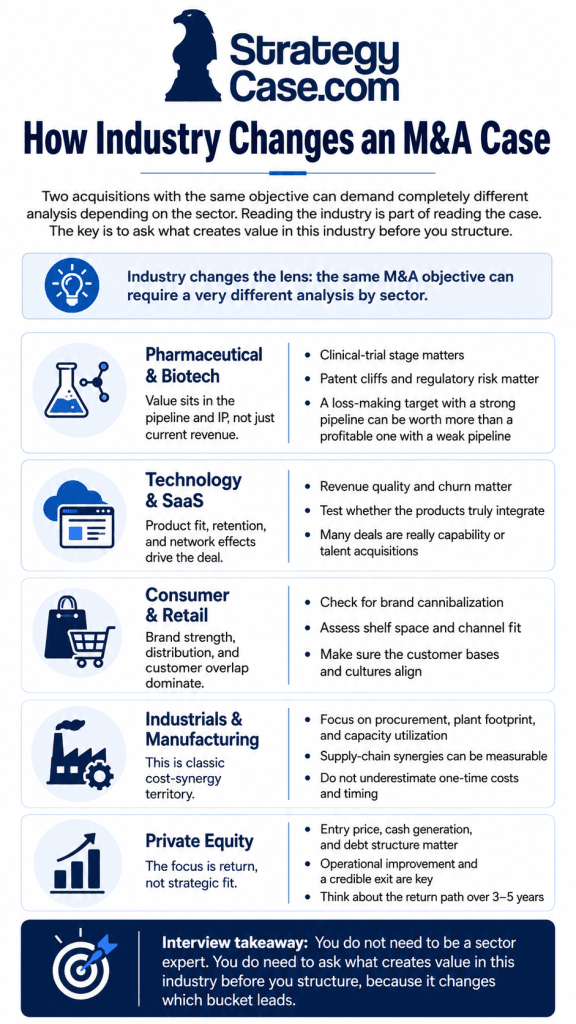
Two acquisitions with the same objective can demand completely different analysis depending on the sector. Reading the industry is part of reading the case. Here is how the lens shifts across the sectors that show up most often.
- Pharmaceutical and biotech. Value sits in the drug pipeline and intellectual property, not current revenue. You weigh clinical-trial stages, patent cliffs, regulatory risk, and the probability a candidate drug reaches market. A profitable-today target with a thin pipeline can be worth less than a loss-making one with a strong one.
- Technology and SaaS. Product fit, retention, and network effects drive the deal. Recurring revenue quality, churn, and whether the two products genuinely integrate matter more than physical assets. Many tech deals are really capability or talent acquisitions wearing a revenue label.
- Consumer and retail. Brand strength, distribution, and customer overlap dominate. The questions are whether the brands cannibalize each other, whether shelf space or channels combine cleanly, and whether the cultures of the two customer bases fit.
- Industrials and manufacturing. This is classic cost-synergy territory: combined procurement, plant footprint, capacity utilization, and supply chain. The upside is more measurable than in consumer or tech, but the one-time cost and time to capture it are real and easy to underestimate.
- Private equity. Cross-cutting all of the above, a financial sponsor cares about entry price, cash generation, debt structure, operational improvement, and a credible exit in three to five years. Strategic fit matters far less than the return and the path to it.
You do not need to be a sector expert. You do need to ask what creates value in this industry before you structure, because it changes which bucket leads. The same instinct applies in a market entry case interview, where the industry shapes the answer just as much.
How to Solve Any M&A Case: A Step-by-Step Approach
Once you have the objective and the archetype, the solving sequence is consistent across deal cases. Think of it as five phases, each testing something different.
- Structure the problem. Clarify the objective, restate it in one sentence, then lay out a tailored structure built around it. This is where the objective-drives-structure logic pays off.
- Probe and refine the hypothesis. Ask targeted questions to test your structure and form an early point of view. Do not interrogate randomly; each question should narrow the decision.
- Run the analysis, quantitative and qualitative together. Work the numbers (revenue, costs, synergies, price) and the strategy in parallel, never in isolation. A number with no strategic meaning is half an answer.
- Brainstorm risks and synergies. Pressure-test the deal: what could go wrong, where the value really comes from, what would have to be true. Structured brainstorming keeps this from turning into a random list.
- Synthesize a recommendation. State a clear yes or no, the two or three reasons behind it, the biggest risk, and what would change your mind. Tie it back to the objective you clarified in phase one.
The thread through all five: every step points at the decision. If an analysis does not move you toward a recommendation, you are spending time you do not have.
M&A Synergies: What They Are and Why Candidates Overstate Them
Synergies are the extra value created when two companies combine that neither could capture alone. They are the heart of most M&A cases, and the place I watch candidates lose the most credibility.
The fastest way to sound junior is to say “there are synergies here” and move on. The fastest way to sound like a consultant is to name the type, estimate it, and then discount it. Here is the breakdown to keep in your head.
| Synergy type | Example | Reality check |
|---|---|---|
| Revenue synergies | Cross-selling, new geographies, pricing power | Hardest to realize and routinely overestimated |
| Cost synergies | Combined procurement, headcount, facilities | More reliable, but capturing them costs money up front |
| Financial synergies | Lower cost of capital, tax efficiency, debt capacity | Real but rarely the strategic rationale |
| Capability synergies | Shared technology, IP, talent | Valuable but slow, and dependent on retention |
The reason to discount is not cynicism, it is data. McKinsey research finds that more than 60% of transactions miss their synergy targets, with revenue synergies the most likely to disappoint. So in a case, the strong move is to assume the headline synergy number is optimistic, focus on the cost synergies you can actually defend, and treat revenue synergies as upside rather than the basis for the deal.
That single habit signals real commercial judgment.
The Mistakes That Sink M&A Cases
After 2,200+ mock interviews and coaching sessions, the same handful of errors come up again and again. Each one is preventable once you know to watch for it.
- Applying the same framework to every deal. The cardinal sin. It guarantees you answer the generic question instead of the specific one in front of you.
- Jumping to valuation too early. Pricing a deal before you understand why the client wants it is backwards. Strategy first, then numbers.
- Separating the numbers from the strategy. Treating the quant as a detour from the “real” case. The number is only useful as evidence for the decision.
- Hand-waving at synergies. Naming synergies without quantifying or discounting them, as covered above.
- Staying high-level. Especially in integration cases, refusing to prioritize. “There are many issues” is not an answer; “here are the two that decide whether this works” is.
- Forgetting the recommendation. Running out of time in the analysis and never stating a clear yes or no. The recommendation is the deliverable.
Notice that none of these are knowledge gaps. They are thinking-process gaps, which is exactly what these cases are built to expose.
Practice M&A Case Questions
Work these out loud, ideally with a partner who pushes back. For each one, force yourself to name the objective and the archetype before you structure anything.
- Target search. A European retailer wants to grow its online business. Which kinds of companies should it consider acquiring, and how would you screen them?
- Pharma deal evaluation. A large pharmaceutical company is considering buying a biotech with one promising drug in late-stage trials. Should they?
- Private equity. A PE firm is evaluating a mid-sized industrial manufacturer. What would make this a good investment, and what return would you need to see?
- Failed-merger diagnosis. Two consumer brands merged 18 months ago and the combined company is underperforming. What went wrong?
- Defensive / strategic. Your client’s two largest competitors just announced a merger. How should your client respond?
If you want fully worked deals across multiple case types, practice complete cases end to end until naming the objective and the archetype becomes automatic.
How M&A Cases Overlap With Other Case Types
M&A cases are rarely pure. A deal-evaluation case often contains a profitability analysis of the target. A growth-driven acquisition borrows from market entry and growth strategy. A PMI case leans on operations. Because the case types share machinery, getting stronger at one lifts the others.
That overlap is good news for your prep. The structuring, math, and brainstorming you drill for a profitability case interview transfer directly. Treat the case types as a connected system rather than a list to memorize separately, and M&A stops feeling like a category of its own.
Do McKinsey, BCG, and Bain Run M&A Cases Differently?
Yes. The underlying skills are the same, but the format differs, and that should shape how you practice. This is based on what I have seen across hundreds of candidate debriefs.
- McKinsey runs interviewer-led cases. The interviewer steers you through the deal step by step, so your job is to structure cleanly and respond sharply to each prompt rather than drive the whole case yourself. Sizing and valuation tend to appear inside the larger problem. The McKinsey case interview guide covers how their format flows.
- BCG leans more on exhibits and data. Expect to interpret a chart or a table about the target or the market, so be ready to pull the deal implication out of a graphic quickly. The BCG case interview guide covers it.
- Bain wants an answer-first, hypothesis-led approach. State a clear early point of view on the deal and then test it. Walking in with no hypothesis reads as indecisive at Bain in a way it might not elsewhere. The Bain case interview guide covers it.
Across all three, the evaluation criteria are identical: did you read the objective, build a fitting structure, integrate numbers and strategy, and land a defensible recommendation? The firm changes the delivery, not the standard.
How to Prepare for M&A Case Interviews
You do not prepare for M&A cases by memorizing a deal framework. You prepare by building the underlying skills until adapting on the spot becomes automatic. Focus on five:
- First-principles structuring, so you can build a tailored structure instead of forcing a template.
- Business judgment, so you understand what actually creates value in a deal and in a given industry.
- Integrated quant and strategy, so your numbers always serve the decision.
- Prioritization, so you spend time on the few drivers that move the answer.
- Adaptation, so a prompt you have never seen does not throw you.
Drill those across many case types, not just M&A, and the deal cases take care of themselves. If you want a structured path with theory and thousands of practice drills, the StrategyCase Case Interview Academy builds exactly these skills and then makes you run them under realistic pressure. That is the difference between knowing about M&A cases and being able to solve one you have never seen.
Frequently Asked Questions
What is an M&A case interview?
An M&A case interview is a case in which you advise a client on a merger, acquisition, or divestiture, such as whether to buy a specific company, which company to buy, or why a past deal failed. Interviewers test whether you can combine strategy, numbers, and risk into a clear recommendation.
Is there a standard M&A case framework?
No, and relying on one is a common reason candidates underperform. M&A cases span very different objectives, so a fixed “fit, synergies, financials, risks” template will misfire on a specific prompt. Clarify the objective first, then build a structure that fits it.
How do you structure an M&A case interview?
Start by clarifying the client’s objective and restating it in one sentence. Then build a tailored structure around that objective, probe to refine your hypothesis, analyze the numbers and strategy together, and finish with a clear recommendation, the biggest risk, and what would change your answer.
What are synergies in an M&A case?
Synergies are the extra value created when two companies combine that neither could capture alone. They fall into revenue, cost, financial, and capability types. Cost synergies are the most reliable; revenue synergies are routinely overstated, and over 60% of deals miss their synergy targets, so quantify and discount them.
Do you need finance or valuation knowledge for M&A cases?
Not much. You should reason cleanly about revenue, costs, synergies, and a sensible price, but interviewers do not expect a full discounted cash flow model. Solid case math and business judgment matter far more than technical valuation knowledge, even at the quant-heavy end.
How are M&A cases different from other case types?
M&A cases combine elements of profitability, market entry, growth, and operations cases, but they always center on a transaction decision: should capital change hands, and on what terms? The defining challenge is reading the objective, because it varies more than in almost any other case type.
How do you prepare for M&A case interviews?
Build the underlying skills rather than memorizing a deal framework: first-principles structuring, business judgment, integrated quant and strategy, prioritization, and adaptation. Practice across many case types so that adapting to an unfamiliar deal prompt becomes automatic.
Final Thoughts
The candidates who ace M&A cases are the ones who read the objective fast, build a structure that fits it, weave the numbers and the strategy together, and commit to a recommendation. The candidates who struggle do the opposite: they reach for a template, treat every deal the same, and hope completeness covers for the lack of a point of view.
If you take three things from this guide, make them these:
- Objective first. Identify what the client wants before you build a single bucket. Everything follows from it.
- Integrate, do not separate. Numbers and strategy are one answer, not two.
- Commit. A clear, well-reasoned recommendation beats an exhaustive analysis with no verdict.
Drill those habits across case types and the M&A case turns from the one you dread into one of the clearest places to show consulting judgment. For the full system, structuring, math, brainstorming, and firm-specific prep, start with the free case interview frameworks guide from StrategyCase.
Related Guides
Keep building the skills that surround the M&A case interview:
- Growth Strategy Case Interview: how to structure organic-versus-acquisition growth questions
- Product Launch Case Interview: another strategic case type that pairs with M&A
- Operations Case Interview: the engine behind post-merger integration questions
- Turnaround and Restructuring Case Interview: how to handle distressed and underperforming deals
- Digital Transformation Case Interview: how to change the digital strategy of a client
- Case Interview Examples: full worked cases from McKinsey and other top firms
Florian Smeritschnig is a former McKinsey Senior Consultant and the founder of StrategyCase. He spent five years at McKinsey, where he evaluated candidates, and has since coached hundreds of candidates into offers at McKinsey, BCG, Bain, and other top firms. Last updated June 25, 2026.
