
Last Updated on July 1, 2026
By Florian Smeritschnig, former McKinsey Senior Consultant. Updated July 2026
A pricing case interview asks you to recommend the right price for a product or service. The fastest way to fail is to default to a memorized template. The fastest way to stand out is to clarify the objective first, then build your structure around it.
Most candidates walk into a pricing case interview hunting for the “pricing framework.” There isn’t one. That single misconception is why strong, smart candidates give answers that sound structured but miss the actual question, and interviewers spot it in the first two minutes.
After evaluating candidates at McKinsey and delivering 2,200+ coaching sessions, I can tell you the pricing case rewards judgment, not recall. This guide gives you the objective-first method, the three classic pricing approaches and when each applies, the math interviewers expect, eight realistic practice prompts, and the mistakes that quietly cost offers.
Key Takeaways
- A pricing case interview tests whether you can set price as a strategic lever, not whether you remember a formula.
- Always clarify the objective first. Profit, revenue, market share, and positioning lead to different “right” prices for the same product.
- The three pricing approaches (cost-based, competitor-based, value-based) are tools, not a structure. Value-based pricing usually sets the ceiling.
- Pricing cases are quantitative. Expect to compare margin against volume and run a willingness-to-pay or break-even calculation.
- According to McKinsey’s pricing research, a 1% price increase, with volume held flat, lifts operating profit by roughly 8% on average. Price is the single most powerful number on the income statement.
What Is a Pricing Case Interview?
A pricing case interview is a case in which you are asked to determine the optimal price for a product, service, or change in price, based on a specific business objective such as maximizing profit, growing revenue, gaining market share, or signaling premium quality. Each objective changes what “optimal” means, so the same product can have several correct answers.
Here is the part candidates miss. Pricing is rarely a standalone case. It shows up inside market entry case interviews, product launch case interviews, and profitability cases as the moment the interviewer zooms in and asks, “So what should they charge?”
What firms actually test in a pricing case:
- Whether you anchor your analysis to the client’s real goal
- Whether you understand how price, volume, and cost interact
- Whether you can quantify a willingness-to-pay or break-even argument
- Whether you can take a clear, commercially sensible position under uncertainty
Verdict: For any pricing case, at McKinsey, BCG, Bain, or beyond, the winning move is to clarify the objective, set a price floor and ceiling, then justify a number with value-based logic and a quick calculation. Memorized frameworks lose. Objective-first structuring wins.
The Objective Defines Everything in a Pricing Case
This is the principle that separates offers from rejections. Before you say a single word about cost-plus or competitor benchmarks, you need to know what the client is trying to achieve. The objective rewrites the entire analysis.
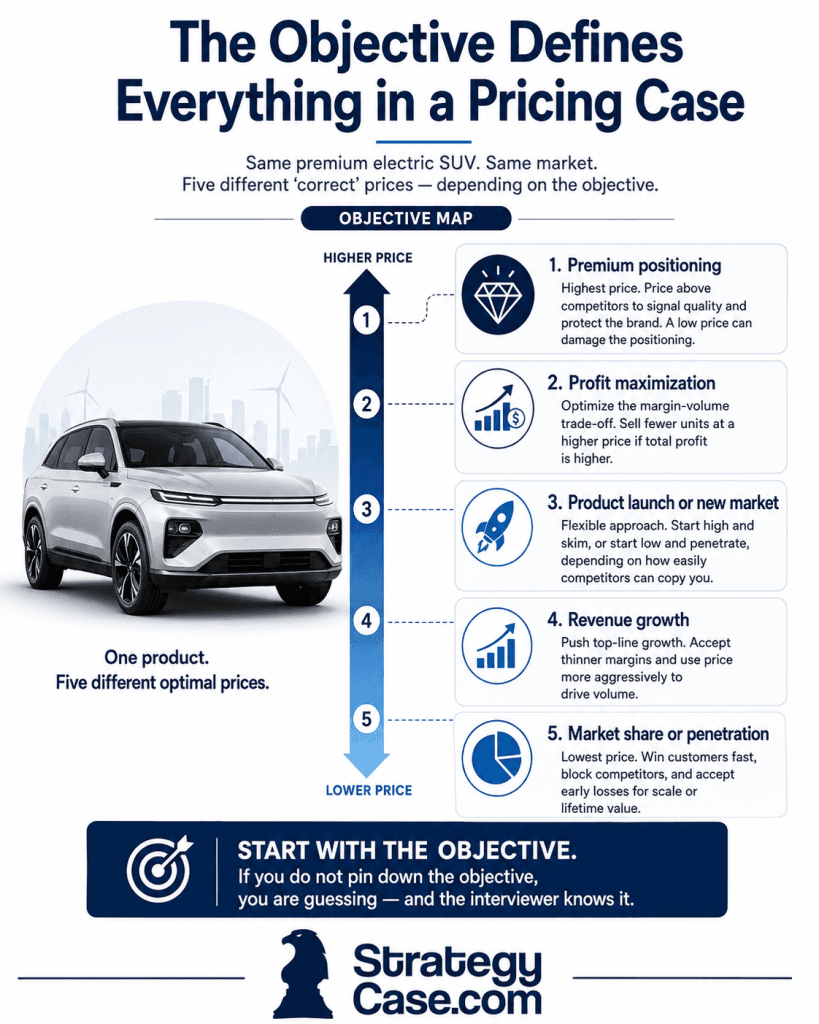
Take one product, a new premium electric SUV, and watch how the “right” price moves with the goal.
Profit maximization
The goal is the best margin-volume trade-off. You look for the price where marginal revenue still beats marginal cost, and you protect the per-unit economics. You are willing to sell fewer units at a higher price if total profit is higher.
Revenue growth
The goal is top-line, sometimes to satisfy investors or hit a market milestone. You may accept thinner margins to push volume, and you weigh price against the demand curve more aggressively.
Market share or penetration
The goal is to win customers fast, often to lock in a network effect or block a competitor. You price low on purpose, accept early losses, and bet on lifetime value or scale economics later.
Premium positioning
The goal is to signal quality. Here a low price actively hurts you, because price is part of the product. You price above competitors to protect the brand, even if you could technically sell more units cheaper.
Product launch or new market
The goal is adoption with room to maneuver. You often start high and skim, or start low and penetrate, depending on how easily competitors can copy you.
Same SUV. Same market. Five different “correct” prices. If you do not pin down the objective, you are guessing, and the interviewer knows it.
The Three Classic Pricing Methods (And When to Use Them)
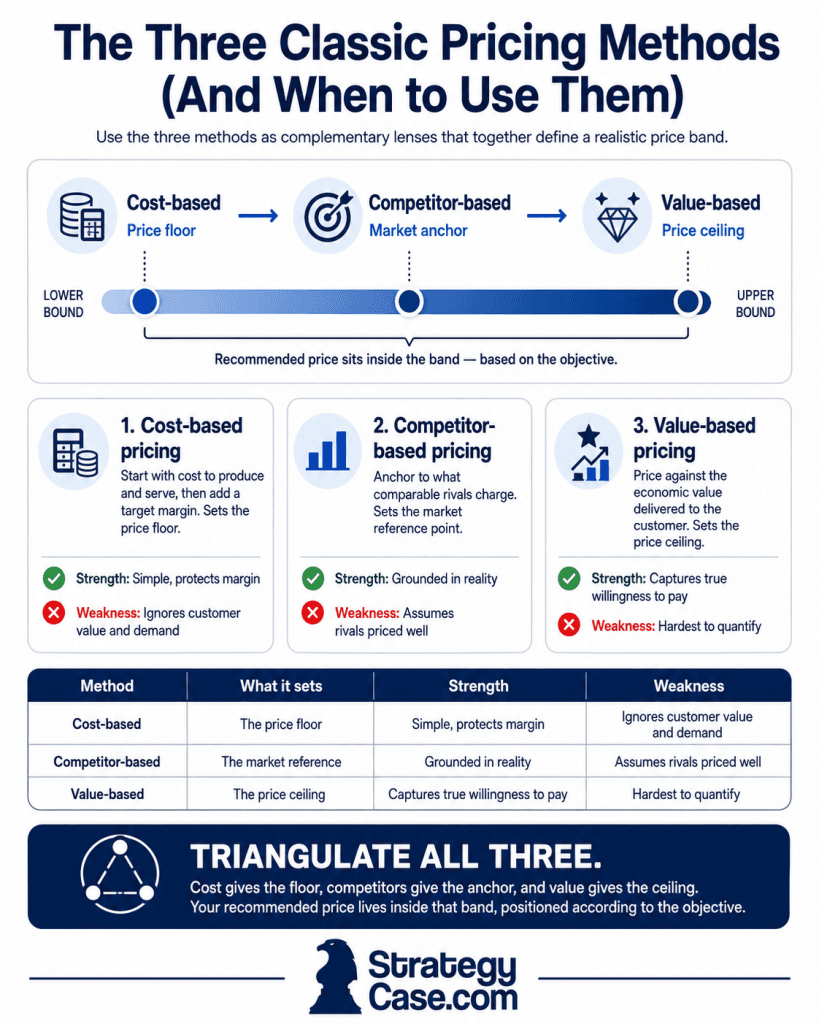
You should know the three standard pricing approaches cold, not so you can recite them, but so you can use them as inputs to your structure. Think of them as the three lenses that together set a price range.
Cost-based pricing
You start from your cost to produce and serve, then add a target margin. This sets your price floor, the level below which you lose money. It is simple and defensible, but it ignores what customers will actually pay, so it almost never gives the right answer on its own.
Competitor-based pricing
You anchor to what rivals charge for comparable products. This tells you the market reference point and where you sit relative to alternatives. The risk is that it assumes competitors priced rationally, and it says nothing about the value you uniquely create.
Value-based pricing
You price against the economic value the product delivers to the customer. This sets your price ceiling, the maximum a rational buyer would pay before the deal stops making sense for them. Value-based pricing forces you to quantify the customer’s gain and then decide how much of it to capture.
| Method | What it sets | Strength | Weakness |
|---|---|---|---|
| Cost-based | The price floor | Simple, protects margin | Ignores customer value and demand |
| Competitor-based | The market reference | Grounded in reality | Assumes rivals priced well |
| Value-based | The price ceiling | Captures true willingness to pay | Hardest to quantify |
The strongest answer triangulates all three: cost gives the floor, competitors give the anchor, and value gives the ceiling. Your recommended price lives inside that band, positioned according to the objective.
Price Elasticity and Willingness to Pay
The concept that makes a pricing answer feel senior is price elasticity of demand: how much volume changes when you change price. You do not need a perfect number. You need to reason about whether demand is elastic (volume drops sharply when price rises) or inelastic (volume barely moves).
Willingness to pay is the same idea from the customer’s side. A good candidate asks, “What does this product actually save or earn the customer, and what would a rational buyer pay for that?” That question turns a vague pricing case into a calculation.
A few drivers to consider out loud:
- Substitutes. More alternatives means more elastic demand and less pricing power.
- Switching costs. High switching costs make demand inelastic and support a higher price.
- Share of wallet. Cheap, low-stakes purchases are less price-sensitive than big-ticket ones.
- Segments. Different customers have different willingness to pay, which opens the door to tiered or segmented pricing.
When I coach candidates through pricing cases, the single fastest upgrade is replacing “I would look at the competition” with “I would estimate the customer’s willingness to pay and size the value we create.”
That one sentence signals commercial judgment.
A First-Principles Approach to Pricing Cases
There is no fixed sequence you must follow, but strong candidates move through a consistent logic. Use this as a thinking pattern, not a template to recite.
- Clarify the objective. Profit, revenue, share, or positioning. Confirm it before structuring. This is the most important 30 seconds of the case.
- Understand the product and customer. What is being sold, to whom, and what value does it create for that buyer?
- Set the floor and ceiling. Use cost for the floor and value (willingness to pay) for the ceiling. Note where competitors sit inside that band.
- Form a hypothesis. Take an early directional view, for example, “I expect a premium price near the value ceiling because switching costs are high.”
- Test it with numbers. Run the margin-versus-volume trade-off or a break-even. Pressure-test how sensitive profit is to your price.
- Recommend and de-risk. State a price, tie it to the objective, and name the risks plus what you would validate next.
This is the same first-principles habit we teach across every case type in the StrategyCase case interview frameworks guide. The structure emerges from the problem, not from memory.
A Worked Pricing Case Example (With the Math)
Let me show you what “test it with numbers” looks like, because pricing cases are quantitative and many candidates stay too qualitative.
Prompt. A B2B software company built a tool that saves a typical mid-size customer about $50,000 per year in labor. It costs the company roughly $5,000 per year to serve each customer. The closest competitor charges around $12,000 per year for a weaker product. What should they charge, and how does the decision change with volume?
Step 1, the floor. Cost to serve is $5,000. With a target gross margin, the floor sits around $12,000 to $13,000.
Step 2, the anchor. Competitors charge about $12,000 for less capability. That is the market reference, and it tells us $12,000 is easily defensible.
Step 3, the ceiling. The customer gains $50,000 a year. A rational buyer will not pay the full $50,000, but capturing 20 to 30% of the value is reasonable, which points to $10,000 to $15,000, and the strong ROI story supports the top of that range.
Step 4, the trade-off. Now test price against volume across a target market of 200 accounts.
| Scenario | Price | Adoption | Customers | Revenue | Cost to serve | Profit |
|---|---|---|---|---|---|---|
| Premium | $15,000 | 40% | 80 | $1.2M | $400K | $800K |
| Penetration | $10,000 | 60% | 120 | $1.2M | $600K | $600K |
Both scenarios produce the same revenue, but the premium price earns $200K more profit because there are fewer accounts to serve. Recommendation: if the objective is profit, price near the value ceiling at roughly $15,000, position it clearly above the competitor on ROI, and watch for segments that justify a lower entry tier. If the objective were market share, the penetration price could be right despite lower profit.
That is the whole point. The numbers do not decide for you. The objective does, and the numbers prove your case. If you want to drill this kind of reasoning, our case interview math guide and chart and data interpretation guide cover the mechanics.
Pricing Strategy Types You Should Know
Interviewers often push you to name and choose a pricing strategy. Knowing the common ones lets you respond with a specific, commercial answer instead of a vague one.
| Strategy | What it means | When it fits |
|---|---|---|
| Price skimming | Launch high, lower over time | New, hard-to-copy products with eager early buyers |
| Penetration pricing | Launch low to win share fast | Network effects, high switching costs later, scale economics |
| Premium pricing | Stay above competitors on purpose | Brand and quality signaling, status goods |
| Dynamic pricing | Flex price by time, demand, or segment | Airlines, ride-hailing, hotels, ski passes |
| Tiered or good-better-best | Multiple versions at multiple prices | Diverse willingness to pay across segments |
| Freemium | Free base, paid upgrade | Software with low marginal cost and upsell paths |
| Bundling | Sell items together | Cross-sell, raise average order value, hide price |
| Razor-and-blade | Cheap base, profit on refills | Recurring consumables tied to a device |
You will not list all eight in an interview. You will pick the one or two that fit the objective and defend the choice.
Pricing Case vs Profitability Case: What Is the Difference?
Candidates confuse these constantly. A pricing case asks what price to set and why. A profitability case interview asks why profit changed and how to fix it, where price is only one of several levers alongside volume, cost, and mix.
The two overlap because price drives profit. The tell is the question. “What should they charge?” is a pricing case. “Profits are down 20%, why?” is a profitability case that may lead into pricing. Many real interviews start as one and evolve into the other, which is exactly why memorized, case-type frameworks break down and first-principles structuring holds up.
Common Mistakes in Pricing Case Interviews
After thousands of coaching sessions, the same errors show up again and again. None of them come from a lack of intelligence. They come from a misaligned approach.
| Mistake | Why it costs you |
|---|---|
| Reaching for a generic framework | Signals memorization, not thinking |
| Skipping the objective | Sends the whole analysis in the wrong direction |
| Ignoring willingness to pay | Misses the single biggest driver of price |
| Jumping to calculations too early | Produces precise answers to the wrong question |
| Forgetting competitive response | Recommends a price rivals will instantly undercut |
| Staying fully qualitative | Lacks the quantitative backbone interviewers expect |
| Picking a number with no logic | Looks like a guess, not a recommendation |
The fix for every one of these is the same: anchor to the objective, set a floor and ceiling, and back your number with a quick calculation.
Practice Pricing Case Questions
Train across different objectives, not just different industries, because the real difficulty is recognizing what kind of pricing problem you are actually solving. Here are eight realistic prompts grouped by what they test.
New product and launch pricing
- A cloud cybersecurity provider is adding an AI threat-detection add-on. How should it price the add-on?
- A medical device company is launching a new surgical tool in European hospitals. What price should it set?
Price change decisions
- A premium watchmaker is considering raising prices 15%. Should it, and what happens to demand?
- A regional bus operator is losing money. Should it raise fares, and by how much?
Segmented and multi-sided pricing
- A food delivery platform wants to redesign pricing across customers, restaurants, and couriers. How should it structure it?
- A streaming service wants to introduce tiered subscriptions. How many tiers, and at what prices?
Dynamic and value pricing
- A ski resort wants to move to dynamic lift-ticket pricing. How should it design the system?
- A SaaS company suspects it is underpricing a flagship product. How should it find the right price?
For each prompt, do not ask “what is the framework.” Ask “what is the objective, what value do we create, and where do the floor and ceiling sit.” You can pull more realistic prompts from our free case interview example library.
How to Prepare for Pricing Cases
Pricing cases reward business intuition more than memorization. To build it:
- Practice objective-spotting. For every prompt, state the goal in one sentence before structuring.
- Drill the floor-anchor-ceiling habit. Make cost, competitor, and value your default three lenses.
- Get comfortable with the math. You should be able to run a margin-versus-volume trade-off and a break-even without hesitation.
- Train across contexts. Five cases with different objectives beat ten that all ask the same question.
- Get feedback that names your blind spots. Self-study cannot tell you why your structure felt generic.
This is the gap StrategyCase is built to close. Our 1-on-1 coaching with Florian gives you targeted feedback from a former McKinsey Senior Consultant on exactly where your pricing reasoning breaks down.
Learn How to Approach Every Case Type
There is no universal pricing framework. What matters is not the label on the case, but the objective behind it.
- The objective defines your structure
- The three pricing methods are inputs, not an answer
- The math, margin versus volume, is where weak candidates fall short
Strong candidates do not rely on memorized templates. They structure from first principles, quantify willingness to pay, and tie every number back to the decision. If you want to build that skill set systematically, our Case Interview Academy teaches how to approach any case type, including pricing, without rigid templates.
For pricing that turns into a growth problem, see our growth strategy case interview guide.
Related guides
- How to get into consulting: the full application and recruiting pillar
- The case interview guide: full guide on the case interview
- The gap between consulting firms and applicants: why most case interview candidates fail
- Best case interview books: what to read, and what to skip
- Avoid the top 5 case interview mistakes: what blocks your offer
FAQ: Pricing Case Interviews
What is a pricing case interview?
A pricing case interview asks you to recommend the optimal price for a product or service based on a specific business objective, such as profit, revenue, market share, or premium positioning. It tests structured thinking and commercial judgment more than recall.
What framework should I use for a pricing case?
There is no single pricing framework. Strong candidates clarify the objective, then triangulate three lenses: cost-based pricing for the floor, competitor-based pricing for the anchor, and value-based pricing for the ceiling. The recommended price sits inside that band, chosen to fit the objective.
What is the most important step in a pricing case?
Clarifying the objective. The same product has different correct prices depending on whether the client wants to maximize profit, grow revenue, gain share, or signal premium quality. Skip this and the rest of your analysis points the wrong way.
Are pricing cases quantitative or qualitative?
Both, but the quantitative side decides offers. You should be able to estimate willingness to pay, run a margin-versus-volume trade-off, and check a break-even. Even a rough calculation makes your recommendation far more convincing than qualitative reasoning alone.
What is value-based pricing in a case interview?
Value-based pricing means setting price against the economic value the product delivers to the customer, then capturing a share of that value. If a tool saves a customer $50,000 a year, a value-based price might capture 20 to 30% of that gain. It usually sets the price ceiling.
What is the difference between a pricing case and a profitability case?
A pricing case asks what price to set and why. A profitability case asks why profit changed and how to fix it, where price is only one lever among volume, cost, and mix. Many interviews start as one and evolve into the other.
How do I prepare for pricing case interviews quickly?
Drill objective-spotting, practice the floor-anchor-ceiling habit, and get fast at the margin-versus-volume math. Then practice across varied objectives and get expert feedback on where your structure feels generic. First-principles thinking beats memorizing pricing templates every time.
About the author: Florian Smeritschnig is a former McKinsey Senior Consultant who evaluated candidates at the firm and has delivered 2,200+ mock interviews and coaching sessions. Through StrategyCase, he has helped 700+ candidates win offers at McKinsey, BCG, Bain, and other top firms.
