
Updated July 2026 · By Florian Smeritschnig, Former McKinsey Senior Consultant
A turnaround or restructuring case interview asks you to diagnose a struggling business and recommend how to fix it, usually under real time pressure. Typical prompts include:
- “A company’s profits have dropped 40% in two years. What should it do?”
- “This business will run out of cash in three months. How does it survive?”
- “A traditional player is being disrupted. How should it respond?”
- “A conglomerate is underperforming. How should it restructure its portfolio?”
At first glance these look like one defined “case type.” They are not. Turnaround cases are objective-driven problems wearing a single label, and that is exactly why they trip people up.
Most candidates lose a turnaround case in the first three minutes. They hear “this company’s profits have collapsed, what should it do?” and immediately reach for revenue minus cost. It feels structured. It is also, in most turnarounds, the wrong place to start, and an experienced interviewer knows it within seconds.
That reflex costs offers. After five years at McKinsey evaluating candidates and 2,200+ mock interviews since, I can tell you the turnaround case is built specifically to expose candidates who pattern-match instead of think. This guide shows you how to read the situation first and build a structure that actually fits it.
Key Takeaways
- There is no single turnaround framework. The winning move is to read the objective first, then derive a structure from the specific situation, not to drop a revenue-versus-cost template onto every prompt.
- The objective changes everything. A cash crisis and a slow strategic decline carry the same “turnaround” label but demand completely different structures, priorities, and recommendations.
- Ask about cash before anything else. A profitable business with no liquidity still dies, so survival sequencing beats long-term optimization when runway is short.
- The hardest part is framework creation, not the analysis. The math and exhibits are standardized; how you frame the problem upfront is what separates strong candidates from the rest.
- Turnaround cases are now common at McKinsey, BCG, and Bain because they mirror today’s restructuring-heavy client work and resist memorization.
- Turnaround cases rarely stand alone. They cut straight across other case types:
- Profitability cases: a profit decline is usually the entry point, even when the root cause sits elsewhere
- Operations cases: margin erosion often traces back to production, supply chain, or capacity problems
- M&A and restructuring cases: portfolio underperformance can require divestitures or capital reallocation
- Pricing cases: aggressive discounting frequently sits underneath a margin collapse
- Growth strategy, market entry, competitive strategy, public sector, and wildcard cases all feed into turnarounds too
- That layering is what makes these cases feel complex. It is also what makes them worth mastering.
What Is a Turnaround or Restructuring Case?
A turnaround case interview presents a business that is failing on some dimension and asks you to diagnose why and decide what to do about it. The underlying process mirrors any case interview, you structure, analyze, draw insight, and recommend, but the context is harsher: time is short, prioritization is everything, and the recommendations have immediate, high-stakes consequences.
“Turnaround” and “restructuring” are used loosely and often interchangeably in interviews. In practice they sit on a spectrum. A turnaround is the broad mandate to return a struggling business to health. Restructuring is a specific set of levers within that mandate, reshaping the cost base, the operations, the portfolio, or the balance sheet. A restructuring case at a firm like BCG or a restructuring-focused boutique simply leans harder on those levers. The thinking you need is the same.
The defining feature is urgency. In a standard profitability case you have room to explore. In a turnaround, the company is bleeding, and the interviewer wants to see whether you can stay structured when the clock and the stakes are both working against you.
Why Turnaround Cases Are Getting More Common
Turnaround thinking shows up in interviews more often now because it reflects what consulting work actually looks like today.
Several forces are driving it:
- Disruption is constant. Business models that worked five years ago are breaking, and AI is accelerating the cycle. More clients arrive in distress rather than with clean growth questions.
- Cost pressure is everywhere. Across sectors, companies are being forced to operate leaner, which puts restructuring on more agendas.
- Investors demand value creation. Private equity and activist owners do not just want growth. They want underperforming assets fixed, restructured, and repositioned.
Firms have rebuilt their interviews around that reality. Both McKinsey and BCG describe their case interviews as realistic client problems you work through step by step, and a distressed business is one of the most realistic problems they can hand you. When I sat on the other side of the table, a turnaround prompt was one of the cleanest ways to find out whether someone could think under pressure or only recite structure when calm.
The point of the case is in the prompt itself: firms are not testing whether you can analyze a problem in isolation. They are testing whether you can fix a business that is not working.
The Biggest Misconception: There Is No Single Turnaround Framework
This is the most important thing to internalize before your next turnaround case. There is no master framework that fits every one of them. Force one on, and you get shallow, misdirected analysis.
Most candidates default to the same reflex:
- “Profits are down, so let me break revenue into price times volume and costs into fixed and variable.”
- “Let me list the standard turnaround buckets and work through them.”
The logic is not wrong. It is applied too early and blindly, before you understand what kind of problem you are actually looking at. A profit decline is often a symptom, not the disease. The real driver might be a cash crisis, a broken business model, an operational breakdown, or a portfolio of value-destroying units. A generic profitability breakdown points your attention at the wrong place and burns the minutes that matter most.
I evaluated plenty of smart candidates who opened a turnaround case with a clean profitability tree and never recovered, because the company was three months from insolvency and they were busy decomposing margin. The tree was tidy. It was also irrelevant.
Strong candidates do the opposite. They do not recall a structure. They translate the objective into the few drivers that matter and build a tailored approach from first principles. Frameworks are not something you apply in a turnaround. They are something you construct.
If you want to train that muscle directly, our case interview structuring drills are built to develop first-principles structuring rather than template recall.
Start With the Objective: It Defines Everything
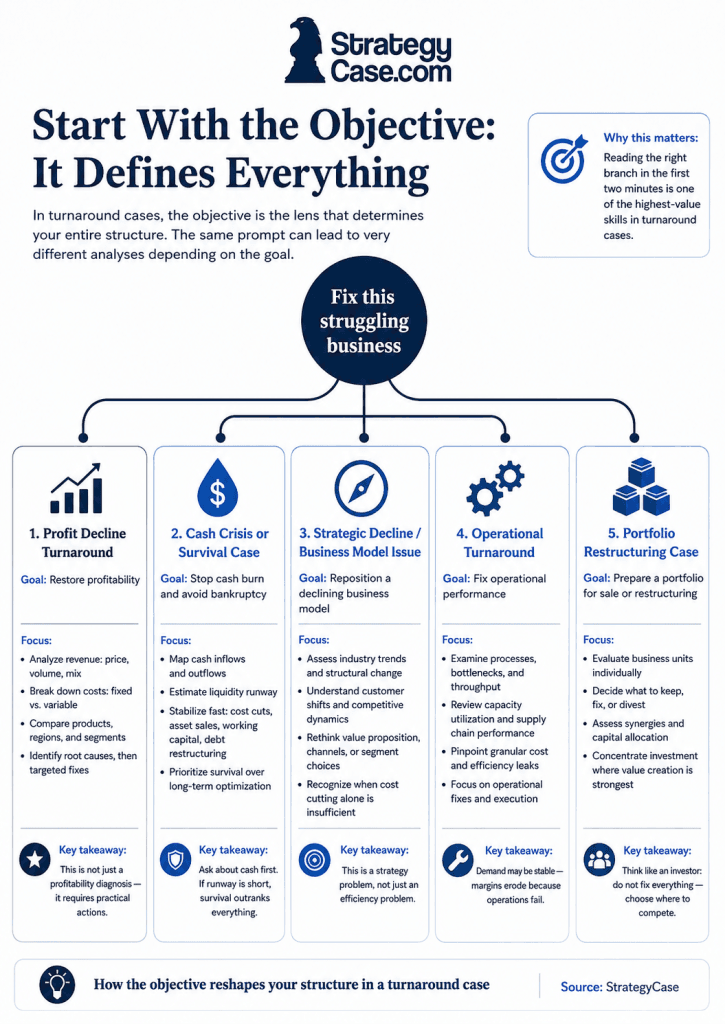
Before you structure anything, get clear on what “turnaround” means in this specific case. The objective is the lens that determines your entire approach. Possible goals include:
- Restore profitability
- Stop cash burn and avoid bankruptcy
- Fix operational performance
- Reposition a declining business model
- Prepare a portfolio for sale or restructuring
Each of these leads to a completely different structure. The same surface prompt, “fix this struggling company,” can branch into five very different cases. Reading that branch correctly in the first two minutes is the single most valuable thing you do.
1. Profit Decline Turnaround
The most familiar type. The company still operates, but performance has deteriorated. The work is to move past the symptom (declining profit) to what actually drives it: break down both sides of the profit equation and isolate where the change happened.
Focus on revenue drivers (price, volume, mix), cost structure (fixed versus variable, and what recently shifted), and differences across products, regions, or customer segments. The problem is usually localized, one segment underperforming, costs creeping up in one area, pricing pressure on one line. One you know where the change is occuring, go deeper into the drivers (external like market factors or internal factors like production and distribution).
This looks like a profitability case, but strong candidates go further: they diagnose the cause and then define targeted, practical fixes, not just an explanation of the decline.
2. Cash Crisis or Survival Case
Fundamentally different. Here the problem is liquidity, not profitability. Even a profitable business fails if it runs out of cash. The lens shifts from long-term optimization to short-term survival.
Map cash inflows and outflows, estimate the liquidity runway, and identify immediate stabilization moves. Typical levers: rapid cost reductions, asset sales, working capital improvements, and renegotiating or restructuring debt. Timing dominates. An action that improves profitability next year is irrelevant if the company cannot make payroll next month.
The rule I drill into candidates: in any turnaround, ask about cash before you ask about anything else. If runway is short, survival outranks everything.
3. Strategic Decline or Business Model Issue
Here the problem is not inefficiency or short-term cash. It is competitiveness. The company is losing customers, facing new competitors, or operating in a shrinking or shifting market.
Focus on industry trends, structural change, evolving customer needs, and competitive dynamics. Solutions involve redefining the value proposition, moving into new channels, or exiting declining segments. Cost-cutting alone will not fix this, and candidates who only cut costs miss the case entirely. This is a strategy problem, and it overlaps heavily with competitive strategy cases.
4. Operational Turnaround
Demand is stable, but operations are eroding margins. The problem is internal: inefficiencies, rising input costs, suboptimal processes.
Focus on production processes, bottlenecks, capacity utilization, throughput, supply chain performance, and granular cost drivers. The goal is to find where value leaks out of the system. This needs more detailed, bottom-up analysis than the other types, and the fixes are operational: process optimization, supplier renegotiation, better utilization. There is heavy overlap with operations cases, so the same deep operational thinking applies.
5. Portfolio Restructuring Case
The issue is not inside one business but across several. Some units perform well, others destroy value. You shift to evaluating each unit, deciding what to keep, fix, or divest, assessing synergies, and reallocating capital.
This requires an investor’s mindset. The goal is not to fix everything. It is to decide where the company should and should not compete. Typical moves: divest underperformers, concentrate investment on high-potential units, simplify the portfolio. This is restructuring at the portfolio level, with major strategic and financial implications, and it connects directly to M&A and restructuring cases.
Diagnose, Stabilize, Restructure, Reposition: The Sequence That Matters
Once you have read the objective, a turnaround follows a logical sequence, and getting the order right is itself part of the test. Many candidates know the levers. Fewer know what to pull first.
| Phase | What you are doing | Why the order matters |
|---|---|---|
| Diagnose | Find the real root cause, not the surface symptom | The wrong diagnosis sends every later step in the wrong direction |
| Stabilize | Stop the bleeding: secure cash, halt losses | A company that does not survive the quarter cannot be restructured |
| Restructure | Fix the cost base, operations, or portfolio | This is where durable value is recovered |
| Reposition | Set up for growth and long-term health | Only credible once the business is stable and viable |
The most common sequencing error is jumping to growth and repositioning before the business is stable. A company in a cash crisis does not need a new digital channel this quarter. It needs to not run out of money. Sequencing your recommendations from survival to recovery to growth signals exactly the kind of judgment interviewers are looking for.
Operational Versus Financial Restructuring
Inside the restructure phase, you usually have two families of levers, and how you weight them matters.
- Operational restructuring reshapes how the business runs: SKU rationalization (cutting the lowest-margin products), supply chain consolidation, process automation, flattening the organization, renegotiating supplier contracts, fixing capacity utilization.
- Financial restructuring reshapes the balance sheet: refinancing, debt-for-equity swaps, covenant amendments, asset divestitures, equity injections.
In a case interview, lead with operational levers where you can. They show business judgment and address root causes, whereas financial engineering on its own often just buys time. Financial restructuring becomes central when the balance sheet itself is the binding constraint, for example in a near-term liquidity or insolvency scenario.
The Real Crux: Framework Creation, Not Analysis
Here is the insight most candidates miss. The hardest part of a turnaround case is not the analysis. It is the structure you build upfront. Get that wrong and even flawless math leads to the wrong answer, because you will be analyzing the wrong things.
Turnaround cases are often decided in the first few minutes. Your initial structure shapes everything that follows. This is exactly what interviewers are testing: can you make sense of an ambiguous, high-pressure situation, define the problem clearly, and focus on what matters?
Most candidates underestimate this step and rush into analysis. Strong candidates slow down and get the structure right.
Once the structure is set, a turnaround follows the familiar case progression. You work through charts, exhibits, calculations, and brainstorming, and the mechanics do not change. Interpreting an exhibit, structuring a calculation, and driving the analysis are the same skills you use in any case:
- Fast, accurate calculation is covered in our case interview math guide
- Extracting insight from exhibits is the focus of our chart interpretation guide
- Generating practical options builds on brainstorming in a case interview
Execution matters, but it rarely differentiates candidates in the first five minutes. The real separator is how you frame the problem before any analysis begins.
Common Mistakes (and How to Avoid Them)
Turnaround cases expose weaknesses fast because there is less room to hide behind a template. The mistakes below double as the signals an experienced interviewer uses to separate strong candidates from average ones.
| Mistake | What it looks like | Why it hurts you |
|---|---|---|
| Defaulting to a profitability framework | Breaking revenue and cost apart before asking if profit is even the problem | In a cash crisis, margin analysis misses the real issue |
| Ignoring the objective | Structuring without defining what “success” means here | Analysis becomes unfocused and scattered |
| Jumping into analysis too early | Crunching numbers before setting direction | Insights do not connect to anything |
| Not prioritizing | Treating every area as equally important | Wastes scarce time and shows poor judgment |
| Treating all issues equally | Working through a checklist without weighting impact | You miss the few drivers that decide the case |
| Over-focusing on math | Believing the calculation is the challenge | The real challenge is deciding what to calculate and why |
The thread running through all of them is the same: anchoring on the objective and prioritizing ruthlessly. Strong candidates align every structure with the goal before breaking anything down, and they quickly find the few drivers carrying the most value or risk. Our guide on why most candidates fail to meet what firms actually want goes deeper on this gap.
Practice Turnaround Case Questions
Repeating the same prompt does not build skill. Exposure to different objectives does. Each scenario below forces you to adapt your structure, your priorities, and your recommendation. The goal is not to find “the framework.” It is to train yourself to translate a situation into a tailored structure.
Scenario 1: A company is losing money rapidly. What should it do? A classic profit-decline case. Clarify first whether the issue is temporary or structural, then isolate where the losses come from and why (revenue decline versus cost increases, and which products, regions, or segments). Identify the main drivers and define targeted actions rather than generic levers.
Scenario 2: A business will run out of cash in three months. How does it survive? A liquidity problem. Shift your thinking immediately: map cash inflows versus outflows, estimate the runway, and identify short-term stabilization moves. Prioritize speed and impact, through rapid cost cuts, working capital improvements, or financing options. Do not get pulled into long-term strategy. Survival comes first.
Scenario 3: A traditional player is being disrupted. What now? A strategic-decline case. Understand what changed (customer preferences, technology, the competitive landscape), assess whether the company can adapt or needs to reposition, then adjust the business model, enter new channels, or exit declining segments. Do not reduce this to a cost exercise. It is about relevance, not efficiency.
Scenario 4: A company has strong revenue but declining margins. Why? Usually an operational or cost-side issue, since revenue is holding. Focus on cost increases (input prices, labor, inefficiencies), operational bottlenecks, and product or customer mix shifts. Go deeper into the operations than a standard profitability case would.
Scenario 5: A conglomerate needs restructuring. How should it proceed? A portfolio-level problem. Break down unit performance (which units create value and which destroy it), then work through divest-versus-retain decisions, synergies, and capital allocation. Think like an investor. The goal is not to fix everything but to decide where to focus and where to exit.
How to Approach These in Practice
Across all five, the same three steps hold:
- Define the objective clearly. Know what success means before you structure. A turnaround can mean restoring profit or simply surviving the next quarter, and those are different cases.
- Build a tailored structure. Translate the objective into the key drivers. A manufacturing turnaround may center on operations, capacity, and supply chain. A SaaS turnaround centers on pricing, retention, and unit economics. The right structure depends on both the objective and the business.
- Prioritize aggressively. Find the few areas that matter most and go there first. With limited time, sequencing is as important as the analysis itself.
When you practice, do not just solve the case. Watch how you decide your focus areas and how your approach adapts as new information arrives. That is where the real improvement happens. Our case interview guide lays out that full sequence end to end.
How to Prepare for Turnaround Cases
Do not memorize turnaround frameworks. Build the underlying skills that apply across every case type:
- Structuring problems from first principles instead of recalling buckets
- Translating a high-level objective into the drivers that matter
- Prioritizing under uncertainty rather than analyzing everything
- Linking qualitative judgment with quantitative validation
These are the same skills tested in every case. Turnarounds simply expose weaknesses faster, because the complexity and time pressure leave nowhere to hide. The goal of preparation is not to recognize case types. It is to become comfortable structuring and solving unfamiliar problems from scratch.
That is exactly how the StrategyCase Case Interview Academy is built: concise theory, targeted drills, and a library of realistic cases across objectives and industries, combined into one system designed to develop these skills rather than pile on more practice cases. If you want direct feedback on your structuring under pressure, 1:1 coaching is the fastest way to find and fix the specific habits holding you back.
Related Guides
- Case Interview Frameworks: How to Structure Any Case
- Profitability Case Interview
- Operations Case Interview
- M&A and Restructuring Case Interview
- Digital Transformation Case Interview
FAQ: Turnaround & Restructuring Case Interview
What is a turnaround case interview?
A turnaround case interview asks you to diagnose a struggling business and recommend how to fix it, usually under time pressure. It mirrors the structure of any case interview, but the context is a company in distress, so prioritization, sequencing, and judgment under pressure matter much more than in a standard prompt.
Is there a framework for turnaround and restructuring cases?
No single framework works for all of them. The strongest approach is to read the objective first, then build a structure tailored to that specific situation. A useful sequence to keep in mind is diagnose, stabilize, restructure, reposition, but the content of each phase depends entirely on the case. Forcing a generic profitability template onto a turnaround is one of the most common mistakes.
What is the difference between a turnaround and a restructuring case?
They overlap heavily and are often used interchangeably. A turnaround is the broad goal of returning a failing business to health. Restructuring is a specific set of levers within that goal, reshaping the cost base, operations, portfolio, or balance sheet. In an interview, the thinking you need is the same: read the objective, structure from first principles, and prioritize.
What should you ask first in a turnaround case?
Ask about cash and the objective before anything else. Confirm what “success” means here (restore profit, survive, reposition, divest) and find out how much liquidity runway the company has. If the business is close to running out of cash, short-term survival outranks every long-term consideration, and your structure has to reflect that.
How do you structure a restructuring case interview?
Clarify the objective, diagnose the real root cause rather than the surface symptom, stabilize the business if cash is at risk, then work through the relevant restructuring levers (operational first, financial where the balance sheet is the constraint), and finish with repositioning for the longer term. The key is adapting that sequence to the specific situation, not applying it mechanically.
Are turnaround cases common at McKinsey, BCG, and Bain?
Yes, and they are getting more common. Disruption, cost pressure, and investor-driven value creation mean more real client work is about fixing underperforming businesses. McKinsey, BCG, and Bain all describe their case interviews as realistic client problems, and a distressed company is one of the most realistic problems they can give you.
What is the biggest mistake candidates make in turnaround cases?
Defaulting to a generic profitability framework before asking whether profitability is even the problem. Other frequent mistakes: ignoring the objective, jumping into analysis too early, failing to prioritize, and over-focusing on math. They all signal pattern-matching instead of problem-solving, and an experienced interviewer spots them quickly.
Master Turnaround Cases With StrategyCase
Turnaround cases are not a case type to memorize. They are a test of whether you can read a distressed situation, build a structure that fits it, and decide what matters before you start analyzing. That skill compounds: master it here and you raise your performance across profitability, operations, pricing, and M&A cases at the same time.
About the Author: Florian Smeritschnig spent five years at McKinsey as a Senior Consultant, where he evaluated candidates, and has since delivered 2,200+ mock interviews and coaching sessions. He understands exactly what top firms look for in successful applicants. He founded StrategyCase.com to make top consulting careers more accessible through tailored, up-to-date insight into the recruiting process. As a case and fit interview coach, he has helped clients secure 700+ offers at MBB, Tier-2 firms, Big 4 consulting divisions, in-house consultancies, and boutique firms. He is the author of The 1%: Conquer Your Consulting Case Interview, The 1%: Case Interview Workbook, and Consulting Career Secrets, all available on Amazon.
