

Last Updated on June 29, 2026
A non-profit or public sector case interview asks how to reach a social goal, like cutting youth unemployment or raising vaccination rates, within a fixed budget rather than how to make a profit. There is no profit line, no obvious metric, and no standard framework. You define the measure of success yourself, then structure around what drives it.
That is exactly why these cases throw candidates off. The usual anchors disappear, so most people reach for a template built for companies, not for governments or charities, and it shows inside the first minute. In five years evaluating candidates at McKinsey, I watched strong problem-solvers stumble here for one reason: they tried to apply a framework instead of building one.
This guide shows you the approach that works, for non-profit, public sector, government, and federal cases alike.
Key Takeaways
- There is no profit metric and no fixed framework. Your first job is to define the outcome metric (what success means, over what budget and timeframe), then structure around its drivers.
- These cases optimize outcomes per dollar, not profit. The strongest recommendations compare options by cost-effectiveness, not by revenue.
- The objective defines the structure. “Reduce homelessness,” “raise vaccination rates,” and “allocate a budget” are three different problems that need three different structures.
- They show up most in social and public sector practices: McKinsey’s Social Sector practice, the Bain and BCG social impact teams, and the large public sector and federal practices at Accenture, Deloitte and the rest of the Big 4. In Europe, Roland Berger owns many public sector engagements.
- The people affected and the constraints matter more than in for-profit cases. Politics, equity, and feasibility shape what is actually possible.
What Is a Non-Profit or Public Sector Case Interview?
A non-profit or public sector case interview is a case where the client is a charity, NGO, foundation, or government body, and the goal is a social outcome rather than profit. Instead of maximizing earnings, you define a measure of success, such as lives improved or outcomes per dollar, and structure your analysis around what drives it.
The prompts look deceptively simple, which is part of the trap:
- A city government wants to reduce youth unemployment. How should it spend its budget?
- A health ministry wants to raise vaccination rates in rural areas. What should it do?
- A foundation has $50 million to improve education outcomes. Where should it invest?
- A transit authority wants more people to use public transport. How?
Each one hands you a vague goal and no scoreboard. Interviewers use these cases to see whether you can take an ambiguous social objective, turn it into something measurable, and reason your way to a clear, feasible recommendation.
McKinsey describes the underlying skill on its own interviewing page: the goal is to see how you “structure tough, ambiguous challenges,” work with data, and form a point of view. A non-profit case is that test with the profit motive removed.
Why These Cases Throw Candidates Off
In a normal business case, profit is the anchor. Revenue minus cost gives you a number, and the whole problem orients around moving it. Take that away and three things happen at once.
First, there is no given metric. Nobody tells you what “better” means, so you have to define it. Second, there is no clean framework. The profitability tree, the market-entry checklist, and the 4Ps all assume a company chasing returns, so they fit awkwardly or not at all. Third, the constraints multiply. Budgets are fixed, the people affected have competing interests, and political and equity considerations decide what is even possible.
Most candidates respond by grabbing the nearest template and forcing the case into it. From the interviewer’s chair, that is obvious immediately, and it signals memorization rather than thinking. The candidates who do well treat the missing metric not as a problem but as the first move: they define success, then build from there.
Where You’ll Actually Face These Cases
These are not fringe cases. Public and social sector work is a large, established part of consulting, so the cases turn up wherever those practices recruit.
- MBB social and public sector practices. McKinsey runs a dedicated Social Sector practice alongside its public sector work, and both Bain and BCG have social impact teams serving governments, foundations, and NGOs. If you apply to the Big 3, expect at least one case that looks like this.
- Big 4 and federal practices. Deloitte, PwC, and the rest of the Big 4 as well as Accenture run some of the largest government and public sector practices in the world. In the US, “federal” case interviews (serving government agencies) are common at these firms, and they lean heavily on public sector logic.
- Social impact and development organizations. Non-profit consultancies and development banks use the same case format to test the same skill.
The practical takeaway: if you are targeting any firm with a government, public sector, or social impact practice, this case type is not optional preparation. Treat it as a core scenario, not a wildcard.
There Is No Single Framework (And That Is the Point)
Candidates often go looking for “the non-profit case framework” or “the public sector framework.” It does not exist, and chasing it is the most common way to fail these cases.
The reason is structural. A framework is a reusable structure for a recurring problem. For-profit cases recur in recognizable shapes, so a handful of structures travel reasonably well. Social problems do not. Reducing homelessness, improving school outcomes, and increasing organ donation share almost nothing beneath the surface.
The drivers are different, the actors are different, and success means something different in each. BCG makes a related point on its own case prep page: “there isn’t always a single ‘right’ answer; what matters most is how you approach the problem and the quality of your reasoning.”
So the skill is not recall. It is building a structure from the specific objective in front of you, the same first-principles structuring that underpins every case interview, not a stored template. A structure is useful only when it is derived from the problem, not stamped onto it.
What Interviewers Actually Test
Strip away the social setting and these cases probe four things:
- Can you define success? Turning a fuzzy goal (“reduce poverty”) into a measurable outcome is the core skill these cases isolate.
- Can you structure ambiguity from scratch? Building a clear, MECE structure without a template to lean on.
- Can you reason about trade-offs? With a fixed budget and competing goods, every choice costs something else. Good candidates make the trade-offs explicit.
- Can you stay practical? Recommendations have to survive real constraints: money, politics, capacity, and the people affected.
Notice what is not on the list: knowing a special non-profit framework. There isn’t one to know.
How to Approach Any Non-Profit or Public Sector Case
The same five-step logic works across every prompt in this category. The order matters.
1. Clarify the Objective
Ask what the client is actually trying to achieve and why now. “Reduce youth unemployment” could mean get more young people into any job, into stable jobs, or into specific industries. Pin it down before you structure anything.
2. Define the Outcome Metric
This is the move that separates strong candidates. With no profit line, you propose the scoreboard: youth in stable employment twelve months out, percentage of the population vaccinated, social return per dollar spent. State it out loud and confirm it. Everything downstream hangs on this.
3. Break the Problem Into Drivers
Now decompose what drives your metric. For employment, that might be the supply of skills, the demand for labor, and the frictions in matching the two. The structure comes from the problem, not from a stored template.
4. Prioritize
You cannot analyze everything in 30 minutes. Form a hypothesis about the binding constraint (is the issue too few jobs, or candidates who are not job-ready?) and focus your time there.
5. Move Into Analysis and Recommend
Quantify enough to compare options on cost-effectiveness, then take a position. The best recommendations name the highest-impact, feasible intervention, the main risk, and what to pilot or measure next.
A Worked Example: Structuring a Public Sector Case From Scratch
Prompt: “A regional government wants to reduce youth unemployment. It has a fixed budget for the next three years. What should it do?”
The weak start, which I heard constantly: “I’d look at the economy, the education system, the labor market, and government policy.” That is a topic list, not a structure, and it has no metric behind it.
Here is the same case built from the objective instead:
- Define success. The goal is more young people (say, ages 15 to 24) in stable employment within three years, per dollar of budget. That last phrase matters: with a fixed budget, the real question is cost-effectiveness, not just impact.
- Decompose the drivers. Youth unemployment has three broad sources. Supply: are young people job-ready (skills, qualifications, mobility, information)? Demand: are there enough suitable jobs, and will employers hire inexperienced workers? Matching: do the two connect (hiring channels, wage subsidies, regulation)?
- Form a hypothesis and prioritize. If local employers have open roles they cannot fill, the binding constraint is supply or matching, and a job-creation subsidy would waste money. I would pressure-test that first rather than spreading attention evenly.
- Quantify to compare options. Rough out the cost per young person employed for two or three interventions (a skills program, a wage subsidy, a job-matching platform). Use simple case math and rough market sizing to estimate reach and cost per outcome. The cheapest path to a real job wins.
- Recommend. Take a position (“fund the two interventions with the lowest cost per stable job, starting with X”), name the biggest risk (deadweight loss, where you pay for jobs that would have happened anyway), and state what you would pilot and measure.
Notice what is missing: a pre-set list of buckets. The structure came from the metric, and the metric came from the objective. That is what first-principles structuring looks like when there is no profit to anchor on.
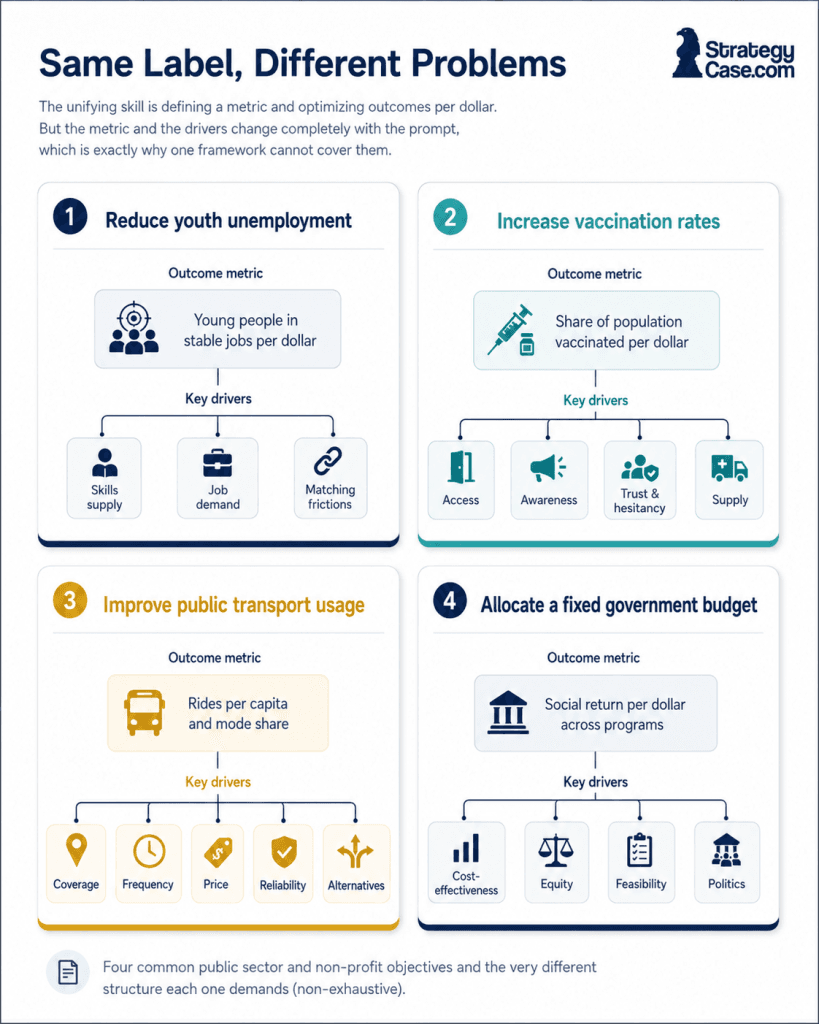
Same Label, Different Problems
The unifying skill is defining a metric and optimizing outcomes per dollar. But the metric and the drivers change completely with the prompt, which is exactly why one framework cannot cover them.
| Prompt | Outcome metric | Key drivers |
|---|---|---|
| Reduce youth unemployment | Young people in stable jobs per dollar | Skills supply, job demand, matching frictions |
| Increase vaccination rates | Share of population vaccinated per dollar | Access, awareness, trust and hesitancy, supply |
| Improve public transport usage | Rides per capita and mode share | Coverage, frequency, price, reliability, alternatives |
| Allocate a fixed government budget | Social return per dollar across programs | Cost-effectiveness, equity, feasibility, politics |
Four common public sector and non-profit objectives and the very different structure each one demands (non-exhaustive).
Across 2,200+ mock interviews and coaching sessions, the candidates who stood out did one thing in the first 60 seconds: they named the metric before drawing a single bucket. The ones who struggled started listing topics.
From the interviewer’s chair, that gap is visible almost immediately.
How These Differ From Standard For-Profit Cases
This is the “key difference” framing many candidates search for, and it is worth making explicit.
| Dimension | For-profit case | Non-profit / public sector case |
|---|---|---|
| Objective | Maximize profit or value | Maximize a social outcome within a budget |
| Success metric | Revenue, margin, ROI (usually given) | You define it (outcomes per dollar) |
| Who is affected | Mainly the company | Citizens, funders, government, NGOs, taxpayers |
| Constraints | Capital, competition | Budget, politics, equity, feasibility, mandate |
| The “answer” | Often a clear financial yes or no | A trade-off across competing goods |
The toolkit overlaps more than candidates expect. A “reduce hospital waiting times” case is an operations case interview in a public setting. A “stop the charity from running out of money” case is a profitability case interview with donations instead of revenue.
The mechanics travel. What changes is that you supply the objective function yourself.
Common Mistakes in Non-Profit and Public Sector Cases
Most errors here come from approach, not intelligence. The split between weak and strong candidates is consistent.
| Weak candidates | Strong candidates | |
|---|---|---|
| Starting point | Grab a for-profit framework | Define success first |
| Structuring | Generic topic list | Drivers built from the objective |
| Focus | Spread evenly, no priorities | Hypothesis on the binding constraint |
| Metric | Stay qualitative | Quantify cost per outcome |
| Constraints | Ignore politics and feasibility | Build them into the recommendation |
A few traps deserve a direct callout:
- Forcing a profit lens. Talking about revenue and margins when the client is a charity or a ministry signals you did not adjust to the setting.
- Never defining a metric. Without a scoreboard, the whole case drifts. Interviewers read this as an inability to handle ambiguity.
- Staying purely qualitative. “We should raise awareness” is weak. “A media campaign at roughly $5 per person reached versus $40 per vaccination through clinics” is a real comparison.
- Ignoring the people affected. Public sector solutions fail on politics and feasibility as often as on logic. Name the groups who win and lose.
Practice Questions
Practice across objectives, not just topics. The hard part is recognizing what kind of problem you are solving and what metric defines it. These span the range you will actually see.
Non-profit and social impact
- A foundation has $50 million to improve childhood literacy. Where should it invest?
- A charity wants to reduce homelessness in a major city. How should it spend its budget?
- An NGO wants to increase clean-water access in a developing region. What should it prioritize?
- A non-profit’s donations are falling and it may run out of money. What should it do?
Public sector and government
- A health ministry wants to raise vaccination rates in rural areas. How?
- A city wants more residents to use public transport instead of cars. What levers should it pull?
- A government wants to reduce youth unemployment within a fixed budget. Where should it start?
- A hospital system has long patient waiting times. How can it cut them?
Budget allocation and federal
- A government has a fixed budget across health, education, and infrastructure. How should it allocate it?
- A federal agency wants to improve a public service’s outcomes without more funding. How?
- A city wants to cut carbon emissions by 30% in ten years. What is the most cost-effective path?
- A national government wants to attract foreign investment. What should it do?
For each, force yourself to state the outcome metric out loud before structuring. That single habit will put you ahead of most candidates. When you want fully worked solutions, the StrategyCase free case library is a good place to drill.
How to Prepare for These Cases
You cannot memorize your way through this category, so prepare the underlying skill instead.
- Train metric definition. Take any social goal and practice turning it into a measurable outcome and a cost-per-outcome comparison. This is the rep that matters most.
- Structure from first principles. Build driver trees for unfamiliar problems without reaching for a template. The case interview frameworks guide shows how to do this under pressure.
- Keep the math simple and decision-relevant. You are comparing options on cost-effectiveness, not building a financial model.
- Practice variety. Five cases with different objectives teach you more than ten variations of “reduce unemployment.” Adaptability is the whole game, and a realistic prep timeline builds it in.
How We Teach You to Structure Any Case
There is no non-profit framework and no public sector framework, because the objective changes with every prompt. What carries across all of them is the ability to define success and build a structure around its drivers.
At StrategyCase, instead of handing you rigid templates, we teach several structuring techniques you can combine to fit any problem: the process perspective, the component perspective, idea expansion, aggregation, and inspiration. They give you flexibility under pressure rather than a script that breaks the moment the case has no profit line.
If you want to build that skill set step by step, you can learn it inside the StrategyCase Case Interview Academy, then pressure-test it with one-on-one coaching on real public sector and social impact cases.
The Bottom Line
A non-profit or public sector case interview is not a test of a special framework, because no such framework exists. It is a test of whether you can take a vague social goal, define what success means, and build a structure around what drives it, all within real constraints.
Define the metric, decompose the drivers, prioritize the binding constraint, quantify enough to compare options on cost-effectiveness, and finish with a clear, feasible recommendation. Do that and you will outperform the many candidates still searching for a template that was never going to come.
FAQ: Non-Profit and Public Sector Case Interviews
What is a non-profit case interview?
A non-profit case interview is a case where the client is a charity, NGO, or foundation and the goal is a social outcome rather than profit. You define a measure of success, such as lives improved or outcomes per dollar, and structure your analysis around what drives it.
Are public sector cases different from normal consulting cases?
The mechanics are similar, but the objective changes. There is no profit to maximize, so you define the metric yourself, and you weigh constraints like budget, politics, equity, and feasibility that for-profit cases usually ignore.
Is there a framework for non-profit or public sector cases?
No. Social problems vary too much for one reusable structure. The skill is building a structure from the specific objective, which is why memorized frameworks tend to fail here.
How do you measure success in a case with no profit?
You propose an outcome metric and, ideally, a cost-effectiveness measure: outcomes per dollar spent. For a vaccination case that might be cost per additional person vaccinated; for an employment case, cost per stable job created.
Which firms give non-profit and public sector cases?
McKinsey (through its Social Sector and public sector practices), Bain, and BCG all use them, as do Deloitte and the other Big 4 firms as well as Roland Berger, Accenture, all firms with large government and federal practices. Expect them if you target any firm with a public sector or social impact arm.
Are these cases harder than standard cases?
They feel harder because the usual anchors are gone, but they reward the same core skill: structuring ambiguity. Once you make defining the metric your first move, they become very manageable.
Are non-profit and public sector cases more qualitative?
Not really. They involve fewer financial statements, but strong answers still quantify, comparing interventions on cost per outcome. Rough numbers sharpen the recommendation just as they do in a profitability case.
How do I prepare for a public sector or federal case interview?
Practice defining outcome metrics, structuring from first principles, and comparing options on cost-effectiveness across a variety of social goals. Avoid memorizing frameworks, and drill real prompts until adapting your structure feels natural.
Related Guides
- Consulting Case Interviews: A Comprehensive Guide. The pillar guide to every stage of the case.
- Case Interview Frameworks. How to build a structure from scratch when no template fits.
- Profitability Case Interview. The diagnostic backbone behind a charity running out of money.
- Growth Strategy Case Interview. Driver-tree thinking that transfers directly to social outcomes.
- Operations Case Interview. The closest sibling for service-delivery cases like hospital waiting times.
About the author: Florian Smeritschnig is a former McKinsey Senior Consultant and the founder of StrategyCase. He spent five years at McKinsey, where he evaluated candidates, and has coached more than 700 people into offers at McKinsey, BCG, Bain, and other top firms. Last updated June 25, 2026.
