
Last Updated on July 6, 2026
Updated June 2026 · By Florian Smeritschnig, former McKinsey Senior Consultant
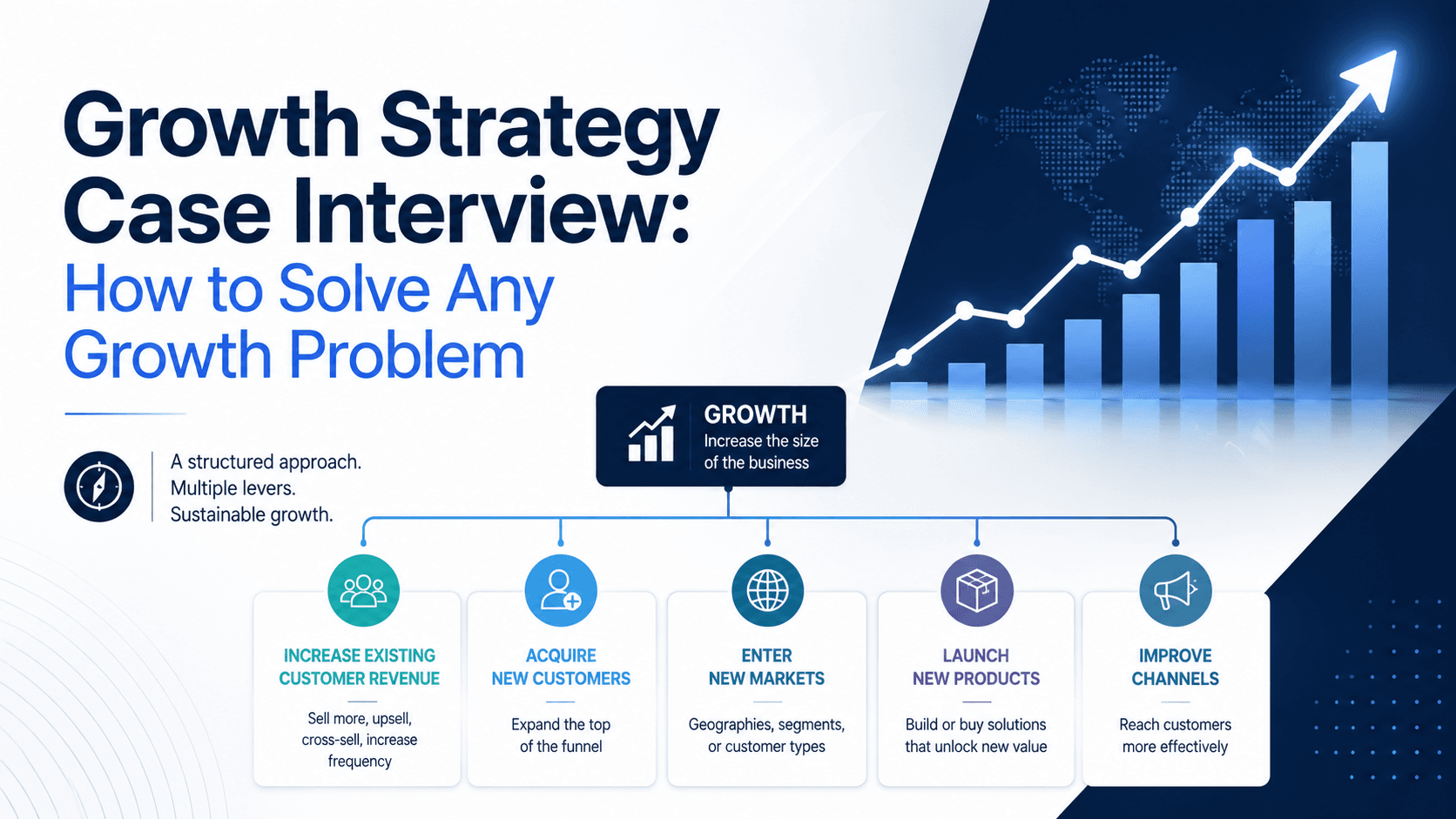
A growth strategy case interview asks one deceptively simple question: how can this company grow? There is no standard “growth framework” to memorize. The candidates who win these cases define what actually needs to grow, anchor it in a metric, diagnose the real constraint, and only then reach for growth levers like new markets or new products. Get that order right and the case almost solves itself. Get it wrong, and no framework will save you.
I spent five years at McKinsey as a Senior Consultant, where I evaluated candidates, and I have since coached more than 700 offers for McKinsey, BCG, Bain and other top firms. The growth cases I watched fall apart failed in the first few minutes, when the candidate slapped a memorized list of growth options onto a problem they had not yet understood.
This guide gives you the method I teach instead: how to read what a growth case is really about, the three growth situations behind almost every prompt, how to structure each one from first principles, and how to prioritize options into a real recommendation. You also get six practice cases across industries, the mistakes that sink most answers, and an honest section on why more growth is not always the right answer.
Key Takeaways
- “Growth” is an objective, not a case type. The same prompt can hide a core-optimization problem, an expansion problem, or a pricing problem, and each one needs a different structure.
- There is no universal growth framework. Strong candidates build structure from the problem: define the goal, anchor it in a metric, then diagnose where growth is blocked.
- Growth levers (raise share, enter markets, launch products, acquire) are outputs of your analysis, not your starting point. Listing them early signals you have not understood the case.
- Most growth cases turn into a profitability, pricing, market entry, or M&A problem. Expect the hybrid and follow it.
- More growth is not always good. Volume can dilute margins and new products can cannibalize existing revenue. Top candidates optimize for value, not growth for its own sake.
What Is a Growth Strategy Case Interview?
A growth strategy case interview is a business problem where the interviewer asks how a company can increase its revenue, volume, or market share. Unlike a fixed case type, “growth” is an objective rather than a recipe. The same goal can come from very different business situations, which is exactly why no single framework fits every growth case.
Both McKinsey and BCG describe the case interview as a test of how you structure and work through an unfamiliar business problem, not how well you recall a template. McKinsey frames its problem-solving interview around analytical thinking and approach, and BCG’s own case interview preparation stresses structuring, analysis, and judgment. Growth is one of the most common problem types both firms reach for, because it mirrors the work consultants actually do.
That last point matters. On live engagements, “how do we grow this business” is one of the most frequent questions a client asks. The interview version is a preview of real consulting work, which is why interviewers care far more about your thinking than about any list of options you can recite.
Why There Is No Standard Growth Framework
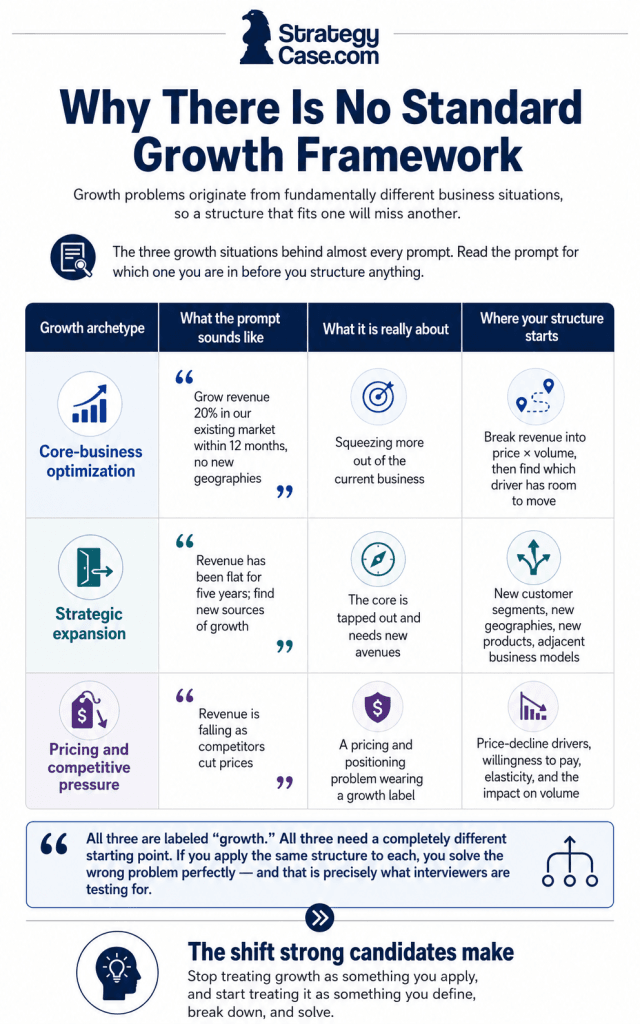
Growth problems originate from fundamentally different business situations, so a structure that fits one will miss another. What looks like the same objective on the surface, “grow the business,” usually hides one of three very different underlying problems.
| Growth archetype | What the prompt sounds like | What it is really about | Where your structure starts |
|---|---|---|---|
| Core-business optimization | “Grow revenue 20% in our existing market within 12 months, no new geographies” | Squeezing more out of the current business | Break revenue into price × volume, then find which driver has room to move |
| Strategic expansion | “Revenue has been flat for five years; find new sources of growth” | The core is tapped out and needs new avenues | Looking at the core business and then identifying how new customer segments, new geographies, new products, adjacent business models could fit (here, analyzing new avenues of growth right away would be actually useful but not in a brainstorming but analytical-manner) |
| Pricing and competitive pressure | “Revenue is falling as competitors cut prices” | A pricing and positioning problem wearing a growth label | Price-decline drivers, willingness to pay, elasticity, and the impact on volume |
All three are labeled “growth.” All three need a completely different starting point. If you apply the same structure to each, you solve the wrong problem perfectly, and that is precisely what interviewers are testing for.
The shift that separates strong candidates is simple to state and hard to do under pressure: stop treating growth as something you “apply,” and start treating it as something you define, break down, and solve.
The First-Principles Method for Any Growth Case
Growth does not follow a clean, fixed sequence of boxes. Your structure should adapt to the specific problem in front of you. The method below is a thinking process, not a template, which is the whole point: it bends to a case you have never seen instead of breaking on it.
Step 1: Define the Objective
Most growth prompts are deliberately vague. “Grow revenue.” “Find new growth opportunities.” “Help the company expand.” If you jump straight into structuring, you will almost certainly head in the wrong direction.
Clarify before you build. What exactly does the client want to grow: revenue, volume, or market share? Is there a quantified target, like +20% or doubling? What is the time horizon, short-term optimization or long-term transformation? Are there constraints on geography, budget, or product scope? Thirty seconds of clarification here saves you from a beautifully structured answer to the wrong question.
Step 2: Anchor It in a Metric
Once the goal is clear, translate it into something measurable. In most cases that becomes revenue growth, and revenue breaks down cleanly:
Revenue = price × volume, and volume = number of customers × usage per customer
This decomposition is your anchor. Every branch of your structure should trace back to it, so your analysis stays focused instead of drifting into a generic list of ideas. When a candidate gives me a structure with no measurable anchor, I know within seconds that the rest will be unfocused.
Step 3: Diagnose the Constraint
Before you propose anything, find where growth is actually stuck today. Is volume capped by low repeat purchase? Is price under pressure from competitors? Is the core market saturated? The constraint tells you which part of your structure to dig into.
This is the step most candidates skip, and skipping it is the single biggest reason growth answers feel shallow. Diagnosis is where you earn the right to recommend.
Step 4: Derive the Levers
Only now do growth options become relevant, and now they are earned rather than guessed. If retention is the constraint, customer-focused levers lead. If the market is saturated, expansion moves to the front. If pricing is bleeding value, repositioning and pricing model changes take priority. The levers fall out of the diagnosis instead of being pasted on top of it.
Growth Levers Are Outputs, Not Your Starting Point
Most candidates treat a growth case as an exercise in listing options: raise market share, enter new markets, launch new products, pursue partnerships or acquisitions. These are not analytical lenses. They are possible answers, and jumping to them early is the clearest signal that you have not understood the problem yet.
In a strong approach, those options only appear after you have diagnosed what needs to grow, how it is measured, and where the constraint sits. A growth case follows the same arc as any other case interview:
- Prompt and objective clarification
- Structuring and probing for data
- Analyze charts
- Case math on the drivers that matter
- Targeted brainstorming once the constraint is clear
- A recommendation, communicated top-down
Take the core-optimization archetype from the table above. You analyze price and volume, find that volume is held back by weak repeat purchase, and only then does “improve customer retention” become a relevant lever. The same levers might surface in a dozen different cases, but in a strong answer they are always derived from the analysis, never used to structure it.
How Strong Candidates Prioritize Growth Options
Once you have several plausible growth paths, the case shifts from diagnosing to deciding. This is where average answers stall: candidates present three or four ideas and treat them as equally valid, instead of committing. The interviewer is not asking “what could we do?” They are asking “what should we do, given this specific situation?”
Strong candidates evaluate options along three dimensions and then make a call.
| Dimension | The question you answer | What a sharp answer sounds like |
|---|---|---|
| Impact | How much does this move the growth metric, incrementally or as a step-change? | “This path adds roughly €20M; the others add €2M each, so it leads.” |
| Feasibility | Can we execute it with current capabilities, and how fast? | “We already have the salesforce, so time to impact is months, not years.” |
| Trade-offs | What does it cost in investment, margin, cannibalization, or risk? | “It lifts volume but dilutes margin, so I would pair it with a price floor.” |
The recommendation should connect straight back to your diagnosis. If pricing was the core issue, pricing actions dominate. If the market was saturated, expansion takes priority. If retention was weak, customer levers win. That through-line, from diagnosis to a small number of justified actions, is what turns a list of ideas into an actual strategy.
Growth Cases Are Almost Always Hybrids
One more trap: treating growth as a standalone case type. In practice, most growth cases quickly become another kind of case once you start digging. A “grow revenue” prompt often turns into a pricing problem, a customer-segmentation problem, or a cost-versus-margin trade-off.
Depending on where your diagnosis leads, a growth case can fold into a:
- profitability case, once revenue and cost drivers come into play
- pricing case, when price pressure is the real issue
- market entry case, when expansion into a new market is on the table
- operations case, when capacity or process limits growth
- M&A case, when acquisition is a growth path
- turnaround case, when growth has to come alongside a fix
- competitive strategy case, when rivals are the binding constraint
- product launch case, when a new offering is the engine
- digital transformation case, when the digtal backbone enables growth
If you cling to a generic growth framework, you will miss these transitions. If you are working from first principles, you simply follow the constraint into whatever case it becomes.
Common Mistakes in Growth Strategy Case Interviews
From the other side of the table, the candidates who lost growth cases almost always made the same handful of errors. Each one is preventable.
- Relying on a generic growth framework instead of building a structure that fits the prompt
- Jumping to ideas before diagnosing the underlying problem
- Never defining what “growth” actually means in this case
- Ignoring how a proposed action translates into revenue and profit impact
- Treating the case as open-ended brainstorming rather than structured analysis
Any one of these looks minor on its own. Stacked together, they signal the one thing interviewers are screening out: a lack of rigorous, first-principles problem-solving.
Not All Growth Is Good: the Insight That Separates Top Candidates
Here is where the strongest candidates pull away. Growth is not automatically valuable, and treating it as if it were is a rookie tell. Increasing volume can dilute margins. New products can cannibalize existing revenue. Expansion adds cost, complexity, and execution risk. Pushed too hard, growth can destroy value rather than create it.
On real McKinsey engagements, the honest recommendation was sometimes to grow less, or to grow more slowly, because the profitable path was narrower than the aggressive one. Candidates who recognize this, and who weigh upside against feasibility, risk, and long-term sustainability, show the business judgment that gets offers. They do not try to maximize growth. They try to maximize value.
Practice Growth Case Questions
To get better, you need exposure to different growth problems across industries, so you train the instinct to structure each one from scratch. Read each scenario below and, before reaching for any solution, force yourself to answer the diagnostic question in the final column.
| Industry | Scenario | The question to diagnose first |
|---|---|---|
| Retail (saturated) | A mid-sized fashion retailer has had flat revenue for three years; foot traffic is declining and store count is stable. The CEO wants growth. | Traffic, conversion, or broader market saturation? |
| SaaS (ambitious target) | A B2B SaaS company wants to double revenue in three years; it is well established in its core segment, but growth has slowed. | Pricing, customer acquisition, retention, or market size? |
| Airline (share expansion) | A regional airline wants to grow its share on European short-haul routes, where low-cost carriers dominate. | Pricing, network strategy, or value proposition? |
| Consumer goods (new avenues) | A global beverage company is stagnating in its core products and wants new growth. | Core business, new products, new markets, or repositioning existing brands? |
| Healthcare (capacity-constrained) | A private hospital group wants revenue growth, but most facilities already run near full capacity. | An operations problem, a pricing opportunity, or an expansion decision? |
| E-commerce (slowing growth) | An online marketplace has grown strongly for years, but year-over-year growth rates are now falling. | Natural maturation, rising competition, or a product and UX issue? |
As you drill these, hold the same discipline every time: define the objective, find the metric, locate the constraint, then choose the levers that fit. It is an intuitive, first-principles process, not a checklist.
How to Prepare for Growth Strategy Cases
Most candidates “prepare” for growth cases by reading frameworks, which does not translate into performance. What works is deliberate, targeted practice on the parts that actually get scored. If you are early in your prep, the guide on how long to prepare for consulting interviews will help you plan the runway, and you can drill on real prompts from this collection of case interview examples.
- Train objective clarification out loud. Take a vague prompt like “the client wants to grow revenue” and practice asking what should grow, by how much, in what timeframe, and under what constraints, until it is automatic.
- Build structures from a blank page. Instead of recalling a framework, start from the core metric and its drivers. If you catch yourself listing ideas such as “markets, products, partnerships” too early, stop, because you are jumping to answers.
- Diagnose before you ideate. Take any growth case and deliberately delay solutions until you have identified where growth comes from today and what limits it.
- Force a decision. After generating options, commit to the one or two you would prioritize and say why. “We could do A, B, or C” is not a recommendation.
- Stress-test with numbers. Even in a qualitative growth case, push for a rough revenue impact and name the trade-offs, like margin versus volume. This is where many candidates fall short.
Frequently Asked Questions
What is a growth strategy case interview?
A growth strategy case interview is a business problem where the interviewer asks how a company can grow its revenue, volume, or market share. It is not a fixed case type with a set framework. The same “grow the business” prompt can hide a core-optimization problem, an expansion problem, or a pricing problem, and your first job is to work out which one you are facing.
Is there a framework for growth strategy cases?
No single framework fits every growth case, and reaching for one is the most common way candidates lose these cases. Build structure from the problem instead: define what needs to grow, anchor it in a metric like revenue = price × volume, diagnose where growth is blocked, and only then choose levers. A memorized list of growth options is a set of possible answers, not a structure.
How do you structure a growth strategy case?
Start by clarifying the objective: what should grow, by how much, in what timeframe, and under what constraints. Translate that into a measurable anchor, usually revenue split into price and volume. Then diagnose the constraint, where growth is actually stuck today, and let your structure flow from there. Growth levers like new products or new markets come last, after the analysis points to them.
What is the difference between a growth case and a profitability case?
A profitability case asks why profit changed and how to fix it, so it always decomposes into revenue minus costs. A growth case asks how to expand revenue, volume, or share, and the constraint can sit anywhere: pricing, demand, capacity, or the market itself. The two overlap constantly, and many growth cases turn into a profitability problem once you start analyzing the drivers.
Do McKinsey, BCG, and Bain ask growth strategy cases?
Yes. Growth is one of the most common case themes at all three firms because it mirrors real client work. The format differs: McKinsey runs interviewer-led cases where growth usually appears inside a larger problem, as the McKinsey case interview guide explains, while BCG and Bain lean more candidate-led. The evaluation criteria are the same everywhere: structured thinking, sound diagnosis, and a clear recommendation.
How do I get better at growth cases fast?
With under four weeks to prepare, drill the thinking process, not more frameworks. Take vague prompts and practice clarifying the objective out loud, build a structure from a blank page, and delay solutions until you have diagnosed the constraint. A handful of cases practiced this way across different industries beats grinding fifty cases with a memorized template.
Final Thoughts
Growth cases are the clearest proof of the bigger truth about case interviews: there are no fixed templates, only structured thinking. The candidates who consistently crack them are the ones who define the problem, diagnose the constraint, and make a clear, defensible call.
If you take three habits from this guide, make them these:
- Define before you structure. Know exactly what needs to grow before you draw a single bucket.
- Diagnose before you ideate. Find the constraint before you propose a lever.
- Optimize for value, not growth. The best recommendation is sometimes to grow less.
If you want to build that skill the way the top 1% do, the StrategyCase Case Interview Academy teaches first-principles structuring, chart reading, case math, and communication, then drills them against realistic cases until the process is automatic. Because in the end, success in growth cases does not come from memorizing answers. It comes from knowing how to think.
Related Guides
Keep sharpening the skills that surround the growth strategy case interview:
- Consulting Case Interviews: A Comprehensive Guide: the StrategyCase pillar that ties every case skill together
- Case Interview Frameworks: how to build structure for any case, not just growth
- Market Sizing Case Interviews: the estimation skill that often sits inside a growth case
- How to Be MECE in a Case Interview: the structuring principle that keeps your buckets clean
- Case Interview Success: what actually separates candidates who get offers
Florian Smeritschnig is a former McKinsey Senior Consultant and the founder of StrategyCase. He spent five years at McKinsey, where he evaluated candidates, and has since coached hundreds of candidates into offers at McKinsey, BCG, Bain, and other top firms. Last updated June 25, 2026.
