
Last Updated on July 2, 2026
Updated July 2026 · By Florian Smeritschnig, Former McKinsey Senior Consultant
A wildcard case is an ambiguous, multi-layered business problem that does not fit any of the standard case types you studied. There is no profitability formula to reach for, no market-entry checklist, no clean bucket. And these cases are no longer the exception.
If you are preparing for consulting interviews by memorizing frameworks, you are solving a problem that no longer exists. In my experience evaluating candidates at McKinsey and delivering more than 2,200 coaching sessions since, most of the cases I now see are wildcards. At McKinsey specifically, I would put it north of 80%.
That is why so many well-prepared candidates still get rejected. They memorized 12 frameworks for an interview that tests whether they can build one from scratch. This guide shows you the first-principles method I used to pass McKinsey, the same method I now use to coach candidates into offers, so you can structure any case the interviewer throws at you.
Key Takeaways
- A wildcard case is a non-standard, ambiguous problem with no matching framework. The majority of modern MBB cases are wildcards, and at McKinsey the share is higher.
- Firms deliberately moved away from framework-friendly cases because memorized structures let weak problem-solvers hide. Wildcards expose who can actually think.
- There is no “wildcard framework.” The skill being tested is building a tailored structure from first principles, not recognizing a pattern.
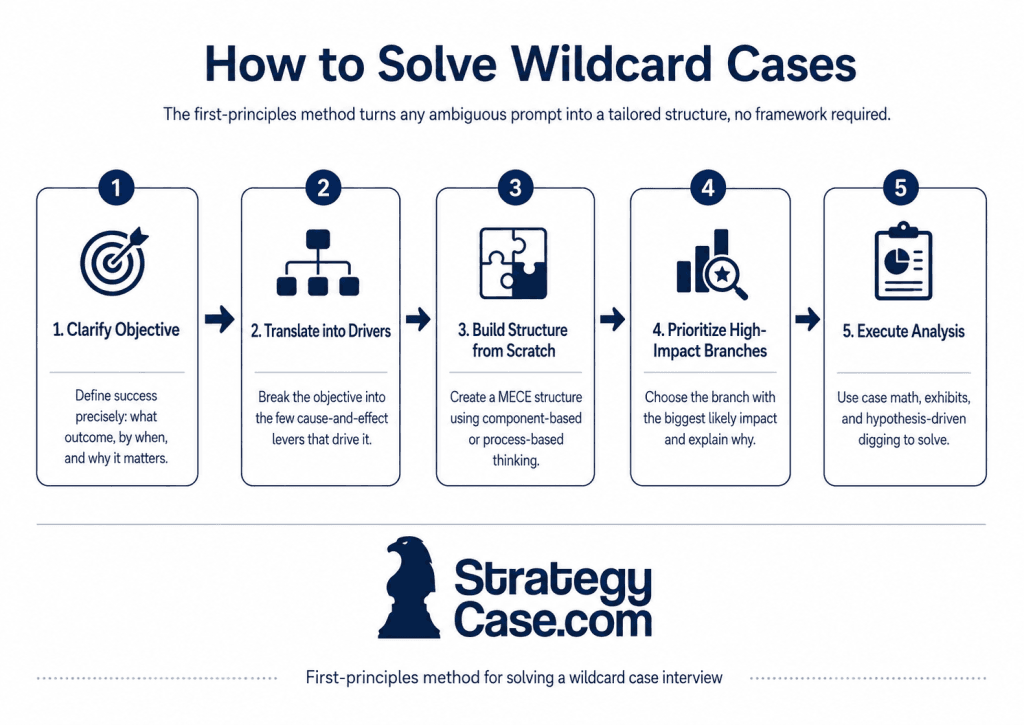
- The method is five steps: clarify the objective, translate it into drivers, build the structure from scratch, prioritize the high-impact branches, then execute the analysis.
- Two cases that look identical can require completely different structures. The objective, not the surface topic, dictates the structure.
What Is a Wildcard Case Interview?
A wildcard case interview is a case that does not map to a recognizable type. Instead of “grow revenue” or “should we enter this market,” you get prompts like: “A national park is losing visitors. What is going on?” or “A hospital wants to reduce patient wait times. How would you approach this?” or “A government agency needs to decide how to allocate a fixed budget across three programs. Advise them.”
None of those come with a template. There is no memorized structure that fits, and that is the point. The interviewer wants to see how you think when you cannot lean on anything you rehearsed.
Candidates often call these “weird cases,” “non-standard cases,” or “unconventional case interviews.” The label does not matter. What matters is that the case is designed to be un-Googleable and un-memorizable.
Why Firms Moved Away from Frameworks
For years, the prep industry taught candidates to recognize a case, pull the matching framework, and fill in the blanks. Firms noticed. When everyone walks in with the same 12 structures, the interview stops measuring problem-solving and starts measuring memorization.
So the firms changed the cases. They shifted toward ambiguous, tailored problems precisely because a memorized framework is useless against them. A profitability framework does not help when the real question is whether a museum should merge with a rival, or how a logistics company should respond to a new regulation.
Here is the insider view. When I was recruiting for McKinsey as a candidate back in 2014, the cases were already drifting away from clean “case type” buckets. By the time I was on the other side of the table, the shift was complete. What is rewarded is not whether someone knows a framework from Case in Point (a case book written by an industry outsider who never worked in consulting nor interviewed candidates).
It was whether they can take a messy prompt and impose structure on it in real time. A candidate who reaches for a textbook framework actually scores worse, because it signals they were pattern-matching instead of thinking.
That is the mismatch at the heart of why so much prep fails. Candidates practice for a test the firms retired years ago. I wrote about this gap in more detail in why most preparation misses the mark, and it is the single biggest reason smart people get dinged.
There Is No Wildcard Framework
Let me kill the most common search on this topic right now. There is no wildcard case framework, and anyone selling you one has misunderstood the assessment.
A framework is a pre-built answer. A wildcard case is defined by having no pre-built answer. The moment you try to force a generic structure onto it, you have failed the exact skill the interviewer is measuring.
What you need instead is not a framework but a method: a repeatable way to generate a custom structure for whatever problem you are handed. That method is first-principles thinking, and unlike a framework, it works on every case, including the standard ones.
The Shift: From Templates to First Principles
First-principles thinking means breaking a problem down to its fundamental parts and reasoning up from there, instead of reasoning by analogy to a case you have seen before.
A memorized framework says: “This looks like a profitability case, so I will use revenue minus cost.” First-principles thinking says: “What is actually being asked here, what would have to be true to answer it, and how do those pieces fit together?”
The difference shows up in the first two minutes, and interviewers can tell instantly. One candidate recites. The other reasons. Only one of them gets the callback.
The good news: first principles is a learnable skill, not a talent. It has a clear process, and once it becomes second nature you stop fearing wildcard cases entirely, because you no longer need the case to match anything.
How to Solve Wildcard Cases
Here is the exact five-step method. It is the same one I teach in one-on-one coaching, and it is deliberately simple, because under interview pressure, simple is what survives.
Step 1: Start with the Objective
You cannot structure a problem you do not understand. Before you build anything, get crystal clear on what success actually looks like.
“Grow the business” is not an objective. Grow revenue by how much, by when, and why does the client care? Ask the clarifying questions until you could restate the goal in one precise sentence. Most failed wildcard cases die right here, at the first step, because the candidate started structuring a problem they had not yet defined.
Step 2: Translate the Objective into Drivers
Once you know the objective, break it into the cause-and-effect relationships that move it. If the objective is reducing hospital wait times, the drivers might be patient inflow, processing capacity, and discharge speed. You are not listing topics. You are identifying the levers that actually determine the outcome.
Step 3: Build the Structure from Scratch
Now assemble those drivers into a clean, MECE structure. Two construction methods cover almost every wildcard case:
- Component-based thinking: break the system into its key parts. To structure customer satisfaction for an airline, you might split it into infrastructure (airport, lounges, digital), staff (crew, ground service), and physical assets (aircraft) and product (seats, food, frequent flier programs).
- Process-based thinking: map the end-to-end journey. For that same airline, you could walk the customer through booking, check-in, boarding, the flight, and arrival, and examine satisfaction at each stage.
Neither is memorized. Both are generated live from the specific problem in front of you. That is the whole game.
For more on this, see our case interview framework guide.
Step 4: Prioritize Like a Consultant
A structure is not a to-do list you march through top to bottom. Real consultants identify where the biggest impact likely sits and go there first. Tell the interviewer which branch you want to dig into and why. That single sentence separates candidates who think like consultants from candidates who think like students.
Step 5: Execute the Analysis
Only now do the standard case skills come back into play: case math, chart and exhibit interpretation, and hypothesis-driven digging. The structure told you where to look. Execution is what you do once you are there.
Different Objectives Require Completely Different Approaches
This is the point that ties everything together, and it is the one competitors miss.
Two cases can describe the identical situation and still demand completely different structures, purely because the objective differs.
Imagine two prompts about the same airline that both use the word “growth.” In the first, the client wants to grow revenue next year. In the second, the client wants to grow long-term market position. Same company, same word, but the structures share almost nothing.
The first is about pricing, load factors, and route economics.
The second is about competitive positioning, brand, and capability building.
If you had a “growth framework” ready, you would have applied it to both and been wrong on at least one. First-principles candidates read the objective, saw two different problems, and built two different structures. That is exactly what I look for when I evaluate a candidate, and exactly what earns the offer.
I coached a candidate last cycle, a strong analyst from a non-target school who had already failed one MBB process by over-relying on frameworks. We spent our sessions doing nothing but this, reading objectives and building structures from scratch, until she stopped reaching for templates.
She restructured a wildcard case about a struggling regional airport live in her McKinsey final round and got the offer. Nothing about the case matched anything she had “practiced.”
That was the point. Once you know how modern cases are evaluated, shift your thinking, and then practice the right way, solving cases becomes almost an automated habit.
Wildcard Cases vs Traditional Case Types
It helps to see where wildcards sit relative to the case types you may have studied.
| Dimension | Traditional Case Types | Wildcard Cases |
|---|---|---|
| Structure | Recognizable pattern (profitability, market entry, etc.) | No pattern, built from scratch |
| What is tested | Do you know the framework? | Can you build a framework? |
| Prep that works | Studying case types | Practicing first-principles structuring |
| Frequency at MBB today | Minority of cases | Majority of cases |
| Where candidates fail | Execution and math | Defining the objective and structuring |
The traditional case types still matter, but not as templates to memorize. Study them to understand common business drivers, then throw the template away.
Every standard case type is really just a wildcard case that happens to have a familiar shape.
Common Mistakes in Wildcard Cases
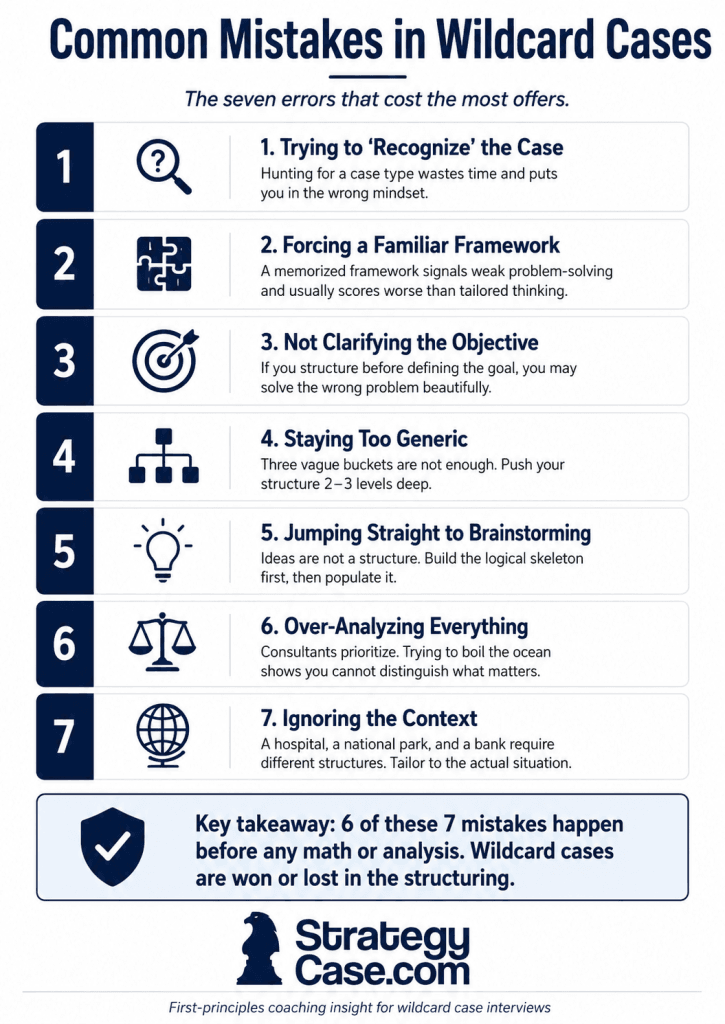
After thousands of coaching sessions, I see the same errors again and again. Here are the seven that cost the most offers.
- Trying to “recognize” the case. The candidate hunts for which type it is instead of accepting there is no type. Wasted seconds, wrong mindset.
- Forcing a familiar framework. The single biggest killer. Interviewers read a forced framework as a lack of genuine problem-solving, and it scores worse than no framework at all.
- Not clarifying the objective. Structuring before you understand the goal means you often solve the wrong problem beautifully. This is the number one root cause of failed wildcard cases.
- Staying too generic. A structure with three vague buckets and no depth is not a structure. Push two to three levels deep so the interviewer sees real thinking.
- Jumping straight to brainstorming. Listing ideas is not structuring. Build the logical skeleton first, then populate it. If you struggle here, deliberate structuring drills fix it faster than doing more full cases.
- Over-analyzing everything. Trying to boil the ocean instead of prioritizing signals that you cannot distinguish what matters. Consultants triage.
- Ignoring the context. A hospital, a national park, and a bank do not behave the same way. Tailor the structure to the actual situation, not to a generic business.
Notice that six of these seven happen before any math or analysis. Wildcard cases are won or lost in the structuring, which is exactly where most prep spends the least time.
Practice Wildcard Case Questions
You cannot memorize your way through these, but you can absolutely train the method. Try structuring each of these from scratch. Clarify the objective first, then build:
- A symphony orchestra is losing subscribers. What should it do?
- An airline wants to improve customer satisfaction without raising costs. Where do you start?
- A city wants to reduce traffic congestion downtown. Advise the mayor.
- A university’s online degree program is enrolling students but few finish. Why, and what should change?
- A grocery chain is deciding whether to open smaller-format urban stores. Should it?
For each, do not write an answer. Write the objective in one sentence, choose component-based or process-based thinking, and draw the structure. That drill, repeated, is what builds the skill. You will find more worked examples in our free collection of real case interview examples.
How to Prepare for Wildcard Cases
If wildcards are the majority of what you will face, your prep should be built around them, not around collecting case types.
- Prioritize structuring over volume. Doing 100 cases badly teaches motion, not mastery. A smaller number of cases where you deliberately build every structure from first principles beats grinding through templates. This is the core of the “prep is broken” problem I keep returning to.
- Practice the objective step obsessively. Since most failures start there, spend disproportionate time on clarifying and restating objectives before you structure anything.
- Get real feedback. You cannot see your own structuring blind spots. This is where a partner or a coach who has actually evaluated candidates matters. When I sit in on a mock, I can usually tell within the first few minutes whether someone is reasoning or reciting, and that is the exact feedback that closes the gap.
- Drill the sub-skills separately. Structuring, brainstorming, math, and chart reading each improve faster in isolation than buried inside full cases.
For the complete method with progression, our comprehensive case interview guide is the pillar that ties all of this together.
If You Want a Complete Case Interview System
Reading about first principles is one thing. Building it into a reflex under pressure is another. That is what the StrategyCase Case Interview Academy is built to do: concise theory, targeted structuring drills, and high-quality cases that mirror the real wildcard problems firms use now, not recycled textbook cases.
If you want direct feedback from someone who evaluated candidates at McKinsey, one-on-one coaching with Florian is the fastest way to fix your structuring. Across 2,200+ sessions and 700+ offers at McKinsey, BCG, Bain, and other top firms, the pattern is consistent: candidates who master first-principles structuring stop fearing the interview, because they no longer need the case to look familiar.
Final Takeaway
Wildcard cases are not special cases. They are the real interview.
The candidates who succeed are the ones who can take any ambiguous prompt, clarify the objective, and build a tailored structure from first principles, live, under pressure. That is the skill the firms actually test, and it is the skill StrategyCase is built to teach.
Related Guides
- Consulting Case Interviews: A Comprehensive Guide: the pillar that ties every skill together
- Case Interview Frameworks: what frameworks are still good for, and what they are not
- Profitability Case Interview: the most common “standard” type, taught the first-principles way
- Market Entry Case Interview: another classic type to understand, not memorize
- How to Be MECE in a Case Interview: the structuring discipline wildcard cases demand
FAQ: Wildcard Case Interviews
What is a wildcard case interview?
A wildcard case is a case interview problem that does not fit any standard case type, like profitability or market entry. It is deliberately ambiguous, so no memorized framework applies. You solve it by building a tailored structure from first principles instead of recognizing a pattern.
How do you solve a wildcard case?
Use a five-step method: clarify the objective, translate it into the drivers that move that objective, build a structure from scratch using component-based or process-based thinking, prioritize the highest-impact branches, then execute the analysis with case math and exhibit reading. The structure is generated live, not recalled.
How common are wildcard cases at McKinsey, BCG, and Bain?
They are now the majority of cases at MBB firms. Based on evaluating candidates at McKinsey and 2,200+ coaching sessions, most modern cases are wildcards, and at McKinsey the share is higher still. Framework-friendly cases have largely been retired.
Is there a framework for wildcard cases?
No. By definition a wildcard case has no matching framework, and forcing a generic one signals weak problem-solving to the interviewer. What works is a repeatable method for building a custom structure, which is first-principles thinking. That method works on every case, including standard ones.
Why do firms use wildcard cases?
Because memorized frameworks stopped measuring anything useful once every candidate walked in with the same templates. Ambiguous, tailored problems force candidates to actually think in real time, which is what consulting work requires. Wildcards separate genuine problem-solvers from pattern-matchers.
How do I prepare for wildcard cases if I can’t predict them?
You cannot predict the case, but you can train the method. Practice clarifying objectives and building structures from scratch, drill structuring separately from full cases, and get feedback from someone who has evaluated real candidates. Volume of memorized cases does not help. Mastery of first-principles structuring does.
Written by Florian Smeritschnig, former McKinsey Senior Consultant and founder of StrategyCase.com. Florian evaluated candidates at McKinsey and has delivered 2,200+ mock interviews and coaching sessions, helping 700+ candidates secure offers at McKinsey, BCG, Bain, and other top firms.
