

Last Updated on July 6, 2026
By Florian Smeritschnig, former McKinsey Senior Consultant · Last updated June 24, 2026
A product launch case interview asks whether a company should launch a new product, and how to launch it well. Here is the part most prep gets wrong: there is no standard product launch framework. The right structure depends entirely on the client’s objective.
Most candidates lose these cases before they start. They reach for a memorized product launch framework, or the 4Ps and the 5Cs, and apply it to a question it was never built for. In five years evaluating candidates at McKinsey, I watched that one mistake sink more product launch cases than weak math ever did. This guide shows you the approach that actually works.
Key Takeaways
- There is no standard product launch framework. The client’s objective, whether that is a launch decision, go-to-market, failure diagnosis, or scaling, decides the structure you build.
- Default frameworks or templates like the 4Ps and 5Cs are the most common reason candidates fail these cases. They signal memorization, not thinking.
- Clarify the objective before you structure anything. Misread it, and even a polished structure answers the wrong question.
- Most product launch cases are hybrids. They drift into pricing, profitability, market entry, or growth as the interview unfolds, so your structure has to adapt in real time.
- Practice a variety of objectives, not a volume of similar prompts. Five cases with different objectives teach you more than ten repeats of “should we launch?”
What Is a Product Launch Case Interview?
A product launch case interview (also called a new product case interview) asks whether a company should launch a new product, and how to launch it successfully. Interviewers use it to test how you structure an ambiguous decision, weigh demand, economics, and execution, and reach a clear recommendation. It is not a test of whether you can recite a framework.
Typical prompts look like this:
- A tech company wants to launch a new AI product. Should it proceed?
- A consumer goods company is introducing a premium product line. How should it position it?
- A bank is considering a new digital offering. How can it drive adoption?
Underneath the surface, firms are assessing three things: your ability to structure ambiguity, to break down the problem based on the actual objective, and to translate strategy into practical execution. McKinsey says as much on its own interviewing page: the goal is to see how you “structure tough, ambiguous challenges,” handle data, and form a recommendation. This is a decision problem under uncertainty, not a checklist.
The Biggest Misconception: There Is No Standard Framework
Faced with a product launch prompt, many candidates default to something like:
- Market
- Competition
- Financials
- Go-to-market
It looks structured. It feels comprehensive. And it usually misses the point, because it assumes every product launch case is the same problem.
That assumption is exactly what the prep industry sells. The 4Ps (Product, Price, Place, Promotion) and the 5Cs (Company, Customers, Competitors, Collaborators, Context) are taught as plug-and-play answers to “new product” cases. BCG quietly contradicts that on its own case prep page: “there isn’t always a single ‘right’ answer; what matters most is how you approach the problem and the quality of your reasoning.” A canned framework optimizes for the wrong thing.
Applying a fixed template creates four predictable problems:
- Misplaced focus: you analyze areas that are not critical to the actual decision.
- No prioritization: everything is treated as equally important, which signals weak judgment.
- Shallow analysis: you touch many buckets but go deep on none.
- Generic communication: your structure sounds standard, not tailored to the case in front of you.
Strong candidates start somewhere else. Before structuring anything, they clarify what the case is really asking: What exactly are we deciding? What does success look like? What would make this a “no”? Only then do they build a structure that reflects that specific objective. A framework is useful only when it is derived from the problem, not imposed on it.
The Key Principle: The Objective Defines the Approach
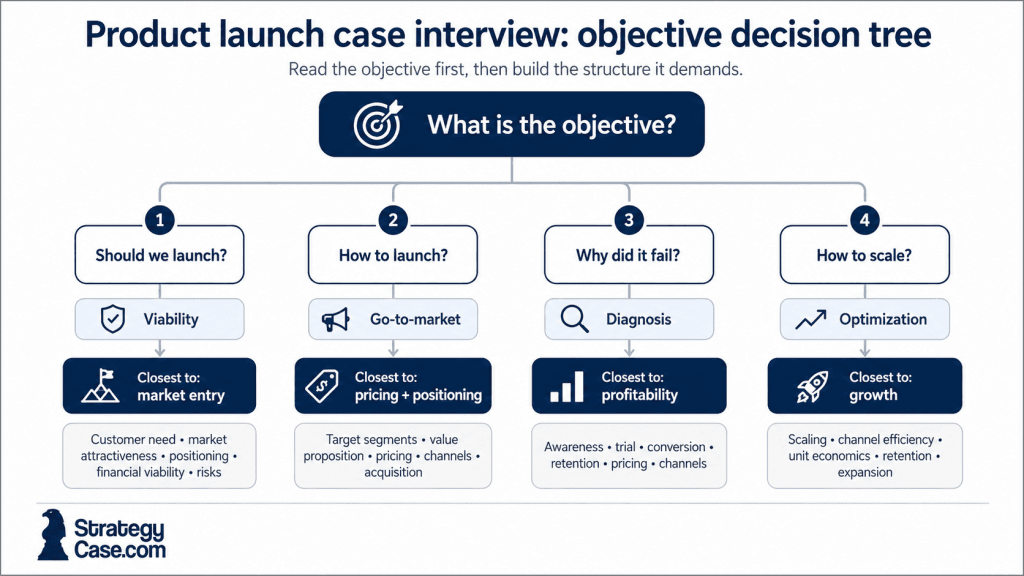
The same “product launch” label can hide completely different problems. Each one demands its own structure.
1. “Should we launch this product?”
Focus: viability and decision-making. You are evaluating whether the launch makes sense at all. The areas that matter: real customer need, market attractiveness, competitive positioning, financial viability, and the key risks (execution, cannibalization, uncertainty). This is closest to a market entry or investment decision.
2. “How should we launch successfully?”
Focus: execution and go-to-market. The decision to launch is already made; the question is how to do it well. The areas that matter: target segments, value proposition and positioning, pricing strategy, distribution channels, and customer acquisition. This is more of an implementation problem.
3. “Why did the product launch fail?”
Focus: diagnosis and root-cause analysis. Now you are looking backward, down the adoption funnel (awareness, trial, conversion, retention), at product-market fit, pricing mismatches, channel issues, and competitive response. This behaves like a profitability or operations diagnostic.
4. “How do we maximize the impact of the launch?”
Focus: optimization and scaling. The product exists, but performance needs to improve: scaling strategy, channel efficiency, unit economics, retention, and expansion. This overlaps heavily with growth strategy cases.
Same label, four different problems, four different structures. Apply one structure to all of them and you will miss what actually matters.
| Objective type | Core question | Primary focus | What matters most |
|---|---|---|---|
| Launch decision | Should we launch? | Viability | Demand, differentiation, economics, risk |
| Go-to-market | How should we launch? | Execution | Targeting, positioning, pricing, channels |
| Diagnosis | Why did it fail? | Root cause | Adoption funnel, product-market fit, pricing, competition |
| Scaling | How do we maximize impact? | Optimization | Growth levers, retention, unit economics |
Four common product launch objectives and the structure each one demands (non-exhaustive).
Across 2,200+ mock interviews and coaching sessions, the candidates who stood out did one specific thing in the first 60 seconds: before drawing a single bucket, they said out loud what decision the client was actually facing. The ones who struggled reached for “market, competition, financials, go-to-market” on autopilot.
From the interviewer’s chair, that gap is visible inside the first minute.
A Worked Example: Structuring a Launch Decision From Scratch
Prompt: “A European consumer-electronics company is considering launching a foldable tablet. Should it?”
The weak start, which I heard constantly: “I’d look at the market, the competition, the financials, and the go-to-market plan.” That is the template reflex, and it is generic.
Here is the same case built from the objective instead:
- Name the decision. The company is deciding whether to commit significant R&D and capital to a new hardware category. Success means a return that beats the next-best use of that money, at a risk level it can live with.
- Ask what would have to be true for a “yes.” Three conditions: enough customers want a foldable tablet at a price that works (real demand, not “the market is large”); the company can build something differentiated and defensible against larger incumbents (a right to win); and the unit economics cover the upfront R&D within a sensible payback.
- Prioritize. If the company has no hardware-differentiation edge, demand barely matters, so I would pressure-test the right to win and the economics first, not the launch campaign.
- Quantify to sharpen the view. A rough addressable segment, times a realistic capture rate, times contribution margin, set against the R&D estimate, tells me whether this is even worth a deeper look. Use case math to stress-test the assumptions that move the answer.
- Recommend. Take a position (“launch only if X and Y hold”), name the biggest risk (cannibalization of existing tablets, or a fast competitor response), and state what you would validate next.
Notice what is missing: a pre-set list of buckets. The structure came from the decision, not from memory. That is what first-principles structuring looks like in practice, and you can drill it with the case interview frameworks guide.
A First-Principles Approach to Any Product Launch Case
There is no fixed sequence and no universal set of buckets. What strong candidates do consistently is anchor their thinking in a few principles:
- Start with the decision, not the structure. Clarify what the client is trying to decide, what a good outcome looks like, and what would make it a bad idea. This calibrates the whole case.
- Build a mental model of the situation. Understand the context, the relevant actors, and the moving parts before you break anything down. Understand the system, then decompose it.
- Decompose around what matters. Instead of standard categories, ask which factors could realistically drive this decision, which are most uncertain, and where things could break. The structure emerges from the problem.
- Prioritize and focus. Once you have a broad and deep structure, form a quick view on where the critical uncertainty sits, and spend your time there.
- Go deep where it counts. Move from “the market is large” to “which segments are relevant, how accessible are they, and what would actually drive adoption?” Depth beats coverage.
- Use numbers to sharpen judgment. Even rough estimates answer whether the opportunity is meaningful, whether the economics work, and how sensitive the outcome is to key assumptions.
- Bring it back to a decision. Take a clear position, support it with your key insights, acknowledge the risks, and outline what you would validate next.
The goal is not to be exhaustive. It is to be decisive and well-reasoned.
Product Launch vs. Market Entry: What’s the Difference?
This is the most common point of confusion, and a frequent follow-up question. A product launch case is about introducing a new product. A market entry case is about entering a new market or geography. They share tools but answer different questions.
| Dimension | Product launch case | Market entry case |
|---|---|---|
| Core question | Should we launch a new product, and how? | Should we enter a new market, and how? |
| What is new | The product, often in a market you already know | The market, often with a product you already have |
| Typical focus | Demand, differentiation, economics, go-to-market | Market attractiveness, entry mode, local competition |
In practice the two often combine: launching a new product in a new region is both at once. That is one reason memorizing a single “market entry case interview” template breaks down the moment the prompt shifts.
Product Launch Cases Are Often Hybrids
In real interviews, cases rarely stay in one clean category. A product launch case evolves with the discussion:
- It becomes a pricing case if willingness to pay turns critical.
- It becomes a profitability case if margins or investment returns come into question.
- It becomes a growth case if the focus shifts to scaling adoption.
- It becomes an operations case if delivery or supply-chain complexity becomes the issue.
What usually happens: you start with a high-level launch question, make a recommendation, and the interviewer zooms into the most critical risk or assumption. That is where the case transitions. You recommend launching, and the interviewer asks about pricing. You argue strong demand, and the interviewer challenges your margins.
This is exactly why memorizing case-type frameworks breaks down. Templates assume stable problem definitions. Real cases shift based on your answers, and strong candidates adapt their structure in real time instead of forcing the problem into a category.
Common Mistakes in Product Launch Cases
Most candidates make the same errors. They come from a misaligned approach, not a lack of intelligence.
- Using a generic framework regardless of the prompt. Defaulting to market, competition, financials, and go-to-market spreads attention too broadly and signals memorization. Interviewers spot it immediately.
- Failing to clarify the objective. Jumping into structure without knowing whether the focus is viability, execution, diagnosis, or scaling leads to confidently answering the wrong question, like building a go-to-market plan when the real issue is whether to launch at all.
- Jumping to go-to-market too early. Discussing marketing channels, branding, and launch campaigns before establishing real demand and economics. This was the single most frequent trap I saw: execution only matters if the launch itself is viable.
- Ignoring financial viability. Staying entirely qualitative (“the market is attractive,” “customers would like it”) without asking whether the launch generates meaningful profit, what the investment is, and how sensitive returns are to adoption. A strong recommendation has an economic backbone.
- Staying too high-level. Listing factors (“we should look at the market”) without pushing into which segments matter, what drives their behavior, and what would realistically drive adoption. Depth differentiates performance.
- Treating the case as brainstorming. Generating marketing ideas and features without structuring, prioritizing, or linking them to the objective. Brainstorming in a case comes after the issue is analyzed, not instead of analysis.
- Not linking insights back to the decision. Producing good observations that never connect to the core question, so the discussion feels fragmented. Every point should move the recommendation forward.
Practice Product Launch Case Questions
To build real skill, practice across different objectives, not just different industries. The hard part of these cases is rarely the product. It is recognizing what kind of problem you are actually solving. The prompts below span that range.
Launch decision cases
Should the company move forward at all?
- A tech company wants to launch a new AI product. Should it proceed?
- An automotive company is considering a subscription-based software feature for its vehicles. Should it launch?
- A retailer wants to introduce a private-label premium skincare line. Is this a good idea?
- A consumer-electronics firm is evaluating a foldable tablet. Should it invest?
- A food delivery platform wants to introduce a B2B catering product. Should it enter that space?
These test whether there is a real customer need, whether the market is attractive, whether the company has a credible right to win, whether the economics justify the investment, and whether the risks outweigh the upside. The first question is not how to launch. It is whether the launch makes sense.
Go-to-market and launch strategy cases
The decision to launch is largely made. How should the company execute?
- A beverage company plans a premium drink. How should it launch?
- A sportswear brand is introducing a new performance shoe. What go-to-market strategy should it use?
- A bank is launching a digital savings product. How should it drive adoption?
- A software company is launching a cybersecurity tool for mid-sized businesses. How should it position the product?
- A travel company wants to launch a premium membership tier. How should it price and market it?
These test segmentation and targeting, positioning and value proposition, distribution and channel strategy, pricing and adoption trade-offs, and practical commercial judgment.
Launch failure and diagnostic cases
What went wrong?
- A fintech product failed after launch. Diagnose the issue.
- A streaming platform launched a premium feature, but adoption is far below expectations. Why?
- A consumer health app launched six months ago, but retention is weak. What is happening?
- A telecom company introduced a new prepaid plan, but uptake is disappointing. Diagnose the problem.
- A food brand launched a healthy snack line that underperformed in year one. Why?
These test root-cause analysis, the ability to separate symptoms from drivers, customer-funnel thinking, prioritization under ambiguity, and the willingness to challenge assumptions. A strong candidate organizes the possibilities and forms a view on what is most likely, rather than listing every option.
Adoption and scaling cases
The product exists. How does it grow?
- A pharma firm wants to maximize adoption of a new drug.
- An edtech company launched a learning platform and now wants to scale usage. How?
- A mobility company launched an EV-charging app but wants to accelerate user growth. What should it do?
- A B2B SaaS company has early traction with a new workflow tool. How should it scale commercially?
- A grocery-delivery service launched a subscription model and wants to increase penetration. How?
These test growth logic, post-launch optimization, channel prioritization, adoption barriers, and the link between commercial strategy and economics. They shift easily into growth, pricing, or profitability territory, which is what makes them good practice.
Special context and hybrid cases
These force you to adapt rather than rely on a familiar pattern.
- A consumer-goods company wants to launch a product in a new international market. Should it, and how?
- A luxury brand is considering a lower-priced extension. Should it launch it, given possible brand dilution?
- A medtech company wants to launch a device in a heavily regulated market. What should it consider?
- A telecom company wants to launch a bundle combining several products. How should it design the offer?
- A hardware company wants to launch a smart-home product, but manufacturing complexity is high. Should it proceed?
Here the key issue may not be demand at all. It may be strategic fit, brand implications, regulatory feasibility, operational constraints, channel conflict, or cannibalization of existing products. That is much closer to how real interviews feel.
How to Practice and Prepare Effectively
Do not treat these prompts as a chance to attach a memorized framework. Use each one to train how you interpret the objective and build a tailored structure around it.
- Start with the objective. Ask what the client is really deciding, whether this is about viability, execution, diagnosis, or scaling, and what success looks like. Misread the objective and even a polished structure will be off.
- Build your structure from first principles. Do not ask, “What is the product launch framework?” Ask what would need to be true for this to work, what could prevent success, and which factors most influence the decision.
- Prioritize with commercial judgment. Not every branch deserves equal time. If a product solves no meaningful customer problem, there is little point spending five minutes on distribution. If demand is obvious but margins are thin, the economics become the issue.
- Push past surface-level answers. “I’d analyze the market, customers, and competition” is weak. “Which customers matter most, why would they adopt this, what are the realistic barriers, and how would the company win?” is one level deeper, where the analysis becomes decision-relevant.
- Practice variety, not repetition. Ten cases that all ask “should we launch?” teach you less than five with completely different objectives. You are training adaptability.
Product launch cases are a good reminder that case interviews are not about memorizing categories. They reward clear thinking when the problem is ambiguous. The more you practice across different objectives and industries, the sharper your instincts get. Use the StrategyCase free case library to get started.
How We Teach You to Structure Any Case
There is no universal product launch case and no one-size-fits-all framework. What matters is the objective behind the case, not its label:
- The objective defines your structure.
- Different goals require different approaches.
- Most product launch cases are hybrids that evolve during the interview.
At StrategyCase, instead of handing you rigid templates, we teach several structuring techniques you can combine to fit any problem: the process perspective, the component perspective, idea expansion, aggregation, and inspiration. These give you flexibility under pressure rather than a script that breaks the moment the case shifts.
If you want to build that skill set step by step, you can learn it inside the StrategyCase Case Interview Academy, and pressure-test it with one-on-one coaching where you get direct feedback on real launch cases.
The Bottom Line
A product launch case interview is not a test of whether you know the 4Ps. It is a test of whether you can identify the decision in front of you and build a structure that fits it. Clarify the objective, decompose from first principles, prioritize where the uncertainty is real, quantify enough to sharpen the call, and bring everything back to a clear recommendation.
Do that, and you will outperform the majority of candidates who are still reciting a template.
FAQ: Product Launch Case Interviews
What is a product launch case interview?
A product launch case interview asks whether a company should launch a new product and how to do it successfully. It tests your ability to assess demand, competition, financial viability, and execution strategy, depending on the specific objective of the case.
Is there a standard product launch framework?
No. The correct structure depends on the client’s objective. A launch decision, a go-to-market strategy, and a failure diagnosis each require a different approach, so applying a fixed framework like the 4Ps or 5Cs often leads to incomplete or misaligned analysis.
How do you solve a product launch case interview?
First clarify the objective. Then identify the key drivers such as demand, economics, and execution. Prioritize the factors that matter most, analyze them in depth, and finish with a clear recommendation supported by the main risks and next steps.
What is the difference between a product launch case and a market entry case?
A product launch case focuses on introducing a new product. A market entry case focuses on entering a new market or geography. Many real cases combine both, especially when a company launches a product in a new region or customer segment.
Do product launch cases require pricing analysis?
Sometimes. Include pricing when it is critical to adoption or profitability, or when the interviewer flags it as a key uncertainty. It is not required in every case. Add it when it directly affects the decision.
Are product launch cases quantitative or qualitative?
Both. Some require market sizing and profitability math, while others lean on strategy and execution. Even in a qualitative case, rough quantification strengthens your reasoning and your recommendation.
Why are product launch cases difficult?
Because they are highly ambiguous and change depending on the objective. Candidates fail most often by applying a generic framework instead of adapting their structure to the specific decision the client needs to make.
How can I prepare for product launch case interviews?
Focus on first-principles thinking rather than memorizing frameworks. Practice identifying the objective, structuring from scratch, prioritizing the key drivers, and linking qualitative insight with quantitative reasoning across different launch scenarios.
Related Guides
- Consulting Case Interviews: A Comprehensive Guide. The pillar guide to every stage of the case.
- Market Entry Case Interview. The closest sibling case type, and a frequent hybrid.
- Growth Strategy Case Interview. Where most post-launch scaling cases lead.
- Pricing Case Interview. For when willingness to pay becomes the crux.
- Digital Transformation Case Interview: how to change the digital strategy of a client.
- Profitability Case Interview. The diagnostic backbone behind a failed launch.
About the author: Florian Smeritschnig is a former McKinsey Senior Consultant and the founder of StrategyCase. He spent five years at the firm, evaluated candidates, and has since run more than 2,200 mock interviews and coached hundreds of candidates into McKinsey, BCG, Bain, and other top firms.
