
Last Updated on July 23, 2026
Updated July 2026. By Florian Smeritschnig, former McKinsey Senior Consultant, 5 years at the firm, 700+ candidates coached to offers.
You have a case interview coming and a finite number of weeks to get ready. The question is not whether to prepare, it is how to spend the hours you have so none of them are wasted.
After five years at McKinsey and more than 2,200 case interviews with my coaching clients, I have found that the prep plan is one of the biggest drivers of progress. It is the first thing we build after an initial baseline case, because it ensures candidates focus on the highest-impact weaknesses first instead of wasting time on random cases or low-value repetition.
A good case interview prep plan runs 4 to 8 weeks and front-loads skills, structuring, math, and chart reading, before you attempt full cases, then shifts to live mocks and real feedback in the final stretch. Two weeks is the realistic minimum for a focused crash plan. Below are week-by-week schedules for each timeline, plus how to adapt them to your firm and your starting point.
Key Takeaways
- Most candidates prepare for 4 to 8 weeks. Two weeks is the crash-plan minimum, not the ideal. (Ask for an extension if possible)
- Build skills first, then case volume. Doing full cases before you can structure or do the math just rehearses your weaknesses.
- Reserve the first week for expert feedback, which is where the biggest score gains happen.
- Include fit interview practice and adapt the plan to your target firm’s screens, the McKinsey Solve, BCG cognitive test, or Bain SOVA, which sit alongside the live case preparation.
How long should your case interview prep plan be?
The honest answer depends on your starting point, but the ranges are consistent across the hundreds of candidates I have coached.
- 8 weeks is comfortable. It lets you build skills properly, practice enough full cases, and still leave room for mocks, firm-specific screens, and fit interview preparation.
- 4 weeks is the common real-world timeline. It works if you are disciplined and put in 12 to 20 focused hours a week.
- 2 weeks is a crash plan. It is enough to be dangerous if you already have a business background and no specific weaknesses when starting out. Prioritize ruthlessly and potentially ask for an extension of the interview date.
One rule holds at every length: hours are not the metric, feedback per hour is. 20 skill-based drills or ten cases with an honest critique and reflection beat forty cases done blind.
The principle behind every good plan: skills before case volume
Most prep plans get the order wrong. They throw you into full cases on day one, so you spend weeks rehearsing a broken structure and slow math instead of fixing them.
Build the components first. You cannot run a clean case if you cannot yet build a structure from first principles, analyze charts, or move quickly through the case interview math. Full cases are where you assemble those skills under pressure, not where you learn them.
This is the same reason case volume alone rarely moves an offer. The candidates who stall are usually the ones who did the most cases with the least feedback, a pattern I have written about in why so much preparation misses the mark.
Your plan should treat skills as the foundation and cases as the test, in that order.
The 8-week case interview prep plan
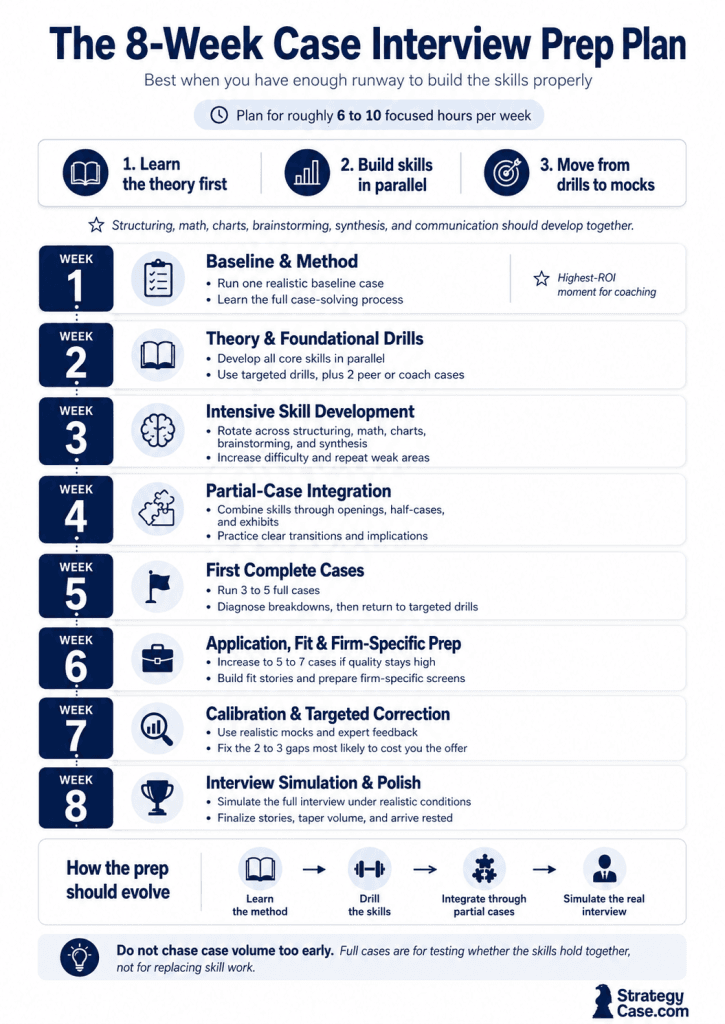
This is the best option when you have enough runway to build the skills properly. Plan for roughly 6 to 10 focused hours per week.
The core case skills should not be separated into isolated weekly blocks. Structuring, math, chart interpretation, brainstorming, synthesis, and communication need to develop in parallel because they constantly interact during a real interview. The right sequence is to first learn the theory and process behind each skill, then drill all of them individually, combine them in partial cases, and only then increase the volume of complete cases.
| Week | Focus | What to do |
|---|---|---|
| 1 | Baseline and method | Complete one realistic baseline case to identify your current strengths and weaknesses. If you want to use a coach, this is the highest-ROI moment of your whole prep. Then learn the full case-solving process before doing further cases: clarifying the objective, asking relevant questions, developing an initial hypothesis, structuring the problem, prioritizing the analysis, interpreting data, performing calculations, brainstorming, synthesizing findings, and giving a recommendation. Study what strong performance looks like at each stage and how interviewers evaluate it. |
| 2 | Theory and foundational drills | Begin developing all core skills in parallel. Learn how to build structures from first principles, set up calculations before solving them, interpret charts systematically, generate ideas through clear categories, and synthesize findings into a concise message. Spend most of the week on targeted drills rather than full cases. Every drill should include the right approach, the thinking process, and the communication required to present it. Run two cases with peers or a coach. |
| 3 | Intensive skill development | Continue rotating through structuring, math, chart interpretation, brainstorming, synthesis, and recommendation drills. Increase the difficulty and variety of the prompts. Practice unfamiliar case types so you learn to construct answers rather than retrieve memorized frameworks. Track recurring mistakes, repeat weak drills, and work on the same skill until both the reasoning and delivery are reliable. Run two cases with peers or a coach. |
| 4 | Skill integration through partial cases | Start combining the individual skills in case openings, half-cases, exhibit sequences, and short analytical modules. Practice moving from the objective to the structure, from the structure to the analysis, and from the analysis to a clear implication. Continue isolated drills alongside these exercises so weaknesses can be corrected and spikes built without spending an entire hour on a full case. Run two cases with peers or a coach. |
| 5 | First complete cases | Complete approximately three to five full cases during the week. The objective is not to accumulate volume but to test whether the skills hold together across an entire interview. After each case, diagnose the specific breakdowns and return to targeted drills before attempting the next case. Keep practicing all core skills in parallel rather than assuming that full cases alone will improve them. |
| 6 | Application, fit and firm-specific preparation | Increase to roughly five to seven complete cases if the quality remains high. Continue targeted drills between cases based on your feedback. Begin or intensify fit interview preparation by selecting strong stories, structuring them clearly, and making your actions, interpersonal decisions, and impact concrete. Prepare for any firm-specific assessment as a separate workstream based on its actual deadline. |
| 7 | Calibration and targeted correction | Complete realistic mocks with strong partners and, ideally, at least one expert who understands the real evaluation criteria to finetune your performance. Use a consistent rubric to identify the two or three weaknesses most likely to prevent an offer. Spend more time correcting those weaknesses through focused drills than simply adding more full cases. Use complete mocks to test whether the corrections remain visible under pressure. |
| 8 | Interview simulation and polish | Simulate the complete interview experience, including fit, case, note-taking, time pressure, difficult follow-up questions, and the final recommendation. Practice recovering after mistakes and adapting when the interviewer changes direction. Finalize your stories and firm-specific preparation. Reduce the workload during the final days so you arrive sharp, confident, and rested. |
The 4-week case interview prep plan
Four weeks is enough for serious preparation, but the schedule needs to be disciplined. Plan for roughly 12 to 20 focused hours per week and prioritize deliberate practice over case volume.
The core case skills should still develop in parallel. Structuring, math, chart interpretation, brainstorming, synthesis, and communication interact throughout every case, so separating them into different weeks is inefficient. The compressed sequence is to learn the theory first, drill each skill individually, integrate them through partial cases, and then increase the number of complete mocks.
| Week | Focus | What to do |
|---|---|---|
| 1 | Baseline, theory, and foundational drills | Complete one realistic baseline case to identify your current strengths, weaknesses, and recurring habits. If you plan to use a coach, this is the highest-ROI moment because the feedback can shape the entire four-week plan. Then learn the full case-solving process before increasing case volume: clarifying the objective, asking relevant questions, forming an initial hypothesis, structuring from first principles, prioritizing the analysis, setting up calculations, interpreting exhibits, brainstorming, synthesizing findings, and delivering a recommendation. Begin drilling all core skills in parallel. Every drill should cover the right approach, the underlying thinking process, and the communication required to present it. Complete approximately three cases with peers or a coach, primarily as diagnostic exercises. |
| 2 | Intensive skill development and partial cases | Rotate systematically through structuring, math, chart interpretation, brainstorming, synthesis, and recommendation drills. Increase the difficulty and variety of the prompts, including unfamiliar and unconventional problems that cannot be solved with memorized frameworks. Start combining skills through case openings, half-cases, exhibit sequences, and short analytical modules. Practice the transitions between stages, such as moving from the client objective to a tailored structure, from an exhibit to a business implication, and from several findings to a clear interim synthesis. Track recurring mistakes and repeat weak drills until the reasoning and delivery become reliable. Complete approximately five to seven cases, returning to targeted drills after each one. |
| 3 | Full-case integration, fit, and firm-specific preparation | Shift more time toward complete cases while continuing targeted drills between them. Complete roughly five to eight full cases, depending on how much time you need to review and correct each performance. The objective is not to maximize volume but to test whether your individual skills remain strong across a complete interview. After every case, identify exactly what broke down, determine why it happened, and complete focused exercises before doing the next case. Prepare your fit stories in parallel by selecting strong examples, structuring them clearly, and making your personal actions, interpersonal decisions, challenges, and impact concrete. Prepare for any firm-specific assessment as a separate workstream based on its actual deadline. |
| 4 | Calibration, realistic simulation, and polish | Complete realistic mock interviews with strong partners and, ideally, at least one expert who understands the actual evaluation criteria. Use a consistent rubric to identify the two or three weaknesses most likely to prevent an offer. Spend more time correcting those weaknesses through focused drills than simply adding more cases. Simulate the complete interview experience, including fit, case, note-taking, time pressure, difficult follow-up questions, interviewer interruptions, and the final recommendation. Practice recovering calmly after mistakes and adapting when the case changes direction. Finalize your fit stories and firm-specific preparation, then reduce the workload during the final days so you arrive sharp rather than exhausted. |
The 2-week crash case interview prep plan
Two weeks is the realistic minimum for focused case interview preparation. Plan for roughly 20-30 concentrated hours per week, with more time required if you are starting from scratch.
A crash plan does not mean doing as many full cases as possible. You still need to learn the theory and process first, develop structuring, math, chart interpretation, brainstorming, synthesis, and communication in parallel, and then test those skills in complete interviews. The difference is that learning, drilling, integration, and live practice must happen within the same week.
| Week | Focus | What to do |
|---|---|---|
| 1 | Baseline, method, and intensive skill development | Begin with one realistic baseline case to identify the weaknesses most likely to prevent an offer. If you plan to use a coach, do it at the start so the feedback shapes the limited preparation time you have left. Then learn the complete case-solving process: clarifying the objective, asking relevant questions, forming an initial hypothesis, structuring from first principles, prioritizing the analysis, setting up calculations, interpreting exhibits, brainstorming, synthesizing findings, and delivering a recommendation. Drill all core skills in parallel rather than assigning separate days to individual skills. Use case openings, individual exhibits, math problems, brainstorming prompts, and short synthesis exercises to create more repetitions than complete cases would allow. Toward the second half of the week, begin combining the skills and complete approximately eight full cases with peers or a coach. Review every case in detail and return immediately to drills for the areas that broke down. Begin fit preparation and any firm-specific assessment work in parallel from the first few days. |
| 2 | Full-case integration, correction, and interview simulation | Shift more time toward realistic full cases while continuing targeted drills between them. Complete approximately ten cases, depending on how much review and correction each one requires. Do not chase the number. Every case should test a specific improvement identified in the previous session. Use a consistent rubric to track structuring, analysis, business judgment, synthesis, and communication rather than relying on general feedback such as “do more cases.” Complete at least one mock with an expert or highly experienced partner who can calibrate you against the actual interview bar. Finalize your fit stories by making the situation, your personal actions, the interpersonal dynamics, and the impact concrete. During the final days, simulate the complete interview under realistic conditions, including fit, case, note-taking, time pressure, interruptions, difficult follow-up questions, and the final recommendation. Reduce the workload immediately before the interview so you arrive sharp rather than mentally exhausted. |
If two weeks feels impossible to manage on your own, this is exactly where a few coaching sessions can earn their cost. With so little time, the biggest risk is not a lack of effort but spending your scarce hours on the wrong things.
I once ran five sessions with a candidate in three days: four cases and one PEI session. The candidate ultimately received the McKinsey offer. That intensity only worked because every session diagnosed the next highest-impact gap, and the work between sessions focused narrowly on fixing it. There was no time for random practice or low-value repetition.
In any case, if you have the option, I would always recommend postponing the interview in this situation.
How to adapt the plan to your situation
The schedules above are the default. Adjust for these common cases:
- Targeting McKinsey: Add dedicated time for the Solve assessment and the Personal Experience Interview. Both are graded and both sink strong casers who ignore them.
- Targeting BCG or Bain: Build in their screens, the BCG cognitive test and Bain’s SOVA, alongside the live case.
- You are an experienced hire: Don’t underestimate the time it takes to adapt to the specific case interview format. Your expertise and background are not enough to stand out. Your gap is usually format, not intellect or knowledge.
- You come from a non-business background: Add a week of business fundamentals up front so case terms and basic economics are second nature.
- You are re-applying after a rejection: Do not just redo volume. Start by diagnosing what went wrong, then rebuild that specific weakness first.
Where most prep plans quietly fail
The plan itself is not the hard part. The hard part is following the right sequence, practicing deliberately, and getting honest feedback before the interview.
Three failure points show up again and again.
The first is moving into full cases too early because they feel more like “real” preparation. In practice, this often means repeating the same weak habits for an hour at a time. Learn the method first, drill the individual skills in parallel, and only then use complete cases to test whether they hold together.
The second is optimizing for speed before the underlying skill is there. A strong structure may initially take five minutes to build because you are consciously applying the right thinking techniques and principles. That is fine. Rushing the process before you understand it teaches you to produce weak answers faster. Speed is a byproduct of skill, not the other way around. Take more time during early drills, focus on getting the reasoning right, and let repetition make you faster naturally.
The third is reaching interview week without ever receiving qualified feedback on what you are actually doing wrong. You can study structuring, math, and chart interpretation on your own, but you cannot easily identify your own blind spots or calibrate yourself against the real interview bar.
That is the gap worth paying to close. Whether it is one expert session or a broader coaching package, include at least one honest outside assessment early enough that you still have time to act on the feedback.
Frequently asked questions
How long does it take to prepare for a case interview?
Most successful candidates prepare for 4 to 8 weeks. Two weeks is the realistic minimum for a focused crash plan, and experienced hires often underestimate the work. Quality of content and feedback matters more than raw hours.
Can I prepare for a case interview in 2 weeks?
Yes, two weeks can be enough, but it is the realistic minimum and requires a highly focused plan. Learn the method first, drill the core skills in parallel, and use full cases to test specific improvements rather than chase volume. Get qualified feedback early so you spend your limited time fixing the gaps that matter most.
How many practice cases do I need?
There is no magic number, and chasing one is the trap. Twenty full cases with real feedback prepares most candidates better than sixty low-quality ones. Once your skills are solid, focus on quality of reps, not the count.
What should I do in the last week before a case interview?
Shift from learning to performing. Do live mocks under realistic conditions, get expert feedback on your specific gaps, lock in your fit interview stories, and prepare your firm’s assessment. Rest the day before rather than cramming.
Do I need a study partner or a coach to prepare?
A partner helps with reps and nerves, and a coach gives you the expert feedback peers cannot. You can build skills and structure on your own, but the fastest gains usually come from one honest outside read of where you are losing points.
Related guides
- The complete case interview guide: the full method your plan is built on
- Best case interview prep courses, ranked: the tools that fit into a plan, honestly compared
- The complete fit interview guide: prepare the behavioral stories your plan includes
The bottom line
A case interview prep plan works when it builds skills before case volume and reserves the final week for live mocks and honest feedback. Pick the 2-week, 4-week, or 8-week schedule that matches your runway, then adapt it to your target firm and your starting point.
If you would rather follow the plan-in-a-box than assemble it yourself, the Case Interview Academy is the structured version of these schedules, with the drills built in. And when you want a former McKinsey consultant to pressure-test you before the real thing, book a coaching session.
About the author: Florian Smeritschnig is a former McKinsey Senior Consultant and the founder of StrategyCase. He spent five years at the firm and has since run more than 2,200 mock case interviews and coached hundreds of candidates into McKinsey, BCG, Bain, and other top firms.
