
Last Updated on June 29, 2026
Updated June 2026 · By Florian Smeritschnig, Former McKinsey Senior Consultant
The Accenture Digital Assessment is an online screening test that graduate and entry-level consulting candidates complete through Accenture’s Discovery Portal after the application stage. It has two timed sections, a Situational Judgment Test and a Numerical Reasoning Test, runs about 60 to 90 minutes, and acts as the first real filter before you reach any interview. To get through it, you need to match Accenture’s behavioral profile on the situational section and hit roughly 60% accuracy under time pressure on the numerical section.
I spent 5 years at McKinsey evaluating candidates, and I have since coached hundreds of applicants through consulting recruiting, including people working through Accenture’s process. The assessment itself is not hard in the way candidates fear. The problem is that most people prepare for the wrong thing: they treat the situational test like a quiz with right answers and the numerical test like a math exam. Both assumptions cost offers. Here is what these screens actually filter for, and how to clear them.
Key Takeaways
- The Accenture Digital Assessment is a real, current screen (2026): an online test delivered through Accenture’s Discovery Portal for graduate and entry-level consulting hires.
- Two sections: a Situational Judgment Test (behavioral fit) and a Numerical Reasoning Test (data and speed), together taking about 60 to 90 minutes.
- It is not scored like a knowledge test. The SJT compares your answers to the profile of a successful Accenture consultant; the numerical section is scored on accuracy, with candidates reporting you need around 60% or higher to pass.
- Accenture publishes no official specs for it. Every number here is candidate-reported and consistent across sources, not an official Accenture figure.
- Two different tests share similar names. The consulting/management track uses the Discovery Portal assessment described here. The technology and software-engineer track uses a separate coding and cognitive assessment (often on HackerRank). Prepare for the right one.
- Pass it and you progress to a recorded digital interview and, usually, an assessment centre with a case interview and behavioral interviews.
What Is the Accenture Digital Assessment?
The Accenture Digital Assessment is an online test that graduate and entry-level candidates complete through Accenture’s Discovery Portal after the application stage. It combines a Situational Judgment Test and a Numerical Reasoning Test, takes about 60 to 90 minutes, and screens candidates before they reach the interview rounds.
Accenture uses the assessment as an early, scalable filter. You typically receive the invite after your application clears the initial screen, often within 3 to 5 weeks of applying, and you complete it remotely in one sitting. The Discovery Portal presents the test as an immersive experience built from short videos, animation, and on-screen data rather than a plain list of questions, so it feels closer to a simulated work scenario than a classic aptitude test.
Here is the format candidates consistently report:
| Feature | What candidates report |
|---|---|
| Platform | Accenture Discovery Portal (online, completed remotely) |
| Sections | Situational Judgment Test, then Numerical Reasoning Test |
| Length | About 60 to 90 minutes total |
| Timing in process | After application screening, often 3 to 5 weeks after you apply |
| Who takes it | Graduate and entry-level consulting and management hires |
| SJT scoring | Responses compared to the behavioral profile of a successful Accenture consultant |
| Numerical scoring | Based on accuracy; candidates report needing roughly 60% or higher |
| Next step if you pass | Recorded digital interview, then an assessment centre |
One honest caveat that most guides skip: Accenture does not publish the format, timing, or pass marks for this assessment. Its official careers material describes a separate, HackerRank-based technical assessment for technology roles and frames assessments as one input that does not replace human interviews.
Everything specific about the Discovery Portal test, the 60 to 90 minute window, and the 60% numerical threshold comes from candidates who have sat it. The figures are consistent across enough independent reports to be reliable, but treat them as well-corroborated estimates, not Accenture policy.
Consulting track vs technology track: prepare for the right test
This is the single most common mix-up, and it matters. Two different assessments travel under similar “Accenture assessment” names:
- Consulting and management track. This is the Discovery Portal assessment described in this guide: Situational Judgment plus Numerical Reasoning, built around a simulated client engagement. If you applied to Accenture Strategy, Accenture Consulting, or a graduate consulting program, this is your test.
- Technology and software-engineering track. Candidates for coding-heavy roles (especially large campus hiring rounds in markets like India) usually face a different battery: cognitive, technical, coding (often on HackerRank), and communication assessments. The numbers and structure are not the same.
Before you prepare, confirm which track your role sits in from your invitation email. Preparing for coding rounds when you are about to take a situational and numerical test, or the reverse, is wasted effort.
What about the old Accenture VR assessment?
For a few years, Accenture experimented with an immersive virtual reality assessment that put candidates into simulated workplace situations. It generated a lot of press, but it was always limited to specific programs and regions, and it is not part of the standard graduate funnel today. If you read older guides referencing a VR headset stage, treat it as history. The current first filter is the Discovery Portal assessment, completed on a normal screen.
The Situational Judgment Test: What Accenture Is Really Scoring
The Situational Judgment Test (SJT) drops you into realistic work scenarios. You read an email, watch a short video of a client or colleague, review a chart, or sit in on a simulated call, and then choose how you would respond from a set of options. There are no dramatic trick questions. The situations are deliberately ordinary: a deadline slips, a teammate goes quiet, a client pushes back, the data does not match the brief.
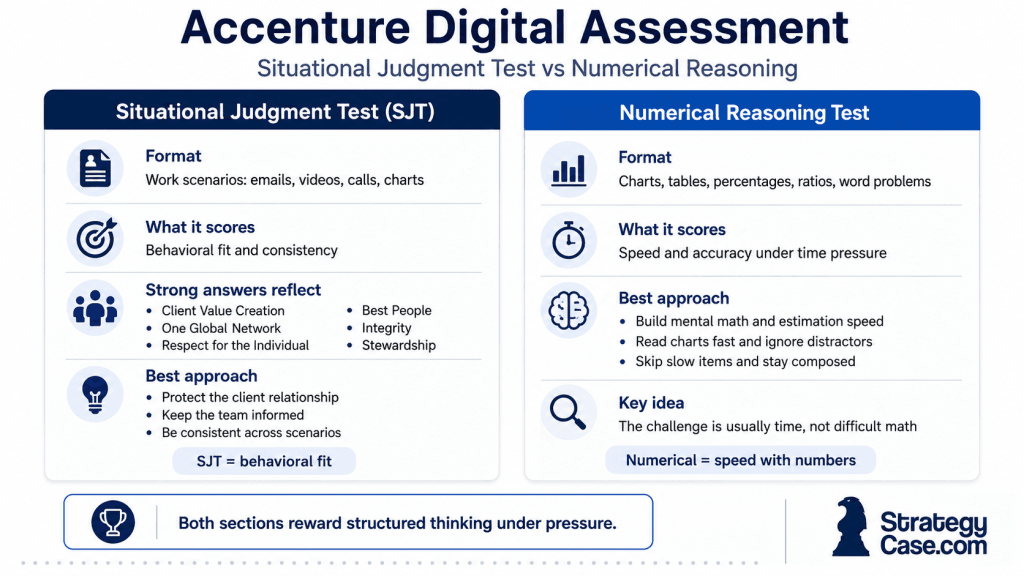
Here is the part candidates miss. The SJT is not scored on whether you picked the “correct” answer. It is a behavioral fit screen. Your responses are compared against the profile of someone who already succeeds at Accenture, and the strongest answers map to Accenture’s six published core values:
- Client Value Creation
- One Global Network
- Respect for the Individual
- Best People
- Integrity
- Stewardship
You can read the official definitions in Accenture’s Code of Business Ethics. In practice, the high-scoring response is usually the one that protects the client relationship, keeps the team informed, acts with integrity even when it is inconvenient, and balances short-term pressure against long-term ownership.
I observed the same with candidates at McKinsey; the same pattern held across every behavioral screen I saw: the people who scored well were not the ones who guessed the “right” answer, they were the ones whose answers were internally consistent. That is the trap in the SJT.
If you answer each scenario in isolation, trying to look impressive, you produce a contradictory profile: collaborative on question 3, a lone hero on question 9. Pick a coherent professional persona, anchored in those six values, and apply it consistently across every scenario. Consistency is the signal the model rewards.
The Numerical Reasoning Test: Speed Over Math
The Numerical Reasoning section gives you data, charts, tables, percentages, ratios, and short word problems, and asks you to reach the right answer quickly. None of it exceeds high-school level. There is no calculus, no advanced statistics, nothing you have not seen before.
So why do strong candidates fail it?
Time.
The section is scored on accuracy, and candidates report you need roughly 60% or higher to clear it, but the real pressure is the clock. You do not have the luxury of working slowly and carefully on every item. The test is filtering for people who stay accurate while moving fast, which is exactly what consulting work demands when a partner asks for a number in the room.
That reframes how you prepare. You are not relearning math. You are building three things:
- Mental and estimation speed. Percentages, ratios, fractions, and growth rates fast enough that you are not reaching for a calculator on the basics.
- Chart reading under pressure. Pulling the right figure from a bar chart, line graph, or table in seconds, and ignoring the distractor data the question includes on purpose.
- Composure. Knowing that you can skip a slow item, bank the easy points, and come back, rather than freezing on one hard question and bleeding time.
This is the same skill set the case interview tests later in the process, which is why building real numerical fluency now pays off twice. If you want structured reps, our case interview math drills train exactly this kind of fast, accurate calculation, and the approach behind the L.E.K. numerical reasoning test guide applies directly to Accenture’s section.
What Happens After You Pass the Digital Assessment
Clearing the Discovery Portal assessment moves you forward, it does not get you the job. Two stages typically follow.
The digital (video) interview
Most candidates next complete a recorded video interview. You answer behavioral and motivational questions to a camera, often on a timer, with no live interviewer. Expect the classics: why Accenture, why consulting, a time you worked in a team, a time you handled a setback. The same consistency principle from the SJT applies.
Your stories should reinforce the same professional persona and the same values. Our consulting fit interview guide gives you a repeatable structure for these answers so you are not improvising on camera.
The assessment centre
The final stage is usually an assessment centre, run virtually or in person, that combines several exercises:
- A case interview, where you work through a business problem with an interviewer
- One or more behavioral interviews built around Accenture’s values
- Sometimes a group exercise, a written case, or a short presentation
The case interview is where many candidates are caught off guard, because nothing earlier in the funnel tested it directly. If you have not practiced cases, start now. Our complete guide to consulting case interviews walks through the structure, math, and communication interviewers score, and the Fit Interview Masterclass covers the behavioral side end to end.
How to Prepare for the Accenture Digital Assessment
Most preparation advice for this test is busywork: grind hundreds of generic SJT and numerical questions and hope. That is the same volume-over-skill trap that traps case interview candidates, and it produces motion, not readiness. Here is the sequence I would give a candidate I was coaching.
- Confirm your track. Reread your invitation. Are you taking the consulting Discovery Portal assessment or the technology coding battery? Everything else depends on this.
- Internalize the six values, then build one persona. Do not memorize “correct” SJT answers. Decide who you are at work, grounded in Accenture’s six core values, and answer every scenario as that consistent person.
- Train numerical speed, not math. Drill percentages, ratios, growth, and chart reading until they are fast and automatic. Practice with a timer so speed under pressure becomes normal, not a shock on test day.
- Prepare the next stages in parallel. Have your behavioral stories and basic case structure ready before you sit the assessment, so a pass does not catch you flat-footed for the video interview and assessment centre a week later.
The candidates who clear Accenture’s funnel are the ones who understood what each stage was measuring and prepared for that specific signal. That is the entire StrategyCase philosophy: build the underlying skill, not a memorized template.
Accenture Digital Assessment: Frequently Asked Questions
Is the Accenture Digital Assessment hard?
Not in terms of difficulty of content. The situational scenarios are everyday work situations, and the numerical questions do not exceed high-school math. What makes it challenging is time pressure on the numerical section and the fact that the situational section quietly scores behavioral fit, not “correct” answers. Prepare for those two realities and it is very passable.
How long is the Accenture Digital Assessment?
Candidates report it takes about 60 to 90 minutes in total, covering both the Situational Judgment Test and the Numerical Reasoning Test in one sitting. Accenture does not publish an official time, so treat this as a well-corroborated range.
What score do I need to pass?
There is no published pass mark. The situational section is matched against the profile of a successful Accenture consultant rather than scored out of 100. For the numerical section, candidates consistently report needing roughly 60% accuracy or higher to advance.
Can I use a calculator?
Reports vary by role and region, and Accenture does not state a single rule. Prepare as if you cannot rely on one: build the mental-math and estimation speed to handle percentages, ratios, and chart reading quickly without it.
What is the Discovery Portal?
The Discovery Portal is Accenture’s online assessment environment. Instead of a plain question list, it presents the test through short videos, animation, and interactive data, framing the situational and numerical questions inside a simulated consulting scenario.
Is this the same test as the Accenture coding assessment?
No. The Discovery Portal assessment described here is for consulting and management roles. Technology and software-engineering candidates take a separate cognitive, coding, and communication assessment (often on HackerRank). Check your invitation to confirm which one applies to you.
What happens if I fail?
Policies vary, but most candidates who do not pass are typically asked to wait before reapplying, often around 6 to 12 months. Use the time to build genuine numerical fluency and behavioral consistency rather than reapplying immediately with the same preparation.
Related Guides
- Bain SOVA, Pymetrics, and HireVue assessments, the closest equivalent screen at an MBB firm
- Kearney Recruitment Test, a Tier-2 firm’s aptitude assessment, compared
- BCG Cognitive Test, how MBB screens the same numerical and logical skills
- Accenture Strategy Salary by Level, what the role pays once you are through the funnel
- McKinsey Solve assessment, how the same digital-screen logic works at McKinsey
Final Word
The Accenture Digital Assessment is real, current, and very beatable once you stop preparing for the wrong test. The Situational Judgment Test rewards a consistent professional profile built on Accenture’s six core values, not clever guesses. The Numerical Reasoning Test rewards speed and composure, not advanced math.
Clear both, and a video interview and assessment centre with a case interview follow, so the smart move is to build real interview skills now rather than treating the assessment as an isolated hurdle.
That is exactly where StrategyCase helps. If you want to walk into the case interview and assessment centre prepared rather than hoping, start with the complete StrategyCase case interview preparation program, or book 1-on-1 coaching with Florian to pressure-test your stories and your structuring before it counts. Prepare for the right signal, and Accenture’s funnel becomes a series of steps you control.
About the author: Florian Smeritschnig is a former McKinsey Senior Consultant and the founder of StrategyCase. He spent five years at McKinsey, where he evaluated candidates, and has coached more than 700 people into offers at McKinsey, BCG, Bain, and other top firms. Last updated June 25, 2026.
