
By Dr. Florian Smeritschnig, former McKinsey Senior Consultant. Updated October 30, 2026.
Anthropic’s move into consulting runs through two ventures. Ode with Anthropic, a US firm with about $1.5 billion in committed capital from Blackstone, Hellman & Friedman, and Goldman Sachs, launched in July 2026. A second consultancy, built with the London private equity firm Hg, was reported by the Financial Times on October 23 and is due to open in London and Berlin before the end of the year. Both put engineers inside client companies to build AI systems on Claude.
That is implementation work, and the distinction decides who should worry. My verdict: The Anthropic consulting push hits the AI implementation business of Accenture and the Big 4 hardest. It reaches McKinsey, BCG, and Bain mostly through their engineering arms. And it is the strongest evidence so far that AI creates consulting work rather than erasing it.
The question I hear most from candidates is some version of “is consulting still worth it if AI is about to gut the job?” This news sharpens it, because the company that builds the AI now wants the consulting fees too.
I’ve spent 12+ years in consulting, 5 of them at McKinsey, and I still work as a consultant and advisor. Below: what Anthropic actually launched, why an AI lab wants a services business, who is exposed, how the big firms are hedging, and what it changes about getting an offer.
Key Takeaways
- Anthropic has two consulting ventures: Ode with Anthropic in the US (about $1.5 billion committed, launched July 2026) and a reported European firm with Hg, due in London and Berlin by the end of 2026.
- Both sell implementation: small teams of engineers who build AI into a client’s most important process. Neither sells vendor-neutral strategy advice.
- The most exposed incumbents are the AI implementation practices at Accenture and the Big 4. Accenture’s shares fell more than 4% on the day the Hg report ran.
- McKinsey and Bain are hedging, not fighting. Both invested in OpenAI’s rival Deployment Company in May 2026, and McKinsey’s QuantumBlack engineers joined Anthropic’s Claude Frontier Academy.
- For candidates, the work the labs can’t sell is framing the problem and owning the call, which is what the case interview tests. Technical candidates also gain a new door: forward deployed engineering.
What Is Anthropic’s Consulting Business?
Anthropic consulting (definition): Anthropic doesn’t bill clients for advice itself. It backs separate firms that do: Ode with Anthropic in the US and a planned venture with Hg in Europe. Both embed engineers inside companies to design, build, and run AI systems on Claude. A third piece, a $100 million partner program, funds firms like Accenture and Deloitte to implement Claude.
Here is how the three pieces compare.
| Ode with Anthropic | Anthropic + Hg venture | Claude Partner Network | |
|---|---|---|---|
| Region | US | Europe (London, Berlin) | Global |
| Backers | Anthropic, Blackstone, Hellman & Friedman, Goldman Sachs, plus Apollo, General Atlantic, Leonard Green, GIC, and Sequoia | Anthropic (own balance sheet) and Hg (managed funds) | Anthropic |
| Status | Announced May 4, 2026; launched as Ode on July 15, 2026 | Reported by the FT on October 23, 2026; not confirmed by either firm | Launched March 12, 2026 |
| Money | About $1.5 billion committed | Undisclosed; reported target value above $10 billion within five years | Initial $100 million for 2026 |
| What it sells | Small teams of senior engineers who build AI into a client’s top priorities | AI consultants and engineers placed inside client companies | Training and support for partners who implement Claude |
| First clients | Private equity portfolio companies, plus large enterprises | Hg’s portfolio, B2B software firms, other white-collar businesses | The partners’ own enterprise clients |
Sources: the Blackstone announcement, Fortune’s report citing the Wall Street Journal on the $1.5 billion, and Anthropic’s partner network launch.
How Ode With Anthropic Works
Ode didn’t start from zero. Weeks after the May announcement, the venture bought Fractional AI, a San Francisco applied-AI firm founded in 2024, and made its team the operating core, SiliconANGLE reported. Bloomberg added that the deal ended Fractional’s 11-month partnership with OpenAI. In August, Ode bought a second consultancy, Casper Studios.
According to TechCrunch, Ode employs 100 engineers and works “Claude-first”: Anthropic’s models wherever possible, a rival’s where they fall short. Ode itself says over half its team are former founders. The target engagement is a CEO’s top one or two priorities, such as the company’s most important business process. The private equity backers refer their portfolio companies, but Ode sells beyond them.
The clearest look at a real engagement came on October 29. Circana, the market research company, announced it had hired Ode to modernize how it produces market intelligence. The scope: a governed platform to build and test AI agents, three starting workflows (data processing, trend forecasting, and product classification), checks against expert-verified cases, and uncertain work routed to Circana’s own specialists. Ode trains Circana’s engineers, and Circana’s operators own the goals.
Now read that scope the way a consultant would, and notice what isn’t in it. Which client segments should get the faster insights first? How should they be priced? What happens to the analysts whose work the agents take over?
The announcement doesn’t cover any of it. That gap is the line between what Anthropic sells and what a strategy firm sells.
The European Venture With Hg
The second venture is still a report, not an announcement. Per the FT, as relayed by City AM and Techzine, Anthropic and Hg plan an independent consultancy with offices in London and Berlin, opening by the end of 2026. Anthropic would fund its share from its own balance sheet, Hg through the funds it manages. First clients would come from Hg’s portfolio of software companies, plus other B2B software and white-collar firms.
The partners reportedly aim to build a business worth more than $10 billion within five years. It would be the first standalone consultancy Anthropic has backed in Europe. Neither company has commented, so treat the details as reported, not confirmed. The market took it seriously anyway: Accenture’s New York-listed shares were down more than 4% by that Friday afternoon.
Why Anthropic Wants Consulting Fees
The short answer is that the money in enterprise technology has always sat in services. Fortune’s reporting on the deal put it at six dollars of services spending for every dollar companies spend on software. Selling a model captures the one dollar. Selling the engineers who put it to work captures part of the six.
The second reason is a delivery bottleneck. In the May announcement, Anthropic’s CFO said enterprise demand for Claude was outrunning any single way of delivering it, and Blackstone’s Jon Gray named the shortage of engineers who can implement frontier AI as one of the biggest barriers to adoption. A model nobody can deploy is revenue left on the table.
The third reason is a race. OpenAI launched the OpenAI Deployment Company on May 11, a week after Anthropic’s announcement. It started with more than $4 billion, is majority-owned by OpenAI, and bought Tomoro, a 150-person applied AI firm, as its first acquisition, Consulting.us reported. TPG leads its investor group, with Advent, Bain Capital, and Brookfield as co-leads.
And there is pressure from the balance sheet. The FT links the European venture to Anthropic’s search for new revenue ahead of a planned IPO. None of this is new in enterprise software: City AM pointed out that ERP vendors built their own consulting practices in the 1990s for similar reasons.
My Take: The AI Labs Just Conceded the Model Isn’t Enough
The most telling line in the whole story came from Eddie Siegel, who co-founded Fractional AI and now helps lead Ode. He told TechCrunch that “model selection matters, but it’s not where the majority of calories are spent.” Coming from the leadership of an Anthropic venture, that is a remarkable admission.
It’s the argument I’ve made about consulting work for years. AI is strong at the pieces and weak at stitching them into an accountable whole. In Mercor’s 2026 APEX-Agents benchmark, the top models finished fewer than 25% of realistic consulting tasks correctly on the first try, which our breakdown of the Mercor findings covers in detail. If a frontier model could transform a company on its own, Anthropic’s venture wouldn’t have bought two consultancies in four months.
In July I wrote that the technology disrupting consulting is also creating a large new market for it, a point I unpacked in the future of consulting. Anthropic and its backers have now put about $1.5 billion behind that sentence.
It also fits a forecast I made in my consulting.de column in February 2025: AI would leave hiring at the leading firms stable at first, make the classic pyramid less relevant by 2027, and drastically cut junior hiring by 2030. The labs selling the build themselves is one way that forecast plays out. The production layer becomes a product, sold by the vendor.
The caveat matters. This doesn’t make every consulting job safe. It means the work is moving, and the build is moving toward engineers who sit next to the model.
Who Anthropic’s Consulting Push Actually Threatens
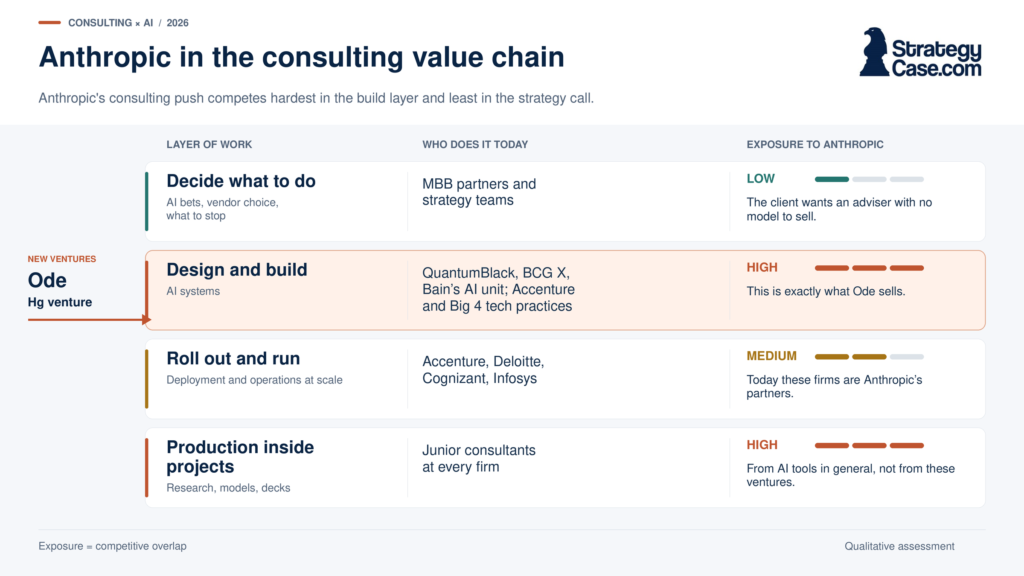
A consulting project has layers, and Anthropic’s ventures compete at some of them much harder than at others.
Most Exposed: AI Implementation at Accenture and the Big 4
The FT framed the Hg venture as a threat to the technology advisory businesses of Accenture and the Big 4, and the share price agreed for a day. The irony is that these firms are also Anthropic’s biggest partners. Deloitte opened Claude to more than 470,000 of its people in October 2025 and planned to certify 15,000 of them. Accenture is training 30,000 professionals on Claude as an anchor of the partner network.
Anthropic says Ode extends that network rather than replacing it. My read: they stay partners on the large rollouts and become competitors on the highest-value builds, the ones where a CEO would rather have the lab’s own engineers in the room.
Exposed Through Their Engineering Arms: McKinsey, BCG, and Bain
The growth at MBB increasingly sits in AI and technology. At BCG, AI-focused services made up 40% of 2025 revenue. Much of that work runs through build teams such as QuantumBlack, BCG X, and Bain’s AI unit, staffed with exactly the engineers and data scientists Ode recruits. When the vendor can send a team that works alongside its own research staff, “we know the models” stops being a selling point.
Least Exposed: the Strategy Call
A lab-backed consultancy is Claude-first by design. A CEO deciding whether to bet a core process on AI, which vendor to trust, and what to stop doing wants advice from someone with no model to sell. Ode can’t be an outsider to the question “should we use Claude?”
That independence is what consulting has always sold: a trusted outsider who frames the real problem and stands behind the call. Experts quoted by City AM, including Source Global Research’s Fiona Czerniawska, made the same point and questioned whether a vendor-built consultancy can give independent advice.
When I interview candidates for consulting roles, this is the capacity I am looking for: someone who can hold a recommendation when a client pushes back, and adjust it without losing the thread. No AI venture sells that. The protection only holds for consultants who actually deliver judgment, though. A junior whose value was mostly production is exposed either way.
The Big Firms Are Hedging, Not Fighting
The firms that look like the labs’ victims are also their partners, and in OpenAI’s case their shareholders.
| Firm | Verified ties to the AI labs’ services push |
|---|---|
| McKinsey | Investor in the OpenAI Deployment Company (May 2026). A cohort of QuantumBlack technologists joined the first residency of Anthropic’s Claude Frontier Academy |
| Bain & Company | Investor in the OpenAI Deployment Company, focused on private equity clients; OpenAI services alliance since 2023 |
| Accenture | Anchor partner of Anthropic’s Claude Partner Network, training 30,000 professionals on Claude |
| Deloitte | Claude available to 470,000+ people; 15,000 to be certified |
| Capgemini | Investor in the OpenAI Deployment Company |
The table lists ties covered in this article, not every relationship these firms have.
My read is that the bet shows where the firms expect their margin to sit: in judgment, and in orchestrating several AI vendors for one client, rather than in the build. There is a tension worth watching, too. Owning a stake in one lab’s deployment arm sits awkwardly next to selling vendor-neutral AI advice. If I were a client, that’s the first question I would ask.
What Anthropic’s Consulting Move Means for Your Consulting Career
Hiring hasn’t collapsed, and one venture launch won’t change this year’s recruiting season. The bigger picture, from the shrinking junior base to the AI-fluency filter, is in our pillar on AI’s impact on consulting careers and hiring. What Anthropic’s consulting push changes is where the value sits, and that depends on who you are.
If You’re Aiming for a Generalist Role at MBB
The labs are turning the build into a product. What’s left for the generalist consultant is framing the problem, forming a view with incomplete data, and defending the call. That is what the case interview tests, and it’s why memorized frameworks are the weakest preparation you can bring: matching a template to a case is the part a model does best.
The firms are already testing this with AI in the room. My MBA coaching clients in the US were among the first to go through McKinsey’s Lilli session, and McKinsey is now piloting an AI client avatar as well, as covered in our McKinsey AI interview guide.
At Bain, Partner-round instructions that candidates shared with me in October describe an immersive case where you get about 10 minutes with ChatGPT after you’ve committed to an answer. The full format is in our Bain AI interview guide. In both, the AI is a prop. Your judgment about its output is what gets scored.
Structuring is one of the skills the labs can’t sell, but not the only one. The StrategyCase Case Interview Academy drills case structuring, exhibit interpretation, and case math together, with thousands of practice drills and sample answers.
If You’re Technical: A New Door Has Opened
Engineers, data scientists, and PhDs now have a route that barely existed two years ago: forward deployed engineering at firms like Ode and OpenAI’s Deployment Company.
The bar is different from consulting. Ode describes over half its team as former founders, so it hires people who have shipped products. MBB’s own AI units are the comparison point, and they still put technical hires through a case interview, as our guide to AI consulting jobs explains door by door. Which route fits depends on what you want to get better at: building systems, or deciding what a business should do.
If You’re Applying in Europe
If the Hg venture launches on schedule, London and Berlin get the first Anthropic-backed consultancy in Europe. For candidates targeting those offices, treat it as a new employer to watch once it’s official and hiring, not one to plan your season around yet.
Anthropic Consulting: FAQs
Does Anthropic do consulting?
Not directly. Anthropic sells AI models and backs separate firms that do the consulting: Ode with Anthropic in the US, launched in July 2026, and a planned European consultancy with Hg, reported in October 2026. It also funds partners such as Accenture and Deloitte to implement Claude through its Claude Partner Network.
What is Ode with Anthropic?
Ode is an AI services firm backed by Anthropic, Blackstone, Hellman & Friedman, and Goldman Sachs, with about $1.5 billion committed. It places small teams of engineers inside companies to build AI systems, using Anthropic’s models first and rivals’ where needed. It launched under the Ode name on July 15, 2026.
What consultancy did Anthropic buy?
Anthropic’s US venture, Ode, bought two: Fractional AI, a San Francisco applied-AI firm, in May 2026, and Casper Studios in August 2026. Terms weren’t disclosed for either deal. Fractional’s team became Ode’s operating core.
Is Anthropic competing with McKinsey, BCG, and Bain?
Partly. Ode and the Hg venture compete with the firms’ AI engineering units, such as QuantumBlack and BCG X. They’re a weaker threat to strategy advice, because a firm backed by a model vendor can’t give vendor-neutral advice on which AI to bet on.
Will AI companies replace consulting firms?
Not on current evidence. The AI labs are building consulting arms because their models can’t transform a company on their own. The work shifts instead: build and deployment move toward engineers, while judgment and client trust stay with consultants. The full argument is in will AI replace consultants.
Should I still go into consulting if AI labs are launching consultancies?
Yes, if you prepare for the version of the job that’s growing. The labs make the build cheaper, which pushes the premium onto framing problems and owning decisions, the same skills firms test in the case interview. Technical candidates also gain a second route into client work: forward deployed engineering.
Related Guides
- The consulting job market: who is hiring, cutting, and freezing right now
- AI in consulting interviews: how AI moved into the recruiting process itself
- The junior consultant in the AI era: what happens to entry-level work and training
- AI consultant salary: what the four different “AI consultant” jobs actually pay
- Digital transformation case interview: how to crack a case about AI strategy
The Bottom Line
Anthropic’s consulting push is real, well funded, and aimed at the build: the engineering work of putting AI inside a company’s operations. That makes it bad news for the AI implementation practices at Accenture and the Big 4, a competitive problem for MBB’s engineering arms, and a much smaller threat to the strategy call, where a client wants an adviser with nothing to sell.
The strangest part is what the move admits. One of the leading AI labs backed a venture that bought two consultancies within four months, because the model alone doesn’t change a business. For anyone preparing for consulting interviews, that tells you which skills keep their price: finding the question the client should be asking, and standing behind your answer when they push back. Templates are the part AI already does.
Build those skills in the order interviews test them.
Start StrategyCase’s free Case Interview Foundations course → 40+ videos, 7+ hours of instruction, and 200+ pages of reading, at no cost.
About the author: Dr. Florian Smeritschnig is the founder of StrategyCase.com and a former McKinsey Senior Consultant who evaluated candidates for the firm. Since 2020 he has delivered 2,300+ mock interviews and coaching sessions, and his clients have secured 700+ consulting offers, 340 of them at McKinsey, BCG, and Bain. He is the author of three books on consulting interviews and careers, including The 1%: Conquer Your Consulting Case Interview.
