
By Florian Smeritschnig, former McKinsey Senior Consultant · Updated July 2026
A Bain consultant’s day runs on a case-team rhythm: a morning huddle to set priorities, a long midday block of modeling and slide work, client meetings in the afternoon, and an end-of-day synthesis before the team breaks. In a normal US week that adds up to roughly 55 to 65 hours, and it now includes a layer of AI tooling that did not exist three years ago.
Most offer holders ask about a day in the life of a Bain consultant get two answers : a firm careers page that reads like a brochure, or a Reddit thread from someone who left in 2019. Neither tells you how the week actually moves. This guide gives you the honest shape of the day, what changes as you get promoted, and the specific parts Bain’s own account leaves out.
Key Takeaways
- The Bain workday is built around the case team, not around your calendar. Your day is set by what the team needs for the next client update.
- Expect 55 to 65 hours in a normal week, with real spikes before major deliverables and genuinely quiet stretches after them.
- AI is now embedded in the daily workflow. Bain gives every employee ChatGPT Enterprise access and runs an in-house platform called Sage, and teams have built more than 19,000 custom GPTs.
- Bain’s own “day in the life” page omits hours, travel, compensation, review cycles, and AI entirely. That omission is the reason most candidates arrive with the wrong expectations.
- The day changes more between levels than between offices. An Associate Consultant builds the analysis; a Manager runs the client relationship.
What a Bain Consultant Actually Does All Day
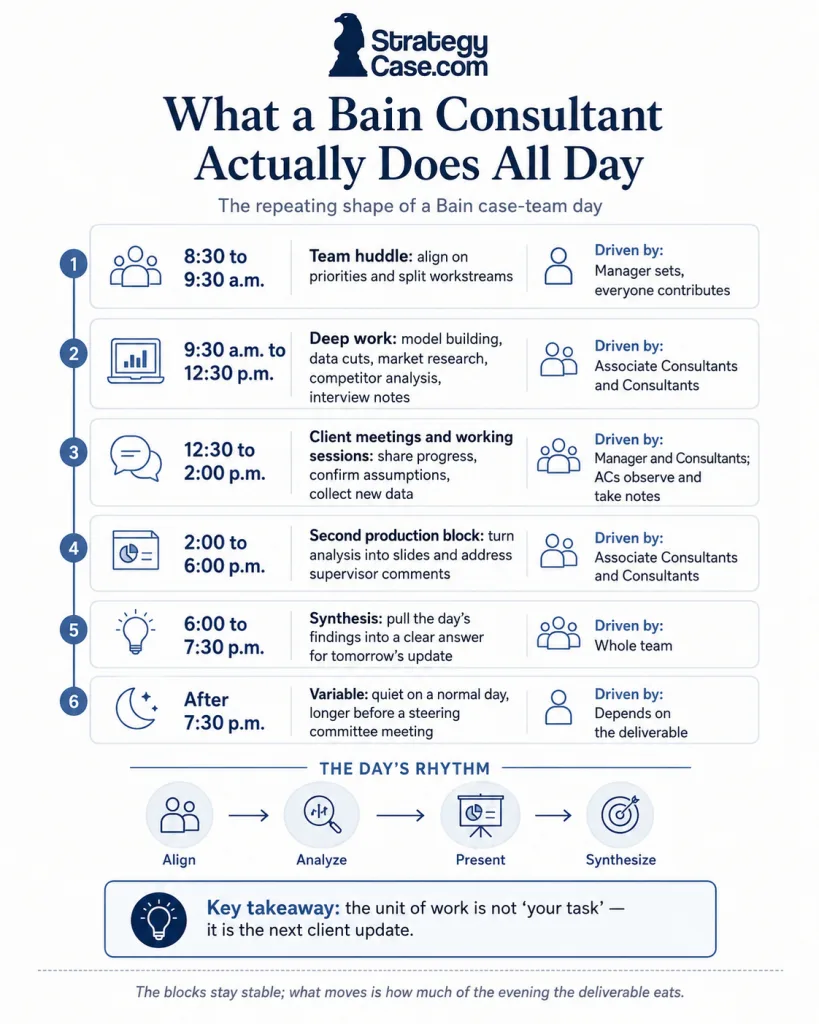
The day has a repeating shape. Bain describes it through its own consultants, and the structure is consistent across US offices: align in the morning, produce in the middle of the day, present in the afternoon, synthesize at the end.
Here is the pattern most case teams follow.
| Time block | What happens | Who drives it |
|---|---|---|
| 8:30 to 9:30 a.m. | Team huddle. The case team aligns on the day’s priorities and splits the workstreams. | Manager sets, everyone contributes |
| 9:30 a.m. to 12:30 p.m. | Deep work. Model building, data cuts, market research, competitor analysis, interview notes. | Associate Consultants and Consultants |
| 12:30 to 2:00 p.m. | Client meetings and working sessions. Share progress, confirm assumptions, collect new data. | Manager and Consultants, ACs observe and take notes |
| 2:00 to 6:00 p.m. | Second production block. Turn the morning’s analysis into slides, address comments. | Associate Consultants and Consultants |
| 6:00 to 7:30 p.m. | Synthesis. Pull the day’s findings into a clear answer for tomorrow’s update. | Whole team |
| After 7:30 p.m. | Variable. Quiet on a normal day, long before a steering committee meeting. | Depends on the deliverable |
In Bain’s own account, Associate Consultant Rachna Kumar from the Seattle office describes the same rhythm: a morning huddle to align on priorities, then a stretch of building analytical models and slide output, then presenting the work to partners and clients. She calls the client presentation the highlight of her day.
That matches what I saw across five years of MBB case teams. The unit of work is never “your task.” It is the next client update, and everything you do that day feeds it.
What Bain’s Own “Day in the Life” Page Leaves Out
Bain’s careers blog ranks first for this question, and it is worth reading. It is also a recruiting document, and it is silent on almost everything candidates actually weigh.
The published account covers team huddles, model building, data processing, and client presentations. It does not mention work hours, travel requirements, compensation, performance reviews, promotion timelines, stress, or AI tools. Not one of those appears.
That gap matters. Across 2,200+ mock interviews and coaching sessions at StrategyCase, the pattern I see in new joiners who struggle is rarely the difficulty of the work itself. They arrived expecting the brochure version of the week, so a normal Thursday crunch reads to them as a personal failure.
Here is what the brochure skips:
- The hours are real and uneven. A normal week lands around 55 to 65 hours. The average is not the experience. You will have 45-hour weeks after a deliverable ships and 75-hour weeks before a board presentation. Our breakdown of consulting work hours across McKinsey, BCG, and Bain has the firm-by-firm detail.
- Review cycles run about every six months. Feedback at Bain is frequent, direct, and written down. That is a genuine advantage for people who want to improve quickly, and it is uncomfortable for people who have never been told plainly that their slide logic does not hold.
- You do not choose your case. Staffing decides, and staffing balances client need against your development. How that process works is covered in our guide to how consulting projects are staffed.
- Compensation is not part of the day-to-day conversation. It is set by level and reviewed annually. Current US figures by level sit in our Bain salary and hierarchy data.
None of this is a knock on Bain. Every firm’s careers page reads this way. But a candidate deciding where to spend the next four years deserves the second half of the picture.
How AI Changed the Bain Workday in 2026
This is the part of the job that looks least like it did in 2023, and it is the biggest single change to the daily routine.
By Bain’s own description, the firm gives every employee access to ChatGPT Enterprise through its OpenAI partnership, regardless of tenure or technical background. It also runs an in-house platform called Sage, built on ChatGPT, which consultants use to surface prior case insights, summarize research, and find internal experts. Sage is integrated with Microsoft Copilot and the daily workflow tools rather than sitting off to the side.
The scale of internal building is the striking part. Bain teams have created more than 19,000 custom GPTs for specific client problems. The firm’s own example: a consultant named Kunal built a GPT that analyzes retail shelf images, cutting out manual review work.
In May 2026, Bain invested in the OpenAI Deployment Company, a venture OpenAI launched with 19 global partners, extending a partnership that already spanned three years of joint client work.
What this means for your day is concrete. Research synthesis that used to take an afternoon takes an hour. First-draft data cuts arrive faster. The work that remains is the work AI cannot do for you: deciding which question matters, judging whether the number is believable, and defending the recommendation to a client who disagrees.
That shift raises the bar on entry-level hires rather than lowering it. If the grunt work compresses, what you are evaluated on is judgment, and judgment shows up much earlier in your tenure than it used to. We cover the hiring consequences in our analysis of AI’s impact on consulting careers and hiring.
Where You Actually Work: Bain’s US Office and Travel Model
Bain does not publish a fixed number of days in the office. Its stated approach is situational: “We work in or out of the office as suits the situation, the team, your growth, and the client.”
Two things about that are worth understanding before you accept an offer.
First, Bain runs a home office model of bigger, fewer hubs rather than spreading people thin across many small locations. You are anchored to a home office where your mentors and peer group sit. In the US that concentrates people in offices like Boston, New York, Chicago, San Francisco, Atlanta, and Dallas.
Second, travel is client-driven, not policy-driven. Post-pandemic, most MBB teams settled into two to three days on site per week or alternating travel weeks, and your specific load depends far more on your case than on any firm rule. A retail operations case with a client in Arkansas looks nothing like a private equity due diligence run out of your home office.
The practical read: ask about the travel pattern of the specific team you are joining, not the firm. The firm-level answer is genuinely “it depends,” and that is not evasion.
The Day Changes More by Level Than by Office
A common mistake is picturing “a Bain day” as one thing. The rhythm holds, but your role inside it changes substantially at each level.
| Level | What your day is mostly about | What you get judged on |
|---|---|---|
| Associate Consultant | Building the analysis. Models, data cuts, research, slide production. | Accuracy, speed, and whether your work needs rework |
| Senior Associate Consultant | Owning a workstream end to end, with less supervision. | Independence and whether you spot the issue before your manager does |
| Consultant (post-MBA) | Structuring the problem and directing the analysis of others. | Problem structuring and the quality of your recommendation |
| Manager | Running the case team and the day-to-day client relationship. | Team output, client trust, and developing the people under you |
| Partner | Client relationships, selling work, and final answer ownership. | Revenue and the firm’s standing with the client |
The transition people underestimate is Consultant to Manager. You stop being rewarded for personally producing the best analysis and start being rewarded for a team producing it without you. Plenty of excellent analysts stall there. The up-or-out model explains what happens when they do.
One Bain-specific habit worth knowing on day one: the firm is unusually disciplined about leading with the answer. If you have not internalized Bain’s answer-first approach, your first few updates will get interrupted, and the interruption is the feedback.
The Honest Part: What Makes the Job Hard
Three things wear people down, and none of them is the workload in isolation.
Low control over your calendar. Your week is set by client deadlines and a staffing process you do not run. For people who need to plan their lives more than two weeks out, this is the real cost of the job, more than the hours themselves.
Constant evaluation. Every case ends in a written review. Feedback is frequent and specific by design, and that is genuinely how you improve fast. It also means you are never quite off the clock mentally in your first year.
The work is only sometimes glamorous. A meaningful share of any case is data cleaning, scheduling interviews, and formatting slides so the logic reads at a glance. The strategy is real, and it sits on top of a lot of unglamorous production.
What people consistently say makes it worth it: the people around you are excellent, the learning curve in year one is steeper than anywhere else they could have gone, and the exit opportunities after two to four years are among the strongest in any industry, particularly into private equity given Bain’s ties to that world.
Frequently Asked Questions: A Day in the Life of a Bain Consultant
What time do Bain consultants start and finish?
Most US case teams start with a huddle between 8:30 and 9:30 a.m. and wrap the core day between 6:00 and 7:30 p.m. Evening work depends on the deliverable calendar. The night before a client steering committee is long; the day after it is often short.
How many hours a week do Bain consultants really work?
Roughly 55 to 65 hours in a normal week for entry-level consultants in the US, with real variance by case. Bain is generally regarded as the most protective of the three MBB firms about weekends, but “protective” is relative in an industry where the client deadline sets the schedule.
Do Bain consultants travel every week?
Not usually, and much less than before 2020. Most teams now do two to three days on client site per week or alternate travel weeks. Bain states it travels “when it helps us drive the best results for clients,” so your load is set by your case rather than a firm-wide rule.
Is Bain using AI to replace entry-level consultants?
Not replacing, but reshaping. Bain has put ChatGPT Enterprise in every employee’s hands and built an internal platform called Sage, and teams have created 19,000+ custom GPTs. The routine research and first-draft analysis compress. What that does is move the evaluation bar toward judgment earlier in your career, which raises expectations of new joiners rather than removing them.
What does an Associate Consultant actually do versus a Consultant?
An Associate Consultant builds the analysis: models, data cuts, research, and slides. A post-MBA Consultant structures the problem and directs that analysis. The AC answers “what does the data say,” the Consultant answers “what should the client do.”
Is Bain a good place to start a career?
For people who want a steep learning curve, direct feedback, and broad exit options, yes. For people who need calendar control and predictable weeks, the tradeoff is real and worth thinking through honestly before you accept.
Related Guides
- The Big 3 consulting firms compared for how Bain differs from McKinsey and BCG
- Pros and cons of a consulting career for the honest tradeoff before you commit
- Consulting vs. investment banking for how the two lifestyles actually compare
- Bain TestGorilla assessment for the screen that comes before the case interview
- The comprehensive case interview guide for the skill that decides whether you get in
Before You Can Live the Day, You Have to Get the Offer
A Bain day is a case-team day. You align in the morning, produce through the middle of it, present in the afternoon, and synthesize before you leave. The hours are long but not uniformly brutal, the AI tooling has genuinely changed the work, and how much you enjoy it depends far more on your tolerance for low calendar control than on the workload itself.
Reading about the day in the life of a Bain consultant is the easy part. Getting to live it means clearing a case interview and an aptitude screen first, and Bain rejects the overwhelming majority of applicants who prepare by grinding practice cases without ever building the underlying skills.
If you are targeting Bain specifically, start with the StrategyCase Case Interview Academy to build the structuring and judgment the interview actually evaluates.
About the author: Florian Smeritschnig spent five years at McKinsey as a Senior Consultant, where he evaluated candidates, and has delivered 2,200+ mock interviews and coaching sessions since. His clients have secured 700+ offers at MBB, Tier-2 firms, Big 4 consulting divisions, in-house consultancies, and boutiques. He is the author of “The 1%: Conquer Your Consulting Case Interview.”