

Last Updated on July 21, 2026
Updated July 2026 · By Florian Smeritschnig, Former McKinsey Senior Consultant
A first-year Staff / Associate at EY Consulting in the US earns roughly $95,000 total compensation in 2026, climbing to $140,000 as a Consultant, $165,000 as a Senior Consultant, $200,000 as a Manager, $280,000 as a Senior Manager, and $450,000 to $1,000,000+ as a Partner. EY-Parthenon (the firm’s strategy practice, formed from the 2014 acquisition of Parthenon Group) pays a premium of 20 to 35% above core EY Consulting at every level. Below is the full EY hierarchy, salary by entry path, the EY-Parthenon premium breakdown, and how EY compensation compares to McKinsey, BCG, Bain, and the other Big 4 firms.
After 5 years at McKinsey, I have coached hundreds of candidates through Big 4 strategy recruiting, including dozens who landed offers at EY-Parthenon and core EY Consulting. The salary numbers below reflect what actually shows up in offer letters in 2025-2026, including the meaningful gap between EY-Parthenon (which competes with MBB) and core EY Consulting (which sits at the lower end of the Big 4 range).
Key Takeaways
- EY has 7 main career levels: Staff / Associate, Consultant, Senior Consultant, Manager, Senior Manager, Senior Manager-Director (SMD), Partner / Principal
- Staff / Associate (US, undergrad entry): ~$82K base + $13K target bonus = $95K total, plus $5-10K signing
- Senior Consultant (post-MBA or 3-4 years promoted): ~$145K base + $20K bonus + $25K signing = ~$190K Year 1, $165K base+bonus thereafter
- Manager: ~$170K base + $30K bonus = $200K total
- Senior Manager: ~$240K base + $40K bonus = $280K total
- Partner / Principal: $450K+ base, scaling past $1M+ with equity participation
- EY-Parthenon premium: 20-35% above core EY Consulting at every level; post-MBA Senior Consultants enter at ~$215K vs ~$165K core
- vs MBB: Core EY pays 15-20% below MBB at most levels; EY-Parthenon sits 5-10% below MBB and matches MBB at Manager+ levels
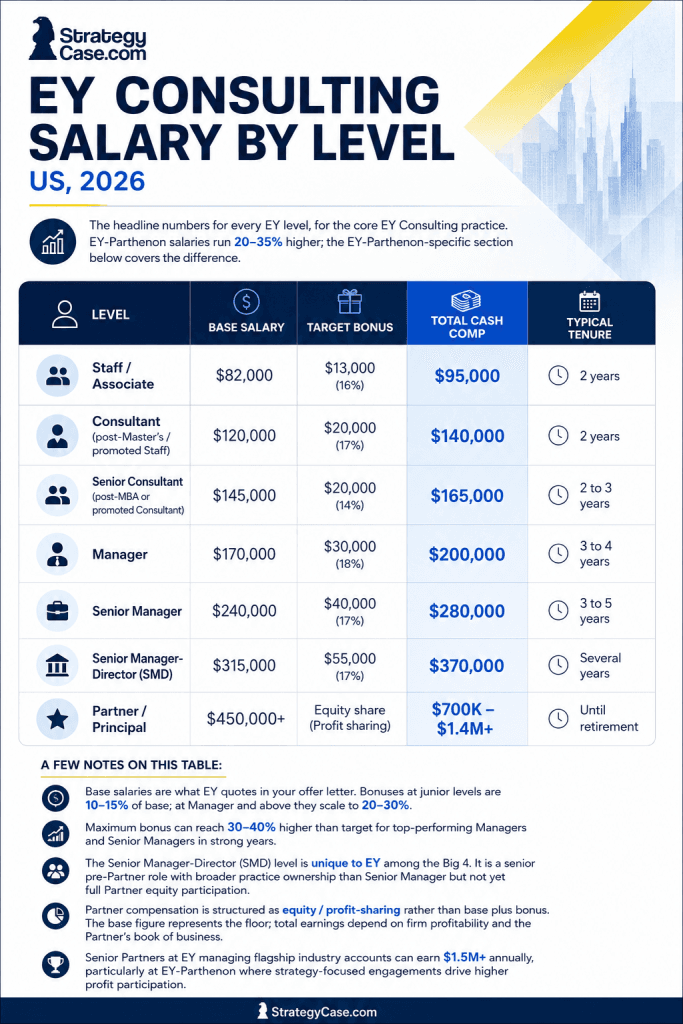
EY Consulting Salary by Level (US, 2026)
The headline numbers for every EY level, for the core EY Consulting practice. EY-Parthenon salaries run 20-35% higher; the EY-Parthenon-specific section below covers the difference.
| Level | Base Salary | Target Bonus | Total Cash Comp | Typical Tenure |
|---|---|---|---|---|
| Staff / Associate | $82,000 | $13,000 | $95,000 | 2 years |
| Consultant (post-Master’s / promoted Staff) | $120,000 | $20,000 | $140,000 | 2 years |
| Senior Consultant (post-MBA or promoted Consultant) | $145,000 | $20,000 | $165,000 | 2 to 3 years |
| Manager | $170,000 | $30,000 | $200,000 | 3 to 4 years |
| Senior Manager | $240,000 | $40,000 | $280,000 | 3 to 5 years |
| Senior Manager-Director (SMD) | $315,000 | $55,000 | $370,000 | Several years |
| Partner / Principal | $450,000+ | Equity share | $700K to $1.4M+ | Until retirement |
A few notes on this table:
- Base salaries are what EY quotes in your offer letter. Bonuses at junior levels are 10-15% of base; at Manager and above they scale to 20-30%.
- Maximum bonus can reach 30-40% higher than target for top-performing Managers and Senior Managers in strong years.
- The Senior Manager-Director (SMD) level is unique to EY among the Big 4. It is a senior pre-Partner role with broader practice ownership than Senior Manager but not yet full Partner equity participation.
- Partner compensation is structured as equity / profit-sharing rather than base plus bonus. The base figure represents the floor; total earnings depend on firm profitability and the Partner’s book of business.
- Senior Partners at EY managing flagship industry accounts can earn $1.5M+ annually, particularly at EY-Parthenon where strategy-focused engagements drive higher profit participation.
The figures above reflect typical US offices (New York, Chicago, San Francisco, Boston, Atlanta, Los Angeles, Houston, Washington DC, Dallas, Charlotte). Tier-2 US offices may pay 10-15% less.
EY-Parthenon vs Core EY Consulting
The single most important distinction inside EY Consulting: which practice you join determines your salary band.
EY-Parthenon is the firm’s dedicated strategy practice, formed from the 2014 acquisition of The Parthenon Group (originally founded by Bain alumni in 1991). It operates as a semi-autonomous strategy unit within EY and competes directly with McKinsey, BCG, and Bain on strategy engagements. EY-Parthenon pays at the top of the Big 4 range and is one of the three Big 4 strategy practices (alongside Monitor Deloitte and PwC’s Strategy&) that consistently compete with MBB for MBA-graduate talent.
Core EY Consulting is the broader practice, organized into three main service areas: Business Consulting (Business Transformation, Risk Consulting), Technology Consulting (Digital Engineering, ERP, Cybersecurity), and Strategy and Transactions (M&A advisory adjacent to EY-Parthenon strategy). Core EY Consulting pays at the lower end of the Big 4 range, slightly below Deloitte and PwC Advisory.
The EY-Parthenon premium at each level (approximate):
| Level | Core EY Base | EY-Parthenon Base | Premium |
|---|---|---|---|
| Staff / Associate | $82K | $115K (Senior Associate entry) | +40% |
| Consultant | $120K | $145K | +21% |
| Senior Consultant (post-MBA) | $145K | $195K | +34% |
| Manager | $170K | $225K | +32% |
| Senior Manager | $240K | $295K | +23% |
| SMD / Director | $315K | Integrated with Partner-track | varies |
| Partner | $450K+ | $500K+ | +11% |
Where the EY-Parthenon premium is largest: At the Senior Consultant (post-MBA entry) and Manager levels, EY-Parthenon Consultants and Managers earn 30-35% above their core EY counterparts. This is the strongest argument for targeting EY-Parthenon specifically rather than core EY Consulting.
Practical implication for candidates: If you have an MBB-quality profile and prefer EY for office, culture, or geographic reasons, target EY-Parthenon specifically. The conversion rate from EY-Parthenon offers to MBB lateral moves is also meaningfully higher than from core EY Consulting, since EY-Parthenon’s project portfolio is strategy-focused.
What’s Included Beyond Base and Bonus
The salary table above covers cash compensation. EY’s total package adds substantial value on top, especially for new hires.
Signing bonus: $5,000-10,000 for Staff / Associate hires, $25,000-30,000 for MBA Senior Consultant hires, sometimes higher for PhD or specialized hires.
Relocation allowance: $5,000-15,000 lump sum depending on office and distance. International relocations include temporary housing for 1-3 months.
Health benefits: Comprehensive medical, dental, and vision coverage. EY covers a significant portion of premiums, employee contribution is typically $50-150/month for individual coverage.
Retirement contribution: 401(k) with firm match plus pension-style “EY Pension Plan” contributions in some practices and tenure bands.
Training and EY Tech MBA: EY launched a fully-paid Tech MBA program through Hult International Business School in 2020, available to high-performing consultants. The program is fully online and covers tuition entirely while the consultant continues working.
Sabbatical: After approximately 7-10 years, consultants are typically eligible for a paid sabbatical of 1-3 months. EY’s sabbatical policies vary by practice and country.
Parental leave: 16 weeks of paid parental leave for primary caregivers, 8 weeks for non-primary caregivers. Among the strongest in Big 4.
Equity / profit-sharing (Partner-track only): SMDs, Partners, and Principals participate in firm equity. This is where total compensation diverges most dramatically from the base-plus-bonus model.
For a typical post-MBA Senior Consultant joining EY Consulting in 2026, the all-in first-year compensation including signing bonus is closer to $185,000-195,000 at core EY, or $235,000-250,000 at EY-Parthenon.
EY Hierarchy: Roles, Tenure, and Promotion Difficulty
EY operates a flatter, less aggressive “up-or-out” structure than MBB. Under-performers are managed out over 6-12 months with structured feedback, but EY has more room for specialists and consistent solid performers than MBB does.
Staff / Associate
Entry-level role for undergraduate hires. Some EY practices use “Staff” terminology (particularly Risk Consulting and Assurance-adjacent practices); others use “Associate” (more common in Business Consulting and Technology). Functionally identical level.
Promotion timeline: 2 years. Promotion difficulty: Low to moderate. The Staff-to-Consultant transition is predictable for performers who deliver consistently and meet utilization targets.
Consultant
Entry point for Master’s-degree hires without an MBA, and the next step for promoted Staff. Consultants own workstream pieces, manage Staff-level work, and start building client-meeting presence on smaller engagements.
Promotion timeline: 2 years. Promotion difficulty: Low to moderate. Performance differentiation begins mattering for promotion velocity.
Senior Consultant
Direct entry point for MBA, PhD, and JD hires (in core EY Consulting). Promoted Consultants also enter here. Senior Consultants own engagement workstreams, manage Consultants and Staff below, and serve as primary day-to-day client contacts on smaller engagements.
Promotion timeline: 2 to 3 years. Promotion difficulty: Moderate. Top performers are flagged for accelerated promotion to Manager.
Manager
Managers own engagements end-to-end. They organize workstreams, manage Senior Consultants and below, and serve as the primary client contact on most mid-size engagements. At this level, consultants specialize meaningfully in industries (financial services, healthcare, consumer products, public sector) or functional practices (operations, risk, technology, M&A advisory).
Promotion timeline: 3 to 4 years. Promotion difficulty: Moderate to high. The Manager-to-Senior-Manager step requires demonstrated business development capability, not just delivery excellence.
Senior Manager
Senior Managers lead larger engagements and account portfolios, manage Managers, and start owning client relationships independently. Business development becomes the primary evaluation criterion.
Promotion timeline: 3 to 5 years. Promotion difficulty: High. The Senior Manager-to-SMD step is where the EY pyramid narrows sharply.
Senior Manager-Director (SMD)
A distinct EY level that sits between Senior Manager and Partner. SMDs have broader practice ownership and significant business development responsibility but do not yet have full Partner equity. The role is sometimes a permanent senior-specialist track for consultants who deliver excellently but do not have the BD profile for Partner. For others, SMD is a 2-4 year waypoint before Partner promotion.
Promotion timeline: Variable (2-5 years). Promotion difficulty: Very high. Not all SMDs reach Partner.
Partner / Principal
The most senior level at EY Consulting. Partners are firm equity holders, own major client relationships, lead practices or industries, and shape firm strategy. EY’s Partner pool is approximately 12,000+ globally across all service lines (Assurance, Tax, Consulting, Strategy and Transactions).
EY Consulting Salary by Entry Path
EY hires through several distinct tracks. Your starting salary depends on which track you enter through.
Undergraduate / Recent Graduate
Enters as a Staff or Associate in core EY Consulting. Total cash comp: ~$95K. Most hires come from a broad school list, much broader than MBB’s target schools. EY has the widest recruiting footprint of any Big 4 firm in some practices (Risk Consulting, Technology Consulting).
Master’s Degree (No MBA)
Enters as a Consultant in core EY Consulting. Total cash comp: ~$140K. Common backgrounds: MA in Economics, MS in Data Science, MS in Information Systems, MEng.
MBA Hire (Direct from Business School)
Enters as a Senior Consultant in core EY Consulting (~$165K total) or a Senior Associate / Consultant at EY-Parthenon (~$215K total). Plus $25-30K signing bonus = ~$185-195K all-in Year 1 at core EY or ~$235-250K at EY-Parthenon. Sourced from a broader MBA list than MBB. EY-Parthenon specifically recruits from M7, Tuck, Darden, Ross, Stern, INSEAD, LBS, and IESE.
Direct EY-Parthenon Entry
EY-Parthenon runs a separate undergraduate recruiting track in some geographies (notably US, UK, Germany, India). These hires enter at a 35-40% premium to core EY Staff. The bar is significantly higher than core EY, EY-Parthenon undergraduate hires typically come from target schools with 3.7+ GPAs.
PhD / Advanced Degree
Enters as a Senior Consultant (same salary band as MBA hires at the respective practice). EY-Parthenon specifically hires PhDs into strategy and analytics roles. Core EY Consulting hires PhDs across cybersecurity, data analytics, AI / ML practices.
Experienced Hire (Lateral from Industry)
Variable entry level depending on prior experience. A consultant from MBB, Deloitte, PwC, or in-house corporate strategy with 5-7 years of experience may enter at the Manager, Senior Manager, or SMD level.
Lateral from MBB
A common pattern: 2-3 years at McKinsey, BCG, or Bain followed by a lateral to EY-Parthenon at the Manager or Senior Manager level. The lateral typically comes with a small salary lift over the equivalent MBB role plus better work-life balance.
EY vs MBB vs Other Big 4
Core EY Consulting sits at the lower end of the Big 4 consulting pay range, while EY-Parthenon competes more directly with MBB and Tier-2 strategy firms.
| Level | Core EY | EY-Parthenon | McKinsey | BCG | Bain | Monitor Deloitte | Strategy& |
|---|---|---|---|---|---|---|---|
| Staff / Associate / Analyst | $95K | $115K-$160K | $140K | $140K | $140K | n/a | $115K-$161K |
| Senior Consultant / Associate (post-MBA) | $165K | $215K | $245K | $242K | $230K | $240K | $156K-$249K |
| Manager / EM / PL | $200K | $295K | $290K | $280K | $290K | $275K | $204K-$320K |
| Senior Manager / AP | $280K | $385K | $420K | $410K | $360K | $385K | $270K-$400K |
| SMD / Director | $370K | Integrated | (n/a same role) | (n/a) | (n/a) | $450K+ | $240K-$350K+ |
| Partner | $700K-$1.4M | $800K-$1.6M+ | $700K-$1.5M+ | $700K-$1.5M+ | $650K-$1.4M+ | $800K-$1.6M | $390K-$728K+ |
For McKinsey-specific data, see the McKinsey hierarchy and salary breakdown. For BCG, see BCG hierarchy and salary. For Bain, see Bain hierarchy and salary. For Deloitte (including Monitor Deloitte), see Deloitte consulting salary. For PwC and Strategy&, see PwC consulting salary. For KPMG, see the KPMG compensation breakdown. For a full overview of Big 4 salaries, check our Big 4 salary guide.
For a general introduction to the Big 4, see our guide to the Big 4.
Why core EY pays below MBB and other Big 4: Three structural reasons. First, EY’s core consulting practice is positioned heavily in risk, regulatory, and transformation work, which carries lower margins than pure strategy work. Second, EY’s headcount across all service lines (Consulting, Assurance, Tax, Strategy and Transactions) is approximately 400,000+ globally, the largest of the Big 4. Per-consultant economics dilute somewhat in this scale. Third, EY’s project mix includes more long-term implementation and managed-services work, which is staffed at lower per-hour rates than short-cycle strategy projects.
Why EY-Parthenon competes with MBB: EY-Parthenon operates as a semi-autonomous strategy practice with its own talent pool, project selection, and compensation structure. The premium pricing comes from the strategy-specific project mix (CEO and board-level advisory, growth strategy, M&A diligence, operating model design) and the recruiting competition with MBB for the same MBA-graduate pool.
Where EY outperforms: Lateral moves into EY from MBB often come with title and salary bumps (MBB Engagement Manager → EY Senior Manager). EY’s strong Risk Consulting and Cybersecurity practices command premium rates and provide specialized career paths that are harder to enter through MBB.
EY Consulting Salary Outside the US
EY operates in 150+ countries. International offices pay in local currency, with significant regional variation.
London: EY UK is one of the highest-paying non-US offices. Staff / Associate base is approximately £35,000-45,000 with bonus bringing total to ~£40,000-52,000. Senior Consultant (post-MBA) base is approximately £65,000-80,000 with target bonus pushing total to ~£90,000-110,000. EY-Parthenon London pays approximately 25-30% above this range.
Continental Europe (Germany, France, Switzerland, Italy, Spain, Netherlands, Nordics): Roughly 50-65% of US salary in local currency equivalent. Switzerland-based offices pay closest to US levels. German offices include the standard 13th-month payment.
India: EY India is one of the largest non-US operations globally (GDS, Global Delivery Services, across multiple Indian cities plus traditional consulting offices in Mumbai, Delhi, Bengaluru, Gurgaon, Chennai, Hyderabad, Pune, Kolkata). Local salaries are paid in INR and typically run at 20-35% of US equivalent in dollar terms, though with significant local purchasing power.
Middle East (Dubai, Riyadh, Doha, Abu Dhabi): EY has invested heavily in Middle East consulting, particularly on Saudi Vision 2030 and UAE national transformation programs. Base salaries are typically 70-85% of US levels in USD equivalent, often with strong take-home advantages due to tax structures.
Asia-Pacific (Singapore, Hong Kong, Tokyo, Sydney, Melbourne, Shanghai, Seoul): Singapore and Hong Kong offices pay closer to US levels. EY’s Australia practice has historically been competitive on local-market terms.
Latin America (São Paulo, Mexico City, Bogotá, Buenos Aires): Roughly 35-50% of US salary in local currency equivalent.
International salaries are worth verifying directly with your recruiter, EY adjusts non-US compensation frequently.
How Fast Can You Reach Partner at EY?
The standard EY promotion track from Staff to Partner is approximately 14-18 years:
- Years 1-2: Staff / Associate
- Years 3-4: Consultant
- Years 5-7: Senior Consultant
- Years 8-10: Manager
- Years 11-13: Senior Manager
- Years 13-15: SMD
- Year 16+: Partner / Principal
Post-MBA hires (Senior Consultants) skip the first four years and reach Partner in approximately 11-14 years. EY-Parthenon hires often have a slightly accelerated path (10-12 years post-MBA) given the smaller practice and faster business development opportunities.
Roughly 3-7% of entering Staff reach Partner at EY. The pyramid narrows most sharply between Senior Manager and SMD, and again between SMD and Partner. Most consultants who “leave EY” are not failures; they are exiting at a point that maximizes their next career step.
For accelerated paths to Partner, the only reliable variables are:
- Consistent top-quartile performance reviews across your tenure
- Industry or functional specialization in high-demand areas (cybersecurity, AI, cloud, M&A advisory, ESG, financial services regulatory)
- Business development demonstrated early (sponsoring proposals, generating leads, building intellectual capital)
The biggest filter at EY is the transition from “great delivery” to “great business development” between Senior Manager and SMD.
What EY Consulting Is Actually Like Week to Week
Core EY Consulting runs roughly 45 to 55 hours in a normal week, with Monday-to-Thursday client travel as the historical default and Friday kept for internal work. EY-Parthenon runs hotter at 50 to 65. Both sit well below the 55 to 75+ that McKinsey, BCG, and Bain expect, and that gap is the single most common reason candidates take an EY offer over a Big 3 one.
The numbers above the fold tell you what EY pays. This section tells you what you do for it.
A Senior Consultant’s Week, In Their Own Words
A Senior Consultant in EY’s Strategy and Operations practice in Western Europe gave StrategyCase a full account of the job. It was recorded in 2020, so read the travel pattern as the pre-hybrid baseline rather than a current policy. The hours, the Friday rhythm, and the weekend protection have held up in what candidates who joined EY report back since.
| Dimension | What the job looked like |
|---|---|
| Travel | Monday to Thursday at the client site, Friday travel a rare exception. No travel when the client is in your home city. |
| Travel radius | Mostly within the region. Occasional international staffing to the UK, the US, and Turkey. |
| Weekly hours | “Very fair for consulting.” Peaks on some projects, calmer on others. |
| Friday | Home office. Out by 5 p.m. at the latest. |
| Weekend work | Off 99% of the time. One or two weekends a year in practice. |
| Day split | Client meetings, Excel and data work, slide building, plus ad hoc requests. |
| Friday split | Career conversations with your counselor and internal projects such as go-to-market work. |
| Project types | Restructuring and bottom-line improvement, carve-outs, integrations, PMO, operational due diligence, mid-market through large-ticket M&A. |
On hours, which is the question candidates actually ask:
“There are peaks and there are more relaxed projects, but in general, working hours are very fair for consulting, especially on Fridays regularly leaving around 5 p.m. latest. Weekends are off 99% of the time. Yes, I have worked weekends before, but on average once or twice a year.”
That is a materially different life from MBB, where weekend work can be a normal part of a hard sprint. If you want the cross-firm picture, our breakdown of how much consultants actually work sets EY against McKinsey, BCG, and Bain hour for hour.
What Has Changed Since That Account
Two things, and candidates weighing an EY offer in 2026 should price both in.
Travel is no longer automatic. The Monday-to-Thursday pattern above was the industry default before 2020. Client-site expectations came back unevenly after that, and they now vary by practice, by client, and by individual engagement rather than by firm policy. Ask your staffing question at the offer stage, not after you sign, and ask it about the specific practice you are joining rather than about EY as a whole.
The core EY and EY-Parthenon gap widened. The account above is core Strategy and Operations. EY-Parthenon carries an MBB-adjacent workload to go with its 20 to 35% pay premium. If you are comparing the hours in this section against an EY-Parthenon offer, add roughly 5 to 10 hours a week and expect less reliable Friday protection.
The Trade-Off That Is Not in the Offer Letter
The upside this consultant named first was scope, not money:
“At EY and especially in Strategy and Operations you really get lots of responsibility from the start and develop not only analytical and conceptual skills, but also are able to work directly with the client on a regular basis.”
The cost lands on your calendar rather than your weekends:
“It’s difficult to make plans during the week with traveling and/or peaks in work, so you are partly restricted to social life on weekends.”
That is the honest shape of the trade. EY gives you back your weekends and takes your weekdays. MBB takes more of both and pays 15 to 20% more for it. Neither is strictly better, and our guide to work-life balance in consulting is worth reading before you optimize purely on compensation.
Their advice to anyone joining was about sponsorship, and it matches what I saw drive outcomes at McKinsey:
“Look for someone in the company that trusts and supports you and you get along with well. Anything will be twice as joyful and half as stressful.”
Find that person in your first six months. At every firm I have worked with, the consultants who stall are rarely the weakest analysts. They are the ones nobody senior is actively invested in. On exits, this consultant was weighing startups and US corporates, which tracks with the standard Big 4 pattern covered in our guide to consulting exit opportunities.
Frequently Asked Questions
How much does an EY Staff / Associate make?
A first-year EY Staff or Associate in a US office earns approximately $95,000 in total cash compensation: $82,000 base salary plus a target bonus of $13,000. Including signing bonus and benefits, all-in Year 1 compensation is closer to $100,000-105,000.
What is the EY Senior Consultant salary?
A post-MBA EY Senior Consultant in 2026 earns approximately $145,000 base salary plus $20,000 target bonus = $165,000 total cash compensation at core EY Consulting. EY-Parthenon Senior Consultants earn approximately $215,000 total. With signing bonus ($25-30K), all-in Year 1 is approximately $185,000-195,000 at core EY or $235,000-250,000 at EY-Parthenon.
How much does an EY Manager earn?
An EY Consulting Manager earns approximately $170,000 base salary plus $30,000 target bonus = $200,000 total cash compensation. EY-Parthenon Managers earn approximately 30-35% more (~$295,000 total). Maximum bonus in strong years can push total comp toward $230,000-260,000 at core EY.
How much does an EY Senior Manager earn?
An EY Senior Manager earns approximately $240,000 base salary plus $40,000 target bonus = $280,000 total cash compensation. EY-Parthenon Senior Managers earn approximately $385,000 total.
How much does an EY Partner make?
EY Partners earn $450,000+ as base / floor compensation, with total annual earnings ranging from $700,000 to $1,400,000+ depending on firm performance and equity participation. EY-Parthenon Partners earn $800K-$1.6M+ at the floor, with top performers reaching $2M+. Senior Partners with major client books typically earn $1.5M to $3M+ per year.
Is EY-Parthenon salary higher than core EY Consulting?
Yes, significantly. EY-Parthenon pays 20-35% above core EY Consulting at every level, with the largest gap at Senior Consultant and Manager levels (30-35%). EY-Parthenon operates as a semi-autonomous strategy practice with its own salary structure designed to compete with MBB for MBA-graduate talent.
Is EY salary higher than Deloitte or PwC?
No. Core EY Consulting sits at the lower end of the Big 4 consulting pay range, slightly below Deloitte and PwC at most levels. EY-Parthenon, however, pays competitively with Monitor Deloitte and Strategy& at the Big 4 strategy practice tier. The Big 4 salary pecking order in 2026 is typically Monitor Deloitte ≈ Strategy& ≈ EY-Parthenon at the strategy tier, then Deloitte ≈ PwC > EY ≈ KPMG at the core consulting tier.
What is the Senior Manager-Director (SMD) level at EY?
SMD is a distinct EY level that sits between Senior Manager and Partner. SMDs have broader practice ownership and business development responsibility than Senior Managers but do not yet have full Partner equity participation. SMD is sometimes a permanent senior-specialist track and sometimes a 2-4 year waypoint before Partner. This intermediate level is unique to EY among the Big 4; other firms typically promote directly from Senior Manager / Director to Partner.
How long does it take to make Partner at EY?
The standard path from Staff to Partner at EY is approximately 12-15 years. Post-MBA Senior Consultants reach Partner in approximately 11-14 years. EY-Parthenon hires often reach Partner in 10-12 years post-MBA. Roughly 3-7% of entering Staff reach Partner.
How much does EY pay in London?
EY London Senior Consultants (post-MBA) earn approximately £65,000-80,000 base salary plus a target bonus of £12,000-22,000, with total cash compensation around £90,000-110,000. Staff / Associate (post-undergrad) total compensation is approximately £40,000-52,000. EY-Parthenon London pays approximately 25-30% above these figures.
What are the typical working hours at EY Consulting?
Core EY Consulting typically runs 45 to 55 hours per week, with Fridays usually finishing by 5 p.m. and weekend work limited to one or two weekends per year. EY-Parthenon runs higher at 50 to 65 hours per week. Both are meaningfully lighter than McKinsey, BCG, and Bain, which typically run 55 to 75+ hours during active engagements.
Do EY consultants travel every week?
Historically yes. The standard pattern was Monday to Thursday at the client site, with Friday worked from home or the local office, and no travel when the client was in your home city. Since 2020, client-site expectations vary by practice, client, and engagement rather than by firm policy, so confirm the travel expectation for your specific practice before accepting an offer.
What does an EY consultant actually do day to day?
A typical day mixes client meetings, Excel and data analysis, slide building, and ad hoc client requests. Project types in Strategy and Operations include restructuring and bottom-line improvement, carve-outs, integrations, PMO work, and operational due diligence across mid-market to large M&A deals. Fridays are typically reserved for internal projects and career conversations with your counselor.
Is work-life balance better at EY than at MBB?
Yes, on hours and weekends. Core EY protects weekends far more reliably than McKinsey, BCG, or Bain, and Friday afternoons are genuinely lighter. The trade is that MBB pays 15 to 20% more and offers stronger exits to private equity and Fortune 500 strategy roles. EY-Parthenon sits between the two on both dimensions.
The Bottom Line
EY Consulting offers two distinct compensation paths: core EY Consulting at the lower end of Big 4 levels, or EY-Parthenon at the top of the Big 4 strategy practice range. Which practice you join matters more than any other variable in the EY compensation question.
For an undergraduate hire, plan on ~$95K total in Year 1 climbing to ~$165K by Year 7 if you promote on schedule. For a post-MBA hire at core EY Consulting, plan on ~$185-195K all-in Year 1 climbing to ~$200K by Manager. For a post-MBA hire at EY-Parthenon, plan on ~$235-250K all-in Year 1 climbing to ~$295K by Manager. Beyond that, compensation depends entirely on whether you reach SMD and Partner.
If you are weighing EY against MBB, the practical differences beyond salary are: EY has more flexibility on hours (45-55 hours/week typical at core EY, 50-65 at EY-Parthenon, vs 55-75+ at MBB), broader practice options (Risk Consulting, Technology Consulting, Strategy and Transactions, EY-Parthenon), strong M&A diligence exposure, and a wider geographic footprint than any individual MBB firm. MBB offers higher exit options to private equity and Fortune 500 strategy roles, more concentrated brand prestige, and a faster pyramid for top performers.
EY’s recruiting splits sharply between core Advisory (broader school list, more flexible bar, transformation- and risk-flavored cases) and EY-Parthenon (MBB-adjacent selectivity, full strategy-style case interviews plus deep PEI). The right preparation strategy depends entirely on which path you target. The Case Interview Academy gives you the full case structuring, math, chart, and communication that EY-Parthenon expects, and a 1-on-1 coaching session calibrates the plan to your specific profile and target practice.
An EY Consulting offer, particularly via EY-Parthenon for strategy-focused candidates, is a strong launching point into both Big 4 consulting and broader corporate operations careers. The salary is competitive for the Big 4 strategy tier, the trajectory is well-defined, and the firm’s scale provides genuine internal mobility opportunities across industries and geographies.
About the author: Florian Smeritschnig spent five years at McKinsey as a Senior Consultant, where he evaluated candidates and since delivered 2,200+ mock interviews and coaching sessions. He founded StrategyCase.com to make top consulting careers more accessible with tailored, up-to-date insights into the recruiting process. As a case and fit interview coach, Florian has helped clients secure 700+ offers at McKinsey, BCG, Bain, Tier-2 firms, Big 4 consulting divisions, in-house consultancies, and boutiques. He is the author of The 1%: Conquer Your Consulting Case Interview, The 1%: Case Interview Workbook, and Consulting Career Secrets, all available on Amazon.

