

Updated May 2026 · By Florian Smeritschnig, Former McKinsey Senior Consultant
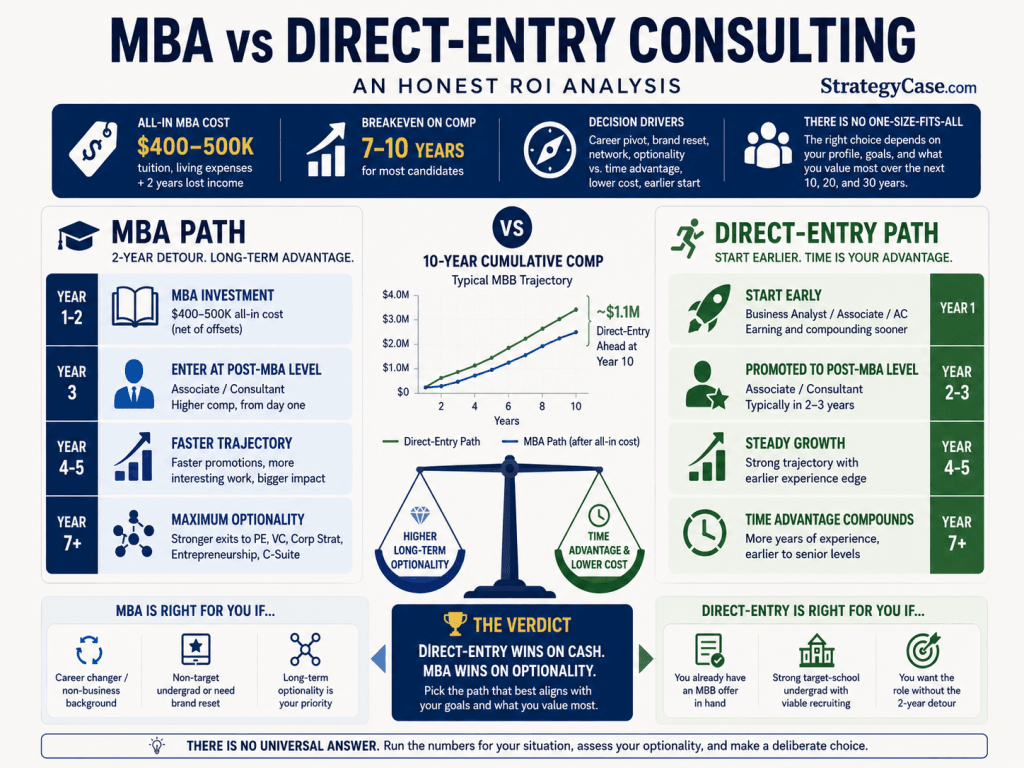
For most candidates, an MBA pays back its $400-500K all-in cost on consulting compensation alone within 7-10 years. Direct-entry consulting beats MBA when you already have an MBB offer in hand, when you are a strong undergrad target-school candidate with viable on-campus recruiting, or when you specifically want the consulting role without the title bump and brand reset. The decision is rarely about whether the MBA “works” financially. It is about whether the 2-year detour buys something you cannot get any other way.
This article on MBA vs direct-entry consulting exists because the standard advice is dishonest in two directions. Career-coach content tells everyone “the MBA always pays off, it is about the network and the experience.” Banker-Twitter content tells everyone “MBAs are obsolete, direct-entry is the only smart move.” Neither is true. The honest answer depends on what you have, what you are missing, and what you are trying to buy with the next 24 months of your life.
I have coached candidates on both sides of this decision. I have seen direct-entry hires at McKinsey out-earn classmates who took the MBA path by year five, and I have seen MBA grads close gaps that direct-entry would have left open forever. What follows is the ROI math, the qualitative trade-offs, the persona-by-persona verdict, and where most candidates miscalculate the decision.
Key Takeaways
- All-in MBA cost is $400-500K for a top US program: $200-250K tuition and living expenses + $200-300K lost income for 2 years
- MBA breakeven on consulting compensation alone: 7-10 years for most candidates
- Direct-entry wins when: you already have an MBB offer, you have strong undergrad target-school recruiting access, or you want the consulting role without the 2-year detour
- MBA wins when: you need a career pivot (non-business background to consulting), you need a brand reset (non-target undergrad), or you want long-term optionality (PE, VC, corporate strategy, entrepreneurship)
- The 10-year compensation gap closes around year 7 for most candidates, by year 10 the MBA path is typically ahead by $200-400K cumulative, before factoring in optionality value
The Honest MBA Cost Calculation
Most “is an MBA worth it” content underestimates the cost. Here is the actual 2026 math for a top US program (Wharton, HBS, Booth, Kellogg, Sloan, GSB, Stern, Columbia, Tuck, Fuqua, Ross, Darden, Yale SOM, Anderson). Figures are calibrated against published cost-of-attendance data such as the Wharton MBA cost of attendance and the HBS MBA tuition and fees page.
Hard costs (out of pocket)
| Item | 2026 Cost |
|---|---|
| Tuition (2 years) | $160,000-185,000 |
| Mandatory fees, health insurance | $10,000-15,000 |
| Books, technology, travel | $5,000-10,000 |
| Living expenses (housing, food, transport) | $50,000-70,000 |
| Total hard cost | $225,000-280,000 |
Soft costs (opportunity cost)
This is what most candidates undercount. If you are a 27-year-old consultant or banker considering an MBA, you are not earning $0 during the 2 years. You are earning a fully-loaded post-tax compensation of roughly $130-180K per year that you forgo.
| Item | 2026 Cost |
|---|---|
| Lost salary (2 years, post-tax) | $200,000-280,000 |
| Lost bonus, equity, retirement match | $40,000-80,000 |
| Total opportunity cost | $240,000-360,000 |
Combined all-in cost: $465,000-640,000
That is the real number. The MBA decision is a half-million-dollar choice. Anyone framing it as a $200K decision is hiding the opportunity cost.
The offsets
Some candidates have offsets that meaningfully reduce the net cost:
- Sponsorship: Sponsored MBB consultants get tuition fully (some offices partially) covered and a partial stipend, dropping all-in cost to $100-150K (mostly opportunity cost)
- Scholarships: Merit scholarships at top programs typically run $40-80K total. Need-based aid varies.
- Summer internship: $40-55K earned during the summer between RC and EC
- Lower-cost schools: Public programs (Anderson, Ross, Darden, Kenan-Flagler) can reduce hard costs by $30-60K
Net all-in cost for the typical unsponsored top-program candidate after offsets: $400-500K.
What an MBA Actually Buys in Consulting
The $400-500K is the cost. What is the product?
1. Title bump and accelerated trajectory
Direct-entry hires usually enter MBB as Business Analysts (McKinsey), Associates (BCG), or Associate Consultants (Bain). The promotion to the post-MBA level (Associate at McKinsey, Consultant at BCG, Consultant at Bain) takes 2-3 years and is not automatic.
MBA grads skip that step. They enter at the post-MBA level on day one, with 2 years of higher compensation, more interesting work, and a faster path to Engagement Manager / Project Leader.
At the same time, direct-entry hires start earlier, often several years before MBA hires complete their degree and re-enter the workforce. So while MBA candidates receive a title and compensation bump on day one, direct-entry consultants often have a meaningful time advantage and may already be close to, or even at, the post-MBA level by the time their MBA peers join.
2. Brand reset and credential premium
The MBA from a top program is a permanent credential. It signals analytical capability and committed career intent in a way that pre-MBA experience often does not. For candidates from non-target undergrad programs, non-business backgrounds, or unfamiliar foreign credentials, the MBA closes the credentialing gap that no amount of work experience can close on its own.
3. Network access
Top MBA networks are dense, durable, and active. Every major consulting firm has alumni at every level of the firm. Every PE fund, hedge fund, and corporate strategy team has MBA alumni. Network access compounds over a 30-year career in ways that are hard to value in a 5-year payback calculation.
4. Optionality at the exit
The biggest under-valued component. MBA grads at MBB exit into PE, VC, hedge funds, corporate strategy, tech product, and entrepreneurship at higher rates and at higher levels than direct-entry hires. The MBA + MBB combination is the most optionality-dense credential stack in the white-collar workforce.
5. Two years of education
The actual classroom education is genuinely valuable for some candidates (career changers, technical-to-business pivots) and largely redundant for others (former consultants, bankers). This is the most variable component of MBA value.
What Direct-Entry Consulting Actually Looks Like
Direct-entry has three main on-ramps:
Path A: Undergrad target-school recruiting (the strongest direct-entry path)
If you are at a target undergrad program (Harvard, Penn, Yale, Princeton, Stanford, MIT, Duke, Northwestern, Michigan, NYU, Berkeley, Brown, Dartmouth, Cornell, Williams, Amherst, UChicago, Notre Dame, Georgetown, UNC, UVA, USC, plus international targets like Oxford, Cambridge, LSE, IIT, INSEAD-undergrad-equivalent peers), you have a real shot at MBB on-campus recruiting as a senior. Offer rates for target-school candidates who actively recruit are typically 1-5% of the applicant pool but 8-15% of candidates who get final rounds.
Path B: Experienced hire / lateral
Direct-entry from another role (consulting at a Tier 2 firm, banking, corporate strategy, internal consulting at Big 4 / Big Tech) is possible at the post-MBA level once you have 3-5 years of relevant experience. MBB hires laterally but selectively. Offer rates are lower than MBA recruiting because the candidate pool is wider and the firms are pickier. However, with the right profile and targeted neworking, interview invites are achievable.
Path C: Off-cycle / non-target undergrad
The hardest direct-entry path. Candidates from non-target schools applying off-cycle have to network their way in, often through referral programs, summer programs (McKinsey Sophomore Summer Business Analyst, BCG Bridge, Bain BEE), or persistent networking over 12-24 months. Possible but with significantly lower base rates.
The compensation curve
Direct-entry compensation at MBB in 2026 (calibrated against published MBA employment reports such as the Wharton MBA Career Outcomes report and equivalent data from peer programs):
| Year | Direct-Entry MBB Level | Total Comp (base + bonus) |
|---|---|---|
| Year 1 | Business Analyst / Associate / AC | $110,000-130,000 |
| Year 2 | Senior Business Analyst / Senior AC | $130,000-160,000 |
| Year 3 | Promoted to Associate / Consultant (or up-or-out) | $200,000-240,000 |
| Year 4 | Associate / Consultant | $220,000-260,000 |
| Year 5 | Senior Associate / Senior Consultant | $250,000-300,000 |
MBA-track compensation at MBB in 2026:
| Year | MBA-Track MBB Level | Total Comp |
|---|---|---|
| Year 1 (post-MBA) | Associate / Consultant | $250,000-290,000 |
| Year 2 | Associate / Consultant | $280,000-320,000 |
| Year 3 | Senior Associate / Senior Consultant / Manager | $320,000-380,000 |
| Year 4 | Manager / EM | $380,000-450,000 |
| Year 5 | Manager / Engagement Manager | $400,000-500,000 |
The MBA-track grad earns more per year starting year 3 (which is year 1 of their post-MBA role) and that gap compounds. The direct-entry hire has 2 extra years of earnings at the front end but at lower levels.
The 10-Year ROI: Where MBA Catches Up
Here is the cumulative compensation comparison over 10 years for a typical candidate considering both paths (assuming both successfully break into MBB).
Direct-entry 10-year path
Starting at age 22 as a Business Analyst, with an aggressive promotion path:
| Year | Age | Role | Annual Comp | Cumulative |
|---|---|---|---|---|
| 1 | 22 | Business Analyst | $120,000 | $120,000 |
| 2 | 23 | Senior BA | $145,000 | $265,000 |
| 3 | 24 | Associate (promoted) | $220,000 | $485,000 |
| 4 | 25 | Associate | $240,000 | $725,000 |
| 5 | 26 | Senior Associate | $275,000 | $1,000,000 |
| 6 | 27 | EM | $340,000 | $1,340,000 |
| 7 | 28 | EM | $380,000 | $1,720,000 |
| 8 | 29 | Associate Partner | $480,000 | $2,200,000 |
| 9 | 30 | Associate Partner | $550,000 | $2,750,000 |
| 10 | 31 | Partner-track | $650,000 | $3,400,000 |
MBA-track 10-year path
Starting at age 22, doing 2 years of pre-MBA work, 2 years of MBA (with $480K all-in cost), then post-MBA MBB:
| Year | Age | Role | Annual Comp | Cumulative |
|---|---|---|---|---|
| 1 | 22 | Pre-MBA consulting / banking | $130,000 | $130,000 |
| 2 | 23 | Pre-MBA Year 2 | $160,000 | $290,000 |
| 3 | 24 | MBA Year 1 | -$240,000 | $50,000 |
| 4 | 25 | MBA Year 2 (summer +$50K) | -$190,000 | -$140,000 |
| 5 | 26 | Associate / Consultant (post-MBA) | $270,000 | $130,000 |
| 6 | 27 | Associate / Consultant | $300,000 | $430,000 |
| 7 | 28 | Senior Associate / Manager | $350,000 | $780,000 |
| 8 | 29 | Manager / EM | $420,000 | $1,200,000 |
| 9 | 30 | EM | $470,000 | $1,670,000 |
| 10 | 31 | Associate Partner | $560,000 | $2,230,000 |
What the math actually shows
By year 10, direct-entry is ahead by about $1.17M cumulative. Direct-entry wins the 10-year comparison on raw compensation.
This is the math the “MBA always pays off” camp ignores. For candidates who can credibly access MBB direct-entry, the MBA is not a financial winner over the first decade. It is a quality-of-life and optionality investment.
Where the MBA actually catches up
Two places:
- At the exit: MBA + MBB grads exit into PE Principal, hedge fund analyst, VC partner, Fortune 500 Chief of Staff / VP Strategy roles at 3-5 years of post-MBA work. Direct-entry grads exit into the same roles but typically 2-3 years later in tenure. The 2-year delay at the entry point becomes a 2-year delay at every subsequent promotion.
- Through optionality value: The MBA opens 2-3 career pivots that direct-entry doesn’t open, career changer to consulting, consulting to private equity at a higher entry point, consulting to corporate strategy executive track. The optionality has real dollar value that doesn’t show up in a year-by-year compensation chart.
Honest verdict: Direct-entry wins the first 10 years on cash. MBA wins from year 10-15 onward if you reach senior roles, and MBA wins on optionality almost immediately.
When MBA Wins: 5 Personas
Persona 1: The Career Changer (MBA always wins)
If you are coming from a non-business background, engineering, science, medicine, law, military, non-profit, academia, direct-entry to MBB is structurally hard. MBB’s lateral pipeline at the post-MBA level overwhelmingly hires from MBA programs, not from raw industry pivots. The MBA is the most efficient on-ramp.
I have coached engineers from FAANG, military officers from elite units, doctors from top hospitals, and lawyers from white-shoe firms, all targeting MBB. For every one of them, MBA was the right path. The credentialing, the structured recruiting cycle, and the network access are not replaceable.
Persona 2: The Non-Target Undergrad (MBA usually wins)
If you went to a non-target undergrad and want consulting, MBA is the brand reset. Direct-entry from a non-target undergrad is the hardest path on the list, the base rate of breaking in is well under 1% of applicants. The MBA closes the credentialing gap in 2 years in a way that 5 years of work experience often cannot.
Persona 3: The International Candidate (MBA usually wins)
If you have foreign credentials (undergrad outside the US/UK, work experience at firms unknown to US recruiters), the MBA is a credentialing intermediary. It re-anchors your candidacy in the US market and gives you network access to MBB recruiters who would not otherwise see your resume.
Persona 4: The Sponsored Returner (MBA always wins)
If you are a current MBB consultant being sponsored for the MBA, take it. The firm pays the tuition, your job is guaranteed at the post-MBA level, and you get 2 years of paid education that compounds your career. The ROI calculation is dramatically different (your all-in cost is ~$100-150K of opportunity cost, mostly time) and the firm has already decided you are worth the investment.
Persona 5: The Long-Term Optionality Buyer (MBA wins on a longer time horizon)
If you are buying optionality for years 10-30, partner-track at MBB, exit to PE Principal, exit to corporate strategy executive, entrepreneurship with VC funding, career pivots you cannot predict today, the MBA buys more optionality than direct-entry. The 7-10 year breakeven gets eclipsed by 25-year optionality compounding.
When Direct-Entry Wins: 5 Personas
Persona 1: The MBB Offer-in-Hand Candidate (Direct-entry wins)
If you have an MBB offer at the Business Analyst / Associate / AC level, take it. You can always do the MBA later (sponsored if you stay, on your own if you exit). Turning down a current MBB offer to apply to MBA programs is irrational on the math; you are paying $400-500K to enter MBB at a higher level that you could reach through 3 years of internal promotion.
Persona 2: The Strong Target-School Undergrad (Direct-entry often wins)
If you are at a target undergrad with active MBB on-campus recruiting and you are competitive (3.7+ GPA, leadership experience, strong networking), direct-entry is the path. The base rate of breaking in from a target undergrad is the highest of any direct-entry path. The 2-year detour to MBA is unnecessary cost.
Persona 3: The Strong Lateral From Adjacent Field (Direct-entry can win)
If you are at a Tier 2 consulting firm (Oliver Wyman, Strategy&, Deloitte S&O, Accenture Strategy, LEK, Roland Berger, Kearney) or at a top investment bank, the direct lateral to MBB at the post-MBA level after 3-5 years of experience is viable. The MBA adds credentialing but you are already in the credentialed pool. Direct lateral wins on the math.
Persona 4: The “Just Want the Job” Candidate (Direct-entry wins)
If your goal is specifically to work at MBB doing the consulting work, not to optimize for PE exit, not to maximize lifetime compensation, not to build a 30-year network, and you have a credible direct-entry path, the MBA is unnecessary cost. Some of the strongest consultants I worked with at McKinsey were direct-entry hires who never wanted the MBA detour. They were right.
Persona 5: The Late Career-Stage Candidate (Direct-entry usually wins)
If you are 30+ with 8+ years of strong work experience, you are often eligible for direct lateral hire at the post-MBA level. The MBA at 30+ has weaker ROI (shorter remaining career to amortize the cost) and the firms hire experienced laterals into the same roles MBA grads enter. Verify your direct-lateral viability before assuming you need the MBA.
The Three Mistakes Candidates Make on This Decision
After watching dozens of candidates make this choice, three patterns produce regret.
Mistake 1: Treating the MBA as a “default” rather than a decision
Some candidates apply to MBA programs without seriously evaluating direct-entry. They assume the MBA is the path because it is the path their peers took. They end up $400-500K poorer than direct-entry alternatives would have left them, often without the corresponding career upside.
The fix: actively price out the direct-entry path. Apply to direct-entry roles in parallel with MBA applications. Make the MBA decision as an informed choice after seeing both options on the table.
Mistake 2: Underestimating the difficulty of breaking in without the MBA
The opposite error. Some candidates assume direct-entry is “easy” if you are smart enough. The base rates do not support that assumption. Direct-entry to MBB from a non-target undergrad is 0.3-0.8% of applicants. From an experienced-hire pool, it is 1-3%. The MBA route at a target program is 8-15% per applicant per firm.
The fix: be honest about your base rates. If you are in the persona where direct-entry breaks in at low rates, the MBA is buying you a better probability of success, not just a credential.
Mistake 3: Optimizing for the first 10 years and ignoring years 10-30
Career compensation is heavily back-loaded. The role earning $1.5-3M in year 12 of post-MBA tenure dwarfs anything in the first 10 years. Candidates who optimize purely for first-decade cash often regret it in years 15-20 when their direct-entry classmates are senior in industry but their MBA-track peers are running their own consulting practices or holding C-level operating roles.
The fix: explicitly value the long-tail optionality. The MBA’s biggest payoff is years 10-30, not years 1-10.
The Verdict (Honest)
If I had to give a one-line rule for the median candidate considering this decision in 2026:
Direct-entry wins on cash. MBA wins on optionality. Pick based on which you value more.
If you already have an MBB offer in hand, take it. If you are at a strong target undergrad with viable on-campus recruiting, pursue direct-entry first and use MBA as a backup. If you are a career changer, non-target undergrad, or international candidate without a credible direct-entry path, MBA is the right investment despite the cost. If you are a sponsored consultant, take the MBA every time.
The decision that ruins the most candidates: doing the MBA out of inertia when direct-entry was the better path, or skipping the MBA out of cost-aversion when their direct-entry path was structurally weak. The cost of either error is 5-10 years of suboptimal career trajectory.
Frequently Asked Questions
Is an MBA worth it for consulting in 2026?
For most candidates, yes, on a 10-15 year horizon. The all-in MBA cost of $400-500K is recouped on consulting compensation alone within 7-10 years for unsponsored candidates and within 2-3 years for sponsored MBB returners. The longer-tail optionality (PE exit, VC partner track, C-suite operating roles, entrepreneurship) tilts the math further toward MBA when you account for years 10-30 of career.
Can I get into MBB without an MBA?
Yes. Direct-entry paths exist at three points: undergrad on-campus recruiting at target schools (highest base rate), experienced lateral hire after 3-5 years at a Tier 2 firm or banking (medium base rate), and off-cycle / non-target candidate networking (lowest base rate). Roughly 20-30% of MBB hires globally come through non-MBA paths.
How much does an MBA actually cost in 2026?
All-in cost for a top US program: $400-500K for unsponsored candidates. This includes $225-280K of hard costs (tuition, fees, living expenses) plus $240-360K of opportunity cost (lost salary and bonus over 2 years). Sponsored candidates have lower all-in cost ($100-150K, mostly opportunity cost). Scholarship recipients can reduce hard costs by $40-80K.
Do MBA grads or direct-entry hires earn more at MBB?
MBA grads earn more per year starting from their first post-MBA role and the gap compounds with seniority. But direct-entry hires earn 2 extra years of front-loaded compensation before MBA grads start. Over 10 years, direct-entry typically wins on cumulative cash by $800K-$1.3M. Over 15-20 years, MBA grads typically pull ahead if they reach senior roles.
What is the breakeven point for an MBA in consulting?
Pure compensation breakeven for an unsponsored candidate at a top program: 7-10 years from MBA graduation. Faster for sponsored returners (2-3 years). When you include optionality value (higher exit-role compensation, faster promotion to senior levels, broader career pivots), the effective breakeven is closer to 5-7 years.
Is it better to do the MBA before or after working in consulting?
For most candidates, working in consulting first (2-3 years pre-MBA) is the stronger sequence. It de-risks the MBA decision (you know you like the work), it opens sponsorship pathways at MBB and Tier 2 firms, and it produces a stronger MBA application. Going straight from undergrad to top MBA is harder (deferred-admit programs are competitive) and weaker pedagogically (you are learning concepts without real-world context).
Which top MBA programs have the best consulting placement?
Wharton, HBS, Booth, Kellogg, and INSEAD have the highest absolute MBB placement volumes (130-400 students per year). Stanford GSB, MIT Sloan, and LBS place fewer students by volume but at similar conversion rates. Tuck, Yale SOM, Darden, Fuqua, Ross, and Stern place 50-100 students at MBB per year. Beyond the top 15-20 programs, MBB placement drops sharply.
Related Guides for MBA vs Direct-Entry Consulting
- MBA Consulting Recruiting Timeline: Year-by-Year
- MBA Summer Associate Consulting Recruiting
- MBA Sponsorship Programs at MBB
- MBA Diversity Programs by MBB
- Wharton Consulting Recruiting
- HBS Consulting Recruiting
- INSEAD Consulting Placement
- LBS Consulting Recruiting
- Booth Consulting Recruiting
- Kellogg Consulting Recruiting
- MIT Sloan Consulting Recruiting
- Stanford GSB Consulting Recruiting
- Consulting Case Interview Guide
- MBB Salaries: McKinsey, BCG, Bain Compensation Data
Where to Go From Here
The MBA-vs-direct-entry decision is one of the most expensive career choices most people make and one of the least seriously analyzed. Three concrete next steps:
- Run your own numbers: Use the cost framework above with your specific salary, target programs, and sponsorship status. If your all-in MBA cost exceeds $500K and your direct-entry path is credible, the math favors direct-entry on a 10-year horizon.
- Audit your direct-entry viability honestly: Look at your undergrad school, your work experience, and your background. Where do you fall in the persona map above? If you have a credible direct-entry path, pursue it in parallel with MBA applications before committing $400-500K.
- Get a second opinion before deciding: If you are within 6 months of a decision deadline, 1-on-1 coaching with Florian at StrategyCase includes a structured framework for evaluating MBA vs direct-entry based on your specific persona.
If you are MBA-bound, the all-in-one case interview preparation program at StrategyCase is built for MBA candidates targeting January internship interviews. If you are direct-entry bound, the same program plus targeted Tier 2 firm prep is the right starting stack.
The wrong decision on this question costs 5-10 years of suboptimal trajectory. The right decision is highly personal. Make it deliberately, with the MBA vs direct-entry consulting math run on your specific numbers, not on generic averages.
About the author: Florian Smeritschnig is a former McKinsey Senior Consultant who has conducted 2,200+ mock case interviews and helped generate 700+ offers at McKinsey, BCG, Bain, and other top firms. He is the founder of StrategyCase.com and the author of The 1%: Conquer Your Consulting Case Interview.
