

By Dr. Florian Smeritschnig, Former McKinsey Senior Consultant · Updated September 2026
Big 4 vs MBB. They differ in one basic way: McKinsey, BCG, and Bain sell strategy advice to senior leaders, while Deloitte, PwC, EY, and KPMG are audit-born networks whose consulting is mostly technology and implementation work. MBB pays more, hires under 1% of applicants, and opens stronger exits. The exception is each Big 4 firm’s strategy arm, which does MBB-style work at a lower hiring bar.
Most MBB vs Big 4 comparisons stop at “MBB is more prestigious.” That’s true, and it won’t help you decide, because the Big 4 is not one employer. A Strategy& offer and a Deloitte technology-implementation offer are different jobs with different pay, interviews, and exits.
I spent five years at McKinsey and since then my clients have secured 700+ consulting offers across MBB, Tier-2 firms, and the Big 4. Here is how the choice breaks down.
Key Takeaways
- MBB (also called the Big 3) is McKinsey, BCG, and Bain. They focus on strategy, extend offers to under 1% of applicants, and pay about $140K total comp at US entry level.
- The Big 4 is Deloitte, PwC, EY, and KPMG. Together they earned about $220 billion in FY2025 with roughly 1.5 million people, about 15 times MBB’s headcount. Most of their consulting is technology, operations, and risk work.
- Each Big 4 firm runs a strategy arm (Monitor Deloitte, Strategy&, EY-Parthenon, KPMG’s strategy practice) that does MBB-style work. Overall offer rates there run roughly 2-5%, and the top of their pay range overlaps MBB.
- Compare MBB to the specific Big 4 practice, not the logo. The gap between two Big 4 practices is often bigger than the gap between McKinsey and Bain.
- Preparation transfers one way. Prepare to the MBB bar and you are ready for the strategy arms; the reverse rarely holds. Apply to both.
Big 4 vs MBB at a Glance
Big 4 vs MBB in one sentence: MBB firms are strategy specialists that advise CEOs and boards, hire a tiny share of applicants, and pay at the top of the market; the Big 4 are much larger multi-service networks that grew out of audit, where only the strategy arms do comparable work at comparable (slightly lower) pay.
The table splits the Big 4 into its two consulting worlds, because that split drives almost every difference that matters to a candidate.
| MBB (McKinsey, BCG, Bain) | Big 4 strategy arms | Big 4 core consulting | |
|---|---|---|---|
| Brands | McKinsey, BCG, Bain | Monitor Deloitte, Strategy& (PwC), EY-Parthenon, KPMG’s strategy practice | Consulting and advisory at Deloitte, PwC, EY, KPMG |
| What you work on | Strategy, organization, and transformation design for CEOs and boards | Growth strategy, M&A, and due diligence, often for private equity clients | Technology, operations, finance, risk, and HR transformation, much of it implementation |
| Typical team | A handful of consultants under one engagement manager, projects of weeks to a few months | Similar to MBB | Larger programs that can run a year or more with dozens of people |
| US entry pay (total comp) | ~$140K | $100K-$161K | $85K-$130K |
| US post-MBA pay | $240K-$242K | $190K-$250K | $130K-$200K |
| Overall offer rate | Under 1% of applicants | Roughly 2-5% | Higher, with far more seats |
| Interview | Case and fit interview in every round | Full case interviews in the MBB style, plus fit | Competency interviews, often with a shorter case, group exercise, or presentation |
| Career model | Strict up-or-out, fast promotion | Up-or-out, somewhat softer | Softer; you can plateau at a level |
| Strongest exits | Private equity, corporate strategy, startups | Corporate strategy, corporate development, lateral move to MBB | Industry roles in technology, finance, operations, and risk |
Pay: US total compensation, 2026, from our salary guides. Offer rates: StrategyCase estimates, since no firm publishes them.
Big 3 vs Big 4: Who Is in Each Group (and Why McKinsey Isn’t a Big 4 Firm)
MBB, or the Big 3, means McKinsey & Company, the Boston Consulting Group, and Bain & Company. The label is about consulting: these three are the most selective strategy firms in the world. For profiles of each firm and how they differ from one another, see our guide to the Big 3 consulting firms.
The Big 4 means Deloitte, PwC, EY, and KPMG, and the label comes from accounting. The Big 8 audit firms of the 1980s merged down to the Big 5, and Arthur Andersen’s collapse after the Enron scandal in 2002 left four. They are still the four largest audit networks in the world, which is why a search for “big 4” returns accounting results. This page is about their consulting businesses only.
That’s also why McKinsey is not a Big 4 firm. McKinsey has never been an audit firm. Its founder, James O. McKinsey, was a University of Chicago accounting professor when he started the firm in 1926 (McKinsey), but the firm built its business on management advice. BCG and Bain never did audit either.
The two groups also differ massively in scale:
| Group | Revenue (latest fiscal year) | People |
|---|---|---|
| Deloitte | $70.5B | 470,000+ |
| PwC | $56.9B | 364,000 |
| EY | $53.2B | 406,000 |
| KPMG | $39.8B | 276,000 |
| Big 4 combined | ~$220B | ~1.5 million |
| MBB combined | $35B+ (McKinsey and Bain don’t publish revenue so these are estimates) | ~100,000 |
Sources: FY2025 revenue announcements from Deloitte, PwC, EY, and KPMG (fiscal years ending May to September 2025). MBB figures from our Big 3 guide.
Size is misleading here, though. Most of those 1.5 million people don’t do strategy work. PwC’s advisory business brought in $24.3 billion of its $56.9 billion. At EY, consulting earned $16.4 billion and EY-Parthenon $6.2 billion, next to $17.9 billion from assurance and $12.7 billion from tax. The share of Big 4 revenue that competes directly with MBB is a small slice of the total.
The Big 4 Is Not One Employer: Strategy Arms vs Core Consulting
The most useful thing to understand about Big 4 vs MBB: you are never comparing MBB with “the Big 4” as a whole. You are comparing it with one practice inside one Big 4 firm, and those practices differ more from each other than McKinsey differs from Bain.
Three of the four firms bought their way into top-tier strategy:
| Firm | Strategy arm | How it was built |
|---|---|---|
| Deloitte | Monitor Deloitte | Acquired Monitor Group in January 2013 |
| PwC | Strategy& | Acquired Booz & Company; the deal closed in April 2014 |
| EY | EY-Parthenon | Acquired the Parthenon Group in 2014; in 2025 EY moved its entire Strategy and Transactions service line under the brand |
| KPMG | KPMG’s strategy practice (often part of Deal Advisory) | No flagship acquisition on the scale of Monitor, Booz, or Parthenon; structure varies by country |
The brand on the door tells you less than it used to. When EY folded Strategy and Transactions into EY-Parthenon, the brand grew to roughly 25,000 professionals across 150 countries (EY). Those are good jobs, but an “EY-Parthenon offer” can now mean MBB-style strategy work or transaction diligence and valuation. Those lead to different careers.
Before you compare any Big 4 offer with MBB, get answers to three questions from the team itself:
- What share of the team’s projects last year were strategy work, as opposed to diligence, implementation, or managed services?
- Who is the client counterpart? A CEO, board, or head of strategy points toward MBB-type work. A CIO or a functional program lead points toward implementation.
- Where did the last few people who left the team go? Alumni moves are the most honest signal of what the job trains you for.
If the answers are “mostly strategy,” “CEO or strategy head,” and “corporate strategy, PE, or MBB,” you are looking at a close substitute for MBB. If not, you are looking at a different career, and you should judge it on its own terms.
How the Work Differs Day to Day
At MBB, you mostly work on what a company should do. A typical project answers a question for the CEO or a business-unit head: where to grow, whether to buy a company, how to restructure a division, how to cut costs without damaging the business. Teams are small, so a first-year consultant owns a real piece of the problem and presents to senior clients early.
In Big 4 core consulting, you mostly work on how a company does it. The largest practices build and run things: technology implementations (ERP, cloud, data platforms), finance and operations transformations, risk and regulatory programs. Programs are longer and teams are bigger. You often go deeper into a function or an industry, which builds real expertise but narrower exposure.
The strategy arms sit in between. Their project mix looks much like MBB’s, with a heavier tilt toward deals, private equity due diligence, and work that leads into implementation for the wider firm.
One structural difference almost never comes up in these comparisons: auditor independence. Under the SEC rules that implemented Sarbanes-Oxley, an audit firm may not provide a defined list of non-audit services to companies it audits. The list includes financial information systems design and implementation, and management functions (Federal Register, 2003).
So a Big 4 consulting team can be blocked from certain work at the firm’s own audit clients, and client conflicts shape which companies you serve. MBB has no audit clients and carries no such conflict. For a junior consultant the day-to-day effect is modest, because most advisory work stays permitted with the client’s audit committee approval. For the firm’s client mix, it matters.
MBB vs Big 4 Salary: How Big the Gap Is
The pay gap depends almost entirely on which Big 4 practice you join. In US total compensation:
| Level | MBB | Big 4 strategy arms | Big 4 core consulting |
|---|---|---|---|
| Entry (undergraduate) | ~$140K | $100K-$161K | $85K-$130K |
| Post-MBA | $240K-$242K | $190K-$250K | $130K-$200K |
| Manager / Engagement Manager | $280K-$290K | $240K-$330K | $180K-$240K |
| Partner | $650K-$1.5M+ | $500K-$1.5M+ | $450K-$1M+ |
Source: StrategyCase salary data, 2026.
Two things stand out. First, the gap between MBB and Big 4 core consulting is widest at post-MBA entry, where it can reach $100K a year. Second, the top of the strategy-arm range overlaps MBB, so a strong strategy-arm offer is not a big financial step down. What the table can’t show is the pace: MBB promotes faster, so the gap compounds over five years for people who stay on track.
For level-by-level detail, see our breakdowns of MBB salaries and Big 4 salaries. Outside the US, both scale down with local markets, and the gap varies by country.
The Hiring Bar: Same Skills, Different Cut-Off
MBB extends offers to under 1% of applicants. The Big 4 strategy arms land at roughly 2-5%, and core consulting, which hires in far larger numbers, is more accessible still. Once you reach the case rounds, about 10-15% of MBB candidates get an offer, against roughly 20-25% at the strategy arms. These are StrategyCase estimates anchored to publicly reported application and hiring volumes, since no firm publishes stage-level pass rates. The method and the stage-by-stage funnel are in our guide to consulting acceptance rates by firm.
The interview formats line up with the work:
- MBB runs two rounds, each with case interviews and a fit interview, and every round has to go well. McKinsey’s case is interviewer-led; BCG and Bain mostly run candidate-led cases (though Bain has started to also use interviewer-led cases)
- The strategy arms run full case interviews in the same style, plus a fit interview. Expect the same skills to be tested, at a somewhat lower cut-off.
- Core consulting leans on competency and behavioral interviews, often with a shorter case, a group exercise, or a presentation, depending on the country and practice.
Back in the day at McKinsey, what separated an offer from a rejection was whether someone could build a structure for the specific problem in front of them, do the math cleanly under pressure, and land an outcome a client could act on. Then do it again in the next case, and the one after that. That consistency across four or five interviews is what makes MBB harder. The underlying skills are the same ones the strategy arms test.
That has a practical consequence. Of the 700+ offers my clients have secured, 340 were at McKinsey, BCG, and Bain. The rest are spread across Tier-2 strategy firms, the Big 4 and their strategy arms, and other consultancies. Across all of them, candidates who prepare to the MBB bar walk into strategy-arm cases ready. Candidates who prepare only for the Big 4 bar rarely clear MBB. So don’t pick one in advance. Prepare once, to the higher bar, and apply to both. Our complete case interview guide covers how.
Exit Opportunities and Career Speed
MBB buys you the most options per year spent. The strict up-or-out model means fast promotion, and the brand is what private equity firms, corporate strategy teams, and startups screen for. The cost is intensity: long hours, heavy travel on many projects, and pressure to keep moving up or move out.
Big 4 core consulting builds depth in a function. People commonly leave for industry roles close to what they delivered: technology leadership, finance transformation, operations, risk. The career model is more forgiving, and many people build long careers inside the firm.
The strategy arms are the flexible middle. They lead to corporate strategy and corporate development roles, private equity portfolio roles for deal-heavy teams, and, for many, a lateral move to MBB. For the full ranking of where consultants go, see our guide to consulting exit opportunities.
Can You Move From the Big 4 to MBB Later?
Yes, and it’s one of the most common lateral routes into MBB. It works best from strategy-arm teams and client-facing strategy work. From audit, tax, or pure implementation it’s much harder, because MBB discounts that experience as “advisory, not strategy.” Our guide on how to switch from Big 4 to MBB covers which backgrounds convert, what level you re-enter at, and how to reposition your resume.
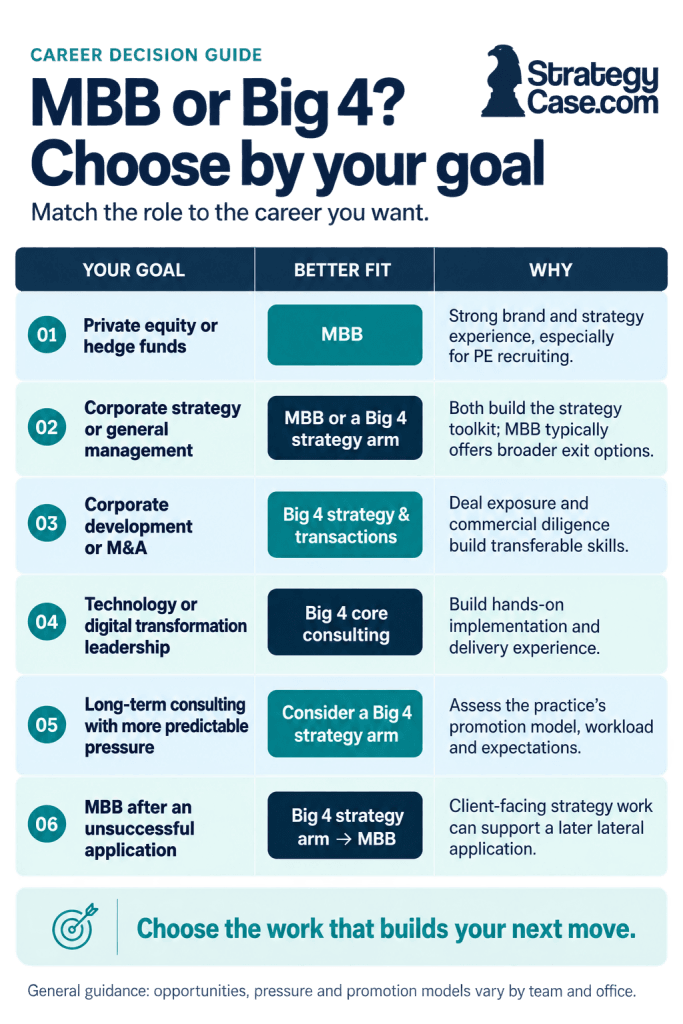
Which Should You Choose? A Decision Guide by Goal
If your goal is private equity, a top corporate strategy role, or the strongest general-purpose brand, choose MBB. If you want strategy work with a lower hiring bar and more practice breadth, a Big 4 strategy arm is the best alternative. If you want to build a technology or transformation career, Big 4 core consulting is often a better fit than either.
| Your goal | Better fit | Why |
|---|---|---|
| Private equity or hedge fund | MBB | PE recruiting leans hardest on the MBB brand and on MBB-style strategy work |
| Corporate strategy or general management | MBB, or a strategy arm | Both teach the toolkit; MBB opens more doors, a strategy arm is easier to enter |
| Corporate development or an M&A career | A Big 4 strategy and transactions team | You see more deals, and diligence skills transfer directly |
| Technology or digital transformation leadership | Big 4 core consulting | The Big 4 run the largest implementation practices, so you learn delivery hands-on |
| A long consulting career with more predictable pressure | A Big 4 strategy arm | Strategy work with a softer up-or-out model |
| MBB is the goal but hasn’t worked out yet | A Big 4 strategy arm, then a lateral move | A recognized bridge if your work there is client-facing strategy |
If You Hold Both Offers
For most candidates with offers from both, MBB wins, because it keeps the most doors open. Before signing, I’d still weigh the offers in a fixed order. First, the work you would do in your first year. Second, the exit you want three years from now. Third, the specific office and team. Brand matters mainly through the second point.
The real exceptions are candidates with a clear career goal the Big 4 serves better, such as corporate development or technology leadership. Another exception is when the MBB offer sits in an office or practice you don’t want and the Big 4 offer is a strong strategy-arm team. In those cases, the “prestige” answer can be the wrong one.
Frequently Asked Questions
Why is McKinsey not part of the Big 4?
Because “Big 4” is an accounting label. It names the four largest audit networks, Deloitte, PwC, EY, and KPMG, and McKinsey has never been an audit firm. McKinsey belongs to a separate group, MBB or the Big 3, with BCG and Bain. The irony is that its founder, James O. McKinsey, was an accounting professor.
Is McKinsey more prestigious than Deloitte?
For strategy consulting, yes. MBB carries the stronger brand with private equity firms, corporate strategy teams, and startups, and it is much harder to get into. The gap is smaller against Deloitte’s strategy practice, Monitor Deloitte, than against its technology or operations consulting.
Is it easier to get into the Big 4 than MBB?
Yes. MBB extends offers to under 1% of applicants, while the Big 4 strategy arms land around 2-5% by our estimates, and core consulting practices hire in much larger numbers. The strategy arms still run full case interviews, so the difference is a lower cut-off on the same skills.
Which Big 4 strategy arm is closest to MBB?
It depends more on the country and the team than on the brand. Monitor Deloitte, Strategy&, and EY-Parthenon all do MBB-style strategy work, and each also houses deal, diligence, or implementation teams. That mix widened at EY when it moved its whole Strategy and Transactions line under EY-Parthenon in 2025. Judge the specific team by its project mix, its client counterparts, and where its alumni go.
Should I take a Big 4 offer if I still want MBB?
Usually yes, if the role is in a strategy arm or strategy-heavy team. An offer in hand beats waiting, and one to three years of client-facing strategy work is a recognized route to MBB as an experienced hire. Audit, tax, and pure implementation roles convert poorly, so check what the job involves before treating it as a bridge.
What is the Big 5 in consulting?
There is no official Big 5 today. The term described the five largest accounting firms before Arthur Andersen collapsed in 2002, which left the Big 4. Some people use “Big 5” loosely to add Accenture, because of its consulting size, but it’s not a standard category.
Related Guides
- McKinsey vs BCG vs Bain: how the three MBB firms differ from each other
- Tier-2 to MBB: closing the last gap from Oliver Wyman, Kearney, or Roland Berger
- Types of consulting firms: where MBB, the Big 4, Tier-2, and boutiques fit
- Experienced hires at McKinsey, BCG, and Bain: entry levels and tracks if you join MBB mid-career
- How to get into consulting: the full application path, from resume to offer
The Bottom Line on Big 4 vs MBB
MBB and the Big 4 are different businesses. McKinsey, BCG, and Bain sell strategy to senior leaders, hire under 1% of applicants, and give you the most career options. The Big 4 are audit-born giants whose consulting is mostly implementation. Their strategy arms are the real alternative to MBB, with similar work, a lower bar, and pay that overlaps at the top.
So compare MBB to the specific Big 4 practice, choose by the exit you want, and prepare once, to the MBB bar, for both. If you want to build that level of case skill, start with the free StrategyCase Case Interview Foundations course, then work through the StrategyCase Case Interview Academy. If you’d like a diagnosis of where you stand and a plan for MBB and Big 4 applications, 1:1 coaching with me starts with a baseline of your current level.
About the author: Dr. Florian Smeritschnig is the founder of StrategyCase.com and a former McKinsey Senior Consultant who evaluated candidates for the firm. Since 2020 he has delivered 2,200+ mock interviews and coaching sessions, and his clients have secured 700+ consulting offers, 340 of them at McKinsey, BCG, and Bain. He is the author of three books on consulting interviews and careers, including The 1%: Conquer Your Consulting Case Interview.
