
Last Updated on July 15, 2026
Updated July 2026 · By Florian Smeritschnig, Former McKinsey Senior Consultant
The MBB target schools for McKinsey, BCG, and Bain in 2026 fall into three tiers: the core MBA target schools (Harvard, Stanford GSB, Wharton, Booth, Kellogg, MIT Sloan, Columbia, INSEAD, LBS, plus Tuck, Yale SOM, Ross, Stern, Darden, Haas, Duke Fuqua), the core undergraduate target schools (the Ivies plus MIT, Stanford, Duke, Northwestern, Chicago, Georgetown, Carnegie Mellon, UC Berkeley, Michigan, UVA, NYU, USC, UCLA), and a semi-target list that varies meaningfully by office.
Below is the full firm-by-firm MBA target school list (40+ schools), the undergraduate breakdown, what “target school” actually means operationally, and the realistic non-target path for candidates whose school is not on the list.
After 5 years at McKinsey and coaching a few hundred candidates through MBB recruiting, I can tell you exactly which schools the firms send recruiters to, where the official lists differ from the reality, and how non-target candidates have realistically broken in over the past three recruiting cycles.
Key Takeaways
- MBB recruits from 40+ MBA programs globally, with the M7 (HBS, Stanford GSB, Wharton, Booth, Kellogg, MIT Sloan, Columbia) plus INSEAD and LBS as the core
- Undergraduate recruiting spans the Ivies plus ~15-20 additional schools, with significant office-level variation
- “Target school” means the firm holds formal on-campus recruiting (OCR) events, sends a dedicated recruiter, and reviews applications through a different track than non-target submissions
- Approximate MBB conversion rates at top MBA schools: 15-30% of interviewed candidates land an offer; 50-70% at HBS / Stanford / Wharton with strong case prep
- Non-target candidates account for 5-10% of MBB hires in the US, primarily through referrals, off-cycle applications, or lateral moves from Tier-2 / Big 4 strategy
- GPA threshold matters more from non-target schools, typical bar: 3.5-3.7 + from semi-targets, 3.8+ from non-targets
What “Target School” Actually Means
Before the lists, the operational definition. “Target school” is not a marketing term, it describes a specific firm-school relationship with four concrete features:
1. On-campus recruiting (OCR) infrastructure. The firm sends dedicated recruiters to the school each year, holds info sessions, runs case workshops, and operates a formal first-round case interview process on campus.
2. Dedicated recruiter relationship. Each MBB office has a specific recruiter who owns the relationship with the school’s career services. This recruiter sees every CV from the school, knows the program’s grading conventions, and calibrates GPA expectations against the school’s curve.
3. Predictable hiring pipeline. The firm hires a known number of consultants from each target school every year (1-15+ depending on school size and office demand). This creates a self-reinforcing alumni network at the firm that further strengthens the relationship.
4. Different application review track. Applications from target schools flow through OCR systems with named recruiter ownership. Non-target applications flow through general portals and get reviewed in batch.
The practical effect: the same CV with a 3.7 GPA reads differently to McKinsey when submitted from Wharton OCR (where it gets read by a recruiter who knows Wharton grades hard in finance courses) versus a regional state school (where it gets read in a batch of 500 applications by a screener who has 60 seconds per CV).
This is why target school status is the single most impactful CV signal in MBB recruiting, alongside GPA and major rigor. For the full GPA breakdown, see the GPA for McKinsey, BCG, and Bain breakdown.
The Full MBB MBA Target School List (2026)
| University | McKinsey | BCG | Bain |
|---|---|---|---|
| Anderson School of Management (UCLA) | Yes | Yes | Yes |
| Berkeley Haas School of Business | Yes | Yes | Yes |
| Carlson School of Management (Minnesota) | No | Yes | No |
| Chicago Booth School of Business | Yes | Yes | Yes |
| Columbia Business School | Yes | Yes | Yes |
| Cornell Johnson Graduate School of Management | No | Yes | Yes |
| Cox School of Business (Southern Methodist) | No | No | Yes |
| Darden School of Business (UVA) | Yes | Yes | Yes |
| Duke Fuqua School of Business | Yes | Yes | Yes |
| Emory Goizueta Business School | No | Yes | Yes |
| ESADE Business School* | No | Yes | Yes |
| ESCP Business School* | No | No | Yes |
| Foster School of Business (Washington) | No | Yes | Yes |
| McDonough School of Business (Georgetown) | No | Yes | Yes |
| Harvard Business School | Yes | Yes | Yes |
| Howard University School of Business | No | Yes | No |
| INSEAD* | Yes | Yes | Yes |
| Jindal School of Management (UT Dallas) | No | No | Yes |
| Jones Graduate School of Business (Rice) | No | Yes | No |
| Judge Business School (Cambridge)* | Yes | Yes | Yes |
| Kelley School of Business (Indiana) | No | No | Yes |
| Kellogg School of Management (Northwestern) | Yes | Yes | Yes |
| Kenan-Flagler Business School (UNC Chapel Hill) | Yes | No | Yes |
| London Business School* | Yes | Yes | Yes |
| London School of Economics* | Yes | Yes | Yes |
| Marriott School of Business (BYU) | No | No | Yes |
| Marshall School of Business (USC) | No | Yes | No |
| McCombs School of Business (UT Austin) | No | Yes | Yes |
| Olin Business School (Washington University) | No | Yes | Yes |
| Owen Graduate School of Management (Vanderbilt) | No | Yes | Yes |
| Ross School of Business (Michigan) | Yes | Yes | Yes |
| Rotman School of Management (Toronto) | No | Yes | No |
| Saïd Business School (Oxford)* | Yes | Yes | Yes |
| Scheller College of Business (Georgia Tech) | No | No | Yes |
| Sloan School of Management (MIT) | Yes | Yes | Yes |
| Stanford Graduate School of Business | Yes | Yes | Yes |
| Stern School of Business (NYU) | Yes | Yes | Yes |
| Tepper School of Business (Carnegie Mellon) | No | Yes | Yes |
| Wharton School (Pennsylvania) | Yes | Yes | Yes |
| Tuck School of Business (Dartmouth) | Yes | Yes | Yes |
| Yale School of Management | Yes | Yes | Yes |
*non-US university
Three observations from this list:
1. Bain has the broadest target school list. Bain recruits from 35+ MBA programs, including several schools that McKinsey and BCG do not formally target. This is consistent with Bain’s strategy of casting a wider net at slightly lower selectivity per school.
2. McKinsey is the most selective. McKinsey formally targets ~20 schools, concentrated heavily on the M7 plus a few additional global programs (INSEAD, LBS, LSE, Oxford, Cambridge). The McKinsey target list is closest to a true “top tier” filter.
3. BCG sits between McKinsey and Bain. BCG targets ~30 schools, with notable extensions into Carlson (Minnesota), Howard, Marshall (USC), McCombs (UT Austin), Olin (Washington University), and Rotman (Toronto) that McKinsey does not formally cover.
The list above is the formal target list. Many candidates from non-listed schools have landed MBB offers, but they did so through referrals, off-cycle applications, or transfer paths described in the non-target section below.
The Core MBA Schools (Tier 1)
These are the schools where MBB sends the largest number of recruiters and hires the most MBAs each year. If you have admission to one of these programs, you have the strongest possible target-school signal.
Harvard Business School (HBS)
Harvard Business School (HBS) is the largest single MBB feeder school globally. McKinsey hires approximately 70-100 HBS MBAs per year; BCG and Bain each hire 40-70. With ~900 graduates per class, MBB collectively employs 15-25% of every HBS cohort.
The case-based curriculum maps directly onto consulting case interviews, and HBS career services runs the most established MBB recruiting pipeline of any business school globally.
Stanford GSB
Stanford Graduate School of Business (GSB) is smaller (~420 graduates per class) and more tech-focused, but MBB still hires significantly here. Stanford has the highest per-capita MBB acceptance rate among the M7, likely because the selectivity pool at the admission stage already filters for analytical capability.
McKinsey, BCG, and Bain each hire ~15-25 Stanford GSB graduates per year. Stanford candidates more frequently choose tech over consulting than HBS candidates, but the MBB recruiting infrastructure is robust.
Wharton (Pennsylvania)
Wharton School at the University of Pennsylvania is the largest finance-focused MBB feeder (~870 graduates per class). MBB hires similar numbers from Wharton as from HBS, though the Wharton pool skews more toward finance practices (Strategy & Corporate Finance at McKinsey, M&A and PE diligence at Bain).
Booth (Chicago)
University of Chicago Booth School of Business has the most quantitatively rigorous MBA curriculum among the M7, and MBB consultants from Booth tend to gravitate toward operations and analytics practices. McKinsey, BCG, and Bain each hire 20-35 Booth MBAs per year.
Kellogg (Northwestern)
Kellogg School of Management at Northwestern University‘s team-and-leadership-oriented culture meshes well with Bain in particular, and Bain has historically been the largest hirer of Kellogg graduates of the three MBB firms. McKinsey and BCG also recruit heavily here.
MIT Sloan
MIT Sloan School of Management has the smallest M7 program but punches above its weight at MBB given the firm’s growing technology and operations practices. Sloan graduates feature disproportionately in McKinsey Digital, BCG X, and Bain’s Advanced Analytics group.
Columbia Business School
Columbia Business School is well-positioned for MBB candidates targeting the New York office. The school’s location and finance-strong curriculum produce a steady pipeline into McKinsey New York’s Strategy & Corporate Finance practice and BCG New York.
INSEAD (France/Singapore/Abu Dhabi)
INSEAD is the largest non-US MBB feeder globally. With its 1-year program and ~1,000 graduates per cohort, INSEAD produces more MBB hires per year than any single US program except HBS. The school’s strong relationships with European MBB offices (Munich, Paris, London) and the Middle East (Dubai) make it especially valuable for candidates targeting non-US offices.
London Business School (LBS)
London Business School (LBS) is the largest UK-based MBB feeder, with strong relationships across MBB’s London offices and broader European offices. Like INSEAD, LBS produces a high proportion of MBB-bound graduates from a relatively small program.
Tuck, Yale SOM, Ross, Stern, Darden, Haas, Duke Fuqua
The “near-M7” tier. These schools formally target all three MBB firms but with smaller per-school hiring numbers (typically 5-15 MBB offers per year per school across all three firms combined). Strong candidates from any of these programs land MBB offers regularly; the school is target enough to be in the door, and case interview performance determines the outcome.
US Undergraduate Target Schools
MBB undergraduate recruiting is significantly broader than MBA recruiting, but the core target list is still concentrated. The schools below have established firm-wide MBB OCR programs in 2026.
Ivy League (all 8): Harvard, Yale, Princeton, Penn, Columbia, Brown, Cornell, Dartmouth.
Top non-Ivy private: MIT, Stanford, Duke, Northwestern, Chicago, Georgetown, Carnegie Mellon, USC, Notre Dame, Vanderbilt, Emory, Rice, Washington University in St. Louis.
Top public: UC Berkeley, UCLA, Michigan, UVA, North Carolina (Chapel Hill), Texas-Austin.
Strong semi-targets (variable by office): NYU, Boston College, Boston University, Tufts, William & Mary, Wisconsin, Wake Forest, Indiana, Georgia Tech, Maryland.
The list is firm- and office-dependent. McKinsey New York might actively recruit at Penn, Columbia, NYU, and Cornell; McKinsey Chicago at Chicago, Northwestern, Notre Dame, and Michigan; McKinsey San Francisco at Stanford, Berkeley, USC, and UCLA. Local geographic alignment matters more than candidates typically expect.
Bain has the broadest undergraduate target list, similar to its MBA recruiting strategy. McKinsey is the most selective at the undergraduate level as well.

International MBB Target Schools
MBB target school lists extend globally, with significant variation by office and region.
United Kingdom: Oxford (Saïd), Cambridge (Judge), LBS, LSE, Imperial College, Warwick Business School. Undergraduate: Oxford, Cambridge, LSE, Imperial, UCL, Warwick, Durham, St Andrews.
Continental Europe: INSEAD (France), HEC Paris, IESE (Spain), IE (Spain), ESADE (Spain), Bocconi (Italy), ESMT Berlin, RSM (Netherlands), Mannheim Business School, St Gallen (Switzerland), IMD (Switzerland).
India: IIMs (Ahmedabad, Bangalore, Calcutta, Lucknow, Indore, Kozhikode), ISB Hyderabad. Undergraduate: IITs, top IIMs, BITS Pilani, top NITs, Delhi University, St Stephen’s.
Asia-Pacific: National University of Singapore (NUS), Nanyang Business School (NTU Singapore), Hong Kong UST Business School, Chinese University of Hong Kong, University of Hong Kong, Tsinghua SEM, Peking Guanghua, Keio Business School, Hitotsubashi (Japan).
Australia: Melbourne Business School, AGSM (UNSW Sydney), Monash Business School. Undergraduate: Melbourne, Sydney, UNSW Sydney, ANU.
Latin America: IPADE (Mexico), INCAE (Costa Rica), FGV-EAESP (Brazil), Universidad de los Andes (Colombia).
Middle East / Africa: Dubai’s INSEAD campus, Saudi-based programs at King Fahd University, South Africa’s Wits Business School and GIBS.
The international target school landscape changes more frequently than the US one. MBB offices in growth markets (Middle East, India, Southeast Asia) adjust their target school list year-over-year as the local talent market evolves.
Approximate MBB Hiring Numbers by School
Useful directional data for candidates evaluating which school maximizes MBB conversion odds:
| School | Approx Total MBB Hires Per Year | Per-Firm Range |
|---|---|---|
| Harvard Business School | 150-200 | 50-70 each |
| Wharton | 130-180 | 40-60 each |
| Stanford GSB | 50-75 | 15-25 each |
| Kellogg | 80-110 | 25-40 each |
| Booth | 70-100 | 20-35 each |
| MIT Sloan | 35-55 | 10-20 each |
| Columbia | 60-90 | 20-30 each |
| INSEAD | 100-150 | 30-50 each |
| LBS | 50-80 | 15-30 each |
| Tuck | 25-40 | 8-15 each |
| Darden, Ross, Stern, Yale, Haas, Fuqua | 20-40 each | 5-15 each per firm |
Numbers are approximate, based on aggregated school-published consulting placement data plus MBB alumni reports.
What If You Are From a Non-Target School?
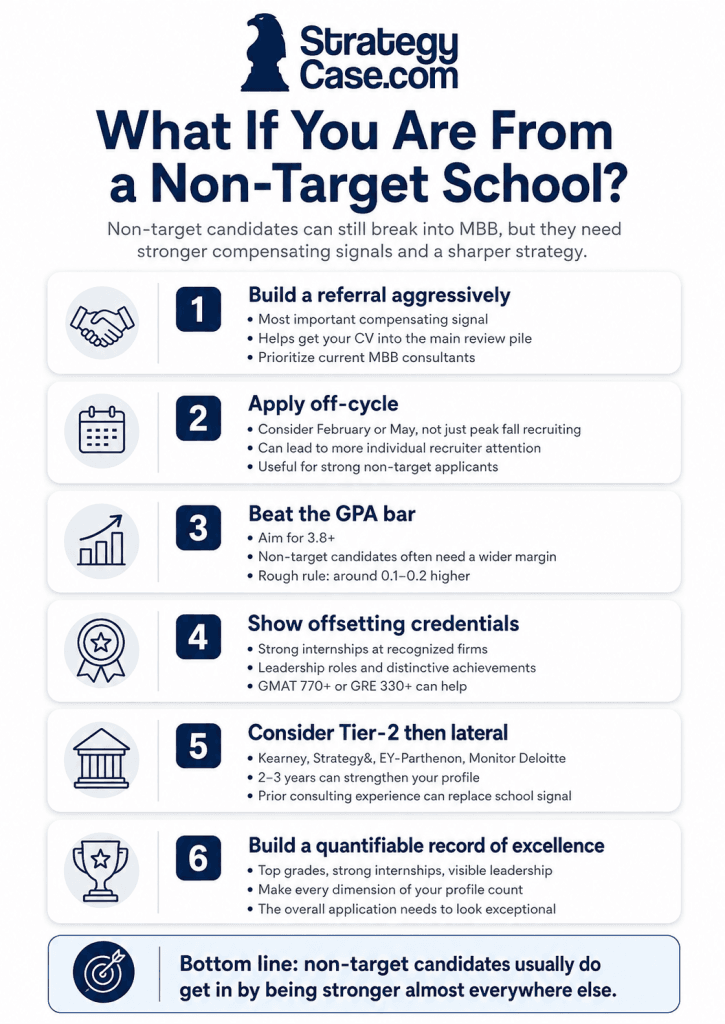
Roughly 5-10% of MBB hires in the US come from non-target schools. The pattern that works for these candidates:
1. Build a referral aggressively. A referral from a current MBB consultant gets your CV onto the same review pile as target-school applicants. It is the single highest-use compensating signal. See how to get a referral for McKinsey, BCG, or Bain for the specific networking approach.
2. Apply off-cycle. MBB firms have informal “diversity” hiring throughout the year that are not part of the main recruiting cycle. A strong non-target candidate applying in February or May (rather than peak September) often gets more individual attention from the recruiter.
3. Beat the GPA bar by a wider margin. For non-target candidates, the unwritten GPA bar is approximately 0.1-0.2 higher than for target candidates. Aim for 3.8+ to be competitive.
4. Demonstrate exceptional offsetting credentials. Strong internships at recognized firms (banking, PE, smaller consulting firms), competitive leadership roles, quantitative test scores (GMAT 770+, GRE 330+), distinctive achievements (founder, published author, athlete, IMO/IOI medal).
5. Consider the Tier-2-then-lateral path. A 2-3 year stint at Kearney, Strategy&, EY-Parthenon, Monitor Deloitte, or similar before lateraling to MBB is a well-trodden path. By the time you lateral, your prior consulting experience replaces the target-school signal in the screening stage. Roughly 15-20% of MBB Consultants in 2026 came through this path.
6. Build a quantifiable record of excellence. Your application needs to communicate that you would have been at a target school if circumstances had been different. Top GPA, prestigious internships, competitive leadership roles, every other dimension needs to be strong.
The consulting resume guide covers exactly what “strong resume from a non-target” looks like in MBB screening.
How Target School Status Affects Recruiting Stages
Target school status meaningfully affects each stage of MBB recruiting:
CV screening: Target school CVs go through OCR systems with named recruiter ownership. Non-target CVs go through general portals and batch review. The screen-in rate is 3-5x higher from target schools at the same GPA.
Case interview invitations: Target schools have dedicated case interview slots reserved by the firm. Non-target candidates compete for general interview slots, which are fewer in number and more competitive.
Case interview pass rate: Once interviewed, target and non-target candidates pass at similar rates. The filter is at the screening stage, not the interview stage.
Office assignment: Target school candidates often have stronger ties to specific offices (their target office’s recruiter knows their school). Non-target candidates have less geographic flexibility.
Offer conversion: Once offered, target and non-target candidates convert (accept) at similar rates. Offer salary is identical.
The practical implication: target school status helps you get IN to the interview process. It does not meaningfully help you once you are interviewing. Case interview and fit interview preparation matter equally for all candidates.
For the broader question of whether MBB is even the right firm tier for your profile, see the what degree do you need for management consulting breakdown.
Frequently Asked Questions
What is an MBB target school?
An MBB target school is a university where McKinsey, BCG, or Bain operate formal on-campus recruiting (OCR) programs. The firm sends a dedicated recruiter to the school, holds info sessions and case workshops, and reviews applications from the school through a different track than general portal submissions. Target school status is the single most impactful CV signal alongside GPA and major rigor.
How many MBB target schools are there in the US?
McKinsey formally targets approximately 20 MBA programs in the US, BCG approximately 30, and Bain approximately 35. At the undergraduate level, MBB collectively recruits from approximately 25-30 core target schools (the Ivies plus 15-20 additional schools), with significant office-by-office variation.
What are the top 10 MBB target schools for MBAs?
The 10 highest-volume MBB MBA feeder schools in 2026 are: Harvard Business School, Stanford GSB, Wharton, Kellogg, Booth, MIT Sloan, Columbia Business School, INSEAD, LBS, and (collectively) the near-M7 tier of Tuck, Yale SOM, Ross, Stern, Darden, Haas, and Duke Fuqua.
Does McKinsey only hire from target schools?
No, but the vast majority of McKinsey US hires come from target schools. Roughly 90-95% of US McKinsey Associates (MBA hires) come from formal target MBA programs. The remaining 5-10% come from non-target schools through referrals, off-cycle applications, or lateral moves from Tier-2 or Big 4 strategy practices.
Can I get into MBB from a non-target school?
Yes. Roughly 5-10% of MBB hires in the US come from non-target schools, primarily through (1) referrals from current MBB consultants, (2) exceptional offsetting signals (top GPA, prestigious internships, competitive achievements), (3) off-cycle applications outside the main recruiting season, or (4) lateral moves from Tier-2 or Big 4 strategy firms after 2-3 years of prior consulting experience.
What is the difference between a target, semi-target, and non-target school?
Target schools have formal MBB OCR programs with dedicated recruiters, info sessions, and on-campus case interviews. Semi-target schools have occasional MBB recruiting events but no full OCR infrastructure, strong candidates can still apply through OCR-adjacent channels. Non-target schools have no formal MBB recruiting presence; candidates apply through the general application portal and compete in batch review against thousands of other non-target applicants.
Which is the largest MBB feeder school?
Harvard Business School is the largest single MBB feeder school globally. McKinsey, BCG, and Bain collectively hire approximately 150-200 HBS graduates per year, representing 15-25% of every HBS cohort. INSEAD is the largest non-US MBB feeder with 100-150 hires per year across the three firms.
What GPA do you need for MBB from a non-target school?
The unwritten GPA bar at non-target schools is approximately 0.1-0.2 higher than at target schools. While target school candidates need approximately 3.7+ for competitive consideration, non-target candidates should target 3.8+ alongside other strong offsetting signals (top test scores, prestigious internships, distinctive achievements). For the full GPA breakdown by firm, see the GPA for McKinsey, BCG, and Bain guide.
Does it matter which MBB target school I attend?
The school affects per-school MBB hiring volume but not individual offer probability once you are in the recruiting process. A strong candidate from Tuck has roughly the same case-interview-to-offer conversion rate as a strong candidate from HBS. What changes is the absolute number of MBB hires per cohort (HBS has 50-70 per firm; Tuck has 5-15 per firm), which means more competition from strong peers at the larger feeders. Some candidates prefer the higher per-capita conversion at smaller target schools.
How does MBB target school recruiting work for undergraduate students?
MBB undergraduate recruiting follows a similar OCR model to MBA recruiting but with stronger geographic clustering. Each MBB office focuses on specific schools in its region (NY office on Ivies plus Columbia/Penn/Cornell; Chicago office on Northwestern/Chicago/Notre Dame/Michigan; SF office on Stanford/Berkeley/USC/UCLA). Bain has the broadest undergraduate target list; McKinsey is the most selective.
The Bottom Line
The MBB target school list is concentrated but not closed. Roughly 90% of MBB US hires come from formal target schools, but the remaining 10%, built through referrals, off-cycle applications, exceptional credentials, or Tier-2-then-lateral paths, is a meaningful number of candidates each year.
For candidates considering business school for consulting specifically, the practical answer is: aim for the M7 (HBS, Stanford GSB, Wharton, Booth, Kellogg, MIT Sloan, Columbia) plus INSEAD and LBS. Below that tier, the near-M7 schools (Tuck, Yale SOM, Ross, Stern, Darden, Haas, Duke Fuqua) are all strong MBB recruiting platforms with smaller cohorts and lower per-school competition.
For candidates already past the school decision (at a non-target school, mid-career, or considering a career pivot), the path is well-documented: referrals, strong offsetting signals, off-cycle applications, and case interview preparation that allows you to convert at the same rate as target school candidates once you reach the interview stage.
If you want a structured assessment of your specific profile (school, GPA, major, experience) and a calibrated plan for which MBB office and firm to target, book a 1-on-1 coaching session. For the broader career arc once you have the offer, see the salary breakdowns for McKinsey, BCG, and Bain, or read Consulting Career Secrets for the full first-five-years playbook.
Target school status helps you get in. Case interview and fit performance get you the offer. Optimize for both, in that order.
About the author: Florian Smeritschnig is a former McKinsey Senior Consultant and the founder of StrategyCase. He spent five years at the firm and has since run more than 2,200 mock case interviews and coached hundreds of candidates into McKinsey, BCG, Bain, and other top firms.
