
Last Updated on July 21, 2026
Updated July 2026 · By Florian Smeritschnig, Former McKinsey Senior Consultant
An Accenture Strategy consultant works on growth, cost, and operating-model problems for large companies, and then usually stays involved while Accenture implements the answer. Strategy is one of five service lines that Accenture folded into a single business unit called Reinvention Services on September 1, 2025, and it is the hardest of those five to get into.
That structure is where most candidates get lost. Job boards list “Accenture Strategy,” “Strategy & Consulting,” and “Management Consultant” as if they were one role, and they are not. Pick the wrong one and you spend six months in a job you did not apply for.
This guide separates them, using Accenture’s own filings, current market reporting, and a time-use breakdown from a practicing Accenture Strategy consultant.
Key Takeaways
- Accenture Strategy sells the “what,” Accenture Consulting sells the “how.” They were merged as “Strategy & Consulting” for years and are now run as separate service lines under one leader each.
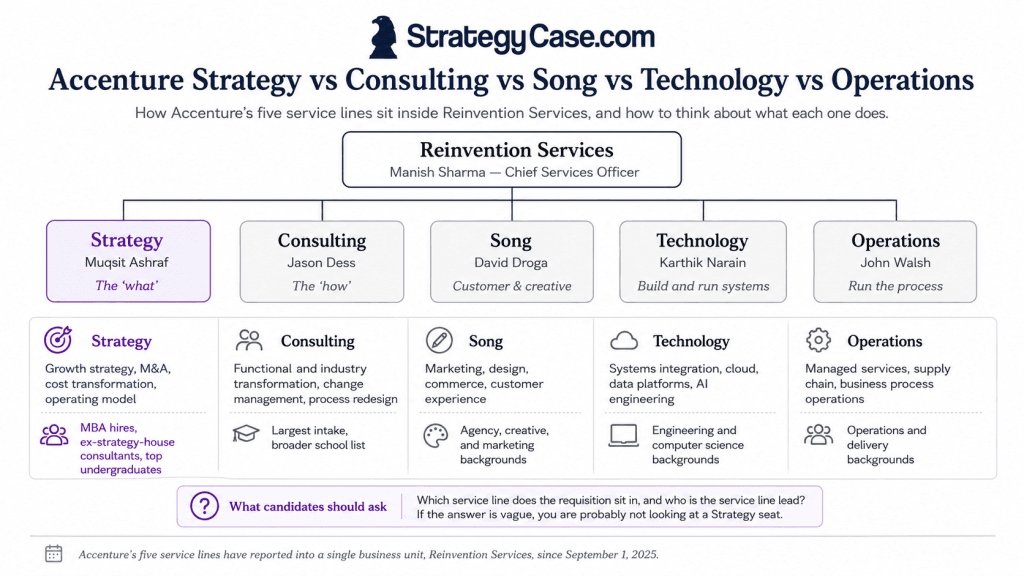
- Reinvention Services, live since September 1, 2025, houses all five service lines: Strategy, Consulting, Song, Technology, and Operations.
- Typical week runs about 55 hours (roughly 9 a.m. to 8 p.m.), with weekend work reserved for internal projects rather than client deadlines.
- Travel is regional, not weekly. One Toronto consultant traveled on 2 of 9 projects, which is the opposite of the Monday-to-Thursday MBB pattern.
- Strategy work at Accenture is rarely standalone. It is usually attached to a transformation the firm also expects to deliver, which is the single biggest difference from MBB.
What an Accenture Strategy Consultant Actually Does
An Accenture Strategy consultant advises senior client leaders on growth, cost, operating model, and technology-enabled transformation decisions. Unlike a pure strategy house, Accenture typically pairs that advice with the delivery capability to execute it, so the consultant’s recommendation is expected to survive implementation.
The work clusters into four buckets. Growth strategy covers distribution, international expansion, and sales force effectiveness. Cost transformation covers zero-based budgeting and procurement. Operating model work covers reorganizations and post-merger integration. Technology strategy covers cloud, data, and AI investment decisions.
The fourth bucket has grown fastest, and it explains the 2025 reorganization better than any press release does. Accenture’s pitch to clients is that the strategy and the system that runs it should come from the same firm.
That is a genuine commercial advantage. It is also the thing that makes the job different from MBB, and candidates should decide how they feel about it before they accept an offer, not after.
Accenture Strategy vs Consulting vs Song vs Technology vs Operations
This is the question that generates the most confusion on candidate forums, and Accenture’s own strategy careers page does not answer it directly.
| Service line | What it sells | Typical work | Who it hires |
|---|---|---|---|
| Strategy | The “what” | Growth strategy, M&A, cost transformation, operating model | MBA hires, ex-strategy-house consultants, top undergraduates |
| Consulting | The “how” | Functional and industry transformation, change management, process redesign | The largest intake, from a much broader school list |
| Song | Customer and creative | Marketing, design, commerce, customer experience | Agency, creative, and marketing backgrounds |
| Technology | Build and run the systems | Systems integration, cloud, data platforms, AI engineering | Engineering and computer science backgrounds |
| Operations | Run the process | Managed services, supply chain and business process operations | Operations and delivery backgrounds |
Strategy and Consulting sat together as “Strategy & Consulting” for several years. Since the reorganization they are run separately, with Muqsit Ashraf leading Strategy and Jason Dess leading Consulting, both reporting into Reinvention Services under Manish Sharma as Accenture’s first Chief Services Officer.
How to read a title on LinkedIn. Practitioners on candidate forums report a rough rule: a profile that says only “Strategy” usually sits in the Strategy arm, while “Strategy & Consulting” more often means Consulting, or a title nobody updated after the split. Treat it as a signal to ask in the interview rather than a fact, because Accenture has not published a mapping.
Ask the recruiter one direct question: which service line does the requisition sit in, and who is the service line lead. If the answer is vague, you are probably not looking at a Strategy seat.
A Real Week: Hours, Travel, and Where the Time Goes
StrategyCase spoke with an Accenture Strategy consultant in the Toronto office about how the job actually breaks down. Their time-use estimate is below. It dates from that interview rather than from 2026, so treat it as a shape rather than a live measurement, but the shape has held up in what candidates report to me since.
| Where the day goes | Share |
|---|---|
| Building slides | 35% |
| Excel analysis | 25% |
| Problem solving, alone and with the team | 15% |
| Client meetings and chasing data | 15% |
| Internal and administrative work | ~10% |
Two things stand out. Slide production outweighs analysis, which surprises candidates who expect strategy work to be mostly modeling. And client contact sits at 15%, so the majority of the week is spent producing the artifact rather than in the room.
Hours. The same consultant reported a typical weekday of 9 a.m. to 8 p.m., which works out to roughly 55 hours a week. Weekend work existed but went to internal projects such as asset development and practice research rather than client deliverables. That is meaningfully lighter than the hours consultants work at MBB.
Travel. This is the sharpest difference from MBB, and it is structural. Accenture staffs regionally. Because roughly 90% of that consultant’s client headquarters sat in Toronto, most consultants in the office did not travel at all. Across nine projects, two involved travel, and travel time on those averaged two to four hours.
If you have seen the Monday-flight-out, Thursday-flight-back pattern described as the consulting default, the regional model is the main reason Accenture people often do not recognize that description of their own job.
What Accenture Strategy Pays
Compensation is the second question every candidate asks, and it deserves its own numbers rather than a paragraph here. A first-year Analyst in the US sits near $85,000 total compensation, and Accenture Strategy carries a premium of roughly 15% to 25% over core Accenture Consulting at the same level.
The full ladder from Analyst to Managing Director, including how Accenture’s equity grants work as a publicly traded company rather than a partnership, is in the Accenture Strategy salary breakdown by level.
One point worth carrying into a negotiation: because Accenture is listed, senior compensation arrives partly as restricted stock rather than partnership profit share. That changes both the risk profile and the vesting timeline compared with an MBB or Big 4 offer.
How Hard Is It to Get Into Accenture Strategy?
Accenture as a whole is moderately difficult to enter. Accenture Strategy is genuinely difficult, and the gap between those two facts catches people out.
The firm hires at very large scale across Technology and Operations, which drags the headline perception of selectivity down. Strategy runs a much smaller intake, recruits from a tighter school list, and screens closer to how a strategy house screens.
The process usually runs as follows:
- Application and resume screen, with the Strategy intake filtering harder on academics and prior strategy exposure.
- Online assessment, which candidates routinely underestimate. The format and how to prepare are covered in the Accenture digital assessment guide.
- Case interviews, closer to MBB in structure than to a typical Big 4 conversation.
- Fit and values discussion, plus a final round with senior practitioners.
Here is the pattern I see most often. I spent five years at McKinsey as a Senior Consultant, evaluated candidates there, and have since coached more than 700 people into offers across MBB, the Big 4, and Accenture. Candidates targeting Accenture Strategy prepare for it as though it were a Big 4 interview, then meet a case that is structurally closer to MBB but far more grounded in delivery reality. They are asked not only what the client should do, but whether it can actually be built and what it costs to run.
That second half is where under-prepared candidates lose the offer. If you are building case skills from scratch, start with the complete case interview guide, then pressure-test your structures against implementation constraints rather than stopping at the recommendation.
Accenture Strategy vs MBB: Who Should Actually Pick It
The verdict: choose Accenture Strategy if you want strategy work that stays connected to delivery, with better hours and far less travel than MBB. Choose MBB if you want the strongest exit brand and strategy work that ends at the recommendation.
| Accenture Strategy | MBB | |
|---|---|---|
| Nature of the work | Strategy tied to a transformation the firm also delivers | Strategy, more often standalone |
| Typical hours | ~55 per week | Materially longer |
| Travel | Regional staffing, frequently local | Historically heavier |
| Technology exposure | High, and increasingly central | Growing, but not the core pitch |
| Exit brand | Strong in technology and transformation roles | Strongest across the board |
| Selectivity | Hard, below MBB | Roughly 1 in 100 applicants |
Neither column is the better answer in the abstract. The honest framing is that Accenture Strategy trades some exit-brand strength for a better week and deeper technology exposure, and whether that trade is good depends entirely on where you want to be in five years.
If you are still comparing firms at the category level, the Big 3 consulting firms guide sets out how MBB differs from everyone else.
Exit Opportunities After Accenture Strategy
The consultant we spoke with listed venture capital, growth-stage startups, and restructuring or turnaround advisory as the paths they were weighing. That is a representative set, and two more show up regularly: corporate strategy at a large company, and technology strategy roles where the Accenture background is an advantage rather than a discount.
The advice they gave on managing this is the most useful thing in the original interview, and it applies at any firm:
Have clarity on the experiences you want to attain, and then chase them down, so that if you leave, you walk away with a strong profile that is transferable to the type of work you want to continue doing.
That is the right instinct. Exit options are built from the projects you take, not from the logo on the badge. The broader map of where consultants go next is in the consulting exit opportunities guide.
The Honest Downsides
Four, based on what practitioners report rather than what recruiting materials say.
Staffing is partly a lottery. Which project you land depends on roll-off timing as much as on preference, so you will not always get the work you want. This is true across consulting, but it bites harder in a firm this large.
Politics and perception management are real. In an organization of several hundred thousand people, managing how your work is perceived takes effort that a smaller firm would not demand of you.
Strategy is rarely sold alone. If you want pure corporate strategy with no technology component, this is the wrong firm, and no amount of enjoying the team will fix that mismatch.
The AI restructuring is live. Accenture ran a business optimization program with $865 million in charges, targeting over $1 billion in savings, and CEO Julie Sweet told investors the firm was “exiting people” where there was no viable path to reskilling them on a compressed timeline. Roughly 11,000 roles went in three months, and the workforce was rebranded internally as “reinventors” in late 2025. The firm still expects headcount to grow in 2026, and it posted $69.7 billion in FY2025 revenue, so this is repositioning rather than retreat. Ask in your interview how it has affected the Strategy practice specifically.
On Glassdoor, Strategy Consultants rate Accenture 3.5 out of 5 across 478 reviews as of July 2026, with work-life balance cited as a strength and progression as a common frustration. That is a fair summary of the trade.
For the wider picture on how AI is changing consulting hiring and what it means for entry-level roles, see AI’s impact on consulting careers and hiring.
Frequently Asked Questions
What does a strategy consultant do at Accenture?
They advise senior client leaders on growth, cost, operating model, and technology investment decisions, then typically stay involved as Accenture implements the recommendation. Day to day the role is slide production, Excel analysis, structured problem solving, and client meetings, weighted roughly 35 / 25 / 15 / 15.
How much does a strategy consultant make at Accenture?
A US Analyst starts near $85,000 total compensation, and Accenture Strategy pays roughly 15% to 25% above core Accenture Consulting at the same level. Senior levels include restricted stock rather than partnership equity. Full figures by level are in the Accenture Strategy salary guide.
What is the difference between Accenture Strategy and Accenture Strategy & Consulting?
Strategy defines what the client should do; Consulting delivers how it gets done. The two were combined under the “Strategy & Consulting” label for several years and are now run as separate service lines. Many profiles still carry the old combined title, so confirm the service line with the recruiter.
Is Accenture Strategy hard to get into?
Yes, considerably harder than Accenture overall. The firm hires at enormous scale in Technology and Operations, which makes it look less selective than it is. Strategy runs a small intake, recruits from a tighter school list, and screens close to how a strategy house screens.
Does an Accenture Strategy consultant travel every week?
Usually not. Accenture staffs regionally, so consultants often serve clients headquartered in their own city. One Toronto consultant traveled on only two of nine projects. This is the clearest lifestyle difference from MBB.
Is Accenture Strategy good for exit opportunities?
It is strong for corporate strategy, technology strategy, growth-stage startups, and transformation roles, and it is competitive but not dominant against MBB for private equity and top-tier venture capital. What you exit into depends more on your project mix than on the firm name.
Related Guides
- How to get into consulting for the full application and recruiting process
- The pros and cons of a consulting career for the honest version of the lifestyle question
- The life of a McKinsey consultant for the same breakdown at an MBB firm
- The life of a BCG consultant for how the week compares at a second MBB firm
- The life of an EY consultant for the Big 4 equivalent
The Bottom Line
An Accenture Strategy consultant gets strategy work with a shorter week, far less travel, and deeper technology exposure than MBB offers, in exchange for a slightly weaker exit brand and strategy that is rarely sold on its own. For a large share of candidates that is the better trade, and most of them never seriously consider it because they cannot tell the service lines apart.
Before you apply, do three things. Confirm which service line the role sits in. Prepare cases that carry through to implementation and cost to run, not just to a recommendation. And ask directly how the 2025 restructuring has landed on the Strategy practice.
If you want that preparation structured rather than improvised, the Case Interview Academy from StrategyCase covers the path, including the implementation-grounded cases Accenture Strategy tends to run.
Florian Smeritschnig is a former McKinsey Senior Consultant who spent five years at the firm, evaluated candidates there, and has delivered more than 2,200 mock interviews and coaching sessions since. He founded StrategyCase.com, and candidates he has coached have secured 700+ offers at McKinsey, BCG, Bain, and other top firms.
