
Last Updated on May 27, 2026
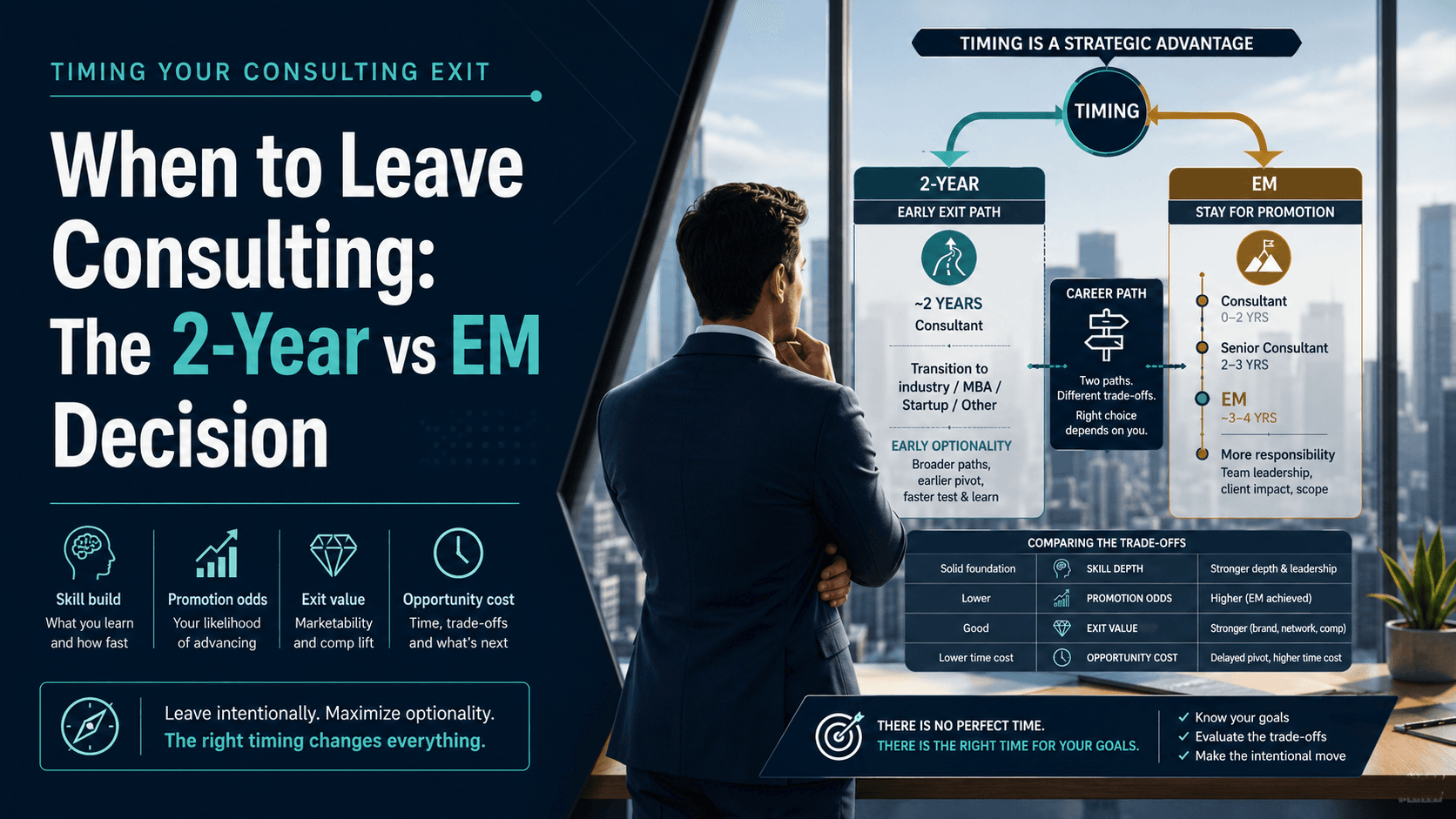
The four critical exit windows at MBB are: the 2-year window (pre-MBA Associate, typically 24-36 months in, primarily PE on-cycle and direct operator roles), the EM window (post-EM promotion, 3-5 years in, broadest exit optionality), the Principal/AP decision (5-8 years in, commit to Partner track or take final off-ramp), and the Partner exit (8+ years in, rare, relationship-driven). Most consultants leave at one of the first two windows. The single most important timing decision is whether to take the EM promotion or exit before it: the choice locks in a 12-24 month commitment that limits your near-term exit options.
You’ve been thinking about leaving for months. Friends ask when you’re going to make the move. Your career counselor has the “let’s talk about your next two years” meeting coming up. You know the destinations (PE, corporate strategy, startups, big tech) but the question that keeps you up at night is when to actually pull the trigger. Now? After EM promotion? After you make Principal? After your next bonus? Every window has a different set of options and a different set of trade-offs, and most consultants get the timing decision wrong because they don’t know what the windows actually are.
This guide gives you the insider framework for when to leave consulting, timing your exit from MBB consulting in 2026. The four critical windows and what each one opens (and closes). When the 2-year exit is right and when it’s premature. Whether to take the EM promotion or skip it. The Principal/AP decision that locks you onto Partner track or releases you to senior corporate roles. The patterns that separate consultants who time exits well from those who leave at the wrong moment, take the wrong destination, or stay too long.
What I’m sharing comes from five years at McKinsey watching colleagues choose their exit moment, plus six years of coaching candidates through every flavor of timing decision. The pattern that separates consultants who landed where they wanted from those who settled: deliberate timing tied to a specific destination, not reactive decisions made because the lifestyle stopped working.
Key Takeaways
- The four exit windows at MBB are: 2-year (pre-MBA Associate), EM (3-5 years), Principal/AP (5-8 years), and Partner (8+ years). Each opens different destinations.
- The 2-year window is mandatory for PE on-cycle recruiting at megafunds; missing this window often means delaying PE entry by 18-24 months or moving to middle-market funds.
- Taking the EM promotion versus exiting at Senior Associate is the single most consequential timing decision for most consultants: the promotion locks in 12-24 months and changes which exits are accessible.
- The Principal/AP decision is the “Partner track commitment” point; taking the promotion is essentially signing on for a 4-6 year Partner track, after which exits become harder, not easier.
- The most common timing mistake is waiting until burnout hits to start the exit process; deliberate timing decisions made 12-18 months ahead of the exit window consistently produce better landing destinations.
The Four Critical Exit Windows
MBB careers have four discrete exit windows, each with different mechanics. The framework matters because the destinations available depend heavily on which window you exit through.
Window 1: The 2-Year Exit (Pre-MBA Associate). Typically 24-36 months in. The classic “do two years at McKinsey, then leave for PE” archetype. Triggered by PE on-cycle recruiting, pre-MBA exits before business school, and direct startup roles for consultants without specific finance ambitions.
Window 2: The EM Window (3-5 Years). Typically 36-60 months in. The post-EM-promotion window for post-MBA Associates and the Senior Associate exit window for pre-MBA Associates who skipped the promotion. The broadest exit optionality of any window: PE off-cycle, corporate strategy, big tech BizOps, startups at Senior IC or VP-track level.
Window 3: The Principal/AP Decision (5-8 Years). Typically 60-96 months in. The point at which firms ask you to commit to the Partner track. Taking the promotion is essentially a 4-6 year commitment to making Partner; exiting at this window is the last chance to leave without the Principal-to-Partner sunk cost.
Window 4: The Partner Exit (8+ Years). Rare in volume but significant in impact. Partners leave for CEO roles at smaller companies, senior operating positions, PE operating partner roles, board portfolios, and government. The dynamics are different from junior exits: relationship-driven, often through specific firm or alumni connections rather than open recruiting.
Most consultants exit through Windows 1 or 2. Window 3 is the rarer “I almost stayed but decided to leave” exit, often associated with consultants who’d been planning Partner track and changed their minds. Window 4 is the rarest and most relationship-driven of all.
For broader context on which destinations open at each window, see our consulting exit opportunities guide.
Window 1: The 2-Year Exit (Pre-MBA Associate)
The classic “do two years and exit” window. This is when pre-MBA Associates at McKinsey, BCG, and Bain leave for premium financial roles or operator positions before business school.
When this window is right:
- You’re targeting PE on-cycle at a megafund. On-cycle recruiting for KKR, Blackstone, Apollo, Carlyle, Bain Capital, and similar firms compresses into February-March of your second year. Miss this window and the next opportunity is off-cycle middle-market recruiting (or waiting until after MBA). For most consultants targeting megafund PE, this window is mandatory.
- You’re planning an MBA and want operator experience first. Some consultants do 2-3 years of MBB, then 1-2 years at a startup or in a specific industry role, then MBA. This sequencing makes sense if you’re targeting VC post-MBA or want general management experience before business school.
- You have a specific operating role lined up. A founder you’ve worked with wants you to join. A specific company has an opportunity you can’t access later. A startup at Series A-B has a Chief of Staff or BizOps lead role with meaningful equity.
When this window is premature:
- You don’t have a specific destination. Leaving at 24-30 months because the hours are heavy, without a clear next role, typically produces worse landings. The window narrows your options to whatever opportunity comes up rather than the right destination for you.
- You’re targeting corporate strategy at top companies. Most corporate strategy roles at Fortune 500 companies want EM-level or above experience. Leaving at 24 months for corporate strategy typically means joining as Senior Manager rather than Director, which is a step down in trajectory.
- You’re targeting big tech BizOps at L6. Same dynamic as corporate strategy. Most ex-consultant BizOps hires at L6 (Google/Meta) come in with 3-5 years of MBB experience. Leaving at 24 months typically lands you at L5, which costs 18-24 months of trajectory.
The PE timing math. PE on-cycle recruiting happens once per year. If you miss the recruiting window because you’re not ready (modeling skills weak, sector view unclear, etc.), the next opportunity is 12 months later, by which time you may be too senior for the Associate seat. The pattern: consultants planning the 2-year exit need to start serious recruiting prep at month 14-16, not month 22.
If you’re targeting PE specifically, see our consulting to private equity guide for the full on-cycle vs off-cycle breakdown.
Window 2: The EM Window (3-5 Years)
The broadest-optionality exit window. Post-MBA Associates exit here after their EM promotion; pre-MBA Associates who skipped the post-MBA business school detour exit at Senior Associate or post-EM.
Why this window opens the most options:
- PE off-cycle opens up. Middle-market PE funds and growth equity firms recruit year-round. With 3-5 years of experience, you have the project depth to compete for off-cycle PE roles at firms like Bain Capital (mid-market), Vista, Audax, and similar.
- Corporate strategy at Director level becomes accessible. With EM-level experience, you can come in as Director of Strategy at Fortune 500 companies rather than Senior Manager. This is the level where compensation works and where promotion to VP within 3 years is achievable.
- Big tech BizOps at L6 becomes the default. Senior Associates and EMs are the natural hire for L6 BizOps at Google, Meta, Microsoft. Comp at L6 is meaningfully higher than L5 ($450-650K vs $300-450K), and trajectory to L7 is realistic.
- Startup VP roles become real. With EM experience, you can join Series B-C startups as VP of BizOps, VP Strategy, or Chief of Staff to CEO. Pre-MBA Associates joining startups typically come in as senior IC roles; EM-level consultants come in as VPs.
- Growth equity Senior Associate roles are at peak fit. Firms like General Atlantic, TA Associates, and Insight Partners hire ex-MBB Senior Associates and EMs into Senior Associate / Associate Plus roles with carry stakes.
The “should I take EM promotion?” question. This is the most consequential timing decision for many consultants. Here’s the honest framework:
- Take EM if you’re committed to MBB for 12-18 more months minimum. EM promotion typically requires a 12-month-minimum tenure to retain bonus and stock incentives. Taking promotion and leaving in 6 months can create friction with bonus payouts and exit references.
- Skip EM if you have a specific destination open now. A PE off-cycle process that’s progressing, a specific corporate strategy role at a target company, a startup with a closing equity window. The EM promotion is worth less than a specific opportunity that’s available right now.
- Take EM if you want corporate strategy at Director+ level. The EM credential makes Director-level roles more accessible. Without EM, you’re typically capped at Senior Manager titles.
- Skip EM if you’re targeting startups or operating roles where “EM” doesn’t translate. Outside corporate strategy and PE, the EM title doesn’t carry direct value. A Series C startup hiring a VP of BizOps doesn’t care whether you were Senior Associate or EM at McKinsey.
When Hannah, a third-year Senior Associate at McKinsey, was offered EM promotion in early 2024, she had a PE off-cycle process at a middle-market growth equity firm progressing. She declined the promotion, finalized the PE process within 8 weeks, and started her PE role at $310K total comp. Had she taken the promotion, she’d have been committed to McKinsey for at least 12 more months, by which time the specific PE opportunity would have gone to another candidate.
Window 3: The Principal/AP Decision (5-8 Years)
The Principal (BCG) or Associate Partner (McKinsey/Bain) promotion is the point where firms ask you to commit to the Partner track. This is the highest-stakes timing decision in an MBB career.
What taking the promotion actually means:
- 4-6 year commitment to Partner track. The promotion is essentially a contract: the firm invests in you, and you commit to making Partner within roughly 4-6 years. Exiting after taking the promotion is possible but carries reference and reputational implications.
- Compensation jump is significant. Principal/AP comp at MBB is roughly $500-700K, with the prospect of $1M+ at Partner. Exiting at this level to most non-PE destinations is a pay cut.
- The role changes. Principal/AP work involves significant business development (selling new engagements), people development (managing senior teams), and practice building (establishing a niche). For consultants who got into MBB for the analytical work, this transition can feel like a different job.
When taking the promotion makes sense:
- You enjoy the work of business development and managing people
- You see yourself at MBB for the next 6-10 years
- You’re earning Partner-track compensation that beats your realistic alternatives
- You have a specific Partner-track vision (which practice, which clients, what your business looks like)
When skipping makes sense:
- You realized during your EM years that you don’t want to be a Partner
- You have a specific senior corporate role available (VP at a Fortune 500, COO at a smaller company, CSO position)
- You’re targeting PE Operating Partner roles, which often hire MBB Principals directly
- The financial math of staying doesn’t beat the alternative (rare but possible at very specific opportunities)
The “after Principal/AP” exit pattern. Most consultants who take the Principal/AP promotion and then leave do so within 18 months. The exit windows after this point narrow significantly: by the time you’re a senior Principal or AP, you’ve invested 3-4 years toward Partner, and walking away from that sunk cost requires a specific opportunity. Many of these exits are to operating partner roles at PE firms, CSO positions at companies the consultant has built relationships with, or board portfolios for consultants who developed strong external networks.
David, a sixth-year AP at McKinsey, took the AP promotion in 2022 expecting to make Partner within 4 years. By his fourth year as AP, he’d realized the Partner role wasn’t what he wanted, and a Fortune 500 company he’d consulted to extensively offered him the SVP Strategy role. He left McKinsey at year 9 to take the corporate position. The lesson: the Principal/AP decision is a real fork in the road, but exits remain possible after, especially through relationships built during the AP years.
Window 4: The Partner Exit (8+ Years)
The Partner exit is the rarest and most relationship-driven of the four windows.
Common Partner exits:
- CEO of a smaller company. Partners frequently land CEO or COO roles at companies in their industry of expertise. The path is relationship-driven: typically a former client, an industry contact, or a search through Heidrick or Spencer Stuart.
- Senior operating positions at Fortune 500 companies. SVP Strategy, Chief Strategy Officer, Chief Operating Officer roles at large companies. Often at companies where the partner consulted extensively.
- PE Operating Partner or Senior Advisor roles. Many PE firms have Operating Partner programs that hire ex-MBB Partners. The work involves portfolio company strategy support, sourcing, and occasional CEO placements.
- Board portfolio careers. Some partners exit to a portfolio of board seats, advisory roles, and selective consulting work. This is more common for partners with 15-20+ year tenures who’ve built deep industry expertise.
- Government roles. Senior policy positions, especially at agencies where the partner consulted extensively (HHS, Treasury, Defense). Less common but real.
Why Partner exits are different:
- Network-driven, not headhunter-driven. Most Partner exits happen through specific relationships, not formal recruiting processes. The headhunters that exist (Heidrick, Spencer Stuart, Russell Reynolds) work on retained searches for very specific senior roles, not open processes.
- Compensation rules are different. Partners typically have unvested equity, deferred compensation, and capital accounts at the firm. Exiting before vesting requires structured negotiation.
- Industry depth becomes mandatory. General Partners can transition to corporate strategy roles in any industry. Specialist Partners typically exit into their specialization. Healthcare partners go to healthcare; tech partners go to tech.
Partner exits represent a small share of total MBB exits but disproportionate impact on the firms’ alumni network strength.
What Determines Your Window (and What Doesn’t)
The window that fits you is determined by three factors. Most consultants overweight the first and underweight the other two.
1. Your target destination (most important). PE on-cycle requires Window 1. Corporate strategy at Director level works in Window 2. CEO roles at smaller companies typically come through Window 3 or 4. Pick your destination first, then the window mostly chooses itself.
2. Your specific opportunity timing. Even within the right window, the specific opportunity available now matters. A PE off-cycle process that’s progressing right now might justify a Window 2 exit even if Window 3 would otherwise be theoretically better. The window is a range, not a point; let specific opportunities pull the timing within the range.
3. Your sector and project depth. Without 3-5 engagements in a specific sector, you’re a generalist. Generalist exits go to lower-quality destinations. The window where you have meaningful sector depth is usually the right window, even if it’s not the earliest available.
What doesn’t determine your window:
- Your tenure peers. If your associate class is leaving en masse at 24 months, that doesn’t mean you should. The right timing for you depends on your destination, not on what your peer cohort is doing.
- Burnout level. Burnout-driven exits go to whatever’s available. The right window is determined by destination alignment, not by how exhausted you are this week.
- Bonus cycle timing. Many consultants delay exits to capture bonus payouts. This is rational at the margin (a $50K bonus is real money) but shouldn’t be the determining factor for choosing between major windows.
- “What looks good on LinkedIn.” Some consultants stay through EM promotion specifically for the resume signal. If you have a specific destination that doesn’t require the EM credential (most startup, hedge fund, and many tech exits), the credential isn’t worth the time cost.
Wrong Timing Patterns I See Repeatedly
Five patterns kill exits that should have worked.
1. The “I’ll leave next year” perpetual delay. Consultants tell themselves they’ll leave after the next promotion, then the next bonus, then the next staffing cycle. The 24-month “I’ll leave next year” loop produces consultants who exit at 5-6 years to corporate strategy when they could have exited at 3-4 years to PE. If you can’t commit to a window, the window will pass you by.
2. Burnout-driven Window 2 exits without destination clarity. The most common bad timing: consultant is exhausted at year 4-5, takes whatever corporate strategy or startup role appears first, regrets the destination within 18 months. The fix: deliberate exit planning 12-18 months ahead of the actual exit, not reactive moves driven by exhaustion.
3. Missing the PE on-cycle window by 6 months. A consultant decides at month 26 of their MBB tenure that they want PE. By then, the megafund on-cycle process for that year has closed. The next opportunity is 12 months later, by which point the consultant is too senior for the Associate role. The fix: PE recruiting prep starts at month 14-16, not month 22.
4. Taking EM promotion as the “safer” choice and then getting stuck. Mark, a third-year Senior Associate at McKinsey in 2022, was deciding between an off-cycle PE process and the EM promotion. He took the EM promotion (felt safer, came with $80K comp bump). The PE process closed without him. Two years later as a third-year EM, he discovered the PE Associate roles he could have taken were now closed to him (too senior), and the off-cycle middle-market opportunities paid less than he’d make staying at McKinsey for two more years. He exited to corporate strategy at year 5, taking a $50K pay cut to make the transition work. The lesson: the “safer” promotion path can foreclose specific opportunities.
5. Staying through Principal/AP promotion without committing to Partner. Consultants who take the Principal/AP promotion and then spend 18-24 months realizing they don’t want to be a Partner accumulate sunk cost without changing their underlying preferences. The Principal/AP decision is a fork; consultants who treat it as “I’ll figure it out later” usually end up exiting at year 9 to roles they could have accessed at year 5.
How to Decide
The framework I use with coaching clients:
Step 1: Identify your target destination from our main guide. Read our consulting exit opportunities guide and the specific spoke for your most likely destination. The destination determines the window.
Step 2: Map the destination to the right window. PE megafund → Window 1. PE off-cycle middle market → Window 2. Corporate strategy at Director level → Window 2. Big tech L6 BizOps → Window 2. Startups → Window 1 or 2 depending on stage. Hedge funds → Window 2 or 3 depending on sector depth required. CEO of smaller company → Window 3 or 4.
Step 3: Start preparation 12-18 months ahead of the actual exit. Headhunter relationships, sector depth, modeling skills (for finance exits), network connections, all of these take months to build. The 12-18 month lead time consistently produces better landings than the 60-day scramble.
Step 4: Make the EM promotion decision deliberately. If you’re targeting Window 2 destinations that require EM-level credentials (corporate strategy at Director+, big tech L6 BizOps), take the EM promotion. If you have a specific Window 1 opportunity that beats the EM track financially or trajectory-wise, skip it. Don’t drift through the decision.
Step 5: Treat the Principal/AP decision as a real commitment. Don’t take the promotion as a delay tactic. If you’re not committed to Partner track, the right move is the off-ramp at EM tenure.
For deeper coaching on timing your specific exit, see our 1-on-1 coaching with Florian.
Frequently Asked Questions
How long do most consultants stay at MBB before exiting?
Median tenure is 2.5-3.5 years for pre-MBA consultants and 3-5 years for post-MBA Associates. Some leave earlier (especially for PE on-cycle). Very few stay until Partner. The bulk of exits happen between Window 1 (2-year exit) and Window 2 (EM window).
Should I leave consulting if I’m burned out?
Yes, but not without a destination. Burnout-driven exits without specific target destinations consistently produce worse landings than exits with 12-18 months of preparation. If you’re at month 14 of an exhausting role, the move is usually to fix the staffing, take vacation, or talk to your career counselor, not to launch an exit process.
When should I tell my partners I’m planning to leave?
Only when you have offers in hand or are in the final stages of a process. Telling partners too early can affect your staffing decisions in subtle ways. Use career counselors and trusted alumni for early-stage exploration; tell active partners last.
Is leaving at 2 years a sign that I couldn’t make it at MBB?
No, the opposite. Leaving at the 2-year window for PE on-cycle is the standard path for high-performing pre-MBA Associates. It’s the consultants who drift through the EM promotion without a clear destination who often struggle.
Should I take the EM promotion if I’m planning to leave?
Depends on the destination. For corporate strategy at Director level: yes. For big tech L6: yes. For PE off-cycle or startup VP roles: usually no, the credential doesn’t translate directly. For Window 1 PE on-cycle: definitely no, you’ll have left before the promotion.
What’s the worst time to leave consulting?
Month 14-18 of EM tenure. By this point, you’ve invested in the EM promotion but haven’t yet built enough EM-level experience to differentiate from post-MBA hires. Window 1 has closed; Window 2 is just opening. Leaving here typically lands you at destinations you could have accessed at Senior Associate without the time cost.
Can I take the Principal/AP promotion and then leave without burning bridges?
Yes, but with friction. The right approach: take the promotion only if you’re committed to giving Partner track a real attempt (3+ years). Leaving within 12-18 months of Principal promotion creates reference complications and can affect alumni network treatment. Most consultants who take the promotion and then exit do so after 2-3 years as Principal/AP, not within the first year.
What about partner-track partners who exit after making Partner?
Less common but it happens. Partner exits are typically to CEO roles at smaller companies, senior operating positions, PE operating partner roles, or board portfolios. The exits are relationship-driven and often through Heidrick or Spencer Stuart retained searches. The dynamics are very different from junior exits.
Bottom Line on When to Leave Consulting
Most consultants exit through Window 1 (2-year exit) or Window 2 (EM window). The destinations available depend heavily on which window you exit through, which means timing matters as much as destination choice. Pick the destination first, map it to the window, then prepare 12-18 months ahead. The consultants who get this right land at premium destinations; the consultants who drift through windows reactively land at whatever’s available when burnout hits.
The EM promotion decision is the single most consequential timing choice for most consultants. Take it if you’re targeting destinations that value the credential (corporate strategy Director+, big tech L6) and you’re committed to 12-18 more months. Skip it if you have a specific Window 1 opportunity that’s progressing or your target destination doesn’t translate the EM credential.
If you’re evaluating which destination fits before you commit to a window, our consulting exit opportunities guide ranks all seven major paths with comparison data. For destination-specific timing details, see the deep dives: PE, corporate strategy, big tech, startups, growth equity, venture capital, and hedge funds.
About the Author
Florian Smeritschnig is a former McKinsey Senior Consultant with five years of MBB experience. He has coached 700+ candidates to offers at McKinsey, BCG, Bain, and other top consulting firms through StrategyCase.com. He has personally witnessed timing decisions across all four exit windows, from the 2-year PE on-cycle exits to the Partner exits to operating leadership.
