

By Dr. Florian Smeritschnig, former McKinsey Senior Consultant. Updated October 2026.
Most people who leave McKinsey start their next job in a strategy, operating, or advisory role, not in private equity or a CEO seat. In a 2025 LinkedIn analysis of 1,644 people who left McKinsey, BCG, or Bain, the largest groups moved into other consulting and advisory work (16.6%), financial services (13.7%), and software (13.1%). Private equity and venture capital together took 5.1%. McKinsey’s edge shows up later: in 2025, Fortune counted at least 18 sitting Fortune 500 CEOs among its alumni, more than any other company.
That gap is the key to McKinsey exit opportunities: the first job and the long career arc tell different stories. Forum threads quote megafund PE offers. Listicles quote famous CEOs, many of whom stayed at the firm for a decade or more. Plan your exit around either story and you’ll expect the wrong job, at the wrong level, at the wrong time.
I spent five years at McKinsey, was promoted to Senior Consultant, did my PhD on a McKinsey-sponsored educational leave, and left officially in 2020 to found StrategyCase.com. This guide sticks to what’s sourced: where McKinsey leavers land first, what each level opens, how leaving the firm works in practice, and what the CEO numbers do and don’t tell you.
Key Takeaways
- PE is a small exit across McKinsey, BCG, and Bain. PE and VC employers took 5.1% of leavers in late 2025. Other consulting (16.6%), financial services (13.7%), and software (13.1%) each took more than twice that.
- The first job is often a level reset. 31.1% of MBB leavers started their next job as a consultant or individual contributor. Director (12.3%) and manager (10%) were the next most common titles.
- The CEO effect is real, but it runs on a long clock. At least 18 current Fortune 500 CEOs are McKinsey alumni, and more than half of alumni over 40 have reached the C-suite, per Fortune’s 2025 analysis. Many of the best-known names stayed at McKinsey for 10 years or more.
- Your level decides your menu. A Business Analyst’s widest exits (PE, tech, startups, business school) differ from an Engagement Manager’s (director-level strategy and operating roles).
- How you leave matters for decades. The Alumni Center gives every leaver a directory, a job board, and transition resources, and your partners stay your references long after you go.
Where McKinsey Alumni Go: The First Job After the Firm
McKinsey exit opportunities, defined: the jobs open to you when you leave McKinsey & Company. They range from other consulting and advisory roles to strategy and operating jobs in industry, tech, financial services, startups, investing (private equity, growth equity, venture capital, hedge funds), and the public sector.
McKinsey doesn’t publish where its leavers go, and neither do BCG or Bain. The best public dataset is a LinkedIn analysis of 1,644 people who left the three firms and started a new full-time role between August 18 and November 18, 2025. The prep company Management Consulted ran it, and Poets&Quants reported the results. It covers every level, from analyst to partner.
Where MBB leavers go, by employer industry
| Employer industry (LinkedIn tag) | Share of leavers |
|---|---|
| Business consulting and services | 16.6% |
| Financial services | 13.7% |
| Software development | 13.1% |
| Hardware, electronics, and devices | 7.2% |
| Retail | 5.3% |
| Venture capital and private equity | 5.1% |
| All other industries | ~39% |
What title they start at
| Title at the next employer | Share of leavers |
|---|---|
| Consultant or individual contributor | 31.1% |
| Director | 12.3% |
| Manager | 10.0% |
| Vice President | 8.8% |
| C-suite | 7.7% |
| Partner | 6.1% |
| CEO | 3.8% |
| Advisor | 3.6% |
| President | 1.3% |
| Managing director, chief of staff, principal, or board member (combined) | 7.8% |
Separately, 6.3% of leavers left to become founders. Most joined private companies (62.8%) rather than public ones (18.7%), and company size split both ways: 37.2% joined companies with $1 billion or more in revenue, while 30.6% joined companies with $25 million or less.
Read the data with three caveats.
- It’s MBB-wide. The analysis isn’t split by firm. Any McKinsey-only percentage you see online, such as “25% of McKinsey alumni go to PE,” has no public dataset behind it. Ask where the number comes from.
- It tags the employer, not the job. A director of strategy at a bank counts as financial services, so corporate strategy roles sit inside every row.
- It’s a snapshot of first moves. It shows where people went next during three months in 2025, not where they are ten years later. Management Consulted separately estimates average consulting tenure at 2 to 4 years; the 1,644-person sample didn’t measure tenure.
The Long Arc: Why So Many McKinsey Alumni End Up Running Companies
McKinsey’s reputation for producing leaders rests on a different set of numbers. In September 2025, Fortune analyzed the McKinsey CEO pipeline, combining public CEO lists with the firm’s own alumni tracking:
- At least 18 current Fortune 500 CEOs are McKinsey alumni, more than any other company. Across the Fortune Global 500, the count rises to 28.
- More than 700 alumni currently hold C-suite roles at companies with more than $300 million in annual revenue.
- More than half of alumni over age 40 have reached the C-suite.
- About 13% of those who left as entry-level analysts have been CEO of a company at some point.
- Roughly a third of alumni CEOs in the Fortune 500 and Global 500 work in banking, insurance, and payments.
Two caveats keep these numbers honest. First, much of the data comes from McKinsey’s own tracking, and McKinsey hires people who were likely to rise anyway, so the firm gets credit for some outcomes it selected for. Second, the arc is long. Fortune’s own examples make the point: Citigroup CEO Jane Fraser spent a decade at McKinsey, five years of it as a partner, and Allianz CEO Oliver Bäte spent 14 years at the firm.
First job vs. career arc
| First job after leaving | 10 to 20+ years later | |
|---|---|---|
| Typical title | Consultant or individual contributor (31.1%), director (12.3%), manager (10%) | C-suite for more than half of McKinsey alumni over 40 |
| Biggest industries | Consulting and services, financial services, software | Banking, insurance, and payments: about a third of McKinsey’s big-company alumni CEOs |
| PE and VC | 5.1% of MBB leavers | Not reported |
| Source | MBB-wide LinkedIn analysis, Aug to Nov 2025 (Poets&Quants) | McKinsey alumni data, Sep 2025 (Fortune) |
Financial services shows up on both sides of the table. It’s the second-largest first-job destination for MBB leavers, and it’s where a third of McKinsey’s large-company alumni CEOs work. If you want a long operating career in banking, insurance, or payments, McKinsey alumni are unusually well represented at the top of those companies.
The practical takeaway: judge your exit by where it leads in five years. The first move after McKinsey is usually lateral or a level reset. What compounds is sector depth, real P&L ownership, and the relationships you keep. For the famous names and how the network functions day to day, see the McKinsey alumni network guide.
McKinsey Exit Opportunities by Level
Your title when you leave sets the realistic menu. McKinsey’s consulting ladder runs Business Analyst, Associate, Engagement Manager, Associate Partner, and Partner. Some offices hire bachelor’s graduates as Junior Business Analysts on a longer track, and offices in German-speaking Europe and some other regions use “Fellow” titles for entry-level hires. The McKinsey hierarchy and salary guide covers pay and promotion at each level.
| Your McKinsey level | Typical time at level | Exits that open widest | What gets harder |
|---|---|---|---|
| Business Analyst (or Junior BA, Fellow) | About 2 years (3 for Junior BAs) | PE associate, tech BizOps or strategy, startup chief of staff, business school | Senior titles: most land at associate or individual-contributor level |
| Associate (post-MBA, PhD/MD/JD, or promoted BA) | 2 to 3 years | Senior manager or director of strategy, BizOps lead, growth equity, startup leadership roles | Megafund PE, which favors earlier leavers |
| Engagement Manager | 2 to 3 years | Director or VP of strategy, general manager of a business line, head of BizOps, operating roles at former clients | Junior investing roles |
| Associate Partner | 2 to 4 years | VP or SVP, C-suite at mid-size companies, PE operating partner, your own practice | Volume: there are fewer roles at this level, so searches run longer |
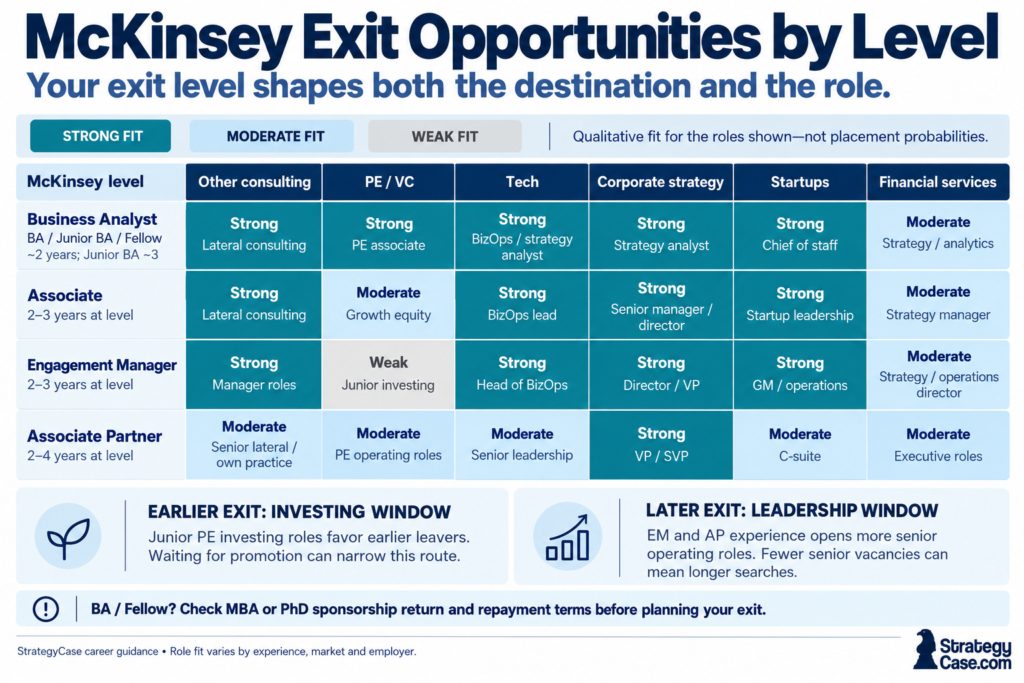
McKinsey exit opportunities by level. PE favors early leavers; director-level and operating roles favor Engagement Managers and above.
Two timing effects pull in opposite directions. Megafund PE recruits consultants early, so staying for the Associate or EM promotion can close that door. Corporate leadership roles work the other way: leaving one promotion too early can cost you a level at your next employer. The when to leave consulting guide covers each window.
If you’re a Business Analyst or Fellow, factor in firm sponsorship. McKinsey sponsors some consultants through an MBA or PhD, and I did my PhD on a McKinsey-sponsored educational leave. The return and repayment terms vary by office, and they shape your exit timing more than most people expect, so read yours before you plan anything else.
How Leaving McKinsey Works: Resigning, Counseled Out, or “On Search”
McKinsey runs on up-or-out: consultants who aren’t progressing toward the next level are eventually told to find their next role. Fortune’s 2025 analysis describes the expectation as making partner within about six years on average, or moving on. Most people leave well before that point.
What sets McKinsey apart is how openly it manages exits. Fortune also reported that the firm often helps departing consultants land prominent roles elsewhere instead of quietly managing them out. Three exit routes are common:
| Route | How it works at McKinsey | What to watch |
|---|---|---|
| Resigning for a role you chose | The most common route. You run the search while staffed and tell your partners once you have an offer or are in final rounds. | Bonus timing, notice period in your contract (often longer in Europe than in the US), and any sponsorship repayment terms |
| Counseled out after reviews | Development feedback first, then a conversation about your next step. In the US, Fortune reported underperforming consultants get three months to show improvement. | The length of your transition period and how references will describe your departure |
| “On search” | In 2024, McKinsey’s UK office offered hundreds of managers up to nine months of company time to find a new job, with career coaching and résumé support and no client work. After nine months, they had to leave whether or not they had an offer. | The clock. Treat month one as search time, not recovery time |
The context matters. McKinsey’s headcount fell from about 45,100 at the end of 2023 to about 40,000 by May 2025, according to Fortune, and the firm attributed the drop to “normal attrition and performance review firings.” More people are leaving at once, at more levels, so a counseled-out exit carries less stigma than it did a few years ago. The consulting job market guide tracks the current state of hiring and layoffs.
If you’ve been counseled out, four moves matter most: get the transition terms in writing, start the search in week one, line up a partner and an engagement manager who will speak to your best work, and build your story around where you’re going rather than how you left. The consulting exit opportunities guide has the full playbook for running a search while you’re still staffed, and compares McKinsey with BCG and Bain.
Using the McKinsey Alumni Center When You Leave
Every former McKinsey employee can register for the McKinsey Alumni Center, the firm’s official alumni platform. Four of its features matter for an exit:
| Feature | What it does for your search |
|---|---|
| Directory | Search alumni and current Firm members by name, office, company, and other filters. It’s the fastest way to find someone who made the exact move you want. |
| Career support | Access and post job opportunities, share your profile, and use transition resources. |
| Recruiter board | Corporate recruiters post roles and search alumni who have flagged themselves as looking. |
| Events and learning | Alumni events, webcasts, and Firm learning courses. |
The community is large and active. McKinsey’s alumni team put it at 70,000 people worldwide in September 2025, and Fortune reported that the firm runs about 180 alumni gatherings a year and that roughly 90% of former consultants engage with at least some of its programs regularly.
One thing the official pages don’t say: membership is the firm’s to grant. In 2025, McKinsey removed me from its alumni network for helping hundreds of candidates get into the firm. You’re unlikely to face that, but the principle applies to every leaver. The network works through relationships you keep warm, with partners and colleagues who will still take your call in five years. Leave in a way that keeps those doors open.
Before You Resign: Options Short of Leaving McKinsey
Some exits are really a request for a break, a degree, or a different kind of work. McKinsey has formal routes for each, and they’re worth checking before you resign:
- Take Time. McKinsey’s program lets consultants take up to 10 weeks of additional unpaid time off per year, according to its careers blog. If the hours are the problem, a planned break can fix it without an exit.
- Sponsored educational leave. An MBA or PhD on leave keeps your place at the firm and widens your options afterward. This is the route I took for my PhD.
- Orphoz. Orphoz describes itself as a McKinsey company focused on implementation and transformation, and its consultants work alongside McKinsey teams, either in tandem or in sequence. It suits people who want to execute change rather than recommend it. The Orphoz interview guide explains how hiring works there.
A useful test before any of these: are you moving toward a specific role, or only away from the hours? Exits driven only by burnout often land in another high-intensity job. If the answer is “away,” try a break first and decide once you’ve recovered.
Matching Your McKinsey Experience to an Exit
The logo gets you interviews. Your staffing history decides whether you get the offer, because each destination tests something specific.
| Destination | Share of MBB leavers | What makes a McKinsey consultant credible | What they test | In-depth guide |
|---|---|---|---|---|
| Other consulting, in-house strategy, independent work | 16.6% (consulting and services) | A sector or functional specialty, senior client relationships | Case interviews at your level, plus fit | Case interviews for experienced hires |
| Tech: BizOps, strategy, product | 13.1% software, 7.2% hardware | Tech client work, metrics fluency, something you ran rather than recommended | Product sense, analytics, behavioral loops | Consulting to big tech |
| Corporate strategy and operating roles | Spread across every industry row | Repeated work in one sector, an owner’s mindset | Case-style problem solving, leadership questions | Consulting to corporate strategy |
| Startups and founding | 6.3% founders | Execution with thin resources, financial runway | Work trials, operating cases | Consulting to startups |
| Private equity | Part of 5.1% (VC and PE) | Diligence experience, a practiced modeling test, a sector view | LBO modeling test, paper LBO, case study | Consulting to private equity |
| Growth equity and venture capital | Part of 5.1% (VC and PE) | Sector theses, operating exposure | Investment memos, market maps | Growth equity, venture capital |
| Hedge funds | Not broken out | Deep sector knowledge, real stock views | Stock pitch, modeling | Consulting to hedge funds |
My own exit sits in the first row. I left McKinsey in 2020, founded StrategyCase.com officially the same year, and I’m still an active consultant and advisor alongside it. That row is the largest for a reason: a McKinsey background converts most directly into more advisory work, as long as you bring a specialty clients will pay for.
It also means case interviews come back for many McKinsey leavers, usually at a higher bar, because you’re now assessed as a senior hire. If you’ve just joined the firm or are about to, Consulting Career Secrets, my book for new consultants, covers the path from your first day to a well-planned exit.
Should McKinsey’s Exit Opportunities Decide Whether You Apply?
If you’re reading this before you’ve applied, here’s the honest version.
The exits are real, but they come from what you do at the firm. The McKinsey name opens interviews across industries. Your level, your sector depth, and the work you led decide the offer at the other end.
The payoff is mostly long-term. The first job after McKinsey is often a lateral move or a level reset. The C-suite record builds over 10 to 20 years, and part of it reflects who McKinsey hires in the first place.
So the better question is whether you want the work. If two to five years of intense problem solving, travel, and steep feedback sounds worth it on its own terms, the exit options are a bonus that compounds. If you only want the exit, there are shorter routes into most of the destinations above.
Your background is a starting point, not a verdict. McKinsey hires through undergraduate, MBA, advanced-degree (PhD, MD, JD), and experienced-hire tracks. Roughly 30% of the clients I coach at StrategyCase come from non-traditional paths: engineers, medical doctors, lawyers, and academics. What decides your chances is where your problem solving stands today, and you can find that out before you apply.
Frequently Asked Questions
What are the most common exit opportunities for McKinsey consultants?
Other consulting and advisory roles, financial services, and tech. In a 2025 LinkedIn analysis of 1,644 people who left McKinsey, BCG, or Bain, those industries took 16.6%, 13.7%, and 13.1% of leavers. Corporate strategy roles appear inside every industry. Private equity and venture capital took 5.1%. No public dataset splits these numbers for McKinsey alone.
Can I move from McKinsey into private equity or venture capital?
Yes, but it’s a narrow path. PE and VC employers took 5.1% of MBB leavers in the 2025 data. Your odds are best as a Business Analyst or early Associate with diligence experience and a practiced modeling test, because megafunds recruit consultants early. VC hires the fewest consultants and favors sector depth or operating experience.
How long do people usually stay at McKinsey before leaving?
Most leave within a few years. Management Consulted estimates average consulting tenure at 2 to 4 years, and Fortune reports McKinsey expects consultants to make partner within about six years on average or move on. Business Analysts typically reach a stay-or-go decision around year two. I stayed five years before leaving in 2020.
Does McKinsey help you find a job when you leave?
Yes. Former employees can use the Alumni Center’s directory, job board, and transition resources, and recruiters can search alumni who flag themselves as looking. For some people being managed out, McKinsey has offered paid search time: in 2024, its UK office gave hundreds of managers up to nine months, with career coaching, to find their next role.
Is McKinsey worth it for the exit opportunities?
For most people, yes, if you also want the work. The brand opens interviews across industries, and the long-run record is strong: Fortune counted at least 18 Fortune 500 CEOs among McKinsey alumni in 2025. But the first job after McKinsey is often a lateral move or a level reset, so join for the training and the work, not for an automatic title jump.
Are McKinsey exit opportunities better than BCG’s or Bain’s?
At the first-job stage, they’re broadly similar, and your staffing matters more than the firm. McKinsey’s advantages show up later: the largest alumni network, at about 70,000 people, and the strongest Fortune 500 CEO record. Bain’s large private equity practice gives its consultants more diligence exposure, which helps for PE.
Related Guides
- McKinsey vs BCG vs Bain: how the three firms compare on culture, work, and careers
- Consulting networking: how to run alumni conversations that turn into referrals
- Consulting resume guide: how to rewrite McKinsey bullets into quantified, destination-specific impact
- Work-life balance in consulting: what the hours really look like, and when they’re fixable without leaving
- How to get promoted in consulting: if staying for the next level is the better exit move
The Bottom Line on McKinsey Exit Opportunities
McKinsey exit opportunities run on two clocks. On the first, the next job, McKinsey leavers look a lot like other MBB leavers: mostly other consulting, financial services, tech, and corporate strategy roles, often at individual-contributor or manager level, with PE a narrow path for early leavers. On the second, ten or twenty years out, McKinsey’s record is stronger than any other company’s on Fortune’s CEO count. Your level, your sector depth, and how you leave decide which version you get.
If you’re still on the way in, every one of these exits starts with an offer, and your background is a starting point, not a verdict. Find out where you actually stand: take the StrategyCase 2-minute diagnostic to see your single biggest bottleneck, what to work on in the next two weeks, and whether your timeline is realistic. If the result raises questions, book a free intro call with me. The same diagnostic is a quick check if you’re leaving McKinsey for a role that brings case interviews back.
About the author: Dr. Florian Smeritschnig is the founder of StrategyCase.com and a former McKinsey Senior Consultant who evaluated candidates for the firm. Since 2020 he has delivered 2,200+ mock interviews and coaching sessions, and his clients have secured 700+ consulting offers, 340 of them at McKinsey, BCG, and Bain. He is the author of three books on consulting interviews and careers, including The 1%: Conquer Your Consulting Case Interview.
