

Last Updated on May 29, 2026
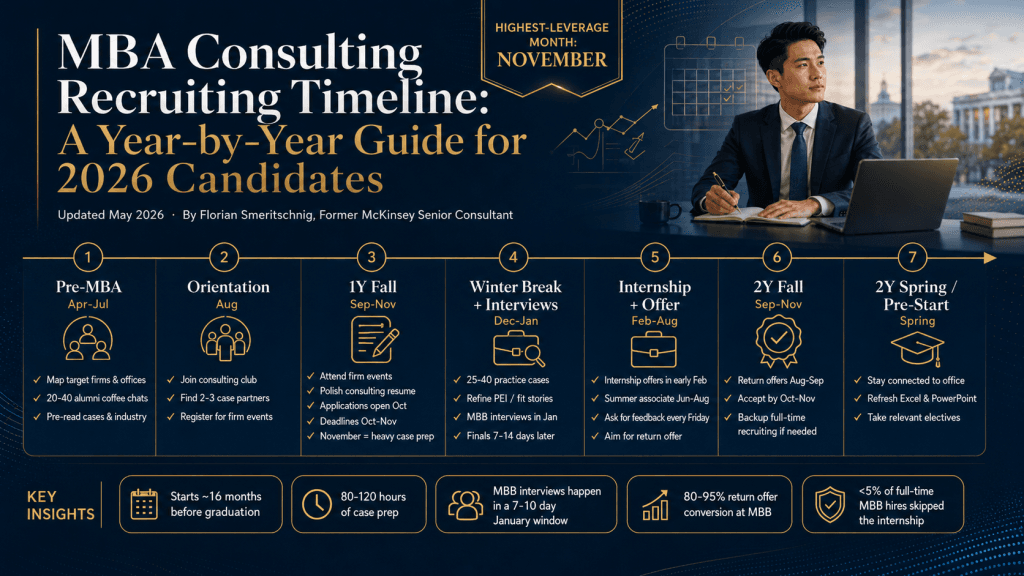
Updated May 2026 · By Florian Smeritschnig, Former McKinsey Senior Consultant
MBA consulting recruiting runs on a tight 20-month cycle. Pre-MBA networking starts in the spring before you matriculate, internship resumes drop in October-November of your first year, MBB case interviews happen in January, and full-time offers for most candidates are wrapped by October of your second year. Miss a single window and you are usually playing catch-up.
The cycle looks orderly on paper. In practice, most MBA candidates I coach underestimate how front-loaded the calendar is. By the time you arrive on campus, the strongest recruiters have already had three months of conversations with firms. The students who land MBB offers are not always the smartest in the class, they are the ones who treated recruiting like a project plan from the day they got their admit.
This guide gives you the month-by-month plan I wish every candidate had before starting their MBA. It is built from coaching hundreds of candidates into McKinsey, BCG, Bain, and other top firms, plus my own five years inside McKinsey and its recruiting funnel. No vague advice. Exact deadlines, exact behaviors, exact mistakes to avoid.
Key Takeaways
- The cycle starts ~16 months before you graduate: pre-MBA networking from April-July of your admit year is non-optional if you want to land MBB
- Internship interviews are January of first year, usually within 7-10 days of returning from winter break, leaving roughly 90 days of structured case prep
- Summer associate return offers convert at 80-95% across MBB for candidates who avoid two specific mistakes (covered below)
- Full-time offers without summer experience are rare at MBB, under 5% of full-time MBA hires didn’t intern with the firm first
- The single highest-leverage month is November of first year: that is when applications close, case prep should be in flow, and weak candidates fall out
Why the MBA Consulting Recruiting Timeline Is Unforgiving
Consulting is the most schedule-driven recruiting cycle on any MBA campus. Investment banking is close, but consulting is tighter. MBB firms run a near-synchronized calendar at the top 15 US programs and INSEAD, LBS, and IESE in Europe. The dates barely move year to year.
That synchronization helps firms compare candidates head-to-head. It hurts candidates who arrive unprepared. I have watched a Wharton candidate with a Goldman background lose his Bain shot because he started case prep in December. He had three weeks. He needed eight. The math just does not work.
Three structural realities make this timeline unforgiving:
- Internship interviews drive the cycle. McKinsey, BCG, and Bain hire ~80-90% of their MBA full-time class out of the summer associate program. Miss the internship cycle and your full-time odds drop sharply.
- MBB synchronizes interview dates. Across most target schools, McKinsey, BCG, and Bain interview within the same 10-day window in late January. You cannot serially recruit MBB the way undergrads sometimes attempt, you are interviewing for all three at once.
- Case prep takes 80-120 hours done properly. Even if you start the day school begins in August, that is 5 months to do it well alongside coursework. Most candidates do it poorly because they underestimate the time.
The candidates who win are the ones who treat the calendar as a hard constraint and reverse-engineer everything from January 1st of their first year.
Phase 1: Pre-MBA (Spring–Summer Before You Matriculate)
The window between accepting your MBA admit and arriving on campus is the most under-utilized period in the entire cycle. Most admits use it to travel and rest. The candidates who land MBB offers also use it to build a head start that is impossible to manufacture later.
April–May: Map the Firms and Decide Your Target Profile
Decide which firms you are targeting before you arrive on campus. “All of MBB plus a few Tier 2” is fine as a working answer, but you need to know the office, the practice area, and the realistic backup options.
Concrete actions:
- Read the firm websites for office, practice area, and recent project examples
- Pull MBA placement reports from your incoming school to see where students actually go
- List 2-3 target offices per firm, geography matters more than candidates think for sponsorship and starting team
- If you are sponsored or returning, confirm your firm’s MBA reimbursement and re-entry terms in writing
May–July: First Wave of Pre-MBA Coffee Chats
This is the single biggest pre-MBA lever. Reach out to alumni from your incoming program who are now at MBB. Ask for 20-minute calls. Not for advice (vague) but for specifics: how did they recruit, what did they wish they had known, who else should they connect you with?
Take Priya, who got into Booth with a non-traditional engineering background. She used April-July before matriculation to do 15 alumni calls, McKinsey, BCG, Bain, and four Tier 2 firms. By the time orientation hit in August, she had eight named referrals who knew her story. She landed three MBB internship interviews and accepted Bain Chicago. The calls were not magic. They were front-loaded relationships that the rest of her class spent September scrambling to build.
Realistic volume: 15-20 calls over three months is achievable without burning yourself out. Anything below 10 is undercutting yourself.
July–August: Pre-Read on Cases and Industry
You do not need to start cracking cases yet. You do need to get the basic vocabulary down so the first weeks of school are not a frantic catch-up. Read a foundational text on case interviews and skim industry primers for sectors you might target.
For a deeper look at what to read before formal prep, the comprehensive case interview guide at StrategyCase covers the full skill landscape and is built for first-time case interviewees and experienced case candidates alike.
Phase 2: Pre-Term and Orientation (August)
You are on campus. Recruiting season has not started, but the foundation laid in August determines who is positioned in October.
Join the consulting club immediately. Every target MBA program has one (Wharton MCC, HBS HMCC, Booth MCG, Kellogg CC, Sloan MCC, etc.). Memberships fill fast. The club runs case prep groups, hosts firm events, and gives you a peer network that is essential for 1-on-1 case practice in October-January.
Identify your case prep partners. You need 2-3 reliable partners who will commit to 4-5 cases per week from October through January. Pick people who are at your level or slightly above. Casing with a peer who is 6 weeks ahead of you is gold. Casing with someone 6 weeks behind is a drag.
Sign up for every firm presentation in September. Not because they teach you anything (they don’t), but because attendance is tracked. Showing your face matters at the margin.
Want a clear case playbook for your MBA recruiting? The Case Interview Academy at StrategyCase is specifically built for candidates targeting January internship and full-time interviews.
Phase 3: First Year Fall, September to November
This is where the recruiting machine starts. The cycle moves fast and the work compounds. Treat September-November as a single intensive sprint.
September: Firm Events and Resume Submission Prep
MBB hosts on-campus events in September at every target school. Presentations, coffee chats, lunches, dinners. Attend everything. Bring questions that show you have read about the firm. Avoid the generic “What do you like about McKinsey?”, it marks you as unprepared. Here’s our consulting networking guide.
Update your resume to consulting format. One page, quantified bullets, no buzzwords. This is the single document that decides whether you get the interview, so it deserves real time. The consulting resume guide covers the exact format MBB recruiters expect and the bullet patterns that get pulled forward.
October: Applications Open
McKinsey, BCG, and Bain typically open their MBA summer associate applications in early-to-mid October. Deadlines fall in mid-to-late October at most US programs and early November at some European programs.
The application package usually includes:
- Online application form with academic and work history
- Resume (1 page, consulting format)
- Cover letter (firm-specific, 1 page)
- Recommendation references (variable by firm)
- Transcript
Submit the application 7-10 days before the deadline. Late submissions could get reviewed last and are reviewed by tired screeners.
November: Case Prep Intensifies + Interview Invitations
By early November, you should be doing 4-5 practice cases per week with partners plus daily drills on structuring, charts, and case math. The candidates who treat November as the warm-up are already behind. November is the work month.
Interview invitations usually arrive between mid-November and mid-December. Not getting an invitation in this window does not always mean rejection, some schools have rolling invite waves into December. But if you are at a target school and have heard nothing by December 15, the signal is real.
This is also the month where most candidates have their first honest case feedback session and discover that what they thought was structured thinking is actually pattern-matched framework recitation. Better to learn it in November than in January. Here is our case interview framework guide.
Phase 4: Winter Break and January Interview Sprint
Winter break is the most important two weeks of your entire MBA recruiting cycle. Treat it accordingly.
Mid-December to Early January: Compressed Case Prep
You have 14-21 days with no coursework. Most candidates run 25-40 cases in this window with rotating partners. Aim for 2 cases per day, alternating between giver and receiver. Add daily drills (the Case Interview Academy comes with 100s of drills we use in coaching that are calibrated to interview pressure).
Also, refine your fit interview stories. McKinsey runs the Personal Experience Interview (PEI), BCG and Bain run behavioral interviews with their own preferred dimensions. For more, check our consulting fit interview guide. You need polished stories, answers, and narratives that cover your motivation, skills. and fit, as well as leadership, drive, impact, and collaboration. Most candidates massively under-prep this part and lose offers on fit, not on cases.
Mid-to-Late January: First Round Interviews
First round interviews typically happen in the first half of January, usually within a 10-day window for all three MBB firms. Format is usually two interviews per firm: one case + one fit, or back-to-back cases with fit blended in.
A second round (final round) follows within 7-14 days for candidates who pass first round. Final rounds are typically held at the firm office (or virtually in some cases) and run 3-4 interviews. Decisions usually arrive within a week. Some firms run only one round of interviews, a superday.
January or Early February: Internship Offers and Decisions
Most internship offers land in late January or early February. You typically have 2-4 weeks to decide. If you have multiple offers, use the time to revisit your office, practice area, and culture fit with the help of alumni calls.
Phase 5: Spring and Summer Internship (February–August)
Once you have signed the offer, the pressure shifts. You are now preparing to perform as a summer associate at a firm where return offer conversion is the next milestone.
February–May: Pre-Internship Prep
Use this period to:
- Connect with your assigned office (networking contacts, staffing coordinator)
- Attend any sponsored events or office visits
- Brush up on Excel, PowerPoint, and basic financial modeling
- Read your office’s recent industry reports
- Check out the book Consulting Career Secrets, which helps interns get return offers
Do not over-prepare. The firm assumes you arrive with the case-interview skill set, not the consultant skill set. They will train you.
June–August: The Summer Associate Engagement
You will typically work on one engagement for 8-10 weeks. Performance is evaluated by your Engagement Manager, the partner on the project, and a few senior colleagues you interact with. Return offer decisions are usually made in early August.
The three mistakes that cost MBA summer associates return offers, which I cover in depth in the MBA summer associate consulting recruiting, are:
- Going invisible on the team: Not becoming a full and active participant in internal discussions, client meetings, and problem-solving sessions.
- Failing to own the work: Not taking responsibility for workstreams, deliverables, deadlines, and mistakes when they happen.
- Showing a weak learning curve: Not demonstrating visible improvement, not seeking feedback actively, and not showing the potential to grow into a full-time consultant.
Avoid these three mistakes, and you stay firmly in the conversation for the return offer.
Phase 6: Second Year Fall, Return Offers and Backup Recruiting
Return offer decisions arrive in August or early September. The conversation then turns to second-year recruiting strategy.
Scenario A: You Got the Return Offer (Most Common)
If you converted your summer offer at MBB, you typically have until October-November of your second year to accept. Use this window to:
- Visit the office if you have not already
- Talk to consultants you would be staffed with
- Negotiate start date (some firms allow 6-12 months of delay for travel or other commitments)
- Sign and put recruiting fully behind you
About 80-95% of MBA summer associates at MBB receive return offers. Among that group, acceptance rates are typically 70-85%, with the dropouts going to PE/VC, startups, or sponsored returners going back to their pre-MBA firm.
Scenario B: No Return Offer (Less Common But Manageable)
If you did not convert, full-time recruiting for MBB in September-November of second year is possible but tight. Some firms recruit for full-time slots that summer interns declined. Slots are limited and competitive. Realistic backup paths include:
- Tier 2 firms (Oliver Wyman, Strategy&, Roland Berger, AlixPartners, LEK)
- Corporate strategy roles at Fortune 500 companies
- Pivot to industry roles (tech strategy, banking, PE)
- A second swing at MBB through a Tier 2 firm with 2-3 years of experience
October–November: Full-Time Offer Acceptance
Most full-time MBA offers are signed by October-November of second year. The cycle for converted summer interns is largely done. New full-time recruiting (for those without summer offers) is more uncertain, some firms run into early spring, others close earlier.
Phase 7: Second Year Spring, Pre-Start Preparation
You have signed. The pressure is off. Use the spring of your second year wisely.
Stay connected with your team. Attend office events when possible. Coffee chats with your future colleagues build the relationships you will rely on in your first 6 months.
Prep for the consultant role itself. Read books on the consulting work life. Touch up Excel and PowerPoint. Brush up on the industries your office is strong in.
Take electives that build relevant skills. Strategy, operations, advanced analytics, behavioral economics. Avoid taking only “easy A” classes, they signal nothing and waste an expensive year of education.
Do not over-prep. The firm trains you on the actual consultant skill set when you arrive. Showing up burnt out from over-prep is a worse opening than arriving fresh and curious.
The Three Highest-Leverage Decisions in the MBA Consulting Recruiting Timeline
After coaching hundreds of MBA candidates through this cycle, three decisions matter disproportionately:
1. The Pre-MBA Networking Decision (April–July)
Doing 20 alumni calls before matriculation creates a head start that is almost impossible to close for candidates who skip it. The students who land MBB at competitive schools (Wharton, HBS, Booth, Kellogg, Sloan, Stanford GSB) overwhelmingly come from the pre-MBA networking cohort.
2. The November Case Prep Decision
If you arrive at December break with weak structuring, weak math, and weak fit stories, the 14-day winter break will not save you. The candidates who pass MBB first rounds in January almost always had 60 hours of case prep banked by Thanksgiving.
3. The Summer Associate Engagement Decision
Every conversation, every analysis, every feedback session in your summer compounds toward the return offer. Treat it as the most important 10-week project of your career so far. The conversion rate gap between “great summer” and “good summer” is the difference between a 95% offer probability and a 60% one.
Frequently Asked Questions
When does MBA consulting recruiting start?
Officially, MBA consulting recruiting starts in September of your first year with firm presentations and application openings. Realistically, the candidates who land MBB offers begin in April-July before matriculation with pre-MBA networking calls to alumni. The application cycle for summer associate positions closes in October-November at most US programs.
When are MBA consulting interviews?
MBB first round interviews are typically held in early January of your first year, usually within a 10-day window for McKinsey, BCG, and Bain combined. Second round (final round) interviews follow within 7-14 days. Most internship offers are extended in late January or early February.
How long does it take to prep for MBA consulting interviews?
Most candidates who land MBB offers prep for 80-120 hours total across August-January. That breaks down to roughly 20-30 hours in September-October on foundations, 30-50 hours in November-early December on case practice and fit stories, and 25-40 hours during winter break in compressed final prep. Trying to compress this into 4-6 weeks is the most common mistake.
What is the difference between MBA summer associate and full-time consulting recruiting?
MBA summer associate recruiting is the primary path: applications in October, interviews in January of your first year, internship in summer between your first and second year. Full-time recruiting (without a summer internship) is a backup path that runs in September-November of your second year, with very limited slots, at MBB, over 90% of full-time MBA hires interned with the firm first.
Do I need to recruit for MBB on campus, or can I apply to other offices?
Both are possible. On-campus recruiting at target MBA programs is the most efficient path because firms run a structured process there. Off-cycle applications to non-target offices (e.g., an LBS student applying to McKinsey Dubai or a Booth student applying to BCG Singapore) are common and accepted, but you are responsible for managing the timeline and process yourself, which means longer cycles and less structured feedback.
How important is the MBA consulting club for recruiting?
Somewhat important but not mission critical. The consulting club gives you access to case prep partners, alumni contact databases, firm-specific intel from second-years who just went through recruiting, and structured prep sessions.
Can I recruit for both consulting and other industries?
Yes, but the calendars conflict. Investment banking interviews run a similar timeline to MBB. Tech product management interviews and PE/VC interviews are more spread out but still time-intensive. Most successful candidates focus 80-90% of recruiting effort on one industry with 10-20% as exploratory backup. Trying to fully recruit for two industries simultaneously usually produces weak outcomes in both.
Related Guides
- MBA Summer Associate Consulting Recruiting
- MBA vs Direct-Entry Consulting: Honest ROI Analysis
- MBA Sponsorship Programs at MBB
- MBA Diversity Programs by MBB
- Wharton Consulting Recruiting
- HBS Consulting Recruiting
- INSEAD Consulting Placement
- Booth Consulting Recruiting
- Kellogg Consulting Recruiting
- MIT Sloan Consulting Recruiting
- Stanford GSB Consulting Recruiting
- Consulting Case Interview Guide
- Consulting Fit Interviews: Complete Guide
- Consulting Resume Guide
Relevant MBB Recruiting Pages
- McKinsey & Company: View student programs, early access events, and internship details on the McKinsey & Company Students Careers page.
- Boston Consulting Group (BCG): Find internship opportunities, early career tracks, and recruiting events on the BCG Careers Early Careers page.
- Bain & Company: Explore MBA-specific pathways, summer associate roles, and fellowships via the Bain & Company Internships & Programs portal.
Where to Go From Here
The MBA consulting recruiting timeline rewards candidates who reverse-engineer the calendar and start earlier than their peers. Three concrete next steps:
- Map your personal calendar against this timeline today. Identify which phase you are in and what is due in the next 30 days.
- If you are pre-matriculation: start building your alumni call list this week. Aim for 20 calls before orientation.
- If you are on campus: join the consulting club, identify 2-3 case partners, and start daily drills no later than the first week of October.
For the deeper case interview prep that determines your January performance, the Case Interview Academy at StrategyCase is built for MBA candidates targeting MBB and includes the structuring, math, chart, and communication modules calibrated to the modern interview. For personalized feedback on your specific gaps, 1-on-1 coaching with Florian is the fastest way to close them before January.
The MBA consulting recruiting cycle is brutal on candidates who underestimate the calendar. It is generous to those who treat it as a project plan and execute. The 1% who land MBB offers do not work harder than everyone else, they start earlier and they prep smarter.
About the author: Florian Smeritschnig is a former McKinsey Senior Consultant who has conducted 2,200+ mock case interviews and helped hundreds of candidates land offers at McKinsey, BCG, Bain, and other top firms. He is the founder of StrategyCase.com and the author of The 1%: Conquer Your Consulting Case Interview.
