
Last Updated on July 23, 2026
Updated July 2026 · By Florian Smeritschnig, Former McKinsey Senior Consultant
If you reach McKinsey’s final round this year, you may meet an unfamiliar third party at the table. Next to the interviewer and the case sits, at least in the US pilot running since early 2026, Lilli, McKinsey’s in-house generative AI. The task: work through a business problem together with the machine. Prompt it, read the output, question it, sharpen it, and compress it into a recommendation.
This is the leading edge of a broader shift in AI in consulting interviews, and it tells you where elite hiring is heading. What gets scored is explicitly not what the AI produces. It is how the candidate handles it: whether they probe with curiosity, distrust a weak suggestion, take it apart, and end up taking their own position.
I spent years in McKinsey’s strategy consulting work and recruiting candidates, and I now work with MBB applicants every day.
My first reaction to the news was not surprise. It was: of course. This was only a matter of time.
Key Takeaways
- AI is moving into the interview itself. McKinsey has piloted its Lilli AI in 2026 final rounds, mostly for US business analysts, and Bain is reportedly building its own AI-enabled component for summer 2026.
- The AI’s answer doesn’t count. Your judgment does. Candidates are judged on how they prompt, challenge, and synthesize the output, not on what the machine returns.
- This is continuity, not a break. The consulting interview was always a simulation of the job. The job changed, so the simulation changed with it.
- It makes the case fundamentals more important, not less. Only someone who can structure a problem can direct a machine through it.
- The two sure ways to fail: ignore the AI and hope it doesn’t reach you, or hand it your thinking and rubber-stamp whatever it says.
What “AI in the consulting interview” actually means
AI-assisted consulting interview (in its current form): An interview format in which the candidate solves a business case while using a generative AI tool in real time. The interviewer evaluates the candidate’s judgment, how they prompt, question, and synthesize the AI’s output, rather than the answer the AI produces.
Picture the regular case interview with one change. Instead of doing all the analysis in your head and on paper, you have an AI assistant in the room, and how you use it becomes part of the evaluation.
The clearest live example is McKinsey. For the firm-specific mechanics and a preparation plan, I cover the format in detail in the dedicated guide to the McKinsey AI interview. This piece steps back to the bigger question: not what one firm is testing, but where the entire hiring model is heading, and why.
This is the next logical step, not a break with tradition
This is not a one-off or a PR stunt. Bain is reportedly building its own AI-enabled interview component for summer 2026, with the same emphasis on how a candidate reasons rather than what the AI generates. The details are not officially confirmed, and the focus is still the US market and entry-level roles. But the logic does not stop at a border, and formats like this spread fast. It is a question of months, not years, before a meaningful share of any applicant class, including in Europe and Asia, has to plan for it.
Anyone who sees this as a break with the tradition of the consulting interview never really understood that interview.
It is the opposite of a break. It is the most consistent continuation of a logic that has held for half a century.
The consulting interview was always a simulation of the job
The selection process at the strategy firms was never built to quiz you on knowledge. It was always built to simulate the job, as realistically as 30 minutes allow.
The case is a client project in fast-forward. A sharpened business situation that tests exactly the skills that matter on the job: structuring a problem, forming a hypothesis, analyzing with incomplete data, and reaching a recommendation, all while staying composed under pressure. If you want the full mechanics, our guide to case interview fundamentals breaks them down. The case is a working trial in the firm’s real operating mode.
The fit interview tests the other half of the job: motivation, values, leadership, and how you handle conflict and resistance. At McKinsey this is the Personal Experience Interview, and those are not academic virtues. They are daily demands on anyone who has to hold up in front of clients.
Both formats follow the same design principle: show me in the interview what you will do on the project. Take that principle seriously and the AI component is not an innovation. It is a necessity. Because the job the interview is meant to simulate looks different today than it did three years ago.
The work changed, and it changed fundamentally
What a first-year consultant actually does has shifted at a remarkable pace. The classic junior work, pulling data together, building models, producing slides, is moving into the machine.
Kate Smaje, McKinsey’s global leader for technology and AI, put it bluntly to Bloomberg: “Do we need armies of business analysts building PowerPoints? No, the technology can do that.” Her qualifier is the important part. It is not necessarily about fewer analysts, but about freeing them to do “the things that are more valuable for our clients.”
The numbers behind it are substantial. McKinsey reports roughly 72% active adoption of Lilli, more than 500,000 prompts a month, and up to 30% time savings on searching and synthesizing knowledge. Even a few minutes saved per prompt adds up, at that volume, to tens of thousands of hours a month that the firm redirects out of pure preparation and into hypothesis testing and client dialogue.
Lilli has long since grown from a knowledge tool into an orchestration layer. McKinsey CEO Bob Sternfels gave the scale a formula in early 2026. Asked how many people work at McKinsey, he now answers “60,000: 40,000 humans and 20,000 agents” (in a later interview the agent count was already 25,000).
Bain has walked the same road: ChatGPT Enterprise for the whole workforce, an in-house platform called Sage, and more than 19,000 GPTs the teams built themselves. By its own account, close to a third of its client work now revolves around AI and technology.
Translated, the human’s value-adding contribution moves from producing the analysis to directing, checking, and owning it. Today’s junior commissions and orchestrates the machine, reads its output against the grain, sees what is missing, and decides what reaches the client. The AI delivers a first draft in 30 seconds.
Scarce is the judgment about whether the answer is right.
So what gets tested changes too
When the job shifts, the simulation has to shift with it, or the interview ends up testing work that no longer exists.
That is exactly why AI in the interview is not a gimmick. It adds a third test to the old pairing of thinking (the case) and character (the fit). That third test is collaboration with the machine. Several consistent reports on the McKinsey pilot we collected from our clients describe the same decisive signal: what gets checked is not whether you can operate a tool, but whether you distrust the output, catch its gaps, and land on a judgment of your own.
Here is the point most people miss.
The AI does not make the classic case craft obsolete. It makes it more important.
Only someone who can structure a problem can steer a machine through it.
Only someone with their own hypothesis notices when the AI sounds plausible but is wrong.
Only someone who understands the business knows which of ten AI suggestions you can put in front of a board, and which nine you cannot.
If you cannot think, you cannot delegate.
What this means for candidates
If you are preparing for MBB right now, this changes your prep, though not in the way most people assume. It is not about prompt-engineering tricks. What gets tested is judgment, not tool knowledge. For the firm-specific tactics, the McKinsey AI interview and Bain AI interview guides go deep. At the level of principle, five shifts matter.
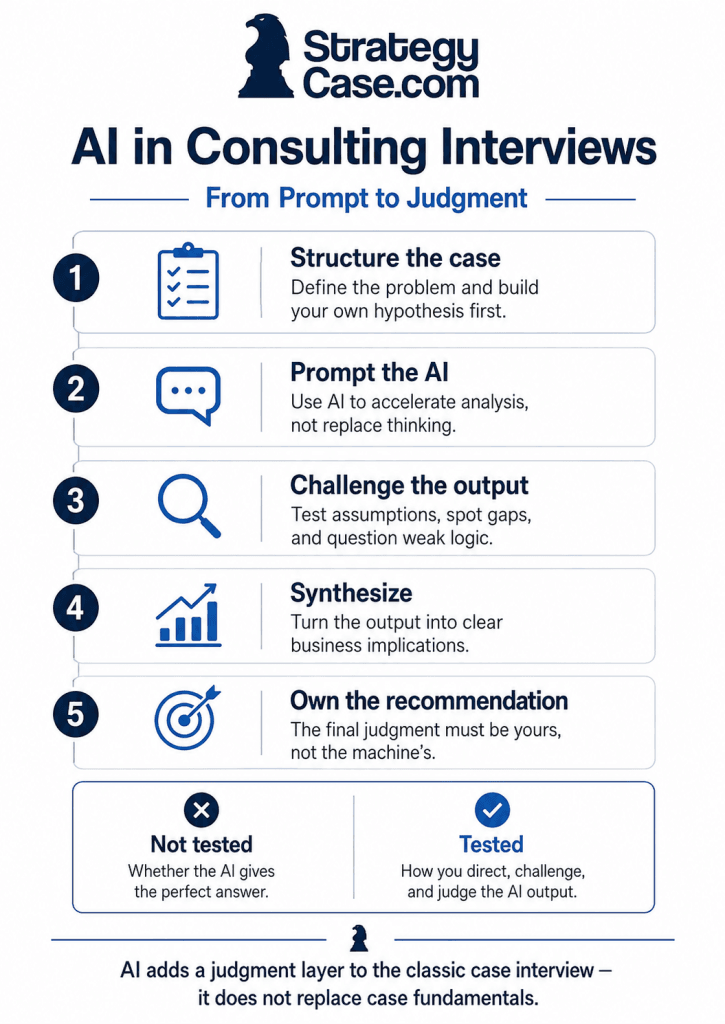
- Treat AI output like an intern’s first draft, not an oracle. The core skill being tested is healthy skepticism. Read along out loud, flag what is unsupported, ask for the source, look for the counterargument. The moment you accept the output and say “looks good,” you have failed.
- Structure first, prompt second. The case craft is worth more now, not less. Go in with your own hypothesis and a clean structure, and use the AI to test and accelerate it, not to replace it. Directing a machine assumes you know where you are going.
- Think out loud with the machine. Practice what you already train in the case, structure, hypothesis, synthesis, now in dialogue with a tool. Prompt, dismantle the output, sharpen it, compress it, in front of an audience and under time pressure. It feels unnatural at first. A few reps in and it becomes routine.
- Own the recommendation. It is not the AI sitting in front of the client at the end. It is you. The machine may supply the path. The decision and its reasoning have to be yours. Take a position, even against what the model proposed.
- Build real fluency, starting today. Use the tools in your studies, your side job, your own projects, until handling them is second nature. And make that experience visible: resumes are increasingly pre-screened automatically, so relevant AI projects belong high on the page.
AI in Consulting Interviews: From Prompt to Judgment
The case interview is not dead. The opposite is true.
The fundamentals, structuring, math, communication, and composure, count more than ever. This is the same gap between what candidates prepare and what firms actually test that StrategyCase has argued for years, now with a sharper edge.
There are only two sure ways to fail this new round.
The first is to ignore the AI and hope it does not apply to you. The second is to hand it your own thinking.
The mirror was updated, not replaced
The consulting interview was always a mirror of the job. It never asked whether a person knows facts. It asked whether they can think, judge, and take responsibility. That question has not changed. What changed is the world it is asked in, a world where the first draft is free and arrives in seconds.
That is why there is now a third chair at the table. Not because the firms want to know whether you can operate an AI, but because they are asking the same question they always have, this time under the conditions of the job you will actually do tomorrow.
If you want help building that judgment under real interview pressure, 1-on-1 coaching with Florian and the Case Interview Academy are built around exactly the skills this new round exposes, structuring, hypothesis, and synthesis, not memorized templates. That is the StrategyCase approach, and it is the one the AI interview rewards.
Frequently asked questions about AI in consulting interviews
Is AI really being used in consulting interviews?
Yes, though it is still early. Since January 2026, McKinsey has piloted its Lilli AI in some final-round interviews, mostly for US business analyst candidates, and Bain is reportedly preparing an AI-enabled component for summer 2026. No firm has published a fully official format yet, so treat the specifics as evolving.
Which firms use AI in their interviews?
McKinsey is the clearest live example with its Lilli pilot. Bain has signaled a similar move for 2026. Given how fast these formats spread and how deeply AI now runs through MBB client work, expect more firms and more offices to follow.
Will AI replace the case interview?
No. The AI component sits on top of the case, it does not replace it. Structuring, math, communication, and composure matter more than before, because you now have to direct a machine instead of just doing the work yourself.
Does the AI grade my answers?
No. The AI does not score you, and its output is not the thing being judged. The interviewer evaluates how you prompt, challenge, and synthesize, in other words your judgment, not the machine’s answer.
Do candidates outside the US need to worry about this yet?
Probably soon. The pilots are US-focused for now, but formats like this rarely stay regional. European and other international candidates should assume it could appear in their cycle and prepare on that basis.
How should I prepare for an AI-assisted interview?
Master the case fundamentals first, then rehearse solving cases out loud while using an AI tool: prompt it, pull its output apart, sharpen it, and own the final recommendation. The firm-specific guides linked above cover the tactics in detail.
Related guides
- The McKinsey AI interview: what Lilli tests and how to prepare
- The Bain AI interview: what’s real and how to prepare
- Consulting case interviews: the comprehensive guide
- When consulting interview preparation misses the mark
About the author: Florian Smeritschnig is a former McKinsey Senior Consultant and the founder of StrategyCase, where he coaches candidates for the world’s top consulting firms. At McKinsey he advised clients in the Travel, Transportation, and Logistics practice, and was involved in local recruiting. Since founding StrategyCase, he has delivered more than 2,200 mock case interviews and coaching sessions and helped generate over 700 offers at McKinsey, BCG, Bain, and other leading firms. He is the author of three books on consulting recruiting and careers: The 1%: Conquer Your Consulting Case Interview, The 1%: Case Interview Workbook, and Consulting Career Secrets.
Sources: StrategyCase.com client reports; McKinsey on Lilli adoption and usage (mckinsey.com); Kate Smaje, interview with Bloomberg; Bob Sternfels on McKinsey’s human-and-agent workforce, Fortune and HR Grapevine; reporting on McKinsey’s final-round AI pilot.
A version of this article was previously published in German for consulting.de
