

Last Updated on September 23, 2026
Updated September 2026 · By Florian Smeritschnig, Former McKinsey Senior Consultant
McKinsey vs BCG vs Bain. They pay within a rounding error of each other, recruit from the same schools, and open nearly identical doors. Pick McKinsey for brand and global staffing, BCG for AI and technology work, and Bain for team culture and private equity exposure. That is the whole ranking debate, resolved.
Most candidates spend their time arguing the question anyway. They read forum threads comparing prestige, they poll friends, and they lose two or three weeks of the recruiting window to a decision that changes very little about their first two years.
The comparison that actually deserves your time is a different one: the three firms screen and interview you in noticeably different ways, and the gap between those processes is far wider than the gap between the firms themselves. I spent five years at McKinsey as a Senior Consultant, where I evaluated candidates, and I have since delivered 2,200+ mock interviews across all three formats. Below is what genuinely separates the three, and how to choose.
Key Takeaways
- Pay is not a differentiator. The three firms sit within a rounding error of each other at every level, so compensation should not decide anything.
- The interview processes differ more than the firms do. McKinsey runs an interviewer-led case plus the PEI, BCG and Bain run mostly candidate-led cases, and all three use a different pre-interview screening test.
- BCG is the AI firm right now. It reported $14.4 billion in 2025 revenue, with AI and technology services making up more than 40% of it.
- Bain is the private equity and culture pick. It has topped Glassdoor’s Best Places to Work a record seven times and is the strongest Big 3 platform for deal and due diligence work.
- Apply to all three. The preparation transfers almost completely, and turning down interviews to “focus” is the most common self-inflicted wound in MBB recruiting.
McKinsey vs BCG vs Bain: The Short Answer
There is no best firm. There is a best fit, and it comes down to what you want out of the first two years and what you want the brand to do for you afterward.
| If you want this | Pick | Why |
|---|---|---|
| The strongest brand and the widest exit options | McKinsey | Largest footprint, deepest public sector and healthcare work, most recognizable name outside consulting |
| Front-row seat to AI and technology work | BCG | AI and tech now make up over 40% of revenue, and the firm is growing fastest of the three |
| Private equity, due diligence, and deal work | Bain | Roughly a third of its business is PE, more than either rival |
| The best team culture and the least travel | Bain | Local staffing model, record seven Glassdoor number-one finishes |
| Early partner exposure and a flatter structure | BCG | Smaller case teams, debate-friendly culture, less hierarchy than McKinsey |
| Global mobility and international staffing | McKinsey | One-firm partnership model staffs consultants across borders more than either rival |
If you’re still deciding what these firms even are before you decide between them, start with the overview of the Big 3 consulting firms. This page assumes you already know that part and are past it.
Not sure which of the three fits your background? A single coaching session that starts with a skills baseline will tell you more about where you stand than another week of forum reading.
What Is Identical at All Three (And Why the Ranking Debate Is a Trap)
Before the differences, the honest part. Four things candidates treat as tiebreakers are not tiebreakers at all.
Pay. The three firms track each other so closely at every level that the difference is noise. Signing bonuses and performance bonuses move more than base salary does, and both vary by office and by year more than by firm. You’ll find the exact bands in our breakdown of McKinsey salaries by level, and the BCG and Bain equivalents are linked at the bottom of this page. Compare them and you will find yourself deciding on something else.
Prestige. McKinsey has the strongest name recognition with people outside consulting, which matters if your parents, your future in-laws, or a non-business hiring manager are the audience. Inside consulting, private equity, and top corporate recruiting, all three are read as the same tier. The gap that forums argue about is real but small, and it shrinks every year you spend after the job.
Exit options. All three place people into private equity, corporate strategy, startups, and senior operating roles. Bain skews more toward PE, McKinsey more toward large corporates and the public sector, BCG sits between them. Those are tilts, not walls.
Selectivity. All three accept well under 1% of applicants. None of them is the easy one.
The candidate who applies to all three has a dramatically better shot. The ranking question feels important but is usually a waste of time.
Where McKinsey, BCG, and Bain Actually Differ
The real differences are structural, and they show up in your daily life as a consultant rather than on your resume.
| Dimension | McKinsey | BCG | Bain |
|---|---|---|---|
| Staffing model | Global. You can be staffed across borders regularly | Regional, with global options | Local. Mostly staffed from your home office |
| Typical travel | Highest of the three | Moderate | Lowest of the three |
| Hierarchy | Most formal and structured | Flatter, debate-friendly | Flattest in feel, team-first |
| Signature strength | Public sector, healthcare, breadth | AI, technology, innovation | Private equity, consumer, results focus |
| Research output | Heaviest (McKinsey Global Institute) | Heavy (BCG Henderson Institute) | Lightest of the three |
| Footprint | 130+ cities in 65+ countries | ~100 offices in 50+ countries | 67 cities in 40 countries |
| Culture in one line | “Obligation to dissent” | Intellectual and idea-led | “A Bainie never lets another Bainie fail” |
A few notes on the numbers. BCG publishes its results, and its 2025 report puts revenue at $14.4 billion, up 7%, with AI and technology services making up more than 40% of the total.
The footprint figures come from the firms themselves: Bain’s own site states 67 cities in 40 countries, and McKinsey’s site states 130+ cities in 65+ countries. McKinsey and Bain are private partnerships that do not publish financials, so any revenue figure you see for either is an estimate.
On the culture point, Bain reports that it has taken the number one spot on Glassdoor’s Best Places to Work list a record seven times and has been the only company to rank consistently in the top four since the list began in 2008.
One cultural detail is worth more than any ranking. When I was at McKinsey, the obligation to dissent wasn’t a poster on the wall. A 24-year-old analyst was expected to speak up when the data pointed the other way, in front of a partner, in front of the client. That norm is exactly what the firm screens for in interviews, and it is a genuinely different experience from a culture built primarily around team harmony.
The Difference Nobody Compares: How Each Firm Screens You
This is the part that should actually shape your plan, and it’s missing from typical comparisons. The three firms test the same underlying skills, structured problem solving, quantitative reasoning, business judgment, and communication, but they package the test differently at every stage.
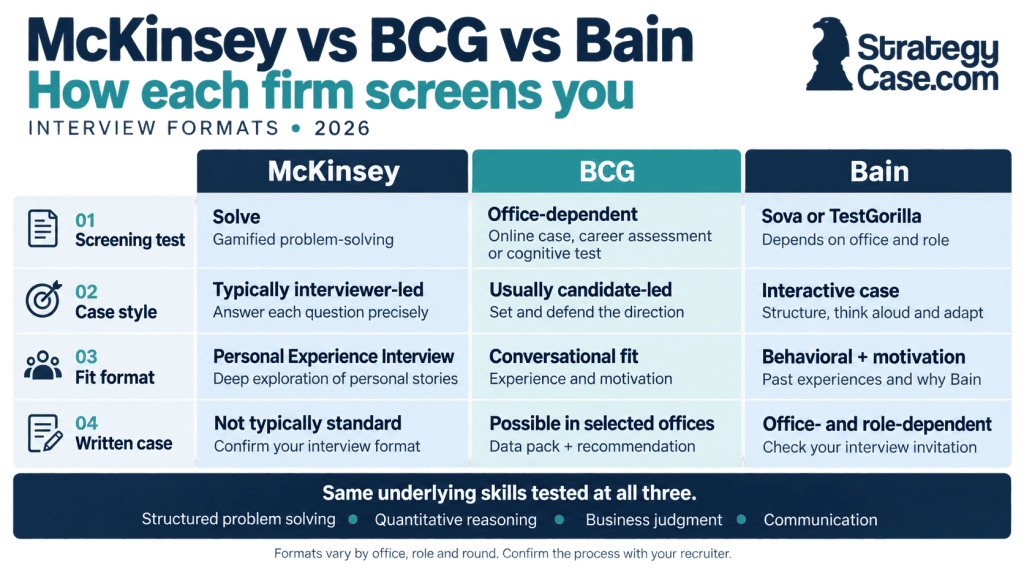
McKinsey: Interviewer-Led Case Plus the PEI
McKinsey screens most candidates with McKinsey Solve, a scenario-based game that assesses how you make decisions, not what business knowledge you have. Then the live interview runs in two parts.
The case is interviewer-led. Your interviewer drives the question sequence and you answer each part in turn, which means you’re graded on the quality of each individual answer rather than on how you steer the whole problem. The fit half is the McKinsey PEI, a structured drill into one personal story per dimension, pushed to a depth that catches most candidates off guard. Expect to be asked what you were thinking and feeling at a specific moment, three or four layers in.
Best suited to: candidates who are disciplined and precise but not natural drivers of an open conversation, and who have genuinely deep personal stories rather than a broad set of shallow ones.
BCG: Candidate-Led Case Plus an Online Case or Cognitive Test
BCG’s screening layer is the most fragmented of the three and varies by office and by year. You may get the BCG Online Case (Casey), a chatbot-driven case, the BCG Consulting Career Assessment or the BCG Cognitive Test, or a video interview, or Pymetrics. Check what your specific office runs rather than assuming.
The live case is mostly candidate-led. You’re expected to set the direction, say what you want to look at next, and defend that choice. It rewards candidates who can hold the thread of a problem on their own.
The fit portion is more conversational than McKinsey’s PEI and less structured. Some offices and rounds also add a written case, where you get a data pack and build a recommendation under time pressure.
Best suited to: candidates who think out loud well, are comfortable being challenged mid-answer, and would rather drive than be driven.
Bain: Answer-First Case Plus Aptitude Testing
Bain screens with aptitude tests, most commonly the SOVA test, sometimes alongside TestGorilla, Pymetrics, or a HireVue video.
The live case is candidate-led like BCG’s 50% of the time and interviewer-led for the remaining 50%, but with a distinct house style. Bain teaches and expects the answer-first approach: lead with your recommendation, then prove it. Candidates trained on a McKinsey-style build-up, where you lay out structure and work toward a conclusion, routinely stall in a Bain case because the interviewer wants the conclusion in the first 20 seconds. Bain also runs a written case in many offices.
Best suited to: candidates who are decisive and comfortable committing to a view early with incomplete data.
That last point is the single most common preparation failure I see across the three firms. Someone builds a clean McKinsey-style structuring habit over six weeks, walks into a Bain interview, and gets marked down not for weak thinking but for burying the answer. The skills transfer. The delivery does not, and nobody tells candidates that until it costs them a round.
If you want the shared foundation underneath all three formats first, work through the complete case interview guide before you worry about firm-specific style.
Ready to build the skill rather than memorize three sets of templates? The Case Interview Academy drills the underlying structuring, math, and chart skills all three firms test, then adapts the delivery per firm.
Which Firm Fits Your Profile?
The right answer shifts with where you’re coming from.
Undergraduates. Apply to all three. At this level the firms are close to interchangeable in what they offer you, and your odds matter far more than your preference. If your school is a core target for one firm and not the others, weight that.
MBA candidates. Your school’s recruiting relationships matter more than any firm-level difference. Look at which firm sends the most partners to your campus, which alumni will actually take your call, and where your classmates have converted offers in the last two cycles.
Experienced hires. This is where the firms genuinely diverge. Different firms run distinct entry tracks and a separate technical interview for specialist profiles. Levels, titles, and the amount of credit you get for prior experience differ meaningfully across the three. Read the detail in our guide to experienced hires at McKinsey, BCG, and Bain before you pick a target.
PhDs and advanced professional degrees. All three run dedicated APD tracks. McKinsey’s is the most established and the most structured, which usually makes it the strongest first target for this profile.
Non-target candidates. Apply to all three without exception. Your constraint is getting a first-round interview at all, not choosing between firms. A single referral will do more for your odds here than any firm choice.
Region matters more than candidates expect. The balance between the three flips by market. In parts of Europe and the Middle East, BCG or Bain can be the stronger local brand and the larger local office. Look at office headcount and partner count in the city you are actually applying to, not at the global ranking.
Should You Apply to All Three?
Yes, in almost every case. Here is the practical reasoning.
The preparation is shared. All three test the same core skills. The firm-specific layer, Solve versus Casey versus SOVA, PEI versus conversational fit, answer-first versus build-up, is maybe 15% of your total prep time once the foundation is in place. Applying to one firm doesn’t save you 60% of the work. It saves you a fraction of it and cuts your odds by two thirds.
That ratio is why every StrategyCase preparation path starts with the shared skills and layers firm-specific delivery on top, instead of running three separate tracks.
The processes run in parallel. MBB recruiting timelines overlap heavily, especially in the typical cycles. You’re not sequencing three attempts, you’re running three at once.
Rejection is firm-specific and time-boxed. Each firm applies its own waiting period before you can reapply, typically counted in months to a couple of years and varying by firm, office, and the stage you reached. Getting dinged by one does not touch the other two. Burning your one application on your “favorite” firm and being told to wait 18 months is a genuinely bad outcome that candidates walk into every year.
Office choice matters more than firm choice. In most MBB applications you name an office, and that decision carries real weight: headcount, language requirements, local competitiveness, and whether they’re hiring at all this cycle. Candidates agonize over the firm and then pick the office casually. It should be the other way around.
For the application mechanics themselves, the pillar on how to get into consulting covers resume, cover letter, and referrals end to end.
How to Choose Between Two MBB Offers
A good problem, and a surprisingly common one. Pay won’t break the tie and neither will prestige, so use criteria that actually vary.
Score each offer on these five:
- The people you actually met. You will spend more waking hours with your case teams than with anyone else. Which interview process left you wanting to work with those people? This is the single best predictor of how happy you will be, and candidates consistently under-weight it.
- The office, not the firm. How big is it, how fast is it growing, what industries does it serve, and who are the partners you would work under? A strong Bain office beats a weak BCG office in the same city, every time.
- Travel and staffing reality. Ask each office directly how much travel a first-year does and how staffing assignment works there. The answer varies more by office than by firm.
- Your realistic exit. If you’re aiming at private equity, Bain’s PE weighting is a real advantage. If you want the public sector or a large-corporate leadership path, McKinsey’s brand and client base tilt your way. If you want to work on AI transformation, BCG is where that work concentrates today.
- Where you will be promoted, not just hired. Ask about the ratio of analysts to associates at that office and how many people made the last promotion cycle. It is an uncomfortable question and it tells you more than any brochure.
What people regret later is almost never the firm on the resume. It is the office, the travel, and the team.
McKinsey vs BCG vs Bain: FAQ
Is McKinsey more prestigious than Bain?
Slightly, and mostly outside consulting. McKinsey has the strongest general name recognition of the three, so it reads as more prestigious to people who don’t work in the industry. Inside consulting, private equity, and top corporate recruiting, McKinsey, BCG, and Bain are treated as one tier.
Which Big 3 consulting firm pays the most?
None of them meaningfully. Base salaries at McKinsey, BCG, and Bain sit within a rounding error of each other at every level, and the variation between offices and between bonus years is larger than the variation between firms. If you’re choosing on pay, you’re choosing on noise.
Is it harder to get into McKinsey or BCG?
McKinsey is usually seen as harder because its brand attracts the largest applicant pool, which pushes its acceptance rate lower. In practice all three accept well under 1% of applicants and the interview bar is close to identical. The bigger difference is format: McKinsey’s interviewer-led case and PEI suit a different candidate than BCG’s candidate-led case.
What is the difference between the McKinsey, BCG, and Bain interviews?
McKinsey runs an interviewer-led case plus the PEI, a structured drill into one personal story per dimension. BCG and Bain both run mostly candidate-led cases, where you set the direction. Bain adds its answer-first style, meaning you lead with the recommendation and then prove it. Each firm also uses a different screening test: Solve at McKinsey, the Online Case or Cognitive Test at BCG, and aptitude tests such as SOVA at Bain.
Can I apply to McKinsey, BCG, and Bain at the same time?
Yes, and you should. The firms recruit in parallel, they don’t penalize you for applying elsewhere, and the preparation overlaps almost entirely. Each firm applies its own waiting period after a rejection, so a ding at one has no effect on the other two.
Which MBB firm is best for private equity exits?
Bain, by a clear margin. Private equity work makes up roughly a third of its business, more than at either rival, which means more deal and due diligence exposure early and stronger relationships with funds. McKinsey and BCG both place people into PE, just from a smaller base of relevant project work.
Related Guides
- GPA Requirements for McKinsey, BCG, and Bain: the academic record each of the three actually expects.
- The Big 3 Consulting Firms Explained: Breakdown of size, revenue, footprint
- The Consulting Fit Interview Guide: how to build the personal stories all three firms ask for.
- BCG Salary and Hierarchy: exact compensation by level at BCG.
- Bain Salary and Hierarchy: exact compensation by level at Bain.
- The McKinsey Case Interview: the firm-specific guide to the interviewer-led format.
The Bottom Line on McKinsey vs BCG vs Bain
McKinsey, BCG, and Bain are more alike than the internet suggests. They pay the same, they hire from the same places, they test the same skills, and they open the same doors. Treat the ranking question as settled and spend the time you save on the parts that actually change your odds.
Three things to do next:
- Apply to all three. Choose your offices carefully and your firm loosely, not the reverse.
- Build the shared foundation first. Structuring, case math, communication, and chart interpretation are graded identically at all three firms.
- Layer the firm-specific delivery last. Solve, Casey, and SOVA for the screens. Interviewer-led plus PEI for McKinsey, candidate-led for BCG, answer-first for Bain.
The candidates who get MBB offers are the ones who built genuine problem-solving skill and then adapted it to three different rooms. Start your MBB preparation with StrategyCase and build the skill all three firms are actually testing.
About the author: Florian Smeritschnig is a former McKinsey Senior Consultant who evaluated candidates at the firm and has delivered 2,200+ mock interviews and coaching sessions. Through StrategyCase, he has helped 700+ candidates win offers at McKinsey, BCG, Bain, and other top firms.
