
Updated November 2026 · By Florian Smeritschnig, Former McKinsey Senior Consultant
The PwC online assessment in the UK is an SHL test in three parts: an unassessed values activity, an untimed behavioral profile, and a timed cognitive test of numerical, inductive, and deductive reasoning. Pass it and an SHL on-demand video interview follows. PwC US runs something else: an untimed work-style questionnaire of about 15-20 minutes, with no math at all.
Many guides still prepare you for Career Unlocked, the Arctic Shores game PwC UK used in earlier cycles. PwC UK’s own page no longer mentions a game. And since PwC UK accepts one application per intake year, preparing for the wrong test can cost you a full year.
Every PwC-specific fact below comes from PwC’s own careers pages in the UK, the US, and Central and Eastern Europe, read in November 2026. You’ll get each stage, what it measures, two worked practice questions, and a seven-day preparation plan.
Key Takeaways
- PwC UK’s online assessment runs on SHL in three parts: “Bringing our values to life” (not assessed), an untimed behavioral profile, and a timed cognitive test of numerical, inductive, and deductive reasoning.
- Career Unlocked isn’t on PwC UK’s current page. The only PwC game-based assessment I found on an official PwC page is in Central and Eastern Europe, and it runs on HireVue, not Arctic Shores.
- PwC US uses a work-style questionnaire with no aptitude questions: untimed, about 15-20 minutes, “Which statement describes you best?” items. Results stay valid for 120 days and aren’t shared with you.
- The UK invite usually gives you seven days, and PwC offers practice tests once you’re invited. Use them before you start: a failed attempt means waiting for the next intake year.
- The video interview is scored by a person. PwC UK says an assessor reviews your recorded answers and that it doesn’t use AI to assess candidate performance in its Early Careers process.
What Is the PwC Online Assessment?
Definition: The PwC online assessment is the first screening stage after you apply to PwC. In the UK it combines a behavioral profile with a timed cognitive test on SHL’s platform. In the US it’s a short work-style questionnaire. It decides who moves on to PwC’s video interview (UK) or live interviews (US).
The format depends on the country and the level you apply at. Here’s what PwC’s own pages say:
| Where you apply | What you take | Timing | Platform |
|---|---|---|---|
| UK, early careers (entry level, undergraduate, graduate) | Values activity (not assessed), behavioral profile, cognitive test of numerical, inductive, and deductive reasoning | Profile untimed, cognitive test timed | SHL, named by PwC |
| UK, experienced hires | Depends on the role: numerical or verbal ability tests, a case study or in-tray exercise, a personality questionnaire | Ability tests timed | Named in advance; PwC points to SHL’s practice tests |
| US, entry level | Work-style questionnaire (“Which statement describes you best?”) | Untimed, about 15-20 minutes, can be paused | Not named; PwC’s help-desk form goes to SHL |
| Central and Eastern Europe, graduates | Game-based assessment, about three minutes per game | No more than 15 minutes | HireVue (browser or HireVue app) |
Sources: PwC UK assessment and selection process, PwC UK experienced-hire assessments, PwC US assessment FAQs, PwC CEE game-based assessment. All read November 16, 2026.
PwC online assessment by region in 2026: SHL tests in the UK, a work-style questionnaire in the US, HireVue games in Central and Eastern Europe
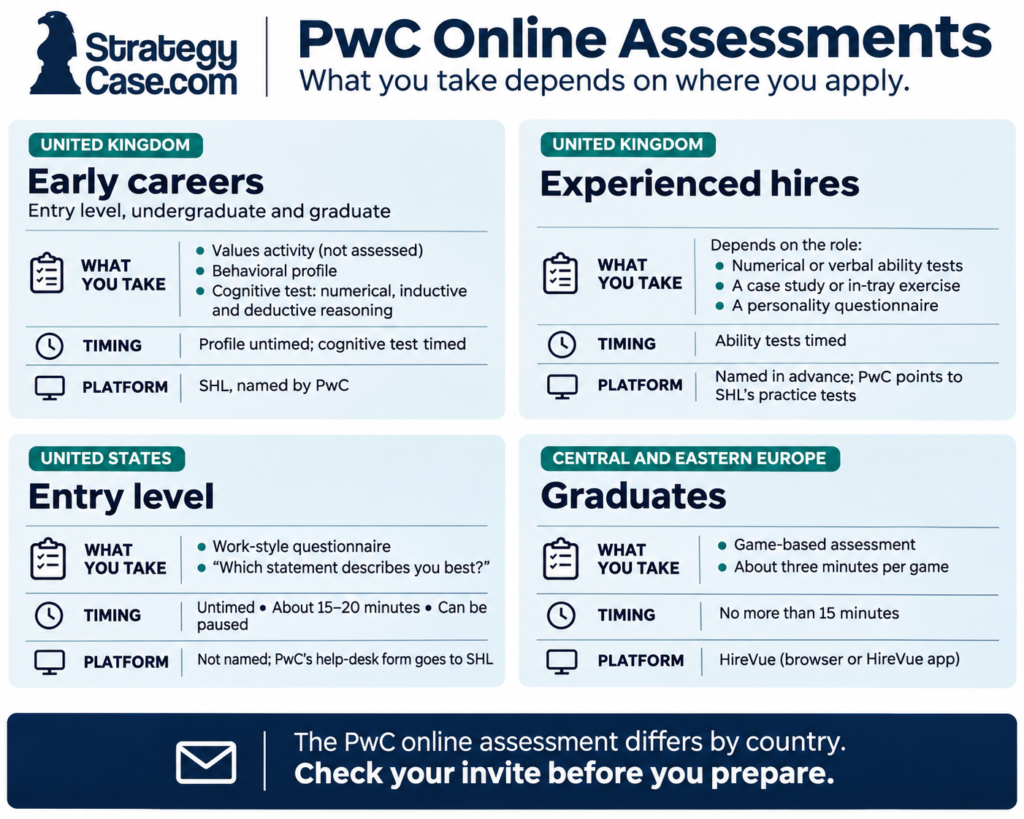
Figure: The PwC online assessment differs by country. Check your invite before you prepare.
Most of this guide covers the UK process. The US questionnaire gets its own section further down.
Is PwC Career Unlocked Still Used?
Not in the UK, going by PwC’s own page. PwC UK’s assessment page, checked on November 16, 2026, says the test is hosted on SHL and describes a behavioral profile and a cognitive test. It doesn’t mention a game, Arctic Shores, or Career Unlocked.
Career Unlocked is the name candidates and prep guides used for PwC UK’s game-based assessment from Arctic Shores. Arctic Shores builds task-based assessments that infer how you work from the way you play, and it has named PwC as a customer in its own announcements. Many prep sites still describe Career Unlocked as PwC’s current test.
The one PwC game-based assessment I found on an official PwC page today is in Central and Eastern Europe, and it runs on HireVue. PwC CEE describes games of about three minutes each, no more than 15 minutes in total, measuring mental agility, reasoning, numerical ability, and how you approach new problems. You get a working-style feedback report afterward, and you can retake the assessment after six months. The HireVue interview guide explains how HireVue’s games and scoring work.
This kind of drift happens with every online test. When we rebuilt StrategyCase’s Bain SOVA practice tests in November 2026, the verbal and situational judgment sections that older guides still describe no longer showed up in our recent candidate reports. Formats change between recruiting seasons, and guides rarely catch up.
So before you prepare, open your invitation email and check which provider and which tasks it names. If it does say Career Unlocked or Arctic Shores, you’re facing a behavior-based game, and the timed-reasoning advice below won’t apply. Our Arctic Shores assessment guide covers that test instead.
The PwC UK Online Assessment, Step by Step
PwC UK describes the online assessment as a series of activities measuring “your cognitive skills, behaviours, natural preferences and reasoning abilities,” hosted on SHL. It runs in this order.
PwC UK online assessment stages in 2026: values activity, untimed behavioral profile, timed cognitive test, SHL video interview
Step 1: “Bringing Our Values to Life” (Not Assessed)
PwC calls this a non-assessed activity. It shows you what working at PwC might feel like and helps you decide whether to continue with the process.
Take PwC at its word: nothing here is scored. It’s still worth reading properly. PwC’s behaviors page says you’ll go through “a series of workplace scenarios” during the assessment process, and this is your first look at how PwC frames them.
Step 2: The Behavioral Profile (Untimed)
PwC says this part asks about your “natural behavioural preferences in a work setting,” and it isn’t timed. Behind it sits the PwC Professional, the framework PwC says it uses to assess early careers candidates. It has two dimensions with three behaviors each:
| Dimension | Behavior | What it means (PwC’s framing, paraphrased) |
|---|---|---|
| Trusted Leadership | Inspire | You understand your impact, and people want to work with you |
| Trusted Leadership | Empower | You coach others and work side by side with them |
| Trusted Leadership | Evolve | You keep growing and help the team adapt to what’s next |
| Distinctive Outcomes | Champion | You commit to quality, integrity, and inclusive behavior |
| Distinctive Outcomes | Build | You bring a business mindset that adds to PwC’s success |
| Distinctive Outcomes | Deliver | You collaborate across PwC to deliver quality for clients |
Source: PwC UK, The behaviours we look for.
Answer the way you work, and picture a real situation from university, a job, or volunteering for each answer. PwC says these behaviors are considered throughout the process, including the assessments and interviews. A profile you invent has to hold up in the video interview and the assessment center too, where you’ll need real examples to back it.
Step 3: The Cognitive Test (Timed)
PwC describes this as “an ability test including numerical, inductive and deductive reasoning,” and it’s timed. PwC doesn’t name the SHL product.
SHL’s general ability test that measures exactly these three abilities is Verify Interactive G+. Per SHL’s factsheet, it allows 36 minutes for up to 24 questions in one sitting. It’s adaptive, so the questions adjust to your answers, and it’s interactive: you may adjust a chart or tap cells to complete a pattern instead of picking from A to E. Treat those numbers as the likely benchmark, not a confirmed PwC spec.
| Question type | What you do | Where candidates lose marks |
|---|---|---|
| Numerical reasoning | Interpret business tables and charts, then calculate shares, growth, and differences | Mixing up percent and percentage points; dividing by the wrong base |
| Inductive reasoning | Find the rule in a sequence of shapes and complete the next panel | Tracking only one rule when two change at once (position and color, say) |
| Deductive reasoning | Apply given rules to reach a conclusion that must be true | Picking what’s likely instead of what’s certain |
Your Seven-Day Window and PwC’s Own Practice Tests
PwC UK says each stage has a completion deadline in your invitation email, “usually seven days from receiving the invite.” Once you’re invited, PwC gives you the chance to take practice tests before you start the real one.
PwC’s Employability Hub also links to SHL’s free practice tests and says the most relevant ones for PwC are numerical reasoning, inductive reasoning, and the behavior-based test. You can take those before you even apply, which matters more than it sounds (more on that in the preparation plan).
PwC Online Assessment Practice Questions (Worked)
The two questions below are our own, written to match the skills PwC lists. They aren’t PwC or SHL questions. The real test may ask you to drag or adjust answers rather than choose a letter.
Worked Example 1: Numerical Reasoning
Audit hours by client
| Client | 2025 | 2026 |
|---|---|---|
| North Ltd | 1,200 | 1,500 |
| Harbour plc | 800 | 900 |
| Fenwick Group | 2,000 | 2,100 |
| Total | 4,000 | 4,500 |
By how many percentage points did North Ltd’s share of total audit hours change from 2025 to 2026?
- A) +3.3 percentage points
- B) +7.5 percentage points
- C) +11.1 percentage points
- D) +25.0 percentage points
Answer: A. North’s share was 1,200 ÷ 4,000 = 30.0% in 2025 and 1,500 ÷ 4,500 = 33.3% in 2026. That’s a rise of 3.3 percentage points.
Every wrong option is a real error:
- D (25.0) is the growth in North’s hours (1,500 ÷ 1,200 − 1). Correct number, wrong question.
- C (11.1) is the relative change in North’s share (33.3 ÷ 30.0 − 1). That’s a percent change, not percentage points.
- B (7.5) divides the 300 extra hours by the 2025 total, mixing two years in one ratio.
One more thing the table hides: Harbour’s hours grew 12.5%, yet its share stayed at exactly 20%. Growth and share answer different questions, and timed tests exploit that.
Worked Example 2: Deductive Reasoning
Five client meetings (Audit, Tax, Deals, Risk, and Legal) take five consecutive slots, numbered 1 to 5.
- Tax is in slot 2.
- Legal is immediately after Risk.
- Deals is not in the first or last slot.
Which of the following must be true?
- A) Deals is in slot 4.
- B) Audit is in slot 1.
- C) Risk is in slot 3.
- D) Legal is in slot 4.
Answer: B. Start with the most constrained piece, the Risk-Legal pair, rather than with the first rule. With Tax in slot 2, the pair fits only in slots 3-4 or 4-5. If it takes 3-4, Deals would need slot 1 or 5, which the third rule forbids. So Risk and Legal take slots 4 and 5, Deals takes slot 3, and Audit is left with slot 1.
The habit to build: place the piece with the fewest possible positions first. It turns a rule list into a two-case check, and that’s how you save time on a 36-minute clock.
How to Prepare for the PwC Online Assessment
Before You Apply
PwC UK accepts one application per intake year. If you’re unsuccessful, you wait for the next intake, and PwC says that even withdrawing before the online assessment counts. The invite then gives you about a week. That makes the time before you apply your real preparation window.
Use it for two things:
- Find your weakest reasoning type. Take SHL’s free numerical, inductive, and deductive practice tests once each, timed. Your lowest score tells you where the next two weeks go.
- Prepare six real examples, one per PwC Professional behavior. They keep your behavioral profile honest, and they’re the raw material for your video interview and assessment center.
A Seven-Day Plan Once the Invite Arrives
| Day | What to do | Why |
|---|---|---|
| 1 | Take PwC’s practice tests from your invite, first untimed, then timed | Learn the interactive answer format before it counts |
| 2-4 | Drill your weakest reasoning type in short timed sets, then review every error | Accuracy first, then speed |
| 5 | One full timed mock: about 24 mixed questions in 36 minutes | Pacing across all three types |
| 6 | Sort your mistakes: wrong base, missed rule, misread question | Most errors repeat in one category |
| 7 | Sit the real assessment, at a time you’re alert, in a quiet room | You only get one attempt this intake year |
If your invite arrives with less time than this, compress days 2-6. Don’t push the real attempt past the deadline in the email.
Practice for PwC’s online assessment with our
Big 4 Online Assessment Practice Tests
- 5 general ability mocks in SHL’s format: numerical, inductive and deductive questions, 24 in 36 minutes
- Untimed practice sets for each of those three question types, every question with a worked solution
- A video interview bank: 30 questions, 8 model answers and 3 timed recording drills
Follows the firms’ published UK formats. One-time payment, 1 year of access, full refund within 24 hours.
Mistakes That Cost Candidates the PwC Online Assessment
- Preparing for Career Unlocked when the invite says SHL. Game practice won’t help on a timed reasoning test.
- Trying to game the behavioral profile. Answers that don’t match how you work have to survive two more stages where you need real examples.
- Practicing multiple choice only. SHL’s interactive format asks you to build answers, so do PwC’s own practice tests to get used to it.
- Getting help, human or AI. PwC UK says it checks for duplicate accounts, highly similar responses, identical transcripts, and signs of third-party or AI support, and it withdraws applications where it finds them.
The PwC Video Interview (SHL On-Demand)
If you pass the online assessment, PwC UK invites you to an on-demand video interview, also on SHL. Questions appear on screen and ask you to describe your experience. There’s no live interviewer: your answers are recorded and reviewed afterward by one of PwC’s assessors.
PwC UK also states that it doesn’t use AI to assess candidate performance in its Early Careers process. A person watches your answers. PwC doesn’t publish how many questions you’ll get or how long you have per answer, so check your invite.
I never worked at PwC, so I can’t tell you what’s on its scoring sheet. What carries over from working with candidates at McKinsey is how recorded answers lose points.
Candidates describe what the team did instead of what they did. They stay general (“I’m a strong communicator”) instead of telling one specific situation. Or they spend half the answer on background and run out of time before the result.
Here’s how that looks for a prompt aimed at PwC’s Empower behavior, such as “Tell us about a time you helped someone else improve”:
- Weak: a claim about yourself (“I always support my teammates”), a group outcome (“we got a great mark”), and no detail anyone could check.
- Strong: one sentence of context, then what you specifically did (you noticed the problem, you changed how you worked with that person), the measurable result, and what you’d do the same way again.
Prepare your six behavior examples in that shape, and practice each one out loud to a timer. The consulting fit interview guide shows how to structure these stories so the result lands early.
The PwC US Online Assessment: A Work-Style Questionnaire
The PwC assessment US candidates get is a different first screen. According to PwC US’s assessment FAQs:
- It’s required for most entry-level roles. Senior associate intern and senior associate full-time roles, seasonal and fixed-term roles, and specialist roles are exempt.
- It arrives by email within a few hours of applying. Your application isn’t complete until the assessment is done, and both must be finished by the application deadline.
- It isn’t timed. PwC suggests setting aside 15-20 minutes. You can stop and come back, and your progress is saved.
- It asks only about your work style. PwC says preparation isn’t needed.
- Results stay valid for 120 days and are applied to your later applications. PwC doesn’t share them with you.
PwC published two sample items. One asks which statement describes you best: “I do not delay when making decisions,” “I always seek to understand the reason behind others’ behavior,” or “I am quick to come up with ways to solve problems.”
Every option is something an employer would like. That’s the design: a forced choice stops you from agreeing with everything, so your picks reveal what you put first.
Choose the statement that’s truest of you most often. If this would be your first job, PwC says to draw on school and volunteer activities. And because one result covers 120 days of applications, give it your full attention the first time.
After the US Assessment: Interviews and the Advisory Case
PwC US’s recruiting page says selected candidates usually do two consecutive live virtual interviews: one with behavioral questions and one with “Innovation Scenario-Based” questions about how you’d approach AI, technology, and new situations. PwC US doesn’t permit AI during the assessment or interviews.
Most Advisory roles add a case interview. PwC’s Advisory case prep page puts it at 30-45 minutes and lists what interviewers listen for: structured thinking, comfort with ambiguity, communication, business intuition and basic numeracy, and curiosity and coachability.
After the screen comes the case, and that’s a different skill set from any online test. If you’re aiming for PwC Advisory or consulting, start StrategyCase’s free Case Interview Foundations course as soon as your assessment is done. It teaches the case interview method from the ground up: 40+ videos, 7+ hours of instruction, and 200+ pages of reading.
What Happens After the PwC Online Assessment in the UK?
After the video interview, PwC UK’s early careers process continues with four more stages:
- Virtual assessment center. PwC calls it a “virtual immersive assessment centre” that assesses you against the core skills and attributes needed at PwC, both human and technical.
- Finding you the right role (graduate programs only). PwC matches you to a business area and office, and a recruiter call recaps your feedback from the earlier stages. Preferences are considered but not guaranteed.
- Business assessment. An in-person interview with a senior leader from your matched business area, held in that office.
- Offer, followed by pre-employment screening of your grades and job history.
Timing rules worth knowing, all from PwC UK’s FAQs:
- PwC UK gives September 17 as the opening date for graduate roles and September 30 for undergraduate and entry-level roles. Roles are filled on a rolling basis and can close early, so apply early.
- An outcome can take up to a month.
- PwC UK doesn’t offer deferred start dates, and offers can’t move to a later intake.
Experienced hires follow a different route: role-specific ability tests, possibly a case study or in-tray exercise, then a technical role assessment and a behavioral interview. PwC says it won’t use a personality questionnaire to screen experienced applicants out.
PwC Online Assessment FAQ
How do I pass the PwC online assessment?
Find out which test your invite names, then prepare for that test. For PwC UK’s SHL assessment, answer the untimed behavioral profile honestly and train the timed numerical, inductive, and deductive questions under a clock. Use the practice tests PwC gives you after the invite, and prepare real examples for each PwC Professional behavior before the video interview.
Is the PwC online assessment difficult?
The cognitive test is the hard part, mostly because of time pressure. SHL’s comparable general ability test allows 36 minutes for up to 24 adaptive questions, which adjust to how you’re doing. The behavioral profile and the US work-style questionnaire have no right answers and aren’t timed.
How long does the PwC online assessment take?
PwC UK doesn’t publish a total. The behavioral profile is untimed, and SHL’s comparable cognitive test runs 36 minutes, so block out at least an hour and don’t start in a rush. PwC US suggests 15-20 minutes for its questionnaire, and PwC Central and Eastern Europe’s games take no more than 15 minutes.
Is the PwC assessment a video?
Not the first part. The PwC UK online assessment is a behavioral profile plus a timed cognitive test. The video interview is the next stage: recorded answers on SHL’s platform, reviewed afterward by a PwC assessor. In the US, the interviews after the assessment are live and virtual.
How many people pass the PwC online assessment?
PwC doesn’t publish pass rates for any stage, so treat any percentage you see online as a guess. What PwC does publish is the cost of failing: in the UK, you can’t apply again until the next intake year. In the US, your result applies to your applications for 120 days.
Can I retake the PwC online assessment?
Not within the same intake year in the UK. PwC accepts one application per intake year, and a failed or withdrawn application means waiting for the next one. PwC Central and Eastern Europe lets you repeat its game-based assessment after six months. PwC US keeps your result on file for 120 days.
Related Guides
- Consulting assessment tests: every major consulting firm’s online test, from McKinsey Solve to the Big 4
- Big 4 case interviews: how Deloitte, PwC, EY, and KPMG run their case rounds
- What are the Big 4?: how the Big 4 compare with McKinsey, BCG, and Bain
- PwC consulting salary: PwC Advisory pay by level
Before You Start Your PwC Online Assessment
The PwC online assessment rewards candidates who prepare for the test they’ll sit:
- Check your invite first. PwC UK uses SHL, PwC US a work-style questionnaire, PwC Central and Eastern Europe HireVue games. Career Unlocked guides describe a test PwC UK no longer lists.
- Train the timed part. Numerical, inductive, and deductive reasoning under a 36-minute benchmark, with the interactive format in mind.
- Answer the behavioral parts as yourself, and back them with six real examples for the video interview.
- Prepare before you apply. One application per intake year makes the weeks before your application the safest time to practice.
When you’re ready for timed practice, get StrategyCase’s Big 4 Online Assessment Practice Tests. For PwC’s test, it has 5 general ability mocks in SHL’s format (24 numerical, inductive and deductive questions in 36 minutes each), untimed practice sets for each of those question types, and a video interview bank with model answers and timed drills. Every reasoning question has a worked solution. It costs $29 one-time with 1 year of access, and you get a full refund within 24 hours of purchase.
Do PwC’s free practice tests first, then use the kit for volume, timing, and the reasoning behind every answer. All questions are original. StrategyCase isn’t affiliated with Deloitte, PwC, EY, KPMG, SHL or Cappfinity.
The PwC online assessment is a format you can learn before test day. Learn it on your own schedule, well before the seven-day window opens.
About the author: Dr. Florian Smeritschnig is the founder of StrategyCase.com and a former McKinsey Senior Consultant who recruited candidates for the firm. Since 2020 he has delivered 2,300+ mock interviews and coaching sessions, and his clients have secured 700+ consulting offers, 340 of them at McKinsey, BCG, and Bain. He is the author of three books on consulting interviews and careers, including The 1%: Conquer Your Consulting Case Interview.
