
Updated November 2026 · By Florian Smeritschnig, Former McKinsey Senior Consultant
A Deloitte case interview is a conversational business problem you work through out loud with a Deloitte interviewer, usually in the same round as a behavioral interview. Deloitte says it scores clear thinking, practical judgment, and professional demeanor, not whether you reach the right answer. Its ten official practice cases make that concrete: only 4 of their 43 questions ask you to calculate anything.
Most candidates prepare for a different interview. They grind MBB-style cases and math drills, then get a case about a ransomware attack, a federal budget, or a warehouse valuation. There, the interviewer wants a prioritized view of what to check first, a position, and a clear next step.
I recruited candidates at McKinsey, not at Deloitte. So everything Deloitte-specific below comes from Deloitte’s own careers pages in five countries and from the answer keys of its ten practice cases, which I went through question by question. You’ll see the format by round, what the cases test, and how Deloitte’s own answer keys separate a good answer from a great one. I am also my experience from coaching clients for Deloitte interviews.
Key Takeaways
- Math is the exception. Deloitte’s ten official practice cases hold 43 questions, and only 4 require a calculation. Seven of the ten cases contain no math at all.
- Service-line knowledge is tested directly. Six of the seven undergraduate cases sit in a specialist area (cyber, forensic, forensic analytics, tech transformation, valuation) and ask questions a generic framework can’t answer.
- Half the cases ask what you’d need to know first. Five of ten include a question about which data, documents, or information you’d collect, which matches Deloitte New Zealand’s rule for senior hires: name the data that would prove or disprove your hypothesis.
- Deloitte’s answer keys separate “good” from “great.” In four cases they spell out the gap: great answers use the case’s own facts, prioritize, sequence the steps, and justify the logic.
- The rounds differ by country and arm. UK graduates discuss a topic they prepared in advance, Deloitte Australia runs a behavioral interview, a case for some roles, then a senior leader or Partner, and Monitor Deloitte’s Middle East practice ran a written case followed by a group case.
What Is a Deloitte Case Interview?
Deloitte case interview, defined: an interview in which a Deloitte professional presents a fictional version of a real client problem and asks you to work through it out loud. Deloitte uses it for Consultative Offerings roles and assesses your logic, judgment, and demeanor rather than a correct answer. Entry-level Audit & Assurance candidates get a scenario interview instead.
Deloitte’s US case and scenario interview tips page lists what it looks for in plain words: answers that “project clear thinking, practical judgment, and a professional demeanor.” It also gives the sequence it wants you to follow. Here is that sequence, with what each step sounds like in the room and where candidates usually slip.
| Deloitte’s step | What it sounds like | Where candidates slip |
|---|---|---|
| 1. Understand the issue | “Before I structure this, is the goal digital growth specifically, or total revenue?” | Asking ten questions. Deloitte says to ask, but not to use questions “as a crutch.” |
| 2. Identify the underlying assumptions | “I’m assuming the spending uplift applies to every visitor, not only to buyers.” | Skipping it entirely and jumping straight to a structure |
| 3. Summarize specific issues and findings | “Three things stand out in this data, and the second matters most.” | Reading the numbers back without saying what they mean |
| 4. State your recommendations | “Fund the website first.” | Hedging with “it depends” and never taking a position |
| 5. Outline next steps and expected impact | “Then fix the training gap before launch, or the new site stalls.” | Stopping at the recommendation |
The same page adds the habits Deloitte wants to see: take notes, share a framework and an initial hypothesis, take a moment before you answer, and “engage the interviewer in a business conversation.” That last line matters more than it looks, and I’ll come back to it in the preparation section.
Want to build those five steps as skills instead of a script? StrategyCase’s free Case Interview Foundations course walks through every part of the case, from the opening and structuring to exhibits, case math, and the final recommendation, with guided live practice. It also covers partner rounds and written cases. Start the free course →
Deloitte Case Interview Format: What Each Round Looks Like
Deloitte doesn’t run one global process. Each member firm and each arm sets its own rounds, and its pages say so (“some Deloitte business areas do not require a case study,” per Deloitte Australia). This is what Deloitte itself publishes, region by region.
| Where you’re applying | What Deloitte publishes | Source |
|---|---|---|
| US, entry-level Consultative Offerings | A case interview; practice tool for undergraduate and advanced-degree candidates. No published round count. | Deloitte US tips page and case prep tool |
| US, entry-level Audit & Assurance | A scenario interview, not a business case | Deloitte US tips page |
| Australia, experienced hires | First interview: behavioral, with your potential coach or manager. Second: a case study for some roles, sometimes shared in advance. Final: a senior leader or Partner. | Deloitte Australia |
| New Zealand | A case on a real or theoretical scenario, resolved “verbally, in writing, or in both formats.” Higher bar from Senior Analyst/Consultant up. | Deloitte New Zealand |
| UK, graduate programs | Online assessment, then a job simulation, then a final stage: a 30-40 minute discussion of a topic you research in advance, plus a skills and motivation interview of about 50 minutes | Deloitte UK |
| Monitor Deloitte, Middle East | Round 1: a written case with 30 minutes to prepare, walked through with the interviewer, then a fit discussion. Final: a group case, then an individual interview with a brief case. | Monitor Deloitte Middle East page (now retired; archived May 2022) |
Case or Scenario: Check Your Service Line First
Before you prepare anything, find out which interview you’re getting. Deloitte’s US site points Consultative Offerings candidates to a case tool and Audit & Assurance candidates to a separate scenario tool. A scenario interview tests judgment and professional response to a situation, so an audit candidate drilling profitability trees is preparing for the wrong hour.
The Big 4 case interview guide compares Deloitte’s format with EY’s, PwC’s, and Accenture’s. The rest of this page assumes you’re on the consulting side.
What a US Campus Process Can Look Like
Deloitte US doesn’t publish its rounds, so one first-hand account helps. A Bentley University graduate student, hired as a Business Technology Analyst at Deloitte Consulting, described the 2018 recruiting cycle on Bentley’s career site. Round one, on campus, was two 30-minute interviews: one behavioral, one case. Round two was a single 45-minute case with a partner.
Two details stand out. Deloitte assigned the candidate an “interview buddy,” a Business Technology Analyst to run mock interviews with. And the partner read the case aloud with no paper copy, so everything depended on the candidate’s notes.
The offer came a week later. Treat it as one office in one year, but the read-aloud format is worth practicing either way.
The Group Case
Monitor Deloitte’s Middle East practice described its final round precisely: every candidate got the same case and 30 minutes to read it and answer an assigned question, and the group then presented its analysis to a panel. Its stated purpose was to assess “your ability to solve problems in a team setting.” Candidate forums report group cases in other offices’ final rounds too, but Deloitte doesn’t publish them, so confirm with your recruiter.
If you get one, the scoring logic follows from that stated purpose. The candidate who talks most rarely helps the group most. Build on other people’s points, keep the group on the assigned question, and make sure your piece of the analysis lands in the final presentation.
Read-Aloud and Written Cases
Deloitte New Zealand says you may resolve a case verbally, in writing, or both. Monitor Deloitte’s Middle East practice opened with a written case: 30 minutes alone with the material, then a walk-through with the interviewer. The written case interview guide covers how to triage the material and build the storyline under time pressure.
For read-aloud cases, practice taking notes while someone reads a full prompt to you once. Write the objective at the top of the page, the numbers in one column, and the client facts (people, constraints, deadlines) in another. Those client facts are what Deloitte’s answer keys reward, as the next two sections show.
What Deloitte’s 10 Official Practice Cases Test
Deloitte publishes ten practice cases in its case prep tool: three for advanced-degree students and seven for undergraduates. Each takes 15-20 minutes, and Deloitte notes the tool “is not an assessment” and doesn’t track your answers. Each case has four to six questions, and every question comes with Deloitte’s own answer review.
I mapped all 43 questions by what they ask you to do. Here’s the result.
| Case | Track | Service line | Questions | Math? | What it tests |
|---|---|---|---|---|---|
| Finance Strategy: Federal Health Agency | Advanced degree | Strategy | 6 | Yes (2) | Defining criteria, building an allocation formula from tables, spotting at-risk programs, writing for Congress |
| LeadAuto: Market Expansion | Advanced degree | Strategy | 4 | Yes (1) | Entry considerations, margin per unit from a data sheet, mobilizing the organization, talent implications |
| Talent Management: Federal Civil Cargo Protection Bureau | Advanced degree | Strategy | 4 | No | Which data to request first, reviewing processes, building a human capital strategy, engaging a new leader |
| Recreation Unlimited | Undergraduate | Functional and Operations Strategy, Enterprise Strategy | 5 | Yes (1) | Diagnosing weak eCommerce, customer value, a budget trade-off, website payback, people and organization |
| XFintech Inc. Ransomware Attack | Undergraduate | Cyber | 4 | No | Containment steps, explaining a breach to the CTO, securing remote workers |
| Data Exfiltration | Undergraduate | Forensic | 4 | No | Data sources, forensic tools, which computer artifacts to review, tracing moved files |
| Applied AI, Automation, and the Future of Work | Undergraduate | Forensic Analytics | 4 | No | What to know before a roadmap, what a roadmap contains, data for AI applications |
| Architecture Strategy: Federal Finance Agency | Undergraduate | Tech Transformation, Enterprise Tech Strategy | 4 | No | Current-state analysis, prioritizing requirements, scope risks, implementation steps |
| Construction Delays: Project Analysis | Undergraduate | Valuation | 4 | No | Stakeholders, documents to request, fixes for schedule and suppliers, cost and penalty exposure |
| Industrial Warehouse Valuation | Undergraduate | Valuation | 4 | No | Valuation methods, comparable properties, single-tenant lease impact, presenting results |
Deloitte’s ten official practice cases mapped by track and skill. Math appears in three cases; questions about what information you’d collect appear in five.
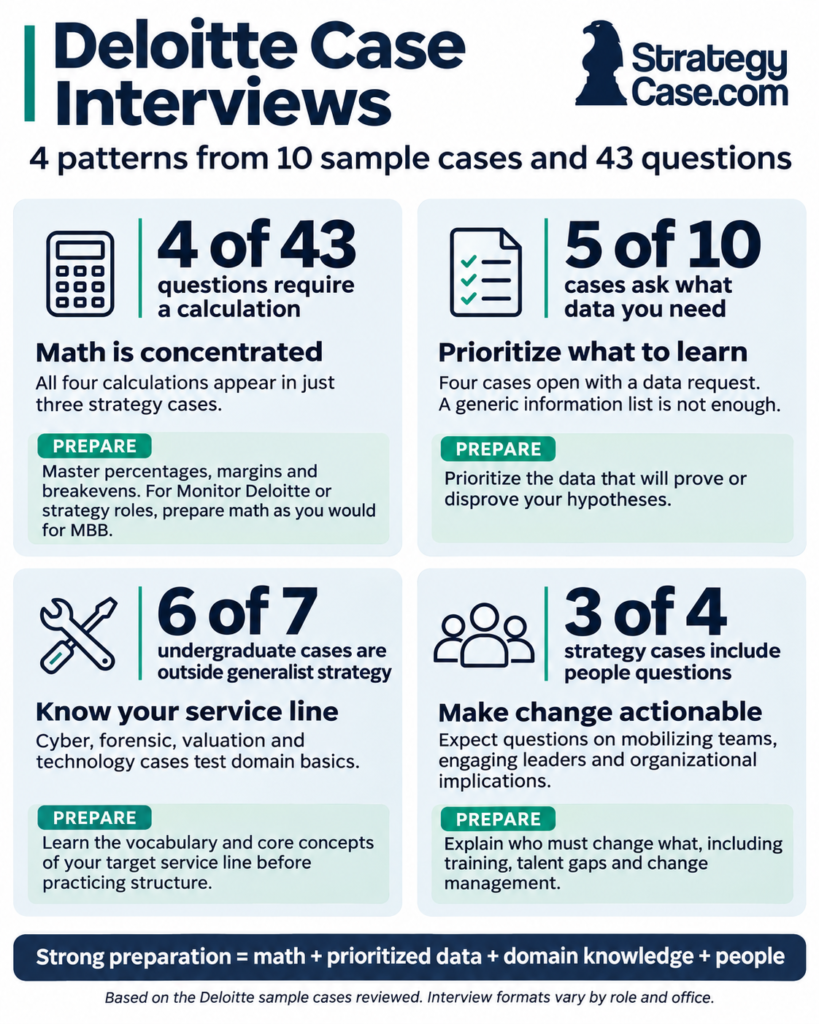
Four patterns come out of that table.
Math Shows Up in Only Three Cases
Only 4 of 43 questions require a calculation, and all four sit in three strategy cases. The arithmetic is light: an allocation formula, a funds-obligated percentage, an operating margin per bus, and a one-year payback. If you’re applying for core consulting, a sound grip on percentages, margins, and breakevens covers it, and the case interview math guide has the shortcuts.
The strategy arm is different. Monitor Deloitte’s Middle East page said its case interview assesses “your ability to easily compute numbers.” If Monitor Deloitte or a strategy role is your target, prepare math as you would for MBB.
Half the Cases Ask What You’d Want to Know First
Five of ten cases include a question like “What data would you want to have to be able to move forward?” or “What documents would you ask the general contractor to provide?” Four of them open with it. It’s tempting to treat that as a warm-up and rattle off a generic list.
Deloitte treats it as the test. Its answer key for the Talent Management case says a great answer “will prioritize the data needed.” Deloitte New Zealand sets the same standard for Senior Analyst and Senior Consultant candidates: “Suggest data you need to prove/disprove any hypothesis you develop.” A prioritized, hypothesis-linked data request is the skill.
Specialist Service Lines Test Domain Basics
Six of the seven undergraduate cases sit outside generalist strategy. The Data Exfiltration case asks which artifacts on an employee’s computer you’d review after files went to a USB drive and a file-sharing site. The warehouse case asks how a long single-tenant lease affects a valuation. No framework answers those.
So if your requisition is in cyber, forensic, valuation, or technology, learn the vocabulary of that service line before you practice structure. For technology roles, the digital transformation case interview guide covers the logic behind roadmaps, requirements, and implementation.
People Questions Close the Strategy Cases
Three of the four strategy cases include at least one question about people: how LeadAuto should “prepare and mobilize the organization,” what the people and organizational implications are at Recreation Unlimited, and how to engage a newly appointed leader at the cargo agency. Deloitte’s suggested answers go into change management, training, and talent gaps.
Deloitte sells change and talent work alongside strategy, and its cases reflect that. So end every case with the people: your recommendation isn’t finished until you’ve said who has to change what for it to work.
Break into Deloitte with our
Case Interview Academy
- 3 courses: case structuring, exhibit interpretation, and case math
- 82 video lessons and thousands of practice drills with sample answers
- 4.9 out of 5 from verified buyers
Built by a former McKinsey Senior Consultant and top global case coach. One-time payment, 1 year of access, full refund within 24 hours.
Good vs. Great: How Deloitte’s Answer Keys Score You
Four of the ten cases (the three advanced-degree cases and Architecture Strategy) don’t give one model answer. They describe what “a good answer may include” and what “a great answer” adds. Read side by side, those keys show exactly where Deloitte draws the line.
| What great answers do | Deloitte’s own example |
|---|---|
| Use the case’s own facts | Talent Management: collect practices from other civil service organizations, because the new Chief Administrator has no civil service background |
| Prioritize | Talent Management: a great answer “will prioritize the data needed” |
| Turn ideas into a sequenced plan | Talent Management: “mapping out a detailed approach with specific action steps” instead of listing options |
| Justify the logic with criteria | Finance Strategy: “no right or wrong answer,” but the formula needs “a logical justification”; efficiency is defined as actual vs planned share of funds obligated |
| Write for the audience | Finance Strategy: name who reads the report to Congress, what they need, and what to leave out |
| Go one step past the question | LeadAuto: after recommending the base bus configuration, open a discussion on configurations, pricing, or cost reductions |
Deloitte case interview good vs great answers, six moves from Deloitte’s official answer keys
None of the six is a framework. Each one is a habit of thought you can only show if you’ve built the skill underneath. That’s why I keep saying modern case prep is broken: memorizing structures gets you to “good” on a Deloitte case, and the scoring sits in the gap above it.
In my coaching sessions, the most common version of that gap is the generic list. A candidate offers eight sensible reasons for a problem, none of them tied to the facts in the prompt. When I interview candidates, a long list rarely stands out; the candidate who connects two client facts the others ignore usually does.
Worked Example: The Recreation Unlimited Website Question
Here’s the gap on one question. Recreation Unlimited is a sportswear company with $11 billion in revenue and only 5% of sales online, against a 10% industry average. It wants +40% annual growth in direct-to-consumer digital channels. Deloitte asks whether a $10 million website upgrade is worth it, given 20 million annual visitors, an extra $1 of spend per visitor, and a 50% margin.
A good answer does the math cleanly. 20 million visitors at $1 each is $20 million of extra sales, which Deloitte’s key calls the contribution before margin. At 50% margin that’s $10 million of profit, so the upgrade pays back its one-time cost in year one if traffic holds.
A great answer states the assumptions out loud (the $1 applies to every visitor, traffic stays flat, the margin holds on the new spend). Then it ties the number back to the objective.
If eCommerce is about $550 million (5% of $11 billion, assuming all of it counts as direct to consumer), +$20 million is under 4% growth, and the client wants 40%. So the website pays for itself but delivers less than a tenth of the target. That’s the bridge to the next question in the case: what else has to change, including the people.
Practicing this on your own? StrategyCase’s Case Interview Academy drills the three skills behind that answer separately: case structuring, exhibit interpretation, and case math, with 82 video lessons and thousands of practice drills with sample answers ($179). If you’d rather practice on full cases, The 1%: Case Interview Workbook has 25 original cases with interviewer notes.
How to Prepare for a Deloitte Case Interview in Three Weeks
Three weeks is enough for a core Deloitte Consulting process if you spend it on the right things. Monitor Deloitte and strategy roles need more time on math and harder cases.
Week 1: Pin down your interview and build the base.
- Confirm your service line, and whether your process has a case, a scenario, a written case, or a prepared topic (UK graduates).
- Read your country’s Deloitte careers guidance end to end.
- Learn the basics of your service line: the main services, typical clients, and the vocabulary in its practice cases.
- Study the fundamentals of a strong case interview performance. Start on structuring from the problem itself. The case interview frameworks guide shows how to build a structure instead of borrowing one. Continue with case math, chart interpretation, and case communication.
- Drill individual skills to lift your weaknesses and polish your strengths.
Week 2: Work Deloitte’s cases the right way.
- Do the official case for your track first, then the others. Cover the suggested answer and write your own before you look.
- Compare your answer to the “great” tier, not the “good” one, and note which of the six moves you missed.
- Practice data requests: for every case, write the three pieces of information you’d ask for first and why.
- Have someone read a full prompt aloud once while you take notes.
- Continue drilling individual skills to lift your weaknesses and polish your strengths.
Week 3: Full mocks and the behavioral half.
- Run more full mocks with a partner, ending each one with a recommendation, next steps, and the people implications.
- Prepare four to six stories with situation, task, action, and result. Deloitte Australia names its method Behavioural Event Interviewing and suggests the STAR framework. I prefer the SCORE framework.
- Rehearse “Why Deloitte?” and “Why this service line?” The Bentley candidate was asked “why technology consulting,” not “why Deloitte.”
Adjust the Plan to Your Track
| If you’re applying for | Shift your preparation toward |
|---|---|
| Undergraduate consulting roles | Your service line’s case in the tool, data requests, and a confident recommendation |
| Advanced-degree roles | Criteria-based answers, the government cases, and talent and change questions |
| Experienced hire roles | Naming the data that would prove or disprove each hypothesis (Deloitte New Zealand’s senior bar) |
| Government & Public Services | Three of the ten official cases involve US federal agencies; the public sector case interview guide covers how those cases differ |
| Monitor Deloitte | Cases close to MBB difficulty, written cases, faster math, and a group case |
| UK graduate programs | The prepared-topic discussion and the skills and motivation interview, more than a live case |
Where Deloitte Candidates Lose the Case
Here’s a pattern I see in coaching, and it surprises candidates who prepared hard. People who trained on MBB material bring an MBB posture to core consulting interviews: driving hard on a hypothesis, pushing back on every steer, treating the case like a performance. Your Deloitte interviewer may well be a technology, operations, or risk specialist rather than a strategy consultant, and to them that reads as someone who will be hard to work with.
Deloitte asks for a “business conversation” for a reason. Keep your structure sharp and your position clear, and still let the interviewer in. Ask what they’ve seen at similar clients, take a steer when it’s offered, and say how your recommendation would land with the client’s people.
Deloitte Case Interview FAQ
Are Deloitte case interviews hard?
They’re moderately hard, and in a different way from MBB cases. Core Deloitte Consulting cases are lighter on math (only 4 of the 43 questions in Deloitte’s official practice cases need a calculation) but heavier on practical judgment, data requests, service-line knowledge, and people questions. Monitor Deloitte runs cases closer to MBB difficulty, including written and group cases.
How long is a Deloitte case interview?
Deloitte doesn’t publish a standard length. In one candidate’s account of a US campus process, the first-round case was 30 minutes and the final-round partner case was 45 minutes. Deloitte’s own practice cases take 15-20 minutes each, and Monitor Deloitte’s Middle East practice gave 30 minutes to prepare a written case before walking through it.
Is there math in a Deloitte case interview?
Sometimes, and it’s usually light. In Deloitte’s ten official practice cases, the four calculations are a funds-obligated percentage, an allocation formula, an operating margin per unit, and a one-year payback. Strategy roles and Monitor Deloitte test math more heavily, so prepare percentages, margins, and breakevens until they’re automatic.
Should I use a framework in a Deloitte case interview?
No. Deloitte’s “great” answers go further by using the case facts, prioritizing, and sequencing next steps. Build the structure from the question, don’t memorize it beforehand.
What is the Deloitte group case interview?
It’s a final-round exercise where several candidates get the same case, prepare individually, then discuss and present to a panel. Monitor Deloitte’s Middle East practice described it as 30 minutes to read the case and answer an assigned question, followed by a collective presentation, scored on problem solving in a team setting. Deloitte doesn’t publish it for every office, so ask your recruiter whether it’s in your process.
Is the Monitor Deloitte case interview different from Deloitte Consulting?
Yes. Monitor Deloitte is Deloitte’s strategy practice, and its cases sit closer to MBB difficulty, with more math, written cases, and group cases. Monitor Deloitte’s Middle East page described a written case with a fit discussion in round one, then a group case and an individual case in the final round. Pay differs between the two tracks as well, which the Deloitte consulting salary guide breaks down by level.
Related Guides
- Comprehensive case interview guide: the five core elements of every case, at any firm
- Case interview examples: official practice cases from McKinsey, BCG, Bain, Deloitte, and others
- Consulting fit interview guide: how to prepare the behavioral half of each round
- Switching from Big 4 to MBB: what changes if you later move to McKinsey, BCG, or Bain
What to Do Before Your Deloitte Case Interview
Case volume won’t decide your Deloitte interview. These three things will:
- Know which interview you’re getting: case or scenario, core consulting or Monitor, live case or prepared topic.
- Prepare for what Deloitte’s cases ask: prioritized data requests, your service line’s basics, light math done cleanly, and the people side of every recommendation.
- Aim for Deloitte’s “great” tier: use the client’s facts, justify your logic, and say what happens next.
Then build the underlying skills before you add case volume. Start StrategyCase’s free Case Interview Foundations course for the method behind both the case and the fit interview (40+ videos, 7+ hours of instruction, 200+ pages of reading). When you’re ready to drill each skill, move on to the Case Interview Academy or work through full cases in the Workbook.
A Deloitte case interview rewards practical, well-reasoned judgment. That’s a skill you can build in three weeks if you practice it directly.
About the author: Dr. Florian Smeritschnig is the founder of StrategyCase.com and a former McKinsey Senior Consultant who recruited candidates for the firm. Since 2020 he has delivered 2,300+ mock interviews and coaching sessions, and his clients have secured 700+ consulting offers, 340 of them at McKinsey, BCG, and Bain. He is the author of three books on consulting interviews and careers, including The 1%: Conquer Your Consulting Case Interview.
