
Updated November 2026 · By Florian Smeritschnig, Former McKinsey Senior Consultant
The Deloitte online assessment in the UK has two stages. The Immersive Online Assessment pairs a behavioral part (you rank workplace actions by how likely you’d take them, then answer working-style questions) with numerical and verbal reasoning, and some questions are timed. Pass it and the Job Simulation follows, with ranked, multiple-choice, written, and video responses.
Deloitte bans AI in both online stages and has you record an integrity statement on camera before you start. Yet if you reach the final stage, it asks you to use ChatGPT, Gemini, or Copilot to research your topic. Deloitte also warns that paid sites selling “assessment insights” are often misleading, and that using third-party answers breaks its rules.
Every Deloitte rule below comes from Deloitte’s own careers pages in the UK, Australia, and Canada, read in November 2026. You’ll get each stage, what it scores, two worked practice questions, the AI rules stage by stage, and a preparation plan.
Key Takeaways
- The Immersive Online Assessment has two parts: ranked workplace scenarios plus working-style questions, then numerical and verbal reasoning. There’s no overall time limit, but on timed questions your speed counts toward your score.
- The Job Simulation tests behavioral skills in four formats: ranking options, picking the best response(s), written answers, and recorded video. Some scenarios involve AI tools, and Deloitte says it wants to see you consider using AI responsibly.
- AI is banned in both online stages and the interviews, but Deloitte asks you to use GenAI for the final-stage topic research. Deloitte says it can detect AI-assisted responses and will remove you from the process.
- The feedback report isn’t your result. After each online stage you get a strengths report, and Deloitte replies within four weeks.
- Deloitte’s free Candidate Zone comes first. Deloitte says candidates who use it often perform better, and that paid “insight” sites aren’t endorsed.
What Is the Deloitte Online Assessment?
Definition: The Deloitte online assessment is the screening Deloitte UK runs after your application: first the Immersive Online Assessment (behavioral scenarios plus numerical and verbal reasoning), then the Job Simulation (work-based scenarios with written and video answers). Together they decide who reaches the final stage at a Deloitte office.
Deloitte UK’s early careers page says the same four steps apply to the Summer Vacation Scheme, Industrial Placements, and the full-time Graduate and BrightStart programs:
| Step | What you do | Timing | What you get back |
|---|---|---|---|
| 1. Apply online | Personal details and grades; Deloitte checks them against the academic criteria in the job description | About 15 minutes, in one session | Automatic move to step 2 if you meet the criteria |
| 2. Immersive Online Assessment | Behavioral scenarios and working-style questions, then numerical and verbal reasoning | No overall limit; some questions timed | A strengths report; a decision within four weeks |
| 3. Job Simulation | Work-based scenarios: rank, select, write, record video | Not published | A strengths report; an email within four weeks |
| 4. Final stage assessment | A 30-40 minute discussion of a topic you research, plus a skills and motivation interview of about 50 minutes | Scheduled | Feedback and, if successful, an offer |
Deloitte online assessment stages in 2026: application, Immersive Online Assessment, Job Simulation, final stage, with four-week waits
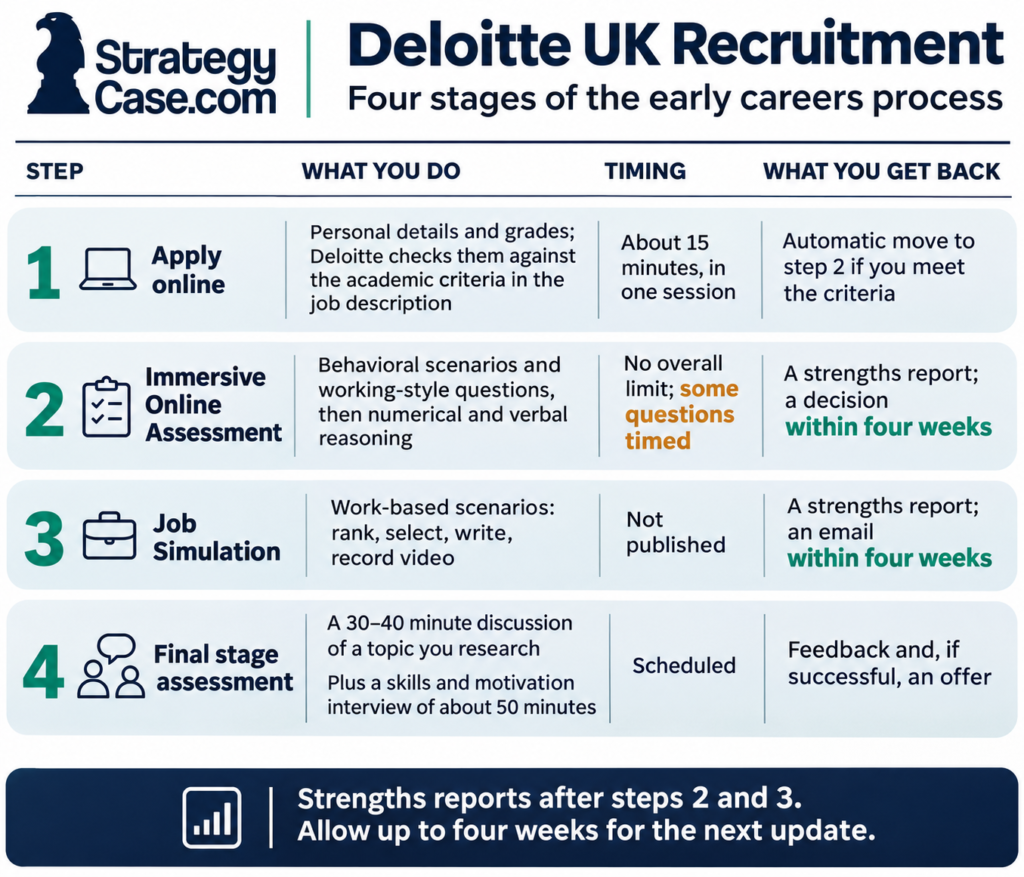
Figure: The Deloitte UK early careers process. Each online stage ends with a strengths report and up to four weeks of waiting.
Three variations matter. Entry Level Apprentices and some shorter work experience programs take a single combined test called OneStop instead of steps 2 and 3. Career Shapers and Aspire applicants finish after the Immersive Online Assessment, and Spring Into Deloitte applicants finish after the Job Simulation.
The Immersive Online Assessment, Step by Step
Deloitte describes the Immersive Online Assessment as a way “to understand your unique strengths.” It has two parts, and the way each one is scored decides how you should prepare.
The Behavioral Part: Ranked Scenarios and Working Style
You get realistic workplace scenarios and rank the actions by how likely you’d be to take each one, from most to least. Then you answer questions about your preferred working style. Deloitte asks you to respond honestly, and one of its UK recruiters advises going with “your gut instinct” rather than second-guessing what Deloitte wants. It’s a situational judgment test in all but name, and our situational judgment test guide explains how employers key and score ranked items like these.
Deloitte UK publishes no competency list for this part. Deloitte Australia does, and it’s the closest official guide to what the scenarios reward:
- Agility, resilience, and the ability to embrace change
- Learning and applying new information quickly
- Collaboration and working within a team
- Problem-solving
- Communication and building lasting relationships
- Integrity
- Analytical ability and tech savviness
Source: Deloitte Australia, How we hire.
Take the honesty advice seriously, for a practical reason. Your answers shape the strengths report you receive, and the same behaviors come back in the Job Simulation and the final interview, where you’ll need real examples to back them.
The Cognitive Part: Numerical and Verbal Reasoning
The second part contains numerical and verbal reasoning questions. Deloitte gives no overall time limit and recommends one sitting, but some questions are timed, and the speed of your response counts toward your score. Deloitte tells you which sections this applies to. Deloitte Australia calls them “time factored” questions.
Deloitte’s careers page doesn’t name the provider, but its Candidate Zone comes close: the registration notice says the site runs on systems operated for Deloitte by Cappfinity Limited, and the question formats match Cappfinity’s own documentation. So Cappfinity is the likely provider, though Deloitte hasn’t said so about the test itself. Our Cappfinity assessment guide lays out the evidence and how Cappfinity times its questions.
That scoring rule changes how you prepare. On a classic aptitude test you can bank time on quick questions and spend it on hard ones. On a time-factored question, a correct answer still earns less if it comes slowly, so you need methods that are accurate and fast at the same time.
Your Strengths Report Isn’t the Result
After the assessment, Deloitte sends a feedback report about your strengths. Deloitte is explicit that this “isn’t the outcome of your assessment.” The decision comes separately, within four weeks.
Two details from Deloitte Australia’s page are worth knowing if you apply there. You take the assessment once, even if you apply for several roles, and the result is shared across your applications. And Australia launched a new assessment at the start of 2026, so anyone who took it in 2025 has to retake it.
Deloitte Online Assessment Practice Questions (Worked)
The two questions below are our own, written to match the skills Deloitte lists. They aren’t Deloitte or Cappfinity questions, and they’re not answers to anything you’ll see on the day.
Worked Example 1: Numerical Reasoning
Training hours logged by a graduate cohort
| Team | Graduates | Q1 hours | Q2 hours |
|---|---|---|---|
| Audit | 40 | 1,600 | 2,000 |
| Tax | 25 | 1,250 | 1,000 |
| Consulting | 35 | 1,050 | 1,400 |
Which team logged the most training hours per graduate across Q1 and Q2 combined?
- A) Audit
- B) Tax
- C) Consulting
- D) Audit and Tax equally
Answer: D. Audit: (1,600 + 2,000) ÷ 40 = 90 hours. Tax: (1,250 + 1,000) ÷ 25 = 90 hours. Consulting: (1,050 + 1,400) ÷ 35 = 70 hours.
The traps are the ones that cost time on a timed question. Audit has the biggest totals, so A looks right at a glance. Consulting grew fastest from Q1 to Q2 (+33%), so C rewards anyone who answers a different question. The fast route is to divide each team’s two-quarter total by its headcount, then compare three numbers.
Worked Example 2: Verbal Reasoning
Deloitte doesn’t publish its verbal format. The most common one in graduate tests is a short passage plus a statement you mark true, false, or cannot say, so that’s what we use here.
Halden Rail runs 48 trains a day between two cities. From March, it will retire its oldest carriages, a quarter of its fleet. The operator expects journey times to stay the same, but says the new carriages will seat 20% more passengers. Fares will be reviewed in September.
| Statement | Answer | Why |
|---|---|---|
| Fares will rise in September. | Cannot say | The passage says fares will be “reviewed,” not raised |
| The new carriages will seat more passengers than the old ones. | True | They’ll seat 20% more |
| The operator expects journey times to fall. | False | It expects them to stay the same |
The first statement is where most points go. “Reviewed” sounds like “rising” if you read with your own assumptions, and verbal reasoning rewards reading only what’s on the page. Our verbal reasoning test guide has the full method for true, false, or cannot say, eight wording traps, and more practice questions with answers.
The Deloitte Job Simulation
If you pass the Immersive Online Assessment, the Job Simulation gives you “a real taste” of working at Deloitte and focuses on your behavioral skills. Deloitte UK lists four response types:
- Ranking response options in order of preference
- Selecting the most appropriate response or responses from a set
- Written responses
- Recorded video responses
Some scenarios mention workplace tools like AI. Deloitte says you don’t need prior AI experience and won’t use an AI tool during the assessment. What it wants to see is how you think, make decisions, solve problems, and “consider using AI responsibly in a professional setting.”
Here’s how that kind of scenario can look. This one is our own illustration, not a Deloitte question. Your manager needs a summary of a client’s spreadsheet by the end of the day, and a teammate suggests pasting it into a public chatbot to save time.
A responsible answer checks the firm’s policy and approved tools before any client data goes anywhere. It also verifies whatever the tool produces before sending it, and it tells the manager how the summary was made. Speed matters, but not more than confidentiality and accuracy.
Deloitte offers in-assessment practice questions and Job Simulation tips in its Candidate Zone, and you get another strengths report afterward. As with the first stage, Deloitte says it will email you within four weeks.
Is the Forage “Deloitte Job Simulation” the Same Thing?
No. Forage hosts free, self-paced Deloitte-branded programs that it also calls job simulations, such as a data analytics program from Deloitte Australia. Forage lists them as having no grades and no assessments. They can teach you about the work, but they aren’t the Job Simulation stage of a Deloitte application, which only arrives by invitation after the Immersive Online Assessment.
Deloitte’s AI and Integrity Rules, Stage by Stage
Deloitte’s Integrity & AI guidance is stricter than most candidates expect, and it treats different stages differently:
| Stage | AI allowed? | What Deloitte says |
|---|---|---|
| Researching careers, planning, preparing | Yes, responsibly | You can use AI to manage your time and prepare |
| Immersive Online Assessment, OneStop, Job Simulation | No | Complete them independently, without AI assistance |
| Interviews | No | AI feedback tools for practice are fine, but your answers must be your own experiences |
| Final-stage topic research | Required | Use GenAI tools such as ChatGPT, Gemini, or Microsoft Copilot alongside other research, and check every output |
| Sharing assessment details with AI tools | Never | It breaches Deloitte’s integrity guidelines and intellectual property |
Deloitte assessment AI rules by stage in 2026: banned in online tests and interviews, required for final-stage topic research
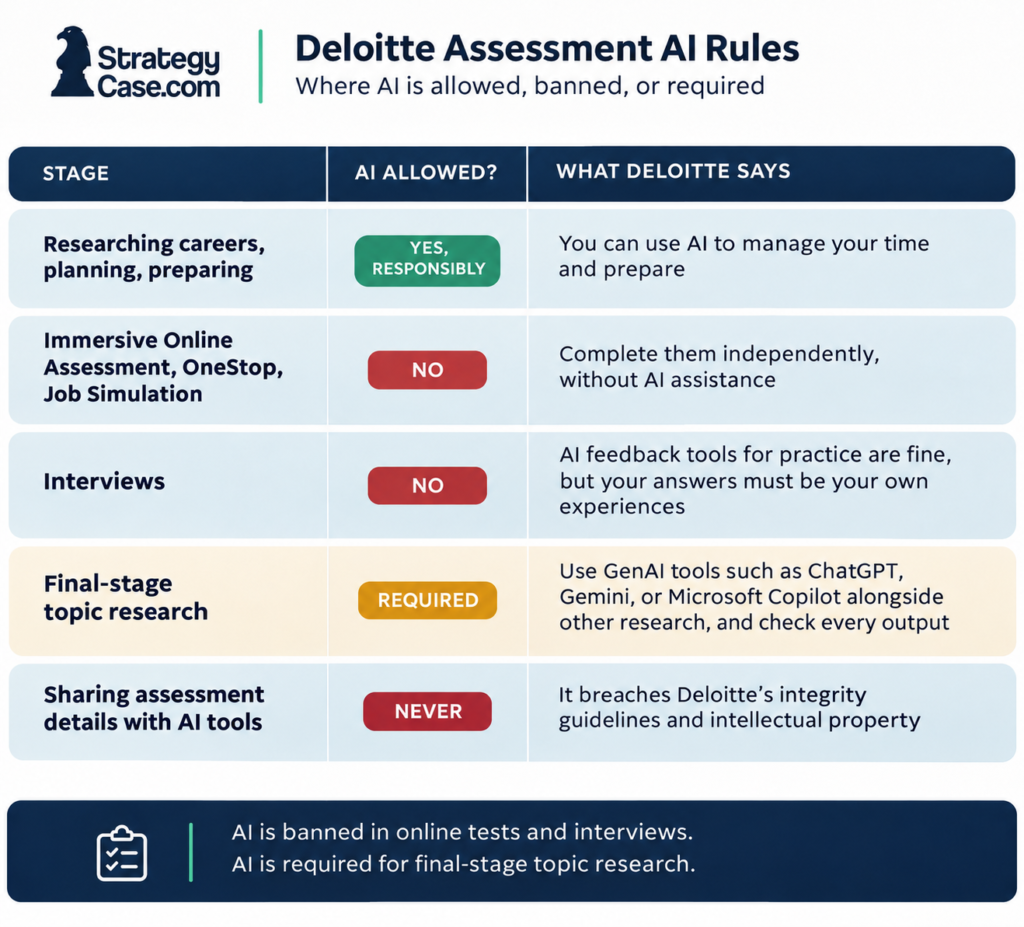
Figure: Where Deloitte bans AI and where it requires it.
Before the online assessment, you record a short integrity statement on camera confirming you’ll follow these rules. Deloitte says it has measures to detect AI-generated or AI-assisted responses. If it finds a breach, it removes you from the process and may report it to your university, and inappropriate AI use found after hiring can lead to dismissal.
One more line matters for how you practice. Deloitte says paid sites selling “assessment insights” aren’t endorsed and may be inaccurate, and that using answers from third parties breaches its guidelines. StrategyCase is a paid site too, and it isn’t endorsed by Deloitte. So the honest route is the one Deloitte implies: do the Candidate Zone first, then build the underlying skills with original practice questions, never with “answers.”
The Deloitte Final Stage Assessment
For Graduate, Entry Level Apprentice, Industrial Placement, and BrightStart roles, the final stage takes place in person at the Deloitte office linked to your application. For the Summer Vacation Scheme it’s virtual, and Deloitte says some programs, including that scheme, run only the interview.
The full final stage has two exercises:
- A topic discussion. You complete mandatory research and analysis on a topic beforehand, then discuss it with an assessor for about 30-40 minutes. Deloitte describes it as a two-way discussion, with the assessor asking questions throughout.
- A skills and motivation interview of about 50 minutes, on how well you match the capabilities Deloitte looks for.
The topic discussion is where Deloitte’s AI rule gets interesting. I interview candidates for all types of consulting roles and one thing carries over from any evaluator’s chair: follow-up questions test whether you own your analysis. A candidate who let a chatbot build the argument can usually present it, yet struggles as soon as the assessor asks why one figure matters more than another, or what would change the conclusion. Use AI to research faster, then make sure every claim is one you can defend in your own words.
Outside the UK early careers route, Deloitte Consulting often adds a case interview, from US campus rounds to the group case study in Deloitte Australia’s Assessment Day. The Deloitte case interview guide breaks down what Deloitte’s ten official practice cases test.
The Deloitte Online Assessment Outside the UK
Deloitte’s process differs by country and level. What each official page says:
| Where you apply | Online stage | Then |
|---|---|---|
| UK, experienced hires | A digital assessment or an initial 30-minute call; tools can include HireVue digital interviews, Codility coding tests, and case studies (Deloitte UK) | Interviews, most often virtual and around an hour |
| Australia, students and graduates | Immersive Online Assessment (new version from early 2026; the link doesn’t expire after 72 hours), then a Digital Interview of three questions or a Job Simulation | An Assessment Day with a group case study and a 1:1 interview with a business leader |
| Canada, students | A HireVue on-demand video interview for the first round (Deloitte Canada) | Behavioral and/or case interviews; some roles add an online assessment |
In Canada, the first screen is a recorded video interview rather than a test. The HireVue interview guide covers how that format works.
How to Prepare for the Deloitte Online Assessment
Before You Apply
- Read the Integrity & AI guidance. You’ll confirm it on camera anyway, and it tells you exactly where AI is off-limits.
- Work through the Candidate Zone. It’s Deloitte’s free hub of practice assessments and tips, and Deloitte says candidates who use it often perform better.
- Find your slower skill. Time a few numerical and verbal questions. On time-factored questions, the weaker of the two costs you twice: in accuracy and in speed.
- Collect real examples for each Deloitte Australia competency above. They anchor your behavioral answers and feed the video responses and the final interview.
A Practice Plan for the Immersive Online Assessment
| When | What to do | Why |
|---|---|---|
| Week 1 | Candidate Zone practice, then untimed numerical and verbal sets with full review | Learn the format and fix method errors first |
| Week 2 | Short timed sets on your weaker skill; note which errors come from rushing | Speed counts on timed questions, but only after accuracy |
| Test day | One sitting, a quiet room, no AI tools or help open | Deloitte recommends one sitting, and its integrity rules apply from the first screen |
For the Job Simulation, practice two things the online test doesn’t cover: writing a short, clear reply to a manager or client in a few minutes, and recording 1-2 minute video answers to a timer.
Practice for Deloitte’s online assessment with our
Big 4 Online Assessment Practice Tests
- 45 behavioral ranking scenarios, every order explained
- 5 Deloitte-style mocks: 12 numerical and 12 verbal questions each, on practice timers
- Numerical and verbal practice sets with worked solutions, plus a video interview bank
Follows the firms’ published UK formats. One-time payment, 1 year of access, full refund within 24 hours.
Mistakes That Cost Candidates the Deloitte Online Assessment
- Gaming the ranking questions. Deloitte asks for honest, instinctive answers, and the same behaviors come back in later stages.
- Practicing slowly and calling it done. On time-factored questions, a slow correct answer still loses points.
- Mistaking the strengths report for a pass or fail. It’s development feedback. Wait for the decision email.
- Doing a Forage program instead of preparing for the real stage. Forage is optional learning, not the Job Simulation.
- Using AI anywhere it’s banned, including asking a chatbot about assessment content. Deloitte treats that as an integrity breach.
Deloitte Online Assessment FAQ
How long does the Deloitte online assessment take?
Deloitte doesn’t publish a total. The Immersive Online Assessment has no overall time limit, though some questions are timed, and Deloitte recommends finishing it in one sitting. The application before it takes about 15 minutes. Candidate reports on total length vary widely, so set aside at least an hour in a quiet place.
Is the Deloitte online assessment timed?
Partly. There’s no overall time limit, but some questions are timed, and on those the speed of your answer counts toward your score. Deloitte tells you which sections are timed before you reach them. Deloitte Australia calls these “time factored” questions.
What is the Deloitte Candidate Zone?
It’s Deloitte’s free, official preparation hub, linked from your invitation emails. It has practice assessments, tips for the Job Simulation, and details of the final stage. Cappfinity Limited runs the site for Deloitte. Deloitte says candidates who use it often perform better, and it never charges for assessment advice.
Can I use ChatGPT in the Deloitte assessment?
No. Deloitte bans AI in the Immersive Online Assessment, OneStop, the Job Simulation, and all interviews, and it says it can detect AI-assisted answers. The exception is the final-stage topic research, where Deloitte asks you to use GenAI tools such as ChatGPT alongside other sources and to check everything they produce.
How long does it take to hear back from Deloitte?
Up to four weeks after each online stage. Deloitte UK says it will get back to you within four weeks of the Immersive Online Assessment and email you within four weeks of the Job Simulation. The strengths report you get straight after each stage isn’t the decision.
Does Deloitte send rejection emails?
Yes. Deloitte UK says it will be in touch either to confirm your success or to offer guidance for future applications, and Deloitte Australia says it contacts all candidates with an outcome or next steps. After the final stage, Deloitte UK also points every candidate to follow-up learning resources in the Candidate Zone.
Related Guides
- Consulting assessment tests: every major consulting firm’s online test, from McKinsey Solve to the Big 4
- PwC online assessment: PwC’s SHL tests, video interview, and what happened to Career Unlocked
- Big 4 case interviews: how Deloitte, PwC, EY, and KPMG run their case rounds
- Deloitte consulting salary: Deloitte and Monitor Deloitte pay by level
Before You Start Your Deloitte Online Assessment
The Deloitte online assessment rewards candidates who know how each stage scores:
- Answer the behavioral parts honestly and consistently, backed by real examples.
- Train numerical and verbal reasoning for accuracy first, then speed, because timed questions count your pace.
- Treat the Job Simulation as real work: clear written replies, short video answers, and responsible judgment on AI.
- Keep AI out of every stage where Deloitte bans it, and use it well where Deloitte requires it.
When you want more timed practice than the Candidate Zone offers, get StrategyCase’s Big 4 Online Assessment Practice Tests. For Deloitte’s assessment, it has 45 behavioral ranking scenarios with every order explained, 5 Deloitte-style mocks with timed numerical and verbal sets, numerical and verbal practice sets, and a video interview bank with model answers and timed drills. Every reasoning question has a worked solution. It doesn’t cover the written Job Simulation tasks. It costs $29 one-time with 1 year of access, and you get a full refund within 24 hours of purchase.
All questions are original. StrategyCase isn’t affiliated with Deloitte, PwC, EY, KPMG, SHL or Cappfinity.
If you’re aiming for Deloitte Consulting, the case interview comes after the screen, and it tests different skills. Start StrategyCase’s free Case Interview Foundations course once your online stages are done: 40+ videos, 7+ hours of instruction, and 200+ pages of reading.
About the author: Dr. Florian Smeritschnig is the founder of StrategyCase.com and a former McKinsey Senior Consultant who recruited candidates for the firm. Since 2020 he has delivered 2,300+ mock interviews and coaching sessions, and his clients have secured 700+ consulting offers, 340 of them at McKinsey, BCG, and Bain. He is the author of three books on consulting interviews and careers, including The 1%: Conquer Your Consulting Case Interview.
