
Updated November 2026 · By Florian Smeritschnig, Former McKinsey Senior Consultant
A situational judgment test (SJT) shows you realistic work scenarios and asks you to pick, rank, or rate possible responses. The employer scores your answers against a key built from the judgments of its experienced people, so the test rewards the behaviors that employer values. In the UK it’s usually spelled situational judgement test. It’s the same test.
Most SJT advice stops at “read carefully and stay professional.” That doesn’t help when all four options sound professional and you have to put them in order. At graduate employers such as KPMG, Deloitte, and EY, the SJT comes early in the process, so a weak order can end an application before you speak to anyone at the firm.
I recruited candidates at McKinsey and have coached consulting candidates since 2020. For StrategyCase’s Big 4 practice kit, we also wrote 45 ranking scenarios of our own, each with the full order explained. This guide shows how SJT keys are built and scored, a four-check method for ordering options, two worked examples, and where you’ll meet an SJT, Bain included.
Key Takeaways
- SJTs come in four main formats: pick the best response, pick the most and least effective, rank every option, or rate each one. The UK Civil Service Judgement Test rates every action on a four-point scale from Counterproductive to Effective.
- The answer key belongs to the employer. It rests on the judgments of experienced people in the role, so the skills a firm publishes (KPMG lists 12) are the closest thing to the key you’ll get.
- Near-misses can still score. UCAT ANZ gives partial marks for answers close to the key, and the Civil Service reports your result as a percentile. None of the Big 4 firms’ UK pages explains how it scores its ranking items.
- The instruction changes the test. “What should you do?” items lean on reasoning and knowledge, and “what would you do?” items lean on personality, according to a 2007 meta-analysis of SJT research.
- Practice the reasoning, not answers. Work out why your second choice beats your third, then answer the real test the way you work: the video interview and assessment center that follow test the same judgment.
Got an invite from Deloitte, PwC, EY, or KPMG? Each firm runs its behavioral stage differently. StrategyCase’s free firm guides, linked in the table below, show what each one asks you to do, taken from the firms’ own careers pages.
What Is a Situational Judgment Test?
Definition: A situational judgment test is a hiring assessment that describes a realistic work problem and asks how to respond. You choose, rank, or rate several plausible actions. Employers score your answers against a key based on the judgments of experienced people in the role, so the test measures how closely your choices match what the organization values.
The US Office of Personnel Management describes SJTs as low-fidelity simulations: a written or video version of the dilemmas a job really throws at you. The scenarios are ordinary on purpose. Two deadlines clash, a colleague’s table has an error, a client asks for a number you can’t give yet. No option is absurd, and that’s what makes the test hard.
An SJT isn’t a personality questionnaire or an aptitude test, though employers often bundle all three into one online assessment:
| Test | What it asks | Right answers? | Example |
|---|---|---|---|
| Situational judgment test | How should (or would) you respond to this work scenario? | Yes, against the employer’s key | KPMG UK’s skills assessment, the Civil Service Judgement Test |
| Personality questionnaire | Which statement is most like you? | No, it describes your preferences | The personality part of BCG’s CCA, Bain’s Sova questionnaire |
| Aptitude test | What’s the answer to this numerical, verbal, or logic problem? | Yes, one correct answer | KPMG UK’s 36-minute reasoning test |
Where You’ll Meet an SJT
| Employer or test | What you do | Also in the screen |
|---|---|---|
| KPMG UK skills assessment | Rank how you’d think, feel, or respond. Untimed; KPMG suggests allowing about 20 minutes | A 36-minute numerical and logical test |
| Deloitte UK Immersive Online Assessment | Rank how you’d most and least likely approach scenarios, plus working-style questions | Numerical and verbal reasoning; later a Job Simulation with ranking, best-response picks, written answers, and video |
| EY UK behavioral skills test | Choose from options, drag items into place, apply rules, record video; the time limit is in your invite | A Realistic Job Preview on teamwork and learning |
| UK Civil Service Judgement Test | Rate each action from Counterproductive to Effective. Untimed | A self-assessment part worth 15% of the score |
| UCAT ANZ (medicine) | 69 questions on clinical scenarios in 26 minutes | The other UCAT subtests |
PwC UK is the exception among the four. Its behavioral stage is an untimed behavioral profile, followed by SHL reasoning tests, as the PwC online assessment guide explains.
Much of the UK search volume comes from the Civil Service. GOV.UK’s guide to the Civil Service Judgement Test says the test is untimed, that most people take two to four minutes per scenario, and that you should set aside at least an hour. You get three scenarios for each of the Civil Service Behaviours tested at your job level, and managers sit a separate Management Judgement Test. GOV.UK links this short official video on the test:
Do McKinsey, BCG, and Bain Use SJTs?
Mostly no, which matters before you buy a generic SJT pack for an MBB application. McKinsey’s Solve is a game-based problem-solving assessment. BCG’s Consulting Career Assessment pairs a personality questionnaire with a timed logic section. Neither has SJT items, and the consulting assessment tests guide maps what each firm uses instead.
Bain is the interesting case. When we rebuilt StrategyCase’s Bain SOVA practice tests in November 2026, none of the Bain candidate reports we found from late 2024 onward mentioned a situational judgment section, though many older guides still list one. Sova’s own generic practice test includes an SJT, which adds to the confusion.
Bain’s TestGorilla assessment is different. Its four-section version has a 12-question Leadership & People Management section with four options per question, built on the Situational Leadership model that TestGorilla names as its basis. The Bain TestGorilla guide covers that section and the Business Judgment section next to it.
SJTs also turn up in game form. HireVue’s chat games, TeamChat and LeaderChat, are text-message SJTs that appear at employers using HireVue’s game-based assessment, as the HireVue interview guide explains.
The Four SJT Question Formats
Most SJTs use one of four response formats, and each one changes what a good answer looks like.
| Format | What you do | What the key compares | Where you’ll see it |
|---|---|---|---|
| Single best | Pick the most effective action | Your pick vs. the keyed best | EY UK; Deloitte’s Job Simulation (best-response picks) |
| Most and least | Pick the most and the least effective action | Both picks vs. the keyed best and worst | Deloitte UK’s Immersive Online Assessment |
| Rank | Put every option in order | Your full order vs. the keyed order | KPMG UK, Deloitte UK |
| Rate | Score each action on its own scale | Each rating vs. the keyed rating | The Civil Service Judgement Test |
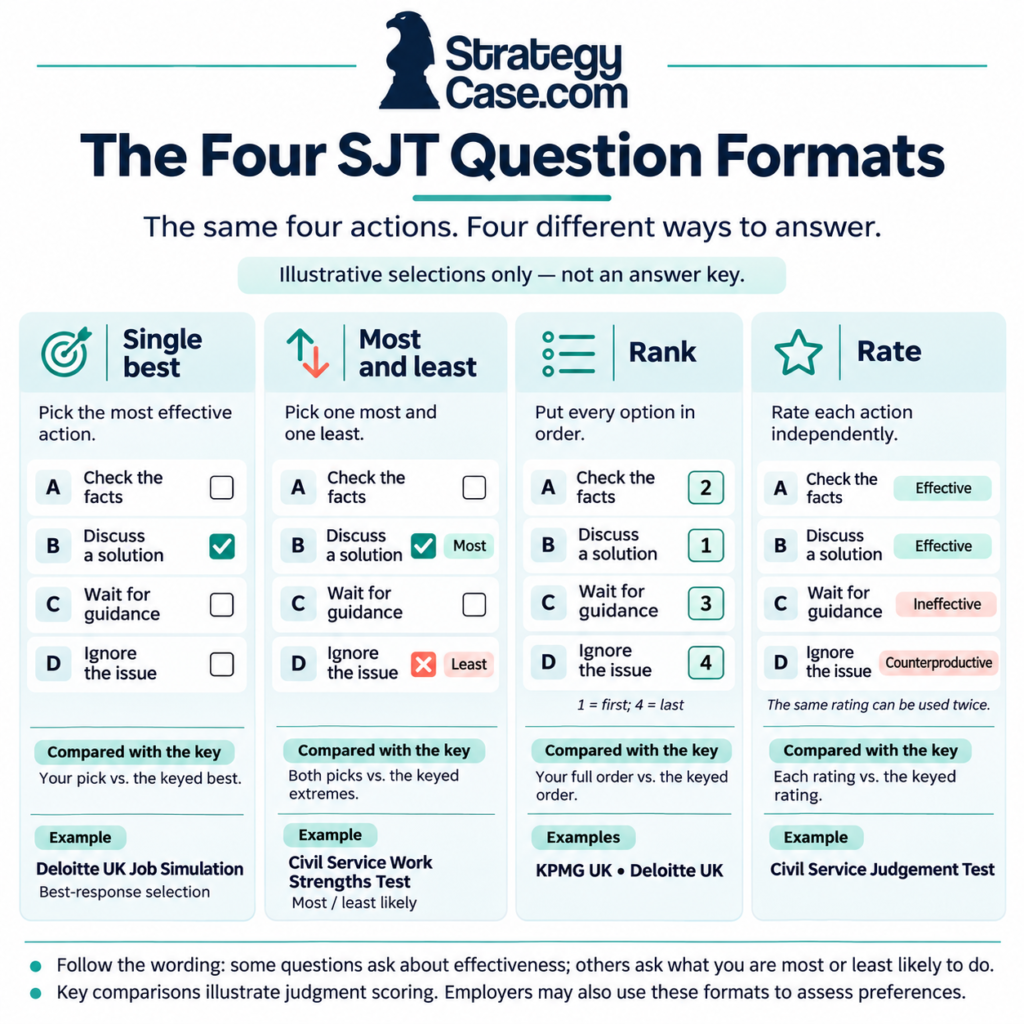
Rating is the only format where two actions can get the same answer. GOV.UK says outright that you can rate more than one action the same, so don’t force a spread.
Some employers go further and ask for written or recorded answers. Deloitte’s Job Simulation does both, so the scenario stays the same but you have to explain your choice in your own words.
“Should Do” vs. “Would Do”: Read the Instruction
Some SJTs ask what you should do. Others ask what you would do, or which response is most like you. That wording isn’t cosmetic.
A 2007 meta-analysis in Personnel Psychology by McDaniel and colleagues found that “should do” versions track cognitive ability more closely, while “would do” versions track personality. Both predicted job performance about equally well.
Both versions are still scored against what works. The difference is consistency. KPMG asks for the answer most like you, Deloitte asks for honest, instinctive answers, and EY tells candidates to “relax and answer each question naturally.” Under those instructions, a pattern you can’t live up to shows later, when the video interview and assessment center ask for real examples.
How SJTs Are Scored
Who Writes the Answer Key
An SJT item has no universal right answer. OPM describes how employers build them: experienced people in the job supply real critical incidents, and the key rests on those experts’ judgments of the best and worst responses. The teamwork SJT used in a 2024 chatbot study (see the FAQ) worked the same way: its key came from ratings by 109 experts.
That’s why the same action can rank differently at two employers. A firm whose published values lead with pace might key “fix it now and tell your manager afterward” higher than a firm that leads with quality and review. The best guide to any key is the employer’s own list of what it assesses. KPMG publishes 12 KPMG Skills, EY lists eight key skills, PwC UK publishes the behaviors it looks for, and the Civil Service tests its Behaviours from the Success Profiles framework.
How Your Answers Turn Into a Score
Employers rarely publish their scoring rules, but the public examples show three patterns:
| Method | How it works | Public example |
|---|---|---|
| Exact match | Credit only when your answer matches the key | Single-best items; the ranking questions in our own Big 4 kit, which mark the full order only |
| Partial credit | Credit for answers close to the key, so a near-miss still scores | UCAT ANZ’s Situational Judgement subtest (scoring page) |
| Percentile | The test compares your result with a reference group and reports a percentile | The Civil Service Judgement Test |
On a partial-credit or rating test, swapping the middle two options costs little, while putting the worst option near the top costs a lot. So get the best and worst options right first, then spend your remaining thinking time on the middle pair. Exact-match scoring punishes any swap, which is why our kit uses it: if you get the full order right there, a real test that gives partial credit won’t surprise you.
How to Rank SJT Options: The Four-Check Method
When every option sounds reasonable, test each one against four questions, in this order:
- Does it solve the actual problem in time? Find the deadline and what’s at stake. An action that’s right in principle but too late usually ranks below one that works now.
- Does the decision stay with the person who owns it? A clash between two deadlines belongs to the people who set them. A commitment to a client belongs to whoever leads the client. Strong options bring the decision to that person, with the facts.
- Does it protect quality and integrity? An option that knowingly lets an error or a misleading figure reach a client fails here, however helpful it looks. It goes to the bottom.
- Does the right person hear about it? Fixing a problem quietly leaves the team exposed to it next time. Strong options tell the people who need to know.
Rank by how many checks each option passes, with check 3 as the tiebreaker. These four checks are the logic behind the explanations in StrategyCase’s Big 4 kit. Its 45 scenarios fall under eight themes, from integrity and quality to planning and priorities to judgment with data and technology.
Worked Example 1: A Ranking Item
Our own illustration, not a question from any employer’s test.
You’re two months into a graduate role on a consulting team. On a client call, the client’s finance director asks you for the savings figure from your analysis. Your manager hasn’t fully reviewed the model yet and isn’t on the call. Rank these responses from most to least effective.
- A. Give the figure, since the client asked you directly
- B. Say your manager is still reviewing the figure, agree on a time to send the checked number, and tell your manager right after the call
- C. Give the figure but say it’s a draft and may change
- D. Say you can’t share anything and ask the client to contact your manager
| Option | 1. Solves it in time | 2. Right owner | 3. Quality and integrity | 4. Right person told | Rank |
|---|---|---|---|---|---|
| B | Yes: the client gets a firm time | Yes: your manager reviews before release | Yes | Yes | 1 |
| D | No: no timeline | Yes | Yes | Partly: you redirect the client but don’t tell your manager | 2 |
| C | Partly: a number now, maybe the wrong one | No: releasing numbers is your manager’s call | Weak: the caveat rarely survives | No | 3 |
| A | On the surface | No | No: an unreviewed number presented as final | No | 4 |
The order is B, D, C, A, and the middle pair is the hard call.
C feels more helpful than D, and in many jobs it would be. In consulting and audit, though, a draft number that reaches a client tends to stick, caveat or not. D is unhelpful, but it puts nothing wrong in the client’s hands.
Worked Example 2: A Rating Item
Our own illustration in the Civil Service rating format, not a Civil Service Judgement Test question.
A colleague on your team has missed two deadlines on a shared report this month and seems stressed. The next section is due on Friday. Rate each action: Counterproductive, Ineffective, Fairly Effective, or Effective.
| Action | Rating | Why |
|---|---|---|
| Ask them privately how things are going and whether the workload is the problem | Effective | Finds the cause before acting |
| Offer to take one section and agree on new dates together, keeping your manager informed | Effective | Protects Friday without going around anyone |
| Quietly redo their sections yourself | Ineffective | Meets the deadline but hides the problem |
| Tell the wider team they’re unreliable | Counterproductive | Damages trust and fixes nothing |
Two actions are Effective here, and the format allows that. If you’re used to ranking items, the instinct is to force a spread. Rate each action on its own merits instead.
How to Practice for a Situational Judgment Test
Practice can’t teach you an employer’s key, because nobody outside the firm has it. It can teach you the format, your pace, and the reasoning that separates the second option from the third. Here’s the order I’d work in:
- Confirm the format from your invite. Rank, rate, most and least, and single best each need different habits. The firm guides in the table above set out each Big 4 test.
- Turn the employer’s published skills into examples. For McKinsey’s PEI, I teach candidates to prepare one real story per assessed dimension with my SCORE storytelling framework. An employer’s skills list works the same way, and those stories feed your video interview too.
- Take the free official practice first. The Civil Service offers an unscored practice test for its Judgement Test, and Deloitte’s Candidate Zone and EY’s practice hub give you the firms’ own material. Deloitte’s Candidate Zone runs on Cappfinity’s systems, and the Cappfinity assessment guide shows its question formats.
- Practice with explanations, not answer keys. After each item, write one sentence on why your second choice beats your third, then check. If your reasoning matches the explanation but your order doesn’t, you’ve found a judgment habit to fix. If neither matches, reread the employer’s skills.
- Sit the real test the way you work. If it’s untimed, use the time. Answer consistently, because the same priorities come back in the video interview and at the assessment center.
SJT Mistakes That Cost Points
- Using AI during the test. All four Big 4 firms ban AI tools and outside help during their assessments, and KPMG re-tests elements of its online assessments.
- Picking the nicest answer. Kindness that leaves the problem unsolved fails check 1.
- Escalating everything. Raising a risk is good. Handing your manager a decision that’s yours to make isn’t.
- Answering for an imagined ideal. A profile you can’t back with real examples falls apart in the interview.
Practice situational judgment tests with our
Big 4 Online Assessment Practice Tests
- 45 behavioral ranking scenarios: rank four workplace actions, with the full order explained against the skills PwC, EY and KPMG publish
- A video interview bank: 30 questions, 8 model answers and 3 timed recording drills
- 10 timed reasoning mocks and 8 practice sets, with a worked solution for all 320 reasoning questions
Follows the firms’ published UK formats. One-time payment, 1 year of access, full refund within 24 hours.
Related Guides
- Arctic Shores assessment: the game-based screen some UK graduate employers use instead of an SJT
- Bain SOVA test: what Bain’s Sova screen covers now
- McKinsey Solve: McKinsey’s game-based problem-solving assessment
- BCG Consulting Career Assessment: BCG’s personality and logic screen for North America
- Consulting fit interview guide: where the same judgment gets tested with your real stories
Frequently Asked Questions
How is an SJT score calculated?
The employer compares your answers with a key built from experienced employees’ judgments. Depending on the test, you get credit only for an exact match, or partial credit for answers close to the key, as on UCAT ANZ. Some employers then compare your total with a reference group: the Civil Service reports a percentile. The Big 4 firms don’t publish how they score.
Can you fail a situational judgment test?
Yes, in the sense that a low score can end your application. Most employers don’t publish a pass mark. They compare your result with other candidates or with a threshold they set, and some weigh it with other evidence: EY UK, for example, judges suitability on your online assessment scores together with your A-level results.
Is ChatGPT good at situational judgment tests?
On paper, yes. In a 2024 study in Scientific Reports, five chatbots took a 12-scenario teamwork SJT keyed by 109 experts. Claude scored significantly higher than 276 pilot applicants, and none of the five scored lower than the humans. The authors warn that a test score doesn’t show a model would act well in real situations. Employers know this too: every Big 4 firm bans AI during its assessments, and the video interview and assessment center that follow test the same judgment without a chatbot.
How long is a situational judgment test?
It depends on the employer. KPMG UK’s skills assessment is untimed, and KPMG suggests allowing about 20 minutes. The Civil Service Judgement Test is untimed too: GOV.UK says most people take two to four minutes per scenario and recommends setting aside at least an hour. UCAT ANZ’s Situational Judgement subtest gives you 26 minutes for 69 questions.
Is it “situational judgement test” or “situational judgment test”?
Both spellings are correct. UK employers and the Civil Service write “judgement,” while US sources such as the Office of Personnel Management write “judgment.” It’s the same kind of test either way.
Can you prepare for an SJT, or should you be yourself?
Both. You can’t learn an employer’s key, but you can learn the formats, the employer’s published skills, and the reasoning behind effective responses, which is what the worked examples above practice. Then answer honestly. KPMG and Deloitte ask for the response most like you, and your answers have to match how you come across in the interviews that follow.
Before You Take Your Situational Judgment Test
The situational judgment test rewards candidates who prepare for the employer in front of them:
- Confirm the format: rank, rate, most and least, or single best.
- Read the employer’s published skills, the closest thing to its key.
- Get the best and worst options right first, then work the middle pair.
- Drop any option that knowingly passes on an error, however helpful it looks.
- Answer the way you work, because the next stages test the same judgment.
When you want more ranking practice than the free tests offer, get StrategyCase’s Big 4 Online Assessment Practice Tests. It has 45 behavioral ranking scenarios in the format of Example 1, each with the full order explained against the skills the firms publish. You also get 10 timed mocks (5 in SHL’s general ability format, 5 Deloitte-style numerical and verbal), a worked solution for all 320 reasoning questions, and a video interview bank.
It’s built for the UK Big 4 screens and doesn’t use the Civil Service rating format. It costs $29 one-time with 1 year of access, and you get a full refund within 24 hours of purchase.
All questions are original. StrategyCase isn’t affiliated with Deloitte, PwC, EY, KPMG, SHL or Cappfinity.
If you’re applying to a consulting team, the SJT is the gate, not the finish: a case interview usually follows, as the Big 4 case interview guide shows. Start StrategyCase’s free Case Interview Foundations course once your online stages are done: 40+ videos, 7+ hours of instruction, and 200+ pages of reading.
About the author: Dr. Florian Smeritschnig is the founder of StrategyCase.com and a former McKinsey Senior Consultant who recruited candidates for the firm. Since 2020 he has delivered 2,300+ mock interviews and coaching sessions, and his clients have secured 700+ consulting offers, 340 of them at McKinsey, BCG, and Bain. He is the author of three books on consulting interviews and careers, including The 1%: Conquer Your Consulting Case Interview.
