
Updated November 2026 · By Florian Smeritschnig, Former McKinsey Senior Consultant
The EY online assessment in the UK has two parts: a Realistic Job Preview that covers teamwork and learning capability, and a behavioral skills test that checks whether you have the skills the role needs. EY says the questions can ask you to interpret a chart, drag items into place, apply a set of rules, or record a video, with a time limit stated in your invite. Strong performers move on to an EY Experience Day.
Candidates often call it the “EY One Assessment,” and most guides then describe a generic aptitude test. EY’s own FAQ is more specific than that, and stricter. It uses your assessment scores alongside your A-level grades, it can ask you to retake any assessment at any point, and a rejection locks you out for six months.
Every EY rule below comes from EY UK’s own careers pages, read in November 2026. You’ll get the six question formats, the eight skills EY looks for, two worked practice questions, the reapplication rules, and a preparation plan.
Key Takeaways
- Two online parts: a Realistic Job Preview (teamwork and learning capability) and a behavioral skills test, both inside EY’s assessment portal.
- Six possible formats, per EY: multiple choice, charts and tables, moving information on screen, drag-and-drop, pattern and rule items, and recorded video. Time limits are stated in your invite.
- Grades still count. EY says it judges suitability on your online assessment scores and your A-level (or equivalent) attainment.
- A rejection costs six months for graduate and undergraduate roles (three for apprenticeships and Career Starters), and EY caps you at two applications a year.
- EY’s practice hub is inside the portal. Use it first: it’s the only place to rehearse EY’s exact interactive formats.
What Is the EY Online Assessment?
Definition: The EY online assessment is the screening stage EY UK runs after your application. It combines a Realistic Job Preview, which covers teamwork and learning capability, with a behavioral skills test. Questions can use interactive formats such as charts, drag-and-drop, rule-based items, and video, and the results feed EY’s shortlisting for its Experience Days.
EY UK’s How to apply page lays out the process for its apprentice, undergraduate, and graduate programs:
| Stage | What happens | What to know |
|---|---|---|
| 1. Application form | Choose one program and location, then enter your details and grades | You can apply for only one program every six months |
| 2. Assessment preparation | A practice hub inside EY’s assessment portal | Practice the formats before the real thing |
| 3. Online assessment | Realistic Job Preview, then a behavioral skills test | Time limits are in your invite and the instructions |
| 4. Shortlisting | EY reviews your application and performance across the whole process | The “highest performers” are invited onward |
| 5. EY Experience Day | Meet EY’s people and show your skills | In person in UK offices for graduate, industrial placement, and apprentice roles; virtual for summer internships |
EY online assessment stages in 2026: application, practice hub, Realistic Job Preview, behavioral skills test, shortlisting, Experience Day
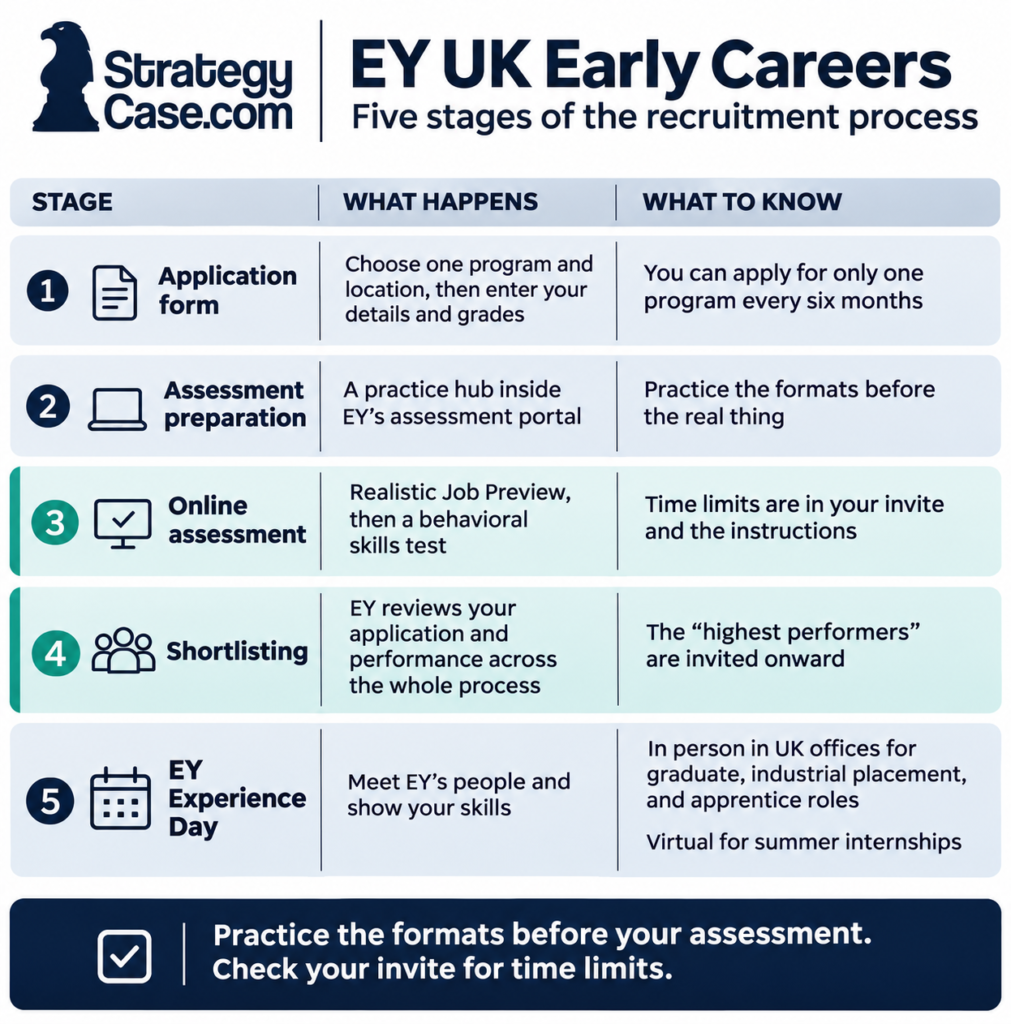
Figure: EY UK’s early careers process, with the online assessment and shortlisting steps marked.
EY’s FAQ adds the timing for this cycle: applications for 2027 opportunities are open and close when filled, and Experience Days begin from mid-October 2026. So the earlier you apply, the more Experience Day slots are still open.
The 6 Question Formats in the EY Online Assessment
EY’s student FAQ answers “What could the online assessments involve?” directly. It says the assessments are designed to understand your abilities, behaviors, and working preferences, and that questions can come in these formats:
| # | Format, in EY’s words | What it usually tests | How to prepare |
|---|---|---|---|
| 1 | Choose an answer from several options | Judgment in work scenarios, or reasoning | Read every option before choosing |
| 2 | Interpret a table, chart or graph | Numerical reasoning | Percentages, shares, and growth under time pressure |
| 3 | Move or change information on screen | Numerical or logical reasoning, answered interactively | Use EY’s practice hub to learn the controls |
| 4 | Drag items into the correct position | Ordering, prioritizing, or rule-based logic | Rehearse the interface as well as the logic |
| 5 | Identify a pattern or apply a set of rules | Inductive and deductive reasoning | Pattern series and rule-checking drills |
| 6 | Record a video response | Motivation and skills, in your own words | Short, specific answers to a timer |
EY online assessment question formats in 2026: multiple choice, charts, on-screen changes, drag-and-drop, pattern and rule items, video
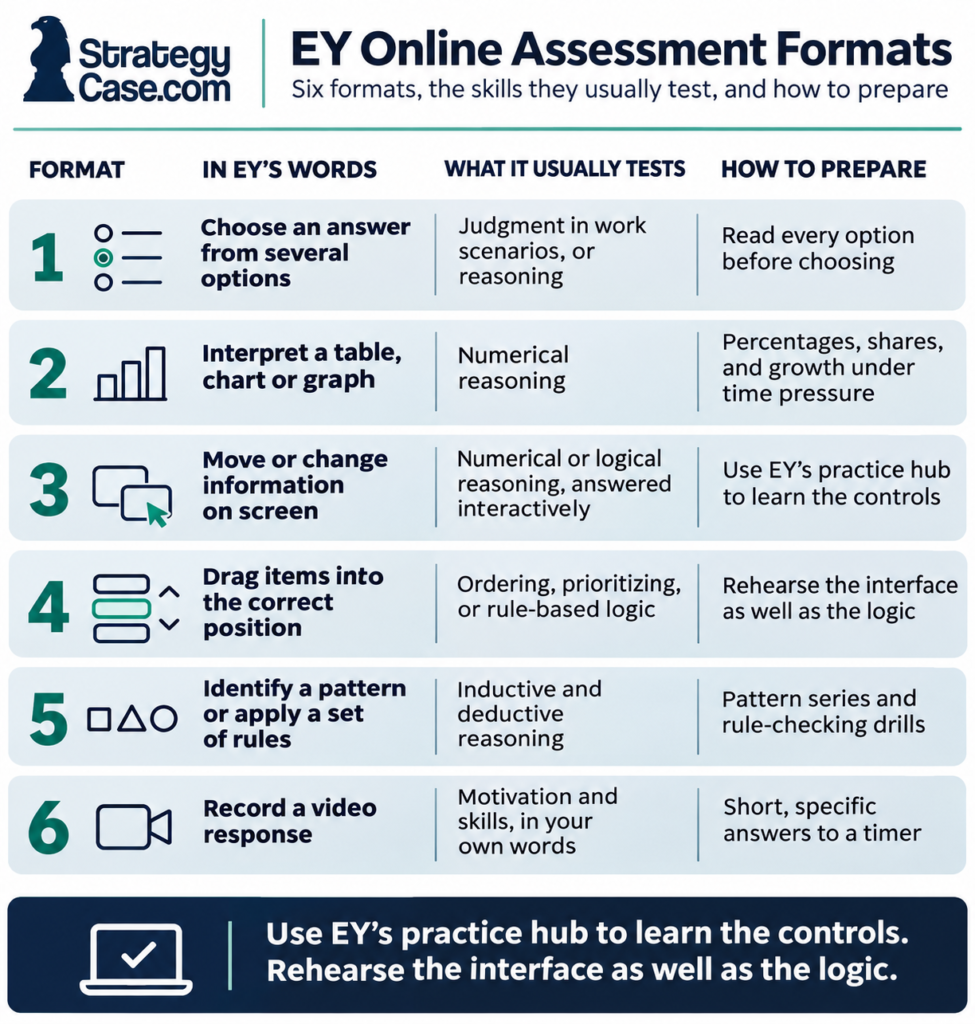
Figure: The six formats EY lists, and what each one usually tests.
EY says the assessment has a time limit, and you’ll see instructions and example questions before the timed section begins. It also recommends completing assessments in one sitting on a PC or laptop rather than a phone. Most untimed parts let you return later if you’re interrupted, and if you get several assessments, EY suggests a break between them.
EY doesn’t name its assessment provider on these pages. Prep sites attribute the UK assessment to Cappfinity, and there’s evidence for it: three answers in EY’s own student FAQ match Cappfinity’s candidate help center almost word for word. Treat it as likely, not confirmed. Our Cappfinity assessment guide sets out what each source says. Formats 3 and 4 matter most for preparation: no outside practice test fully copies EY’s interactive controls, which is exactly why EY built a practice hub into its portal.
The 8 Skills EY Looks For
EY’s Key skills page lists eight skills it assesses through the recruitment process:
| EY skill | What EY describes, roughly |
|---|---|
| We are proactive | Self-motivated, taking responsibility for high-quality outcomes |
| We do the right thing | Working ethically, reliable, and driven |
| We are curious | Learning quickly, asking questions, gathering relevant information |
| We build relationships | Engaging people and building credibility inside and outside the office |
| We show agility | Thriving under pressure and adapting when things change |
| We think critically | Solving problems by analyzing the situation from different angles |
| We embrace technology | Learning new technologies, including their risks |
| We are motivated | Enthusiasm to succeed and a career aligned with EY’s purpose |
Paraphrased from EY UK’s Key skills page, November 16, 2026.
These eight skills are what the behavioral skills test and the video response are reading. EY’s own advice for the assessment is to “relax and answer each question naturally,” which matches what I’d tell you anyway: an invented profile has to survive the video, the Experience Day, and the people you’d work with.
Prepare one real example per skill, from university, work, or volunteering. When you record a video response, open with your point, tell one specific situation, say what you did and what changed, and stop. The consulting fit interview guide shows how to structure those stories so the result lands early.
EY Online Assessment Practice Questions (Worked)
The two questions below are our own, written to match formats 2 and 5 from EY’s list. They aren’t EY or Cappfinity questions, and the real assessment may ask you to drag or change information instead of picking a letter.
Worked Example 1: Interpreting a Table
Revenue by service line at a mid-sized advisory firm (£m)
| Service line | 2025 | 2026 |
|---|---|---|
| Assurance | 120 | 126 |
| Tax | 80 | 92 |
| Consulting | 100 | 122 |
| Total | 300 | 340 |
Which service line’s share of total revenue fell from 2025 to 2026?
- A) Assurance
- B) Tax
- C) Consulting
- D) None of them
Answer: A. Assurance went from 120 ÷ 300 = 40.0% of revenue to 126 ÷ 340 = 37.1%. Tax rose from 26.7% to 27.1%, and Consulting from 33.3% to 35.9%.
The trap is D. Every line grew in pounds, so “none of them” feels safe. But Assurance grew 5% while the total grew 13%, so its share shrank. When a question asks about share, compare each line’s growth with the total’s growth first: anything growing slower than the total loses share.
Worked Example 2: Applying a Set of Rules
A valid client file code follows these rules:
- It has six characters: two letters, then four digits.
- The first letter is the office: L, M, or B.
- The second letter is the service: A or T.
- The four digits add up to an even number.
- If the office is M, the last digit can’t be 0.
Which code is valid?
- A) MA4510
- B) BT3312
- C) LT2271
- D) LX4402
Answer: C. LT2271 has a valid office (L), a valid service (T), and digits that sum to 12, an even number.
A breaks the last rule: its digits sum to 10, but office M can’t end in 0. B’s digits sum to 9, which is odd. D uses X, which isn’t a service.
The habit to build: check the quick, structural rules first (length, letters), then the arithmetic. You’ll eliminate most options before you add a single digit.
How EY Decides Who Moves On
Your online assessment doesn’t stand alone. EY’s FAQ says it has studied how A-level attainment and online assessment performance predict success at EY, and it assesses your suitability “by considering your scores in the online assessments and your academic attainment at A-level or equivalent.”
I screened applications at McKinsey, so this doesn’t surprise me. Academic results are one of the few signals every applicant has, and firms keep using them. The assessment is where you add evidence on top. If your grades are borderline, your scores carry more weight, and EY’s partnership with RARE, which puts your achievements in the context of your background, can help too.
After the assessment comes shortlisting. EY says it reviews “your application and performance throughout the whole process,” including any motivational statement or degree requirement, and invites the highest performers to the next stage. There’s no fixed timeframe: it depends on the business area, location, and role.
EY’s Rules: Reapplying, Integrity, and Adjustments
EY’s participation rules are stricter than most firms’, and they shape how you should approach the assessment:
| Rule | What EY says |
|---|---|
| Wait after a rejection | Six months for graduate and undergraduate vacancies; three months for apprenticeships and Career Starters |
| Applications per year | A maximum of two, in line with the six-month rule; one application at a time |
| Reapplying | Use a new email address (a system restriction) and declare it’s your only application in six months |
| Switching programs | Withdraw and start again from the beginning; no swaps mid-process |
| Integrity | Complete every assessment alone, without help; don’t share or use assessment materials |
| Proctoring | If asked to keep your camera or microphone on, keep it on throughout |
| Retakes | You agree to retake any assessment at any point if EY asks |
| Adjustments | Request them before you start; EY can’t offer a retake if you ask afterward, and extra time is usually capped at 25% |
Source: EY UK student FAQs, November 16, 2026.
The retake rule is the one to take seriously. EY can ask you to repeat any assessment at any point, and it says it may suspend your assessment, reject your application, or withdraw an offer if it suspects you had help. A score you didn’t earn won’t survive a supervised retake, so the only preparation that holds up is real skill.
The EY Experience Day
If you’re shortlisted, you’re invited to an EY Experience Day. For graduate, industrial placement, and apprentice programs, it takes place in person at an EY UK office, with a virtual option if you live abroad or need adjustments. For summer internships, it’s virtual.
EY says booking instructions arrive by email and in your candidate portal, slots can fill quickly, and it aims to give you at least a week’s notice. It reimburses travel up to a set maximum, so wait for its expenses guidance before booking anything.
EY doesn’t publish the Experience Day’s exercises on these pages, but it says it’s where you showcase your skills, so expect the eight skills above to be assessed again. If you’re applying to EY’s consulting or EY-Parthenon teams, case-style thinking may come up too. The Big 4 case interview guide covers how Deloitte, PwC, EY, and KPMG run their case rounds.
The EY Online Assessment Outside the UK
EY’s member firms run their own processes, so check your invite. In the US, EY’s HireVue privacy notice says it uses HireVue for digital interviews, coding tests, and cognitive assessments, and the HireVue interview guide explains how that platform scores you.
The other Big 4 firms run their own screens, too: PwC UK and KPMG UK point candidates to SHL-style reasoning tests, and Deloitte runs an Immersive Online Assessment plus a Job Simulation. The PwC, Deloitte, and KPMG guides cover each one.
How to Prepare for the EY Online Assessment
Before You Apply
- Choose your program carefully. You get one application at a time, two a year at most, and no mid-process swaps.
- Write your eight-skill story bank. One real example per EY skill, for the behavioral test and the video.
- Train chart reading and rule-checking. These are the two formats where practice changes your score fastest.
- Request adjustments first. EY can’t add them after you’ve completed an assessment.
A Five-Day Plan Once the Invite Arrives
| Day | What to do | Why |
|---|---|---|
| 1 | Work through EY’s practice hub in the portal | Learn the drag-and-drop and on-screen controls before they count |
| 2-3 | Short timed sets on charts and tables, then pattern and rule items; review every error | Formats 2 and 5 reward practice most |
| 4 | Record three 1-2 minute answers to likely skill questions and watch them back | Video responses lose points on rambling openings |
| 5 | Sit the assessment on a laptop, in one quiet sitting, with a break between parts | EY’s own recommendation for focus |
Practice for EY’s online assessment with our
Big 4 Online Assessment Practice Tests
- 45 behavioral ranking scenarios, every order explained against EY’s published skills
- Numerical and pattern questions with worked solutions, in timed mocks and untimed practice sets
- A video interview bank: 30 questions, 8 model answers and 3 timed recording drills
Follows the firms’ published UK formats. One-time payment, 1 year of access, full refund within 24 hours.
Mistakes That Cost Candidates the EY Online Assessment
- Skipping the practice hub. Interactive formats cost time if you meet the controls for the first time under a clock.
- Taking it on a phone. EY recommends a PC or laptop.
- Answering the question you expected. Chart items often ask for a share, a difference, or a change, and the wrong one is always among the options.
- Asking for adjustments afterward. EY can’t offer a retake once you’ve finished.
- Getting help. EY can make you retake any assessment and withdraw an offer if it suspects assistance.
EY Online Assessment FAQ
How long does the EY online assessment take?
EY doesn’t publish a single length. It states the time limits in your invite and in the assessment instructions, and you see example questions before the timed section starts. Untimed parts can usually be paused and resumed, and EY suggests a break between assessments if you’re given several.
What is the EY One Assessment?
It’s the name candidates commonly use for EY’s online assessment in the UK. EY’s own pages describe it as a Realistic Job Preview (covering teamwork and learning capability) plus a behavioral skills test, with formats that can include charts, drag-and-drop, rule items, and recorded video.
Does everyone get an EY online assessment?
Expect it if you apply to an EY UK early careers program. EY’s How to apply page lists the online assessment as a standard stage between the application form and shortlisting for apprentice, undergraduate, and graduate programs. Your invite tells you which parts you’ll take and their time limits.
Can I retake the EY online assessment?
Not straight away. If you’re rejected at any stage, you must wait six months before applying again for a graduate or undergraduate vacancy (three months for apprenticeships and Career Starters), and you can apply at most twice a year. When you reapply, EY asks you to use a new email address.
Does EY use your grades after the assessment?
Yes. EY’s FAQ says it considers both your online assessment scores and your A-level (or equivalent) attainment when judging suitability. It also works with RARE to put your achievements in the context of your socio-economic background, if you choose to share that information.
How do I prepare for the EY online assessment?
Start with the practice hub inside EY’s assessment portal, because it’s the only way to rehearse EY’s interactive formats. Then train chart interpretation and rule-based logic under time pressure, prepare one real example for each of EY’s eight skills, and practice short video answers to a timer.
Related Guides
- Consulting assessment tests: every major consulting firm’s online screen, by firm
- KPMG online assessment: KPMG’s skills test, 36-minute reasoning test, and video interview
- EY consulting salary: EY and EY-Parthenon pay at every level
- Big 4 salaries: Deloitte, PwC, EY, and KPMG pay compared by level
Before You Start Your EY Online Assessment
The EY online assessment rewards candidates who prepare for the formats EY publishes:
- Rehearse the interactive formats in EY’s own practice hub before your timed attempt.
- Train charts and rules, the two formats where practice pays fastest.
- Know the eight EY skills, with one real story for each, for the behavioral test and the video.
- Treat it as a one-shot attempt: a rejection costs six months, and EY can ask you to retake any assessment.
When you want more timed practice than EY’s hub offers, get StrategyCase’s Big 4 Online Assessment Practice Tests. For EY’s test, it has 45 behavioral ranking scenarios with every order explained, numerical and pattern questions with a worked solution for every question, and a video interview bank with model answers and timed drills. It uses multiple choice, so pair it with EY’s hub for the drag-and-drop controls. It costs $29 one-time with 1 year of access, and you get a full refund within 24 hours of purchase.
All questions are original. StrategyCase isn’t affiliated with Deloitte, PwC, EY, KPMG, SHL or Cappfinity.
If you’re aiming for EY’s consulting or EY-Parthenon teams, the case interview comes after the screen, and it tests different skills. Start StrategyCase’s free Case Interview Foundations course once your online stages are done: 40+ videos, 7+ hours of instruction, and 200+ pages of reading.
About the author: Dr. Florian Smeritschnig is the founder of StrategyCase.com and a former McKinsey Senior Consultant who recruited candidates for the firm. Since 2020 he has delivered 2,300+ mock interviews and coaching sessions, and his clients have secured 700+ consulting offers, 340 of them at McKinsey, BCG, and Bain. He is the author of three books on consulting interviews and careers, including The 1%: Conquer Your Consulting Case Interview.
