
Updated November 2026 · By Florian Smeritschnig, Former McKinsey Senior Consultant
The Arctic Shores assessment is a task-based psychometric test: up to nine short, game-like tasks with no questions and no right answers. It measures how you behave, think, and learn, compares you with a norm group, and sends you a feedback report scored on 1-10 scales. Each employer picks the tasks it cares about, so two candidates can get different sets.
Many guides still call it “the PwC game” and promise to teach you how to beat it. Both are out of date. PwC UK’s careers page now describes an SHL test with no game, and KPMG UK points candidates to SHL practice tests. Arctic Shores itself says that following outside guides tends to produce “poor or invalid measures,” which makes you less likely to progress.
I recruited candidates at McKinsey, and StrategyCase built the first dedicated McKinsey Solve preparation, so I’ve spent a lot of time on game-based screens. Everything specific to Arctic Shores below comes from its own website and help center, and from employers’ own pages, read in November 2026. You’ll get the format, the employers that name it, what the tasks measure, how scoring works, and what preparation can and can’t change.
Key Takeaways
- Up to nine tasks, no questions, no right answers. Arctic Shores scores your behavior against a norm group, and each employer chooses which tasks to include.
- The Big 4 have mostly moved on. PwC UK now uses SHL and KPMG UK points to SHL practice tests. Employers that name Arctic Shores today include the Environment Agency, First Bus, and WSP.
- Arctic Shores says you don’t need to practice beyond the built-in practice task, and that outside guides lead to invalid results. Learning the controls helps. Performing a “target profile” doesn’t.
- It’s still a filter. The Environment Agency, for one, shortlists partly on the assessment score, so treat it as seriously as any screen.
- Your preparation is your setup: a recent device, stable Wi-Fi, notifications off, adjustments declared before you start, and one uninterrupted sitting.
What Is the Arctic Shores Assessment?
Definition: The Arctic Shores assessment is an online psychometric test made of short interactive tasks instead of questions. Rather than asking how you’d behave, it records how you do behave across thousands of small decisions, then compares your results with a norm group to describe your traits for the role an employer is hiring for.
Here’s what Arctic Shores publishes about the format:
| Feature | What Arctic Shores says |
|---|---|
| Format | A “task-based assessment”: interactive tasks, no traditional questions |
| Number of tasks | Up to nine, chosen by the employer; each one unlocks the next |
| What it measures | Personality traits and what it calls Workplace Intelligence (its take on cognitive ability) |
| Right answers | None; there’s “no right or wrong way” to approach the tasks |
| Practice | One practice task in the onboarding, which doesn’t count toward your score |
| Your report | A feedback report showing each behavior on a 1-10 spectrum against a norm group |
| The employer’s report | A separate report on how you performed in the areas it chose to assess |
| Setup | A device no more than four years old, stable Wi-Fi, alerts off, one sitting if possible |
| Length | Not published; it depends on the tasks your employer selects |
Sources: Arctic Shores candidate guidance and its candidate help center, read November 16, 2026.
Arctic Shores assessment process in 2026: invite, onboarding with practice task and adjustments, up to nine tasks, two reports
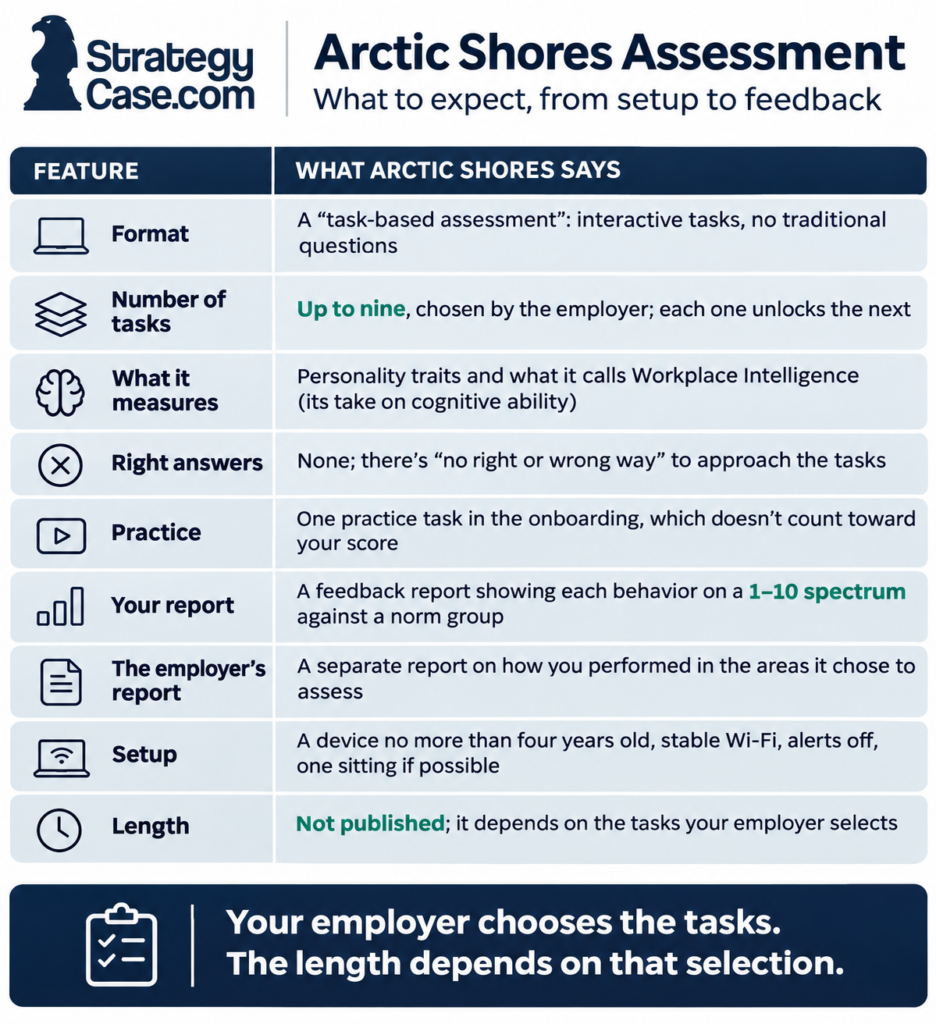
Figure: How the Arctic Shores assessment runs from invitation to feedback report.
One step in the onboarding matters more than candidates expect. Arctic Shores says reasonable adjustments must be declared before you begin, and they can’t be added once you start. If you need extra time or another adjustment, sort it out with the employer before you click start.
Which Companies Use Arctic Shores?
Arctic Shores doesn’t publish a full client list, and employers change vendors between recruiting cycles. These are the employers I could confirm on an employer page or in Arctic Shores’ own case studies:
| Employer | What the source says | Source |
|---|---|---|
| Environment Agency | A behavioral-based assessment “delivered by Arctic Shores,” with game-style tasks; shortlisting uses your assessment score | Environment Agency’s application guide |
| First Bus (graduate programs) | An online assessment through Arctic Shores with game-based exercises, then a Teams video interview and an assessment center | First Bus careers |
| WSP (UK graduate program) | An online behavioral assessment, with candidates pointed to Arctic Shores’ support pages | WSP job ad, 2025 cycle |
| Capita, FDM Group, Publicis, Adecco, Burness Paull, Essex Fire & Rescue, Experis Academy | Named in Arctic Shores’ customer case studies | Arctic Shores case studies |
| ReGeneration (Greece) | A graduate program that has used Arctic Shores since 2018 to shortlist for partner employers, including PwC Greece | Arctic Shores’ ReGeneration case study |
The pattern is clear even if the list isn’t complete: graduate schemes, apprenticeships, and high-volume early careers hiring, where employers want a screen that doesn’t rely on resumes.
What About PwC and KPMG?
PwC UK‘s earlier game, which candidates and prep guides call Career Unlocked, is described as an Arctic Shores assessment. PwC’s current assessment and selection page describes something else: a test hosted on SHL with an untimed behavioral profile and a timed numerical, inductive, and deductive reasoning test. PwC’s online assessment guide covers each stage. Outside the UK, PwC Greece’s Head of Talent is quoted in Arctic Shores’ ReGeneration case study, praising its gamified tools for shortlisting entry-level candidates.
KPMG UK‘s application process page describes an untimed skills test where you rank how you’d respond to scenarios (allow about 20 minutes), then a 36-minute numerical and logical reasoning test. It points candidates to SHL’s practice tests, not to Arctic Shores. Our KPMG online assessment guide covers both tests.
Deloitte and EY don’t name their providers, but the evidence for both points to Cappfinity, whose reasoning questions, unlike Arctic Shores’ tasks, have right answers. Deloitte’s online assessment mixes ranked scenarios with timed numerical and verbal questions. Our Deloitte and EY guides cover what each firm does publish.
So if a guide tells you Arctic Shores is “the Big 4 game,” check the date. In the UK, Big 4 applicants now mostly face timed reasoning tests, while the Arctic Shores game turns up at other graduate employers.
What the Arctic Shores Tasks Measure
Arctic Shores builds its tasks from research methods in cognitive neuroscience and behavioral science. It says they don’t test knowledge or past experience. Instead, they focus on how you typically think, react, and approach challenges. It also says, plainly, that it won’t reveal what each task measures, because it wants instinctive responses.
The task list varies by employer, and Arctic Shores doesn’t publish one. The only task its help center names is the arrow task (“Direction”) used in the practice section. Candidates and prep sites report a wider set, and several of them resemble classic research tasks:
| Task type candidates report | What you do | Research task it resembles |
|---|---|---|
| Balloon | Pump a balloon to earn money, and bank it before it pops | The Balloon Analogue Risk Task, a published measure of risk-taking (Lejuez et al., 2002) |
| Arrows (“Direction”) | Respond to the direction of the central arrow while ignoring the arrows around it | Flanker-style attention tasks |
| Memory and sequence tasks | Remember and reproduce patterns that get longer | Working-memory span tasks |
| Prediction and pattern tasks | Learn a rule from feedback and predict what comes next | Learning and rule-detection tasks |
Task names come from candidate reports and can differ by employer package. Arctic Shores doesn’t confirm which tasks measure which traits.
The research link explains why these tasks are hard to fake. In the research version of the balloon task, no single choice is “correct”: banking early and pumping late are both behaviors, and what matters is the pattern across many balloons. That’s why acting out an “ideal” level of caution is hard to sustain across dozens of rounds.
How Arctic Shores Scores You
There’s no pass mark in the usual sense. Arctic Shores compares your results with a “comparison group” (a norm group of demographically similar people who took the assessment before), then shows each behavior on a 1-10 spectrum. For your own report, it stresses there’s “no better or worse.”
The employer sees it differently. It gets its own report on the areas it chose to assess and uses it to decide who moves on. Arctic Shores says every employer looks for something different and there’s “no single way to pass,” which is true. But it’s still a filter: the Environment Agency, for example, says shortlisting is based on your responses and your assessment score.
I interview candidates for MBB on a daily basis, and the logic behind a screen like this is familiar from the evaluation side. Interviews are the expensive part of hiring, because every hour costs senior people’s time. The early screen exists to decide where that interview time goes.
Your job at this stage isn’t to look perfect. It’s to give the employer a clean, consistent read, so the profile it sees is the one it’ll meet in the interview.
That’s also why a “disappointing” report isn’t a verdict on you. A low score on one spectrum can be exactly what one role wants and a poor fit for another. Arctic Shores also notes that other personality tests will give you different results, because they measure different things and rely on how you describe yourself.
Can You Practice for the Arctic Shores Assessment?
Partly, and the part you can’t practice matters more. Arctic Shores’ help center says no practice is needed and that a practice task is built into the onboarding. It goes further: it says online guides aren’t created by its experts, may be misleading, and that using them “will result in poor or invalid measures, meaning you’re less likely to progress.”
This is the opposite of most online tests, and it’s worth understanding why. When we built StrategyCase’s McKinsey Solve guide, practice paid off because Solve has better and worse answers: your decisions either solve the problem in front of you or they don’t, so learning the game’s logic raises your score. Arctic Shores reads your natural behavior across thousands of micro-decisions. There’s no strategy to learn, only a profile to distort.
ChatGPT doesn’t help either. Arctic Shores says it tested various GenAI tools and none could complete the assessment, and it reminds candidates that employers’ AI policies differ, so check yours.
What does help is everything around the tasks:
- Do the practice task to learn the controls and check your device works.
- Read every instruction, and re-read it if you need to. Arctic Shores lets you.
- Use a device no more than four years old, fully charged, on stable Wi-Fi, with notifications off.
- Pick the time of day you’re most alert, because attention tasks punish fatigue.
- Declare adjustments before you start. They can’t be added later.
- Finish in one sitting if you can, as Arctic Shores recommends.
If you’re also applying to firms with timed aptitude tests, put your practice hours there. Those tests have right answers, so practice changes your score. The consulting assessment tests guide maps which screen each major firm uses.
Practice the Big 4 online assessments with our
Big 4 Online Assessment Practice Tests
- 10 timed mocks: 5 in SHL’s general ability format (24 questions in 36 minutes) and 5 Deloitte-style numerical and verbal mocks
- 8 practice sets by question type, with a worked solution for all 320 reasoning questions
- 45 behavioral ranking scenarios and a video interview bank
Follows the firms’ published UK formats. One-time payment, 1 year of access, full refund within 24 hours.
What Comes After the Arctic Shores Assessment?
The next stage depends on the employer, but the pattern on employers’ own pages is consistent: a recorded or live video interview, then an assessment center or interview day. First Bus, for example, moves candidates to a Microsoft Teams video interview on motivation and skills, then an assessment center. WSP’s graduate ad says most applicants reach the interview day within 8-10 weeks of applying.
Those later stages test what Arctic Shores can’t see: your examples, your motivation, and how you think out loud. If your next step is a recorded video, the HireVue interview guide explains how one-way video answers are assessed. For the interview itself, the consulting fit interview guide shows how to structure the stories behind your strengths.
Arctic Shores Assessment FAQ
How long does the Arctic Shores assessment take?
Arctic Shores doesn’t publish a standard length, because each employer chooses its own set of up to nine tasks. Add time for the onboarding and practice task. Block out an uninterrupted stretch and finish in one sitting if you can, as Arctic Shores recommends.
Can you fail the Arctic Shores assessment?
There’s no fixed pass mark, but you can be screened out. Employers receive a report on the traits they chose and use it to decide who progresses, and the Environment Agency says shortlisting is based partly on the assessment score. The best protection is a consistent, natural approach rather than trying to guess an ideal profile.
Can I practice Arctic Shores tasks?
Only the format. Arctic Shores gives you a practice task in the onboarding and says no other practice is needed. It also says outside guides tend to produce invalid results. Use the practice task to learn the controls and test your device, then approach the real tasks naturally.
What companies use Arctic Shores?
Employers that name it on their own pages include the Environment Agency, First Bus, and WSP’s UK graduate program. Arctic Shores’ case studies add Capita, FDM Group, Publicis, Adecco, Burness Paull, Essex Fire & Rescue, Experis Academy, and Greece’s ReGeneration program. PwC UK and KPMG UK now point candidates to SHL tests instead.
Can ChatGPT pass the Arctic Shores assessment?
No, according to Arctic Shores. It says it tested various GenAI tools and none could complete the assessment, because the tasks record your reactions and decisions in real time rather than asking questions. Check your employer’s AI policy anyway, since rules differ by company.
What does my Arctic Shores feedback report mean?
It places each behavior assessed on a 1-10 spectrum compared with a norm group of similar people. Arctic Shores says there’s no better or worse end for you personally. The employer reads the same data against what its role needs, which is why the same report can fit one job well and another poorly.
Related Guides
- Free GMAT quant questions: free numerical practice for the timed tests that do reward practice
- BCG one-way video interview: how to answer recorded video questions with no interviewer
- BCG Pymetrics test: another behavior-based game screen, and whether BCG still uses it
- McKinsey Solve: the outcome-based game where practice does change your score
Before You Start Your Arctic Shores Assessment
The Arctic Shores assessment rewards candidates who stop trying to beat it:
- Learn the format, not a profile. Do the practice task, read every instruction, and approach each task the way you naturally would.
- Control your setup. A recent device, stable Wi-Fi, no notifications, adjustments declared up front, one sitting.
- Spend your practice hours where they pay: the timed reasoning tests and interviews that usually come with or after this screen.
If those later stages include a consulting firm, the case interview will test skills no online screen does. Start StrategyCase’s free Case Interview Foundations course to learn the method from the ground up: 40+ videos, 7+ hours of instruction, and 200+ pages of reading.
Arctic Shores is one of the few screens where being yourself is the actual instruction. Take it seriously, set yourself up well, and save the grinding for the tests that reward it.
About the author: Dr. Florian Smeritschnig is the founder of StrategyCase.com and a former McKinsey Senior Consultant who recruited candidates for the firm. Since 2020 he has delivered 2,300+ mock interviews and coaching sessions, and his clients have secured 700+ consulting offers, 340 of them at McKinsey, BCG, and Bain. He is the author of three books on consulting interviews and careers, including The 1%: Conquer Your Consulting Case Interview.
