
Updated November 2026 · By Florian Smeritschnig, Former McKinsey Senior Consultant
An SHL test is an online pre-employment assessment that an employer buys from SHL and picks from SHL’s catalog. Its general ability test, Verify Interactive G+, gives you 36 minutes for up to 24 adaptive questions on numerical, deductive, and inductive reasoning. Its personality questionnaire, the OPQ, takes about 20 minutes. Your invite decides which ones you get.
That’s the problem with most SHL guides. They describe “the” SHL test, when SHL sells dozens, and many are written by companies selling SHL-style practice packs. SHL’s own help center says it doesn’t sell practice tests to candidates at all. Everything paid is third-party, ours included.
My experience recruiting at McKinsey and coaching consulting applicants shapes the preparation advice in this guide. For SHL’s test formats and rules, I draw on its official practice materials, help center, and fact sheets, alongside employer careers pages, checked on November 23, 2026, as well as candidate feedback collected over time. You’ll find an overview of the test types, an explanation of Verify G+ with two worked questions, and clear guidance on calculators, outside help, retakes, and results. The guide finishes with a practical preparation plan.
Key Takeaways
- “SHL test” is a family, not one test. SHL’s free practice site lists more than 20 assessments, from general ability and numerical reasoning to personality, situational judgment, coding, and video interviews.
- The general ability test (Verify Interactive G+) allows 36 minutes for up to 24 questions, about 90 seconds each. It’s adaptive, so you can’t go back, and its interactive version asks you to drag and build answers instead of picking A to E.
- SHL sells no practice tests to candidates. Its free ones may not match the real difficulty, and results you get there are never shared with the employer.
- SHL’s anti-cheating features end the test if you switch tabs or windows repeatedly, press Print Screen repeatedly, or resume too often. Results go only to the employer, never to you through SHL.
- In consulting and the Big 4, three employers point to SHL: BCG’s Consulting Career Assessment (US, Canada, Mexico), PwC UK’s online assessment, and KPMG UK’s 36-minute reasoning test.
Applying to BCG in North America, or to PwC or KPMG in the UK? Skip to which consulting and Big 4 firms use SHL for the version you’ll face and the practice that matches it.
What Is an SHL Test?
Definition: An SHL test is any online assessment from SHL, a talent assessment company that employers pay to screen applicants. The employer chooses which tests to send, sets the deadline, and receives the results. You take them through a link in your invite, usually before any interview.
SHL is the vendor, not the test. The company says it runs 10 million personality assessments a year across more than 3,000 customers, so the same name covers a graduate scheme at a bank, a call center role, and a consulting firm’s first screen. Two invites that both say “SHL” can contain completely different tasks.
At the consulting and Big 4 employers that use SHL, the invite pairs two things: a behavioral questionnaire and a timed reasoning test. The questionnaire asks how you like to work. The reasoning test measures how fast and accurately you solve small, exact problems.
If you’re applying to consulting firms, the SHL test is one of several screens you might meet. The consulting assessment tests guide maps every major firm’s online test.
The SHL Test Types
SHL’s free practice site lists these assessments. Each row is a separate product, and an employer can combine several in one invite.
| SHL test | What it measures | Notes from SHL’s practice site |
|---|---|---|
| General Ability (Verify Interactive G+) | Numerical, deductive, and inductive reasoning in one test | Interactive and standard multiple-choice versions; the interactive practice version gives no report |
| Numerical Reasoning | Reading tables and charts of business data, making deductions | Interactive and standard versions; interactive gives a report |
| Verbal Reasoning | Understanding written passages and evaluating arguments about them | One practice version |
| Inductive Reasoning | Spotting patterns and predicting the next step | Interactive and standard versions |
| Deductive Reasoning | Drawing logical conclusions, completing scenarios from incomplete information | Interactive and standard versions |
| Calculation | Solving equations and arithmetic problems | A separate, narrower test than numerical reasoning |
| Checking Information | Reviewing written text for accuracy at a detailed level | Detail-checking, not reasoning |
| Personality (OPQ) and Behavior-Based | How you prefer to work | No right or wrong answers, per SHL |
| Motivation Questionnaire (MQ) | What energizes you at work | Example questions only |
| Situational Judgment Test | Choosing the best action in workplace scenarios | You evaluate several possible actions |
| Video interviews | Recorded answers about your experience and behavior | Asynchronous; camera can stay covered in practice |
| Job skills simulations | Excel 365, Office literacy, coding, email writing, contact center | Role-specific |
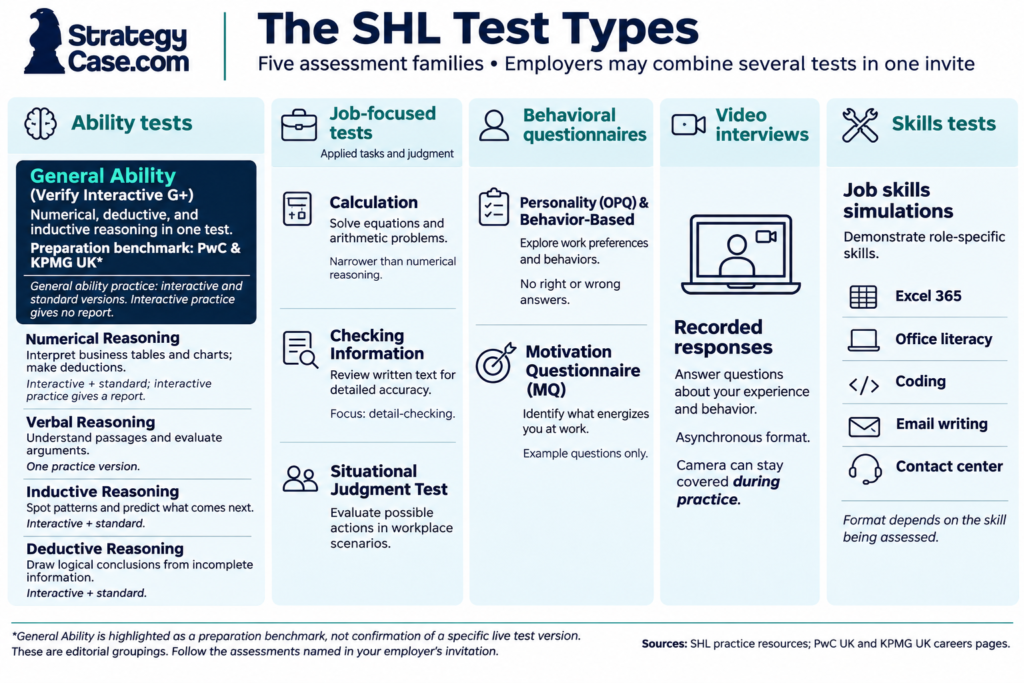
Two practical points follow from that list. First, the “SHL calculation test” and “SHL checking test” are separate, narrower products, so practicing for them won’t prepare you for a general ability invite (or the reverse). Second, the practice site offers interactive and standard versions of the same test, so check which one your invite describes and practice that one.
The SHL General Ability Test (Verify Interactive G+)
If your invite mentions numerical, inductive, and deductive reasoning together, it’s probably this one. Here is what SHL’s Verify Interactive G+ factsheet states:
| Spec | SHL’s figure |
|---|---|
| Time allowed | 36 minutes |
| Maximum questions | 24 |
| Sittings | One |
| Where you take it | Unsupervised, on any device, including a phone |
| Format | Interactive, activity-based, and adaptive |
| Scores | A score for each of the three abilities, plus a general ability score |
Adaptive means the questions adjust to your answers. SHL’s help center adds the consequence: on an adaptive test you can’t go back and change an earlier answer. Interactive means you might drag a bar on a chart to the right value or place items in a grid instead of choosing from options.
The time budget is the whole difficulty. 36 minutes for 24 questions is 90 seconds each, and that includes reading the chart. Here is SHL’s own short introduction to Verify Interactive:
SHL’s official introduction to Verify Interactive, from SHL’s YouTube channel.
The two questions below are our own, written in the style of the numerical and deductive tasks. They aren’t SHL questions, and the real test may ask you to drag or build the answer rather than pick a letter.
SHL Numerical Reasoning: A Worked Example
A regional ferry operator carried these passengers:
| Route | 2024 | 2025 |
|---|---|---|
| North | 120,000 | 138,000 |
| South | 80,000 | 84,000 |
| Island | 50,000 | 43,000 |
By how many percentage points did Route North’s share of total passengers change from 2024 to 2025? Give your answer to one decimal place.
- A) +4.1 points
- B) +15.0 points
- C) +8.5 points
- D) +7.2 points
Answer: A. Total passengers increased from 250,000 in 2024 to 265,000 in 2025. North’s share was:
- 2024: 120,000 ÷ 250,000 × 100 = 48.0%
- 2025: 138,000 ÷ 265,000 × 100 ≈ 52.0755%
The change is 52.0755 − 48.0 ≈ +4.1 percentage points.
Each wrong option reflects a different mistake:
- B (+15.0) is the growth rate of North’s passenger numbers: 18,000 ÷ 120,000 × 100 = 15%. It does not measure the change in North’s share.
- C (+8.5) is the relative percentage increase in North’s share: (52.0755 − 48.0) ÷ 48.0 × 100 ≈ 8.5%. The question asks for percentage points, not a percentage increase.
- D (+7.2) uses the wrong year’s total to calculate North’s 2025 share: 138,000 ÷ 250,000 × 100 = 55.2%. Subtracting the original 48.0% then gives 7.2 points.
For practice, try this question with a 90-second target. Before calculating, identify whether the question asks for growth in passenger numbers, a share of the total, or a change in that share.
SHL Deductive Reasoning: A Worked Example
Four presentations (Budget, Hiring, Pricing, and Safety) occupy slots starting at 9:00, 10:00, 11:00, and 12:00. Each presentation occupies one slot.
The following rules apply:
- Pricing comes immediately after Budget.
- Hiring comes earlier than Budget.
- Safety is not first.
Which statement must be true?
- A) Hiring is at 9:00.
- B) Safety is at 12:00.
- C) Pricing is at 11:00.
- D) Budget is at 10:00.
Answer: A. Budget cannot be first because Hiring must come before it. Budget cannot be last because Pricing must come immediately after it. That leaves two possible positions for Budget:
| Arrangement | 9:00 | 10:00 | 11:00 | 12:00 |
|---|---|---|---|---|
| Budget at 10:00 | Hiring | Budget | Pricing | Safety |
| Budget at 11:00 | Hiring | Safety | Budget | Pricing |
In the second arrangement, Hiring and Safety occupy the first two slots. Since Safety cannot be first, Hiring must take 9:00.
Hiring is at 9:00 in both valid arrangements, so A must be true. B, C, and D are true in the first arrangement but false in the second. They could be true, but do not have to be.
That distinction is central to deductive reasoning: a statement is not necessarily true just because it fits one valid arrangement. Use the constraints to narrow the possibilities, then test which statement holds in every valid case.
SHL Inductive Reasoning: How to Decode a Series
Inductive questions show a sequence of shapes or grids and ask what comes next. Test one property at a time: number of elements, position, rotation, shading, then size. When one rule doesn’t explain every step, look for a second property changing at the same time.
Practice these from images, not text. SHL’s free inductive practice test comes in both interactive and standard versions, and the interactive one gives you a report.
The SHL Personality Questionnaire (OPQ) and Behavioral Tests
At BCG, PwC, and KPMG, the SHL screen includes a behavioral part alongside the reasoning test. SHL’s best-known questionnaire is the Occupational Personality Questionnaire (OPQ). SHL’s OPQ page says it takes 20 minutes and runs in 37 languages.
SHL’s assessment advice states that behavioral style has no right or wrong answers. It also warns candidates not to guess what assessors want, because they may guess wrong, and to answer honestly. That matches what the employers say: PwC UK calls its behavioral profile a measure of your natural preferences and doesn’t time it, and BCG’s Consulting Career Assessment FAQ says its behavioral part has no right or wrong answers.
No right answers doesn’t mean no consequences. The employer still reads your profile against the job. Three habits help:
- Answer as you behave at work, not as you’d like to be seen. If the questionnaire asks you to rank statements, every choice is a trade-off, and an “ideal” profile is hard to keep consistent.
- Read the employer’s published behaviors first. PwC publishes its behaviors and KPMG its 12 skills. Knowing them helps you recognize which real examples to think of, and they come back in the video interview.
- Don’t rush. Untimed means untimed. Read every statement before you rank it.
Some invites also include a situational judgment test (SJT), where you rate or rank actions in workplace scenarios. KPMG UK’s skills assessment works this way. SHL’s free practice site has an SJT practice test.
Which Consulting and Big 4 Firms Use SHL?
Three employers in consulting and the Big 4 point to SHL on their own pages. The rest use other providers or don’t name one.
| Employer | Where | The SHL stage | What the firm says |
|---|---|---|---|
| BCG | US, Canada, and Mexico offices | Consulting Career Assessment (CCA): behavioral traits plus a timed logic portion | BCG’s CCA FAQ: designed and administered by SHL, customized to BCG; 30-35 minutes including a tutorial and practice questions; calculator allowed; no retake |
| PwC | UK early careers | Untimed behavioral profile, then a timed test of numerical, inductive, and deductive reasoning; then an SHL on-demand video interview | PwC UK’s assessment page: hosted on SHL; a PwC assessor reviews the video |
| KPMG | UK graduate, undergraduate, and apprentice programs | Untimed skills assessment (rank responses, about 20 minutes), then a 36-minute numerical and logical test | KPMG UK’s application process: points candidates to SHL’s practice tests; re-tests elements of the online assessments |
Not on SHL: McKinsey screens with its own McKinsey Solve assessment, and Bain uses Sova or TestGorilla depending on the office (Bain online assessment guide).
Deloitte UK and EY UK don’t name a provider on their careers pages, but the evidence points to Cappfinity: Deloitte’s Candidate Zone runs on Cappfinity’s systems, and EY’s FAQ closely mirrors Cappfinity’s help text. The Cappfinity assessment guide shows the evidence.
Notice the overlap. KPMG’s 36 minutes and PwC’s three reasoning types match SHL’s Verify Interactive G+ exactly, though neither firm names the product, so treat G+ as the likely benchmark rather than a confirmed spec. The firm guides cover each process in full: PwC online assessment, KPMG online assessment, and the BCG Consulting Career Assessment.
SHL Test Rules: Calculators, Cheating, Retakes, and Results
These answers come from SHL’s candidate help center. Where SHL’s platforms differ, I say so, because your invite’s instructions override any general rule.
Can you use a calculator on an SHL test?
Usually, for numerical tests. SHL’s help center says you may use a calculator on numerical and calculation tests unless told otherwise. But it also describes platforms where only the on-screen calculator is allowed, and one FAQ says calculators aren’t allowed before adding numerical tests as the exception.
BCG’s CCA explicitly allows one. Pen and paper are allowed in every version SHL describes, so practice with them.
Can you go back, pause, or restart?
On an adaptive test you can’t return to an earlier question. If you leave in the middle of a timed test, the timer keeps running. If your browser crashes, SHL says you can usually log back in with your original details a few minutes later, but its help center also mentions an allowed restart time of 4 hours, and resuming too many times invalidates the test.
Can SHL detect cheating?
SHL’s anti-cheating features invalidate a test, with no option to resume, for:
- Switching to another tab or window, or clicking outside the test, repeatedly
- Pressing Print Screen repeatedly
- Resuming the test more times than allowed
An invalidated test goes back to the recruiter, not to SHL support. Employers can check later too: KPMG UK says it re-tests elements of its online assessments. Close every other tab before you start.
Can you retake an SHL test?
Only if the employer allows it. SHL’s help center describes a cooling period that recruiters set to restrict repeat attempts, and it sends reattempt requests to the recruiter. BCG’s CCA has no retake, and BCG’s US careers pages say it reuses your score for 12 months.
How do you get your SHL test results?
From the employer, if at all. SHL says only the results recipient the company chose can see your scores, its support team can’t share them, and the feedback you get is at the company’s discretion. Practice-site results are never shared with an employer.
How to Prepare for an SHL Test
In coaching, I treat the online test as its own workstream, with its own diagnosis and its own practice plan. Case prep doesn’t cover it. A candidate who structures a market entry case well can still run short of time on 24 reasoning questions in 36 minutes, because the test rewards speed on small, exact problems. That’s why my US coaching clients get the CCA practice tests: the CCA comes before any BCG interview.
Here’s the plan I’d follow with an invite in hand:
- Identify the exact test. Read the invite for the abilities named, the time limit, and whether a calculator is allowed. If it’s vague, check the employer’s careers page, as the firm table above does.
- Take SHL’s free practice test in the matching version. SHL’s practice tests page has interactive and standard versions. Take each relevant one once, timed, and note your weakest ability.
- Drill the weak type untimed first. Accuracy before speed. For numerical, name the base before you calculate. For deductive, write out every arrangement.
- Then add the clock. Work in blocks of eight questions in 12 minutes, the 90-second pace of the 36-minute test.
- Sit at least one full timed mock in one go, on the device you’ll use, before test day.
- Set up the test like an exam. SHL’s own list of do’s and don’ts: a quiet room, a rebooted computer, every other tab closed, and no logging in right before the deadline.
SHL notes that its practice tests may not match the difficulty of your real test, and that it doesn’t have practice tests for every assessment or language. That’s where third-party mocks help with volume. None of them is official, so treat them as practice for the format, not a preview of the questions.
If you’re applying to consulting, passing the SHL test only gets you to the case interview, and that tests different skills. Start StrategyCase’s free Case Interview Foundations course while you prepare for the screen: 40+ videos, 7+ hours of instruction, and 200+ pages of reading.
SHL Test FAQ
Is the SHL test hard?
Each question uses familiar math and logic: percentages, ratios, and rules. The difficulty is the clock. The general ability test allows about 90 seconds per question, and it’s adaptive, so it adjusts to your answers and won’t let you go back. That’s why timed practice matters more than learning new math.
How long is an SHL test?
It depends on the tests in your invite. SHL’s general ability test takes 36 minutes and the OPQ personality questionnaire about 20. BCG’s CCA runs 30-35 minutes including a tutorial, KPMG UK’s reasoning test 36 minutes, and SHL’s AI video interview 20-25 minutes. Block out an hour so you never start in a rush.
Can you fail the SHL personality test?
There’s no published pass mark, and SHL says behavioral style has no right or wrong answers. The employer still compares your profile with what the role needs, so it does count. Answer honestly and consistently: guessing at “ideal” answers risks contradicting yourself across the questionnaire.
Are SHL practice tests the same as the real test?
No. SHL says its practice tests give a similar experience in question types and format, but not an exact one, and the difficulty may differ. They’re the best way to learn the interface. For volume, you’ll need more questions than SHL offers for free.
Does SHL sell practice tests?
No. SHL’s help center says it doesn’t sell online or paper practice tests to candidates and points to its free ones instead. Any paid “SHL practice test” comes from a third party and contains original questions in SHL’s style, not real SHL questions.
Who sees my SHL test results?
Only the person the employer chose as results recipient. SHL support can confirm that you finished, but it can’t give you your scores. Some employers send feedback: KPMG UK, for example, sends a personalized skills feedback report after its online assessments.
Related Guides
- Deloitte online assessment: the Immersive Online Assessment and Job Simulation (no SHL named)
- EY online assessment: EY’s six question formats explained
- Arctic Shores assessment: the game-based screen some UK employers use instead
- BCG online assessment: which of BCG’s five screens your office uses
- BCG Cognitive Test: BCG’s own reasoning test outside North America
Before You Take Your SHL Test
The SHL test rewards candidates who prepare for the version in their invite:
- Name the test first. SHL sells dozens; your invite and the employer’s page tell you which.
- Expect 90 seconds per question on the general ability test, with no going back.
- Answer the personality part honestly. It’s untimed, and consistency matters more than an “ideal” profile.
- Keep it clean. Switching tabs or pressing Print Screen can end the test, and some employers re-test.
Then practice with the questions that match your employer.
Applying to PwC or KPMG in the UK? Get StrategyCase’s Big 4 Online Assessment Practice Tests. It has 5 general ability mocks in SHL’s format (24 numerical, inductive, and deductive questions in 36 minutes each), untimed practice sets by question type, 45 behavioral ranking scenarios, and a video interview bank, with a worked solution for all 320 reasoning questions. The mocks are multiple choice and not adaptive, so use SHL’s free interactive tests to get used to dragging answers. $29 one-time, 1 year of access, and a full refund within 24 hours of purchase.
Applying to BCG in the US, Canada, or Mexico? Get StrategyCase’s BCG CCA Practice Tests. 15 timed logic mocks in the format candidates report (8 questions in 12 minutes), 15 drills across five question types, and 2 unscored personality practice sets: 210 original questions, each with a worked solution. $19 one-time, 1 year of access, and a full refund within 24 hours.
All questions are original. StrategyCase isn’t affiliated with SHL, Boston Consulting Group, Deloitte, PwC, EY, KPMG, or Cappfinity.
About the author: Dr. Florian Smeritschnig is the founder of StrategyCase.com and a former McKinsey Senior Consultant who recruited candidates for the firm. Since 2020 he has delivered 2,300+ mock interviews and coaching sessions, and his clients have secured 700+ consulting offers, 340 of them at McKinsey, BCG, and Bain. He is the author of three books on consulting interviews and careers, including The 1%: Conquer Your Consulting Case Interview.
