
Updated November 2026 · By Florian Smeritschnig, Former McKinsey Senior Consultant
A verbal reasoning test gives you a short passage and a set of statements. You mark each statement True if the passage confirms it, False if the passage contradicts it, and Cannot Say if the passage doesn’t settle it either way. The test measures one thing: whether you can judge written evidence without adding what you already know.
That last part is where scores fall apart. The questions read like simple comprehension, so strong readers rush them, fill small gaps with common sense, and mark True on statements the passage never proves. On SHL’s Verify Verbal Reasoning test, you get 19 minutes for up to 30 questions, about 38 seconds each, so there’s no time to reconsider a habit mid-test.
This guide covers the graduate and professional verbal reasoning test that employers such as Deloitte use, not the 11+ school entrance paper. You’ll get a three-question rule for every statement, eight wording traps to watch for, a worked example, practice questions with answers, and a list of which employers actually include a verbal section.
Key Takeaways
- The answer comes from the passage alone. True needs a sentence that confirms the statement, and False needs a sentence that contradicts it. With neither, the answer is Cannot Say, even when the statement is true in the real world.
- The traps are small wording shifts. “May” becomes “will,” “some” becomes “most,” “after” becomes “because of.” Each one turns a confident True into Cannot Say.
- False needs evidence too. A statement the passage never mentions is Cannot Say, not False. Mark False only when you can point to the sentence that rules the statement out.
- Pace is tight. SHL’s fact sheet allows 19 minutes for up to 30 questions, and the UCAT gives 22 minutes for 44. Train for accuracy first, then speed.
- Check whether your test has a verbal section at all. Deloitte UK’s Immersive Online Assessment does. PwC UK’s graduate tests and McKinsey Solve don’t.
What Is a Verbal Reasoning Test?
Definition: A verbal reasoning test is a timed aptitude test in which you read a short passage of business-style text and judge whether statements about it are True, False, or Cannot Say based only on what the passage says. Employers use it to screen graduate and professional applicants for how well they evaluate written information.
SHL’s own example page describes the task in one line: you read a passage and decide whether each statement is true, false, or cannot say “given the information in the passage”. Its fact sheet adds that the passages use workplace content and that the skill matters in roles where you analyze written information and prepare documents or presentations.
Not every verbal test uses the three-option format. Here’s how the common ones compare:
| Test | Format | Length | Answer options |
|---|---|---|---|
| SHL Verify Verbal Reasoning | Passage, then statements | Up to 30 questions, 19 minutes allowed | True / False / Cannot Say |
| Deloitte UK Immersive Online Assessment (verbal part) | Not published by Deloitte | No overall limit; some questions timed | Not published |
| UCAT Verbal Reasoning (UK medicine and dentistry) | 11 passages, 4 questions each | 44 questions, 22 minutes | Mixed question types; no prior knowledge expected |
| Kearney recruitment test (verbal sections) | Argument questions and a long reading passage | Part of a 40-question, 60-minute test | Multiple choice |
| Watson-Glaser (TalentLens) | Five critical thinking subtests | Varies by version | Inferences rated by probability, not three options |
Sources: SHL Verify Verbal Reasoning fact sheet (2018), Deloitte UK early careers assessment page, UCAT test format and scoring, our Kearney recruitment test guide, TalentLens Watson-Glaser.
The rest of this guide focuses on the True / False / Cannot Say format, because it’s SHL’s format and the one with the most counterintuitive scoring.
How to Answer True, False, or Cannot Say
The Three-Question Rule
Run every statement through three questions, in this order:
- Can I point to a sentence that confirms it? The statement can paraphrase, combine two sentences, or do a simple step such as “two of six is fewer than half.” If the passage forces the statement to be true, mark True.
- Can I point to a sentence that contradicts it? The passage has to rule the statement out, not merely leave it unsupported. If it does, mark False.
- Neither? Mark Cannot Say. Your knowledge of the world, the most likely outcome, and what a sensible company would do are all irrelevant.
Decision rule for a verbal reasoning test: point to a confirming sentence for True, a contradicting sentence for False, otherwise Cannot Say
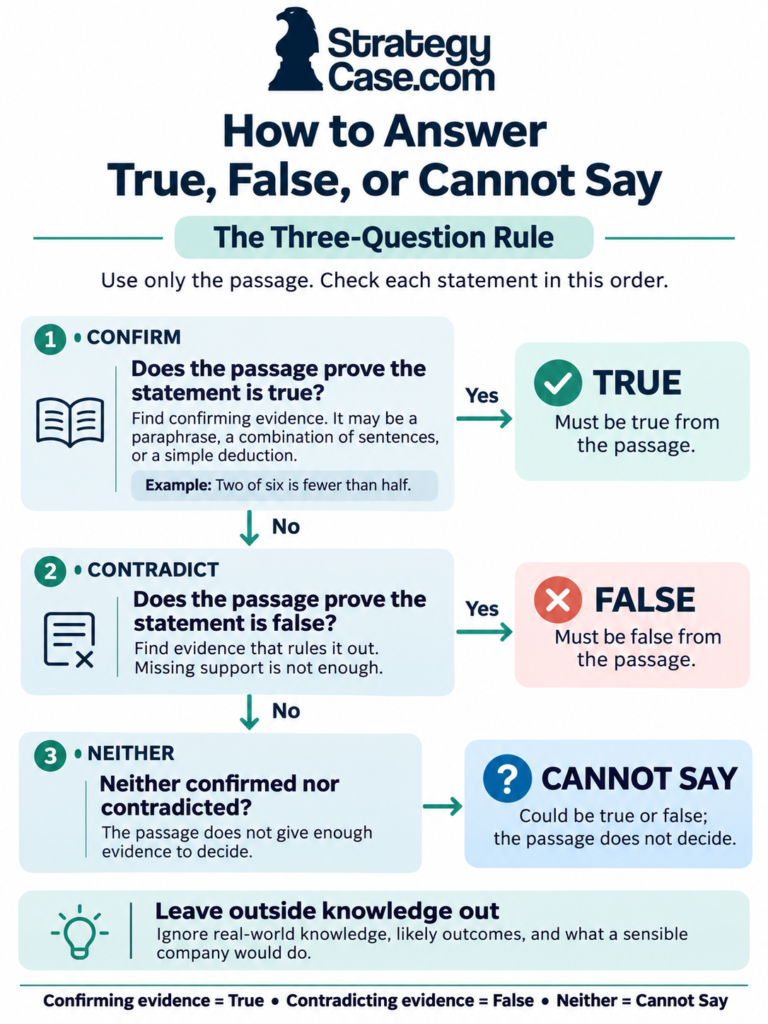
Figure: The three-question rule. If you can’t put your finger on the deciding sentence, the answer is Cannot Say.
The “point to it” test reflects how answer keys are written. When we developed the verbal reasoning questions for StrategyCase’s Big 4 practice tests, every True or False answer had to cite the words in the passage that supported or contradicted the statement. Our review process rejected any Cannot Say answer if the passage contained enough evidence to decide either way. That is what makes a fair question: the passage either gives you enough evidence to reach a conclusion or leaves something essential unknown.
If your verbal test is part of Deloitte’s UK screen, read our Deloitte online assessment guide next. It covers what the rest of that assessment scores and how the timed questions work.
False vs Cannot Say: The Hardest Call
False and Cannot Say both mean “you can’t mark this True,” so candidates treat them as one bucket. The test doesn’t.
False means the passage rules the statement out. Cannot Say means the passage is silent or incomplete. Compare two statements about the same sentence:
Passage: “The company has not yet decided whether to cut prices.”
| Statement | Answer | Why |
|---|---|---|
| The company will cut prices. | Cannot Say | No decision has been made, so the passage doesn’t tell you the outcome |
| The company has decided to keep prices unchanged. | False | The passage says no decision has been made, which contradicts “has decided” |
Both statements feel equally unsupported on a first read. Only the second claims something the passage denies. When you’re torn, ask: “Which sentence would I quote to prove it’s false?” If you can’t name one, it’s Cannot Say.
The opposite mistake costs points too. Candidates who’ve been burned by Cannot Say start marking it whenever a statement uses different words from the passage. A correct paraphrase is still True: “imports were lower than exports” is True if the passage says “exports exceeded imports.”
8 Wording Traps in Verbal Reasoning Tests
The hardest statements differ from the passage by a word or two. Here are eight shifts to watch for, each with the answer it produces.
| # | Trap | Passage says | Statement says | Answer |
|---|---|---|---|---|
| 1 | Possibility becomes certainty | “The plant may close next year.” | “The plant will close next year.” | Cannot Say |
| 2 | Quantity stretched | “Some branches report delays.” | “Most branches report delays.” | Cannot Say |
| 3 | Quantity narrowed | “All branches report delays.” | “Some branches report delays.” | True |
| 4 | Sequence read as cause | “Sales rose after the campaign launched.” | “The campaign raised sales.” | Cannot Say |
| 5 | “The only” vs “one of” | “Cost was the only reason customers gave for leaving.” | “Customers gave several reasons for leaving.” | False |
| 6 | Past trend projected forward | “Demand has grown for three years.” | “Demand will keep growing.” | Cannot Say |
| 7 | Outside knowledge | (Passage about a retail bank’s branches; no mention of interest rates.) | “The Bank of England sets UK interest rates.” | Cannot Say |
| 8 | Two claims in one statement | “The firm cut costs in 2025.” (Nothing on prices.) | “The firm cut costs and raised prices in 2025.” | Cannot Say |
Trap 3 is the one that catches overcautious candidates. If all branches report delays, some branches do, so the answer is True. Trap 8 flips to False when the passage contradicts either half: if the passage says prices were frozen, “cut costs and raised prices” is False.
Verbal Reasoning Test Examples and Practice Questions
Worked Example: One Passage, Six Statements
This passage and its statements are our own, written in the style of a graduate verbal reasoning test. They’re not taken from SHL, Deloitte, or any real test.
Kessel Line runs six ferries across the Varden Strait. It converted two of them to battery power in 2025 and plans to convert the other four by 2029, provided the port authority finishes a new charging berth. On the converted ferries, fuel costs per crossing have fallen by about half, while maintenance costs have risen. Passenger numbers on the strait grew by 8% in 2025, the same rate as in 2024. The company has not yet decided whether to pass its lower fuel costs on to passengers through cheaper fares.
| Statement | Answer | Deciding words |
|---|---|---|
| 1. Fewer than half of Kessel Line’s ferries have been converted to battery power. | True | “six ferries”; “converted two of them”; “the other four” still to come |
| 2. All six ferries will run on battery power by 2029. | Cannot Say | “plans to,” and only “provided” the berth is finished |
| 3. A battery-powered crossing costs Kessel Line less in total than it did before conversion. | Cannot Say | Fuel fell, maintenance rose, and no total is given |
| 4. Passenger growth on the strait sped up in 2025. | False | “the same rate as in 2024” |
| 5. Fares on the strait will fall. | Cannot Say | “has not yet decided” |
| 6. Kessel Line has already decided whether to pass its lower fuel costs on to passengers through cheaper fares. | False | “has not yet decided” contradicts “has decided” |
Statement 3 is the one business-minded readers get wrong. Halving fuel costs sounds decisive, so you mark True. The passage gives one cost going down and another going up, with no figure for the total, so it can’t support any conclusion about overall cost.
Statements 5 and 6 rest on the same sentence and get different answers. That pairing is the False vs Cannot Say distinction in its purest form.
Practice Questions With Answers
Try these before you read the answers. Give yourself about three minutes, including time to read the passage. This is a suggested practice target; actual test timings vary.
Brennmoor Water supplies about 400,000 homes. In 2025, it lost an estimated 22% of the water it treated through leaks, above the 15% maximum set by its regulator. The company has since fitted acoustic sensors to its oldest pipes. These pipes make up a third of its network and are currently the only pipes equipped with sensors. It says the sensors find leaks faster, but that it is too early to measure their effect on total losses. If losses remain above the maximum in 2027, the regulator can fine the company.
- In 2025, Brennmoor Water lost more water through leaks than its regulator allows.
- Acoustic sensors now cover Brennmoor Water’s whole network.
- The sensors have reduced Brennmoor Water’s total water losses.
- The regulator will fine Brennmoor Water in 2027.
- The regulator accepts some loss of water through leaks.
Answers:
| # | Answer | Deciding words |
|---|---|---|
| 1 | True | “22%,” “above the 15% maximum” |
| 2 | False | “a third of its network”; “the only pipes equipped with sensors” |
| 3 | Cannot Say | “too early to measure their effect on total losses” |
| 4 | Cannot Say | “can fine,” and only “if losses remain above the maximum” |
| 5 | True | A “15% maximum” means losses up to 15% are within the limit |
If you missed question 4, that’s trap 1: “can” became “will.” If you missed question 5, you probably marked Cannot Say because the passage never uses the word “accepts.” That’s the overcautious mistake from the False vs Cannot Say section: a correct inference from the passage is still True.
Why Analytical Candidates Lose Points on Cannot Say
Here’s the pattern that matters most if you’re applying to consulting. A case interview, which I coach people for, rewards you for forming a view from incomplete data. You state a hypothesis early, then test it. Waiting for complete information before saying anything reads as passive.
The verbal test scores the same move as a mistake. Statement 3 in the Kessel Line example exists for exactly this reader: you expect battery ferries to be cheaper to run, so you complete the missing calculation in your head and mark True. The passage never adds the two cost lines together, and the key says Cannot Say.
So switch modes on purpose. In the test, you’re the auditor: nothing counts unless it’s on the page. In the case interview that follows the screen, you’re expected to commit to a view with gaps in the data. After the screen comes the case, and it rewards the opposite habit. If consulting is your target, StrategyCase’s free Case Interview Foundations course covers the skills the case interview tests, from structuring to interpreting charts.
How Long Is a Verbal Reasoning Test?
Length depends on the publisher and the employer, but the pace is consistently tight:
| Test | Questions | Time | Time per question |
|---|---|---|---|
| SHL Verify Verbal Reasoning | Up to 30 | 19 minutes allowed (17-19 on average) | About 38 seconds |
| UCAT Verbal Reasoning | 44 | 22 minutes | 30 seconds, including reading 11 passages |
| Deloitte UK Immersive Online Assessment | Not published | No overall limit | Some questions timed; your speed counts toward the score |
Three practical consequences follow:
- Read the passage once, properly. Several statements share one passage, so a careful first read pays for itself across all of them. Rereading for every statement is where the time goes.
- Answer from the deciding words. Once you’ve found the sentence that decides a statement, or confirmed there isn’t one, move on. Second-guessing a clean Cannot Say is a common time sink.
- Expect a possible re-test. SHL’s fact sheet lists the format as “one plus verification test,” so an employer can ask you to confirm an unsupervised score later. Prepare to score the same way twice.
Which Employers Use Verbal Reasoning Tests?
Before you spend a week on verbal practice, check that your test has a verbal section. Formats change between recruiting seasons, and many prep guides describe sections that no longer exist. When we rebuilt our Bain Sova practice tests in November 2026, the verbal sets that older guides still describe no longer showed up in our recent candidate reports.
| Employer screen | Verbal reasoning? | What we know |
|---|---|---|
| Deloitte UK (Immersive Online Assessment) | Yes | Numerical and verbal reasoning after the behavioral part; Deloitte doesn’t publish the verbal format |
| PwC UK (graduate SHL tests) | No | The timed tests are numerical, inductive, and deductive. See our PwC online assessment guide |
| KPMG UK | Not named | A ranking skills test plus a 36-minute numerical and logical test. See our KPMG online assessment guide |
| Kearney | Yes, multiple choice | Two verbal sections inside a 40-question test with negative marking |
| Bain (Sova) | Not in recent reports | Candidates since late 2024 report a personality questionnaire, then numerical and logical questions. See our Bain Sova test guide |
| McKinsey | No | McKinsey Solve is a game-based assessment |
For consulting applicants, Deloitte’s UK graduate screen is the one in this table with a classic verbal reasoning section, while the MBB firms screen with their own formats. For every firm’s online screen in one place, see our consulting assessment tests overview.
How to Prepare for a Verbal Reasoning Test
Verbal reasoning is a learnable format. The skill underneath, reading for evidence, improves fastest when you see exactly why each answer is right. Work through these steps in order:
- Learn the rule untimed. For every statement, write down the deciding words, or “none” for Cannot Say. If you can’t write them, you guessed, even if you got it right.
- Keep a trap log. After each set, tag every miss with one of the eight traps. The traps you hit more than once become your focus.
- Add the clock last. Once your untimed accuracy is consistently high, practice at your test’s real pace: about 38 seconds per question for SHL-style tests, 30 for the UCAT.
- Use the free official practice first. SHL offers a free verbal reasoning practice test on SHL Direct, though it warns that practice difficulty may not match the test you’ll take. Deloitte UK candidates get Deloitte’s own Candidate Zone.
- Finish with full timed mocks and worked solutions. Feedback is what turns a score into a fix, which is why every practice question needs an explanation tied to the passage.
If your verbal test is part of a Big 4 UK screen, StrategyCase’s Big 4 Online Assessment Practice Tests include five Deloitte-style mocks with 12 numerical and 12 verbal questions each, plus untimed practice sets by question type, with a worked solution for every reasoning question. The verbal questions use the True / False / Cannot Say format.
Practice true/false/cannot say questions with our
Big 4 Online Assessment Practice Tests
- 45 behavioral ranking scenarios, every order explained
- 5 Deloitte-style mocks: 12 numerical and 12 verbal questions each, on practice timers
- Numerical and verbal practice sets with worked solutions, plus a video interview bank
Follows the firms’ published UK formats. One-time payment, 1 year of access, full refund within 24 hours.
Verbal Reasoning Test FAQ
What’s the difference between False and Cannot Say in a verbal reasoning test?
False means a sentence in the passage contradicts the statement. Cannot Say means the passage doesn’t give you enough to decide. If the passage never mentions the topic, the answer is Cannot Say, not False. Mark False only when you can quote the words that rule the statement out.
Can I use my own knowledge in a verbal reasoning test?
No. Judge every statement on the passage alone, even when you know the statement is true in the real world. The UCAT states it directly: you’re not expected to use prior knowledge. A true fact the passage doesn’t mention is Cannot Say.
How long is a verbal reasoning test?
It depends on the test. SHL’s Verify Verbal Reasoning allows 19 minutes for up to 30 questions, about 38 seconds each. The UCAT gives 22 minutes for 44 questions. Deloitte UK sets no overall limit, but some questions are timed and your speed counts toward the score.
Is this the same as the 11+ verbal reasoning test?
No. The 11+ verbal reasoning paper is a school entrance test for 10- and 11-year-olds, with a different style of questions. This guide covers the tests employers use to screen graduate and professional applicants, mostly in the True / False / Cannot Say format.
Where can I practice verbal reasoning tests for free?
Start with SHL’s free practice tests and verbal reasoning example questions on SHL Direct. If you’ve been invited by an employer, use its own practice portal, such as Deloitte’s Candidate Zone. The worked example and five practice questions on this page also come with the deciding words for every answer.
Do consulting firms use verbal reasoning tests?
Some do. Deloitte UK’s graduate screen includes verbal reasoning, and Kearney’s recruitment test has two multiple-choice verbal sections. McKinsey uses its game-based Solve assessment, and recent candidates report no verbal section in Bain’s Sova test. Check your firm’s current format before you practice.
Related Guides
- Deloitte Online Assessment: What Each Stage Tests
- PwC Online Assessment: What PwC Actually Tests Now
- KPMG Online Assessment: Skills Test, 36-Minute Test, Video
- Consulting Assessment Tests: Every Firm’s Online Screen
- Kearney Recruitment Test: 40 Questions, 60 Minutes
Pass the Verbal Reasoning Test by Reading for Evidence
A verbal reasoning test rewards discipline more than reading speed. The points to keep:
- True and False both need a sentence you can point to. With neither, it’s Cannot Say.
- Watch for the eight wording traps, especially “may” becoming “will” and “after” becoming “because of.”
- Don’t overcorrect: a correct paraphrase or a simple inference is still True.
- Check that your employer’s test has a verbal section before you practice for one.
Your next step: take the Brennmoor questions again tomorrow without looking at the answers, and write the deciding words for each. Then practice at your test’s real pace.
If your test is a Big 4 UK screen, practice with StrategyCase’s Big 4 Online Assessment Practice Tests. You get five Deloitte-style mocks with 12 numerical and 12 verbal questions each, untimed practice sets, and a worked solution for every reasoning question. It’s a one-time $29 with 1 year of access and a full refund within 24 hours.
And if consulting is where you’re headed, remember that the screen is only the first gate. The case interview after it tests a different skill, and you can start building it now.
About the author: Dr. Florian Smeritschnig is the founder of StrategyCase.com and a former McKinsey Senior Consultant who recruited candidates for the firm. Since 2020 he has delivered 2,300+ mock interviews and coaching sessions, and his clients have secured 700+ consulting offers, 340 of them at McKinsey, BCG, and Bain. He is the author of three books on consulting interviews and careers, including The 1%: Conquer Your Consulting Case Interview.
