
Updated November 2026 · By Florian Smeritschnig, Former McKinsey Senior Consultant
The KPMG online assessment in the UK has two parts: an untimed skills assessment where you rank how you’d think, feel, or respond to workplace scenarios (allow about 20 minutes), and a timed 36-minute numerical and logical reasoning test. Pass both and a six-question recorded video interview follows. Then comes Launch Pad, an in-person half-day assessment.
Many guides still describe KPMG UK’s test as a game or credit it to Cappfinity or Arctic Shores. KPMG UK’s own page tells a simpler story, and it points candidates to SHL’s practice tests. It also warns that it re-tests elements of the online assessments, so a score you didn’t earn tends not to survive.
Every KPMG rule below comes from KPMG’s own careers pages in the UK and Australia, read in November 2026. You’ll get both tests, the 12 skills KPMG scores, two worked practice questions, the video interview, and Launch Pad.
Key Takeaways
- Two online assessments, back to back: an untimed skills assessment (rank how you’d respond, about 20 minutes) and a timed 36-minute test of numerical and logical reasoning.
- KPMG publishes what it scores. Its 12 KPMG Skills, from Career Motivation to Integrity, drive the skills assessment, the video interview, and Launch Pad.
- The 36-minute test matches SHL’s general ability format, and KPMG points candidates to SHL’s practice tests. You also get practice questions right before the live assessment.
- The video interview is six recorded questions from an AI avatar called Leah, but a person on KPMG’s Student Recruitment team scores your answers.
- Integrity checks are real: KPMG re-tests elements of the online assessments and withdraws candidates who used AI or shared content.
What Is the KPMG Online Assessment?
Definition: The KPMG online assessment is the screening stage KPMG UK runs after you submit your application. It combines an untimed skills assessment, where you rank responses to workplace scenarios, with a 36-minute numerical and logical reasoning test. Together they decide who moves on to KPMG’s video interview.
KPMG UK’s application process page sets out four stages for its graduate, undergraduate, and apprentice programs:
| Stage | What you do | Timing | What you get back |
|---|---|---|---|
| 1. Explore and apply | An unassessed look at the role through everyday scenarios, then the application form | Untimed | Assessment against entry criteria, with contextual recruitment |
| 2. Online assessments | Skills assessment (ranking), then a numerical and logical reasoning test | ~20 minutes untimed, then 36 minutes timed | A personalized skills feedback report |
| 3. Video interview | Six pre-recorded questions from an AI avatar; you prepare, then record | Allow 40 minutes | Scored by a member of the Student Recruitment team |
| 4. Launch Pad | An in-person half-day with assessed and unassessed activities | Half a day | An offer within 2 working days if successful; feedback on request if not |
KPMG online assessment stages in 2026: application, skills assessment, 36-minute test, video interview, Launch Pad
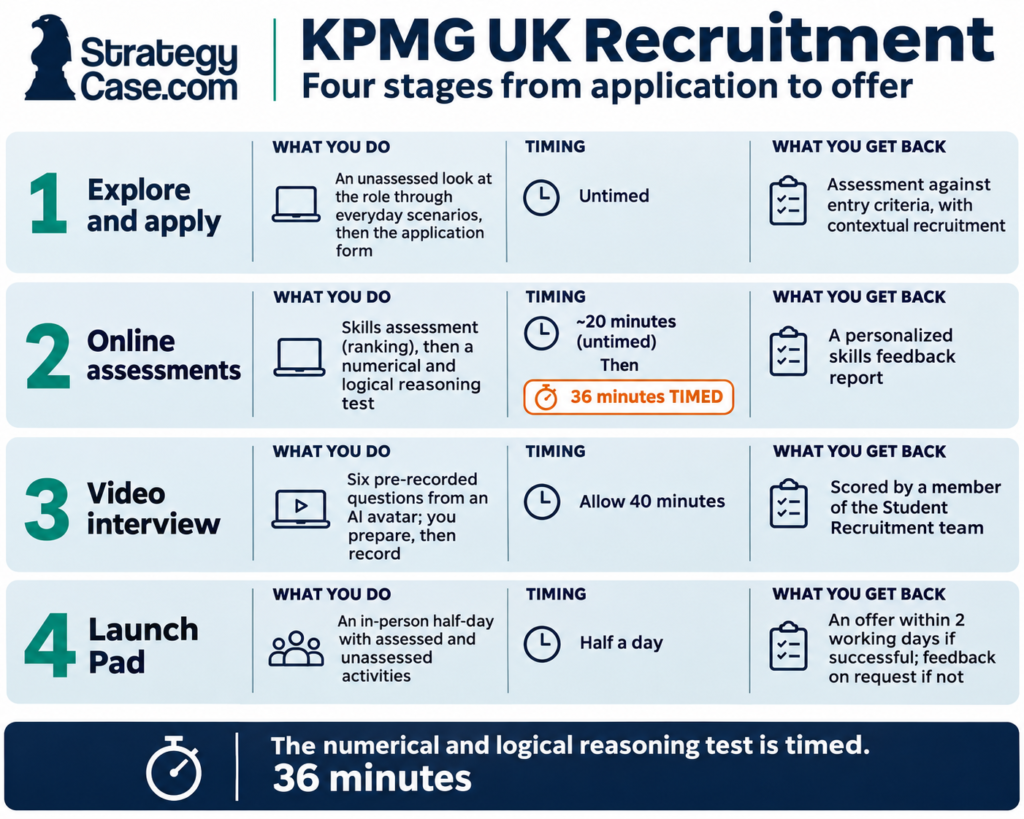
Figure: KPMG UK’s four recruitment stages, with the timed test marked.
Stage 1 is worth a few honest minutes. KPMG says the scenario-based preview isn’t assessed, and it exists to help you check the program suits you. KPMG’s FAQ adds that once you’re recruited for a specific program and business area, you can’t switch route later.
The 12 KPMG Skills: What You’re Scored On
Unlike most firms, KPMG publishes the skills it assesses. Its KPMG Skills page lists 12, and the skills assessment, video interview, and Launch Pad all look for them:
| # | KPMG Skill | In KPMG’s words, roughly |
|---|---|---|
| 1 | Career Motivation | You know why KPMG, this program, and this location |
| 2 | Learning & Curiosity | You pick up new information quickly and stay open to new ideas |
| 3 | Resilience | You stay calm and productive when things are unclear or go wrong |
| 4 | Relationship Building | You make connections easily and adapt how you work with others |
| 5 | Effective Communication | You understand and explain spoken and written information clearly |
| 6 | Initiative | You set demanding goals and take on extra responsibility |
| 7 | Planning & Organisation | You set objectives, manage your time, and work in a logical order |
| 8 | Results Focused | You deliver quality work across several tasks at once |
| 9 | Critical Thinking | You evaluate information and make logical, data-based judgments |
| 10 | Inclusive Collaboration | You build team cohesion and draw out others’ views |
| 11 | Integrity | You uphold ethical standards and keep confidential information safe |
| 12 | Applying Expertise & Technology | You apply your knowledge and use technology to work better |
Paraphrased from KPMG UK’s Skills page, November 16, 2026.
This list is the most useful thing on KPMG’s site, and most candidates skim it. For McKinsey’s PEI, I teach candidates to prepare one real story per assessed dimension, built with my SCORE storytelling framework. KPMG’s 12 skills invite the same approach. Pick a real example for each, and you have the raw material for the skills assessment, all six video questions, and Launch Pad.
The KPMG Skills Assessment (Situational Judgment)
The first online assessment presents workplace scenarios and asks you to rank how you would think, feel, or respond, “thinking about yourself at work and picking the answer that is most like you.” It’s untimed, and KPMG suggests allowing 20 minutes.
It’s often called the KPMG situational judgment test, and the format is the same idea: several plausible responses, ranked. KPMG publishes no answer key, and it asks for the answer most like you, not the one you think it wants.
Here’s what a ranking item can look like. This one is our own illustration, not a KPMG question.
Scenario: Your manager hands you a task with a vague brief and a 5 p.m. deadline, then goes into back-to-back meetings.
- A) Start straight away, write down your assumptions, and check them with your manager at the next break
- B) Ask a colleague who has done similar work how they approached it
- C) Wait until your manager is free so you can get a clearer brief
- D) Break the task into parts and finish the parts that don’t depend on the unclear points first
Every option touches a KPMG skill. A and D show Resilience and Planning & Organisation, B shows Relationship Building, and C protects quality but risks the deadline. That’s the point of the format: the ranking reveals what you put first. Answer the way you work, because the same priorities come back in your video answers and at Launch Pad.
The KPMG Numerical and Logical Reasoning Test (36 Minutes)
The second assessment is timed. KPMG gives you 36 minutes to “interpret information, complete numerical calculations and draw logical conclusions.” It doesn’t name the product, but it says the most relevant practice is SHL’s behavior-based and general ability tests, and it links to SHL’s practice tests.
The timing is a strong hint. SHL’s general ability test, Verify Interactive G+, allows exactly 36 minutes for up to 24 questions across numerical, deductive, and inductive reasoning, per SHL’s factsheet. It’s adaptive, and the questions are interactive: you may adjust a chart or complete a pattern instead of picking A to E. Treat that as the likely benchmark, not a confirmed KPMG spec.
Two practical rules from KPMG: take it on a desktop or laptop, ideally in Chrome, on a stable connection. And use the practice questions KPMG offers right before the live assessment, because they show you the interactive answer format.
KPMG Online Assessment Practice Questions (Worked)
The two questions below are our own, written to match the skills KPMG lists. They aren’t KPMG or SHL questions, and the real test may ask you to drag or adjust answers rather than choose a letter.
Worked Example 1: Numerical Reasoning
Units shipped by a client’s three depots last quarter
| Depot | Units shipped (000s) | Error rate |
|---|---|---|
| North | 240 | 2.5% |
| Central | 300 | 4.0% |
| South | 260 | 1.5% |
Which depot shipped the most error-free units?
- A) North
- B) Central
- C) South
- D) Central and South equally
Answer: B. Error-free units are units × (1 − error rate). North: 240 × 0.975 = 234,000. Central: 300 × 0.96 = 288,000. South: 260 × 0.985 = about 256,100.
The trap is answering the question you expected. South has the lowest error rate, so C feels right, but the question asks for a volume, not a rate. Central’s size outweighs its higher error rate. Reading the question twice costs five seconds; answering the wrong one costs the mark.
Worked Example 2: Logical Reasoning
Four trainees (P, Q, R, and S) join four teams (Audit, Tax, Deals, and Consulting), one each.
- P doesn’t join Audit or Tax.
- Q joins Deals or Consulting.
- R joins Tax.
Which of the following must be true?
- A) P joins Deals.
- B) S joins Audit.
- C) Q joins Consulting.
- D) S joins Tax.
Answer: B. R takes Tax. P can only take Deals or Consulting, and so can Q, so between them they fill both. That leaves Audit for S. A and C could be true, but neither must be, because P and Q could swap.
The habit to build: when two pieces compete for the same two slots, look at what’s left over. That’s usually where the “must be true” answer sits.
The KPMG Video Interview
If you pass the online assessments, KPMG may invite you to a recorded video interview. You get six pre-recorded questions asked by an AI avatar KPMG calls Leah. For each one, you have a set time to prepare, then you record your answer. KPMG suggests allowing 40 minutes.
Leah only asks the questions. KPMG says your recorded answers “will be reviewed and scored by a member of our Student Recruitment team.” It’s checking whether your skills and strengths match those needed at KPMG and how motivated you are for your chosen program.
I never worked at KPMG, so I can’t tell you what’s on its scoring sheet. What carries over from recruiting candidates at McKinsey is how recorded answers lose points.
Candidates describe what the team did instead of what they did. They make claims (“I’m very organized”) instead of telling one specific situation. Or they spend half the answer on background and run out of time before the result.
The fix is the story bank from the KPMG Skills section. Open each answer with your point, tell one real situation, say what you did and what changed, and stop. The consulting fit interview guide shows how to structure those stories so the result lands early.
KPMG Launch Pad: The Final Stage
Launch Pad is KPMG UK’s final stage: an in-person half-day that mixes assessed and unassessed activities. You’ll be assessed on the KPMG Skills throughout, and you’ll meet people from the business area and location you applied to, from trainees to partners. KPMG sends full instructions, including travel expenses and dress, before the day.
KPMG’s page lists these dates for the current cycle:
| Date | Venue |
|---|---|
| November 17, 2026 | London, the Oval |
| December 1, 2026 | Birmingham, NEC |
| December 9, 2026 | Manchester, Midland Hotel |
| March 16, 2027 | Bristol, Ashton Gate Stadium |
| March 23, 2027 | Glasgow, Radisson Blu |
| April 22, 2027 | London, the Oval |
| May 5, 2027 | Leeds, New Dock Hall |
If you’re successful, KPMG says you’ll have your offer within 2 working days. If not, you can ask for feedback.
KPMG UK doesn’t publish a case interview for its graduate programs, but consulting roles across the Big 4 often include one. The Big 4 case interview guide explains how Deloitte, PwC, EY, and KPMG run those rounds.
The KPMG Online Assessment Outside the UK
KPMG’s member firms run different tests, so check your invite:
| Where you apply | Online stage | What’s different |
|---|---|---|
| UK | Skills assessment (untimed, ~20 min) + 36-minute numerical and logical test; KPMG points to SHL’s practice tests | Video interview with an AI avatar, then Launch Pad |
| Australia | Two Criteria assessments: a timed, game-based cognitive test (problem-solving, numerical, verbal) and an untimed workplace behaviors assessment | Complete within 48 hours of the invite; results stay valid for 12 months (KPMG Australia FAQ) |
| US | Not published | I couldn’t find an official KPMG US page describing an online test, so rely on your invite |
KPMG Australia’s FAQ describes the two assessments as about 15 minutes each in one answer and about an hour together in another, so block out the longer time.
And one name you won’t find on any of these official pages: Arctic Shores. Older guides list KPMG as an Arctic Shores client, but KPMG UK now points to SHL. The Arctic Shores assessment guide covers which employers use that game today.
How to Prepare for the KPMG Online Assessment
Before You Apply
- Write your 12-skill story bank. One real example per KPMG Skill, from university, work, or volunteering. It keeps your skills assessment consistent and feeds the video interview.
- Find your weaker reasoning type. Take SHL’s free numerical, deductive, and inductive practice tests once each, timed.
- Check the invite window. KPMG’s FAQ says both assessments must be finished within the number of calendar days in your invitation. If you can’t make it, tell KPMG straight away, not at the end of the window.
A Five-Day Plan Once the Invite Arrives
| Day | What to do | Why |
|---|---|---|
| 1 | Re-read the 12 KPMG Skills and your story bank | The skills assessment and video interview test the same priorities |
| 2-3 | Short timed sets on your weaker reasoning type, then review every error | Accuracy first, then speed |
| 4 | One full timed mock: about 24 mixed questions in 36 minutes | Pacing across numerical, deductive, and inductive items |
| 5 | Do KPMG’s pre-test practice questions, then sit both assessments on a laptop in Chrome | Learn the interactive format right before it counts |
Practice for KPMG’s online assessment with our
Big 4 Online Assessment Practice Tests
- 45 behavioral ranking scenarios for KPMG’s skills test, every order explained
- 5 general ability mocks in SHL’s format: 24 numerical and logical questions in 36 minutes
- A video interview bank: 30 questions, 8 model answers and 3 timed recording drills
Follows the firms’ published UK formats. One-time payment, 1 year of access, full refund within 24 hours.
Mistakes That Cost Candidates the KPMG Online Assessment
- Ranking for an imagined ideal. KPMG asks for the answer most like you, and your priorities have to hold up in two more stages.
- Practicing without a clock. The second test is 36 minutes, and pacing is half the challenge.
- Taking it on a phone. KPMG says to use a desktop or laptop.
- Getting help, human or AI. KPMG says it re-tests elements of the online assessments and withdraws candidates who act dishonestly, and it may report them to professional bodies, law enforcement, or fraud databases.
One more line from KPMG’s FAQ matters here. KPMG says it has no relationship with, and doesn’t endorse, providers that sell help with its assessments. That includes StrategyCase. So treat KPMG’s own pages and pre-test practice as your first stop, and use original practice questions to build the skills, never to memorize “answers.”
KPMG Online Assessment FAQ
How long does the KPMG online assessment take?
Plan for about an hour in the UK. The skills assessment is untimed, and KPMG suggests allowing 20 minutes. The numerical and logical reasoning test is timed at 36 minutes. Add a few minutes for the practice questions KPMG offers right before the live test.
Is the KPMG online assessment hard?
The 36-minute reasoning test is the hard part, mostly because of time pressure: SHL’s matching general ability test fits up to 24 adaptive questions into those 36 minutes. The skills assessment has no published answer key and isn’t timed, so honesty and consistency matter more than speed there.
Is the KPMG online assessment an SHL test?
KPMG UK doesn’t say so outright, but it points candidates to SHL’s practice tests as the most relevant, and its 36-minute timing matches SHL’s Verify Interactive G+ general ability test. KPMG Australia uses Criteria instead, so check which provider your invite names.
What is the KPMG video interview like?
You answer six pre-recorded questions asked by an AI avatar called Leah, with a set preparation time before each recording. KPMG suggests allowing 40 minutes. The avatar only asks the questions: a member of KPMG’s Student Recruitment team reviews and scores your answers.
Can I use ChatGPT for the KPMG online assessment?
No. KPMG says you confirm you’re completing the assessments without help from others or AI. It re-tests elements of the online assessments and withdraws candidates found acting dishonestly. For guidance on responsible AI use during the wider application, KPMG points to its integrity guidance.
How long does it take to hear back from KPMG after Launch Pad?
KPMG UK says successful candidates get their job offer within 2 working days of Launch Pad. If you’re unsuccessful, you’re offered the option to request feedback. After the online assessments, you receive a personalized skills feedback report.
Related Guides
- Consulting assessment tests: every major consulting firm’s online screen, by firm
- Deloitte online assessment: the Immersive Online Assessment and Job Simulation
- KPMG consulting salary: KPMG Advisory pay at every level
- Big 4 salaries: Deloitte, PwC, EY, and KPMG pay compared by level
Before You Start Your KPMG Online Assessment
The KPMG online assessment rewards candidates who prepare for what KPMG publishes:
- Know the 12 KPMG Skills, and have one real story for each.
- Rank honestly in the skills assessment, because the same priorities come back on video and at Launch Pad.
- Train the 36-minute test under a clock, with SHL’s free practice tests and KPMG’s pre-test questions.
- Keep it clean: KPMG re-tests and withdraws candidates who cheat.
When you want more timed practice than the free tests offer, get StrategyCase’s Big 4 Online Assessment Practice Tests. For KPMG’s two tests, it has 45 behavioral ranking scenarios with every order explained and 5 general ability mocks in SHL’s format (24 questions in 36 minutes) with a worked solution for every question, plus a video interview bank with model answers and timed drills. It costs $29 one-time with 1 year of access, and you get a full refund within 24 hours of purchase.
All questions are original. StrategyCase isn’t affiliated with Deloitte, PwC, EY, KPMG, SHL or Cappfinity.
If you’re aiming for KPMG’s consulting teams, the case interview comes after the screen, and it tests different skills. Start StrategyCase’s free Case Interview Foundations course once your online stages are done: 40+ videos, 7+ hours of instruction, and 200+ pages of reading.
About the author: Dr. Florian Smeritschnig is the founder of StrategyCase.com and a former McKinsey Senior Consultant who recruited candidates for the firm. Since 2020 he has delivered 2,300+ mock interviews and coaching sessions, and his clients have secured 700+ consulting offers, 340 of them at McKinsey, BCG, and Bain. He is the author of three books on consulting interviews and careers, including The 1%: Conquer Your Consulting Case Interview.
