
Updated August 2026 · By Florian Smeritschnig, Former McKinsey Senior Consultant
A first-year Business Analyst at McKinsey & Company in the US earns roughly $140,000 total compensation in 2026, climbing to $245,000 as a post-MBA Associate, $290,000 as an Engagement Manager, $420,000 as an Associate Partner, and $500,000 to $1.2 million+ at the Partner and Senior Partner levels. Below is the full McKinsey salary breakdown by role, by entry path, and by region, plus how McKinsey compensation compares to BCG and Bain at every step.
Update, August 2026: McKinsey has raised US Business Analyst base salary from $112,000 to $120,000, effective January 2027. The increase covers summer Business Analyst interns and was applied retroactively to candidates who had already accepted offers, who were emailed directly rather than held to their signed number. Bain has already matched at $120,000. BCG has confirmed to offer holders that updated letters are coming. No change has been confirmed at the post-MBA Associate level, and no confirmation exists yet for non-US offices. Figures below reflect the new US base.
I spent 5 years at McKinsey as a Senior Consultant. Since leaving, I have coached candidates to more than 700 offers in MBB recruiting, with the majority targeting McKinsey specifically. I can tell you exactly how the firm’s hierarchy maps to day-to-day responsibilities, how the much-discussed “One Firm Principle” affects Partner pay globally, and which salary numbers floating around online are inflated, outdated, or simply made up.
Key Takeaways
- McKinsey has 6 career levels: Business Analyst, Associate, Engagement Manager, Associate Partner, Partner, Senior Partner
- Business Analyst (US, undergrad entry): $120K base + $20K target bonus = $140K total, rising to ~$148K at maximum bonus
- Associate (US, post-MBA): ~$195K base + $50K bonus + $30K signing = ~$275K Year 1, $245K base+bonus thereafter
- Engagement Manager: ~$225K base + $65K bonus = $290K total
- Associate Partner: ~$280K base + $140K bonus = $420K total
- Partner: $500K+ base, with profit-sharing pushing total comp past $1.5M for established Partners
- One Firm Principle: McKinsey Partners earn equally globally regardless of office, a unique trait among MBB firms
McKinsey Salary by Level (US, 2026)
The headline numbers for every McKinsey level, all US offices, base plus target bonus:
| Level | Base Salary | Target Bonus | Total Cash Comp | Typical Tenure |
|---|---|---|---|---|
| Business Analyst | $120,000 | $20,000 | $140,000 | 2 years (3 for Junior BAs) |
| Associate (post-MBA / promoted BA) | $195,000 | $50,000 | $245,000 | 2 to 3 years |
| Engagement Manager | $225,000 | $65,000 | $290,000 | 2 to 3 years |
| Associate Partner | $280,000 | $140,000 | $420,000 | 2 to 3 years |
| Partner | $500,000+ | Profit share | $700K to $1.5M+ | Several years |
| Senior Partner | $1,200,000+ | Profit share | $1.5M to $5M+ | Until retirement |
A few notes on this table:
- Base salaries are what McKinsey quotes in your offer letter. Bonuses are paid annually based on individual and firm performance, the figures here are realistic targets, not maximums.
- Maximum bonus can reach 30-40% higher than target for top-performing Associates and Engagement Managers. Associate Partners in strong years see $180K+ in performance bonus.
- Partner compensation is structured as profit-sharing rather than base plus bonus. The base figure represents the floor; total earnings depend on firm profitability.
- Senior Partner compensation has the widest range: Senior Partners with major industry portfolios at top offices reach $3-5M+ per year.
- “Junior BA” track: Some McKinsey offices hire Bachelor’s-only candidates as “Junior Business Analysts” on a 3-year promotion track (versus 2 years for the standard BA role). Salary is typically 10-15% below the standard BA in the same office.
The figures above reflect typical US offices (New York, Chicago, San Francisco, Boston, Atlanta, Washington DC, Los Angeles, Houston). McKinsey operates in 130+ cities globally; non-US offices pay in local currency at meaningfully different levels.
What’s Included Beyond Base and Bonus
The salary table above covers cash compensation. McKinsey’s total package adds substantial value on top, especially for new hires.
Signing bonus: $10,000-15,000 for Business Analyst hires, $30,000-35,000 for MBA Associate hires, sometimes higher for PhD and Advanced Degree Holder (ADH) candidates. Paid in your first paycheck or split across the first six months.
Relocation allowance: $5,000-15,000 lump sum depending on office and distance. International relocations include temporary housing for 1-3 months.
Health benefits: Comprehensive medical, dental, and vision coverage. McKinsey covers a significant portion of premiums, employee contribution is typically $50-150/month for individual coverage.
Retirement contribution: 401(k) with firm match (typically 50% match up to 6% of salary) plus profit-sharing contributions for tenured consultants.
Training and McKinsey Academy: New hires complete formal training programs at the firm’s regional training centers. McKinsey covers travel, lodging, and materials. MBA sponsorship is available for high-performing Business Analysts, the firm pays full tuition in exchange for a return commitment.
Sabbatical: After approximately 8-10 years, consultants are typically eligible for a paid “take time” sabbatical of 1-3 months. McKinsey is known for relatively flexible sabbatical policies, including externships at clients, NGOs, or for personal pursuits.
The “One Firm Principle”: Unique among MBB, McKinsey Partners participate in a global profit pool rather than office-specific or country-specific pools. A McKinsey Partner in Sydney, São Paulo, or Stuttgart earns the same percentage of firm profits as a Partner in New York, adjusted only for cost-of-living factors. This affects Partner-level compensation more than salary at lower levels, but it is one of the most important cultural and financial features of the firm.
Profit-sharing (Partner-track only): Senior Engagement Managers, Associate Partners, Partners, and Senior Partners participate in firm profit-sharing. This is where total compensation diverges most dramatically from the base-plus-bonus model.
For a typical post-MBA Associate joining in 2026, the all-in first-year compensation including signing bonus is closer to $275,000-280,000 rather than the $245,000 base-plus-bonus figure above.
The August 2026 Base Salary Increase, and What It Actually Means
McKinsey lifted US Business Analyst base pay from $112,000 to $120,000 in August 2026, effective January 2027. Two details matter more than the headline number.
The first is who it covers. The firm applied it to candidates who had already signed, including summer interns converting to full-time, and emailed them directly. Firms are not obligated to do that. A signed offer at $112,000 is a signed offer. Reopening it costs money and sets a precedent, and McKinsey did it anyway, which tells you something about how tight undergraduate recruiting currently is.
The second is where the money came from. Base went up roughly seven percent, but early reports from signed offers put target total compensation at about $139,000, essentially flat against the old $112,000 base plus bonus. The increase appears to be a rebalancing from variable pay into fixed pay rather than new money.
That is not a criticism. For most candidates a dollar of base is worth more than a dollar of target bonus. Base is guaranteed, it is what mortgage lenders underwrite against, it compounds through every future percentage raise, and it is the number your next employer anchors on when you leave. A firm shifting comp from bonus to base is quietly improving the offer even when the total does not move.
What it does mean is that you should not read “MBB raised salaries” as “MBB increased what I will earn.” Ask your recruiter for the target bonus and the maximum bonus alongside the new base. The base number is the one that gets announced. The other two are the ones that changed.
How AI Is Changing McKinsey Partner Compensation
One important 2026 update is that McKinsey is reportedly changing the cash-versus-equity mix of Partner compensation. According to the Financial Times, McKinsey has been working on a partner pay overhaul called Project Acorn, designed to simplify payouts, increase the firm’s capital reserves, and make its compensation model more resilient as consulting work becomes more AI-driven and more outcome-based.
The key point is not that McKinsey Partner compensation is disappearing or becoming unattractive. Rather, the structure of Partner compensation appears to be shifting slightly away from immediate annual cash payouts and toward a greater equity component. In simple terms, a larger share of Partner economics may stay inside the firm for longer.
Why does this matter? Because AI is changing the consulting business model. If more analytical work can be automated, the traditional leverage model of large junior teams billing many hours becomes less central. At the same time, clients are increasingly interested in outcome-based work, where fees are tied to measurable savings, performance improvements, or implementation results.
That creates a different cash-flow profile for a firm like McKinsey. Instead of purely billing for time and advisory work, the firm may need more internal capital to fund technology, support larger transformation programs, and absorb delayed or more variable payments from clients.
For candidates and junior consultants, this does not change the basic salary bands discussed above. A Business Analyst, Associate, Engagement Manager, or Associate Partner will still be compensated through the usual mix of base salary, bonus, benefits, and promotion-based increases.
The bigger implication is at the Partner level. McKinsey Partner compensation is likely becoming more tied to long-term firm ownership, capital discipline, technology investment, and the ability to create measurable client impact. That is an important shift: the top of the pyramid remains highly lucrative, but the model is becoming more institutional and less purely cash-distribution driven.
McKinsey Hierarchy: Roles, Tenure, and Promotion Difficulty
McKinsey operates an “up-or-out” promotion system. Consultants either advance within a predictable tenure window or transition out of the firm. The system was formalized in 1951 and has been relaxed somewhat in recent years through the introduction of “Expert” tracks and longer promotion windows, but the core principle remains.
Here is what each level actually does, and how hard the next promotion is.
Business Analyst (BA)
Entry-level role for undergraduate hires. Some offices also hire Master’s-degree holders without an MBA as BAs. Business Analysts conduct research, build financial models, analyze data in Excel and Alteryx, and create PowerPoint slides under direction from Associates and Engagement Managers. They already own working-level client relationships and workstreams. This is McKinsey’s way of testing readiness for the next level.
Promotion timeline: 2 years (standard BA), 3 years (Junior BA). Promotion difficulty: Moderate. The BA-to-Associate transition is the most predictable promotion in the McKinsey ladder, most BAs who perform well are promoted on schedule. Many strong BAs are sponsored to an MBA between BA and Associate.
Associate
Direct entry point for MBA, PhD, JD, and MD hires (Advanced Degree Holders / ADHs). Promoted BAs also enter here. Associates own specific workstreams within engagements, manage client meetings on their topics, and start building business intuition beyond pure analysis.
Senior Associates often take on Engagement Manager responsibilities in their second or third year.
Promotion timeline: 2-3 years (MBA hires and ADHs), 2 years (promoted BAs). Promotion difficulty: Moderate to high. Performance differentiation starts mattering, top Associates are flagged for accelerated promotion, weaker performers see extended tenure or counseling out.
Engagement Manager (EM)
EMs own engagements end-to-end. They organize workstreams, manage BAs and Associates, serve as primary day-to-day client contacts, and ensure delivery against engagement objectives. At this level, consultants begin specializing in industries (Banking, Healthcare, Tech) or functional practices (Strategy & Corporate Finance, Operations, McKinsey Digital).
Engagement Managers typically work full-time on-site at the client. The role is widely considered the most operationally intense in the McKinsey ladder.
Promotion timeline: 2-3 years. Promotion difficulty: High. The EM-to-Associate Partner step requires demonstrated business development capability, not just delivery excellence.
Associate Partner (AP)
The most difficult promotion at McKinsey. Associate Partners are evaluated less on delivery and more on client management, business development, and the ability to scope and sell future work. They run multiple engagements simultaneously and start building their own client relationships.
Promotion timeline: 2-4 years. Promotion difficulty: Very high. This is where most “up-or-out” transitions happen. Many strong APs never make Partner as the firm’s pyramid narrows sharply at this step. McKinsey’s “Expert” track offers an alternative for consultants who excel in delivery but prefer not to focus on business development.
Partner
Partners are firm owners. They build C-suite client relationships, identify and sell new engagements, scope projects, and assemble teams. Some Partners remain heavily client-facing, while others move into firm leadership, recruiting, or practice-area leadership.
Promotion timeline: Several years before Senior Partner consideration. Promotion difficulty: High.
Senior Partner (Director)
The most senior level at McKinsey. Senior Partners (formerly called Directors) own major client relationships, lead practices or geographies, and shape firm strategy. They typically retire at or around age 55, though many continue in advisory or board roles.
How “Up-or-Out” Works in Practice at McKinsey
McKinsey formally implemented “up or out” in 1951. The system has been relaxed somewhat over the past decade, longer promotion windows, formal “Expert” tracks for specialists, and more flexible career arcs are available. But the core principle remains: consultants who do not progress within the typical tenure window are counseled to transition out.
Historically, approximately 20% of the lowest-performing consultants at McKinsey departed annually. The current rate is somewhat lower due to relaxed policies and the firm’s growth.
“Counseled out” does not mean fired-on-the-spot. Underperforming consultants typically receive 6-12 months of structured feedback, performance improvement plans, and explicit transition support. McKinsey (like BCG and Bain) helps departing consultants find roles at clients, portfolio companies, NGOs, or other firms. The McKinsey alumni network is one of the firm’s most valuable assets, alumni include the CEOs of Google, Boeing, American Express, and dozens of other Fortune 500 companies.
McKinsey Salary by Entry Path
McKinsey hires through several distinct tracks. Your starting salary depends entirely on which track you enter through.
Undergraduate / Recent Graduate
Enters as a Business Analyst. Total cash comp: ~$140,000 (base + target bonus). Most hires come from target schools (Ivies, top public universities, top European business schools). Two-year tenure before promotion to Associate (or sponsored MBA).
Junior BA (Bachelor’s-only, certain regions)
A subset of BA hiring used in some non-US offices for candidates with a bachelor’s degree only (no Master’s). Promotion timeline extended to 3 years, with salary typically 10-15% below the standard BA in the same office.
MBA Hire (Direct from Business School)
Enters as an Associate. Total cash comp: ~$245,000 (base + target bonus), plus $30-35K signing = ~$275-280K all-in Year 1. Sourced from top MBA programs (HBS, Wharton, Stanford GSB, Booth, Kellogg, MIT Sloan, Columbia, INSEAD, LBS, IESE).
Advanced Degree Holder (ADH): PhD, MD, JD
Enters as an Associate (same salary band as MBA hires). McKinsey runs a dedicated ADH program with a “Bridge to McKinsey” onboarding for non-business PhDs and other advanced-degree holders. Total comp matches MBA hires. Common ADH backgrounds: Economics PhD, Physics PhD, Operations Research PhD, MD-PhD, JD from T14 law schools.
Experienced Hire (Lateral from Industry)
Variable entry level depending on prior experience. A senior strategist or consultant from a top-tier firm with 5-7 years of experience may enter at the Engagement Manager or Associate Partner level, with corresponding salary. Less common but possible, especially in McKinsey Digital and the Implementation practice.
Internship to Full-Time
Summer internships at the BA or Associate level pay prorated full-time salary. Successful interns receive return offers, typically with a $10-15K signing bonus on top of the standard package.
McKinsey vs BCG vs Bain: How MBB Salaries Compare
MBB salaries cluster within a narrow band. In 2026, McKinsey typically leads by 3-5% at most US levels, though the gap is small and adjustments happen within 6-12 months. Choosing your MBB firm based on salary at the offer stage is rarely the right call, fit, office, project mix, and culture matter much more.
| Level | McKinsey (2026, US) | BCG | Bain |
|---|---|---|---|
| Business Analyst / Associate / Associate Consultant | $140K | ~$140K | ~$140K |
| Associate / Consultant (post-MBA) | $245K | ~$242K | ~$230K |
| Engagement Manager / Project Leader / Manager | $290K | ~$280K | ~$290K |
| Associate Partner / Principal / Associate Partner | $420K | ~$410K | ~$360K |
| Partner | $500K+ | $500K+ | $450K+ |
| Senior Partner / Director | $1.2M+ | $1.2M+ | $1M+ |
For BCG-specific data, see the BCG hierarchy and salary breakdown. For Bain, see the Bain hierarchy and salary breakdown. For a general overview of MBB salaries, see our MBB salary guide.
Why does McKinsey tend to lead by 3-5%? Three reasons most candidates do not know:
- Larger revenue base. McKinsey’s annual revenue is approximately $15B versus BCG’s ~$13B and Bain’s ~$5-6B. A larger profit pool per consultant supports higher compensation.
- One Firm Principle premium at Partner level. McKinsey Partners participate in a global profit pool, which insulates them from local-market profitability dips. This pulls average Partner comp up.
- Aggressive talent retention. McKinsey adjusts compensation upward proactively when BCG or Bain leads, more often than the reverse. Over a multi-year arc, this produces persistent McKinsey leadership.
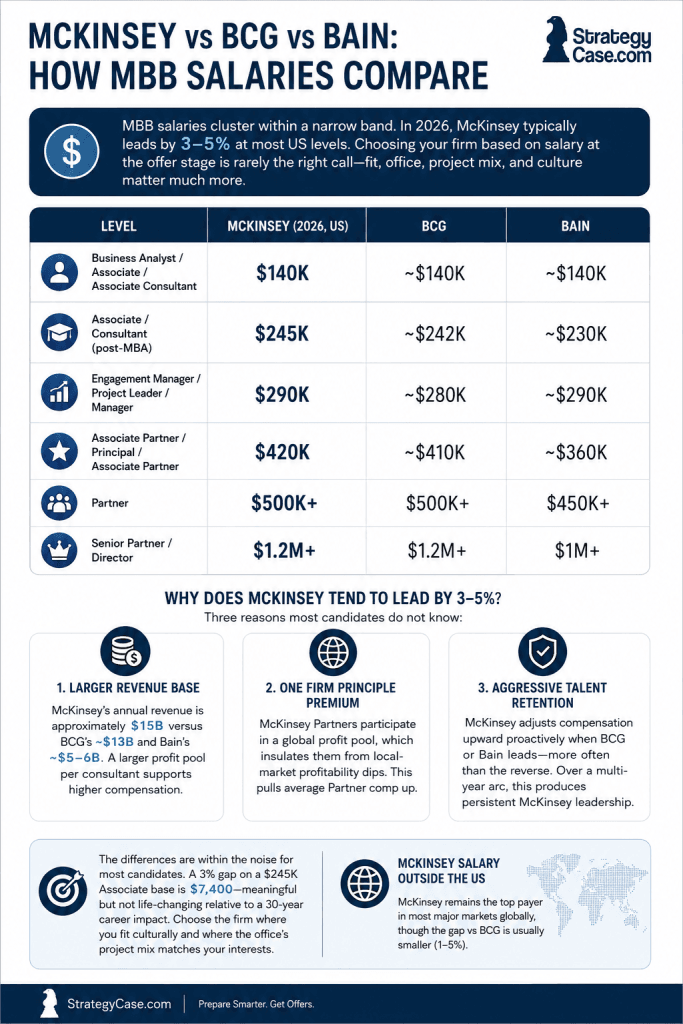
The differences are within the noise for most candidates. A 3% gap on a $245K Associate base is $7,400, meaningful but not life-changing relative to a 30-year career impact. Choose the firm where you fit culturally and where the office’s project mix matches your interests.
McKinsey Salary Outside the US
McKinsey operates in 130+ cities. International offices pay in local currency, and total compensation varies significantly by region. US offices remain the highest-paying globally on a nominal basis, though the One Firm Principle means Partner compensation converges across geographies.
London: McKinsey London is a high-paying non-US office for most pre-Partner levels. BA base is approximately £55,000-65,000 with bonus bringing total to ~£75,000-85,000. Associate (post-MBA) base is approximately £105,000-120,000 with target bonus pushing total to ~£150,000-170,000.
Continental Europe (Germany, France, Switzerland, Italy, Spain, Nordics): Roughly 60-75% of US salary in local currency equivalent. Switzerland-based offices typically pay closest to US levels.
Asia-Pacific (Singapore, Hong Kong, Tokyo, Shanghai, Sydney, Mumbai, Bengaluru): Singapore and Hong Kong offices often pay closer to US levels in USD terms, due to talent competition and cost of living. McKinsey has one of the largest India presences in MBB, with offices in Mumbai, Delhi, Bengaluru, Gurgaon, and Chennai, salary scales differ significantly from Western markets.
Middle East (Dubai, Abu Dhabi, Riyadh, Doha): Often higher than European offices on a take-home basis due to tax advantages (no personal income tax in UAE). Base salaries are typically 80-95% of US levels in USD equivalent. McKinsey’s Middle East practice is rapidly growing.
Latin America (São Paulo, Mexico City, Bogotá, Buenos Aires): Roughly 40-55% of US salary in local currency equivalent, with strong upward trajectory.
Africa (Johannesburg, Lagos, Nairobi): Variable depending on office, typically 50-65% of US levels in USD equivalent for pre-Partner roles.
International salaries are worth verifying directly with your recruiter, McKinsey adjusts non-US compensation frequently and the One Firm Principle changes how Partner-level comp works once you reach that step.
How Fast Can You Reach Partner at McKinsey?
The standard McKinsey promotion track from Business Analyst to Partner is approximately 10-12 years:
- Years 1-2: Business Analyst
- Years 3-5: Associate
- Years 5-7: Engagement Manager
- Years 7-9: Associate Partner
- Year 9-12+: Partner
Post-MBA hires (Associates) skip the BA stage and reach Partner in approximately 8-10 years. ADHs (PhD, MD, JD) typically follow the same 8-10 year track as MBA hires.
Fewer than 1 in 10 entering BAs reach Partner at McKinsey. The pyramid narrows at every level, most sharply between Engagement Manager and Associate Partner. Most consultants who “leave McKinsey” are not failures, they are choosing to exit at a point that maximizes their next career step (corporate strategy, private equity, startup leadership, NGO leadership, or other consulting firms).
The McKinsey alumni network is among the most valuable corporate networks in the world. Alumni include the CEOs of Google (Sundar Pichai’s predecessor was a McKinsey alum), American Express, Boeing, Allstate, plus founders of dozens of unicorns. The decision to leave McKinsey at any level is rarely a career setback when handled well.
For accelerated paths to Partner, the only reliable variables are:
- Consistent top-quartile performance reviews across your tenure
- Industry or functional specialization that the firm needs to grow (AI strategy, sustainability, healthcare, growth)
- Business development demonstrated early, sponsoring proposals, building intellectual capital, generating leads through alumni networks
The biggest filter is the transition from “great delivery” to “great business development” between Engagement Manager and Associate Partner.
Frequently Asked Questions
How much does a McKinsey Business Analyst make?
A first-year McKinsey Business Analyst in a US office earns approximately $140,000 in total cash compensation: $120,000 base salary plus a target bonus of around $20,000, reaching roughly $148,000 at maximum bonus. The $120,000 base reflects an increase from $112,000 announced in August 2026 and effective January 2027.
What is the McKinsey Associate salary?
A post-MBA McKinsey Associate in 2026 earns approximately $195,000 base salary plus $50,000 target bonus = $245,000 total cash compensation, with an additional $30,000-35,000 signing bonus. All-in Year 1 compensation is approximately $275,000-280,000.
How much does a McKinsey Engagement Manager earn?
A McKinsey Engagement Manager earns approximately $225,000 base salary plus $65,000 target bonus = $290,000 total cash compensation. Maximum bonus in strong years can push total comp toward $330,000-350,000.
How much does a McKinsey Associate Partner earn?
A McKinsey Associate Partner earns approximately $280,000 base salary plus $140,000 target bonus = $420,000 total cash compensation. Maximum bonus in strong performance years pushes total compensation toward $480,000+.
How much does a McKinsey Partner make?
McKinsey Partners earn $500,000+ as base compensation, with total annual earnings ranging from $700,000 to $1,500,000+ depending on firm performance and individual contribution. Senior Partners (formerly Directors) typically earn $1.2M to $5M+ per year, with top earners at major offices reaching higher.
Is McKinsey salary higher than BCG and Bain?
In 2026, McKinsey typically pays 3-5% above BCG and Bain at most US levels. The gap is small at early career levels (within $5-15K) and widens slightly at Partner and Senior Partner due to McKinsey’s larger revenue base and the One Firm Principle’s effect on Partner profit-sharing.
What is the McKinsey One Firm Principle?
The One Firm Principle means McKinsey operates as a single global firm where Partners share in a unified profit pool rather than office-specific pools. A McKinsey Partner in Mumbai earns the same percentage of firm profits as a Partner in New York (adjusted for cost-of-living factors). This is unique among MBB firms and significantly affects Partner-level compensation across geographies.
How long does it take to become a Partner at McKinsey?
The standard path from Business Analyst to Partner at McKinsey is approximately 10-12 years. Post-MBA Associates and ADHs (PhDs, MDs, JDs) shorten this to 8-10 years. Fewer than 1 in 10 entering Business Analysts reach Partner, the pyramid narrows sharply between Engagement Manager and Associate Partner.
How much does McKinsey pay in London?
McKinsey London Associates (post-MBA) earn approximately £105,000-120,000 base salary plus a target bonus of £30,000-45,000, with total cash compensation around £150,000-170,000. Business Analyst (post-undergrad) total compensation is approximately £75,000-85,000.
What is McKinsey’s “up or out” policy?
McKinsey formally implemented “up or out” in 1951. Consultants who do not advance within typical tenure windows (2-3 years at most levels) are counseled to transition out. Historically, approximately 20% of the lowest-performing consultants departed annually. The current rate is somewhat lower due to relaxed policies and the introduction of formal “Expert” tracks for specialists who excel at delivery but prefer not to focus on business development.
The Bottom Line
McKinsey salaries are competitive with BCG and Bain at every level, leading by 3-5% on average. The compensation question that actually matters is not “how much does McKinsey pay?” but “what level can I realistically enter at, and what is my realistic 5-year trajectory?”
For an undergraduate hire, plan on ~$140K total in Year 1 climbing to ~$245K by year 4 if you promote on schedule. For a post-MBA hire, plan on ~$275K all-in Year 1 climbing to ~$420K by Associate Partner in your sixth or seventh year at the firm. Beyond that, compensation depends entirely on whether you reach Partner and how aggressively you build your book of business.
The path to a McKinsey offer runs through three distinct assessments: the McKinsey Solve Game (digital aptitude), the McKinsey case interview (analytical problem-solving), and the McKinsey PEI / Personal Experience Interview (leadership, connection, drive, growth). If you want a structured plan for the full McKinsey recruiting cycle, book a 1-on-1 coaching session with a former McKinsey consultant and top global case coach.
A McKinsey offer is one of the most valuable career assets a candidate can secure in their twenties. Year 1 total compensation alone covers most candidates’ full undergraduate tuition. The work is hard, the hours are real, and the exit options at every level are among the strongest in business. The salary, while excellent, is the smallest part of the McKinsey decision.

2 Responses
[…] our consulting salary reports or this Wage Information by Strategy Case can present additional insights into the revenue potential at every degree. This info aids new […]
[…] our consulting salary reports or this Salary Guide by Strategy Case can provide further insights into the income potential at each level. This information aids new […]