
Updated July 2026 · By Florian Smeritschnig, Former McKinsey Senior Consultant
Consulting networking is the year-long process of building relationships with current consultants at McKinsey, BCG, Bain, and other target firms so that by the time you formally apply, you have at least one referral, multiple internal advocates, and direct insight into the office and practice you are targeting. Effective networking lifts your application screening odds by 2-4x, particularly if you come from a non-target school or non-traditional background.
The actual work breaks into three phases: finding the right consultants to contact (5 channels), opening relationships through specific outreach moves (LinkedIn, events, alumni networks, mentorship programs), and maintaining the connection until your application cycle. Below is the full timeline, the specific channels in order of impact, the exact outreach templates that work in 2026, and what most candidates get wrong about consulting networking.
After 5 years at McKinsey and coaching hundreds of candidates into MBB and tier-2 offers, I can tell you the candidates who treat networking as a real project (rather than a 4-week scramble before deadlines) outperform their peers consistently. The rest of this guide is the system I teach in coaching: where to find consultants, how to start the conversation, how to keep it warm, and how to convert it into a referral that actually changes screening outcomes.
Key Takeaways
- Networking lifts your screening odds 2-4x at MBB. Strongest effect for non-target school candidates and experienced hires.
- Start 6-12 months before your consulting application cycle, not 4 weeks before. The relationships that produce referrals take time to warm up.
- 5 channels matter, in priority order: mentorship programs (highest impact), alumni networks, on-campus events, LinkedIn cold outreach, firm-sponsored info sessions.
- The first message matters less than the second. Most candidates obsess over the perfect cold message and then disappear after one reply. Cadence and follow-up are what separate networkers from list-builders.
- Mentorship programs are the highest-leverage channel — admission often comes with near-guaranteed interview invitations. McKinsey Firsthand, BCG Emeralds, and Bain Spark are the flagship programs in 2026.
- Volume is not the answer. A few well-maintained relationships outperform 60 cold-message recipients who never replied.
Why Networking Matters Disproportionately in Consulting
Only 1-3% of applicants secure offers at McKinsey, BCG, or Bain in 2026. The application volume has risen meaningfully since remote testing made it easier to apply from anywhere, and the screening filter has tightened in response.
Inside that screening process, three things happen that make networking unusually high-leverage:
1. The application screen is the deepest funnel cut. At most MBB offices, 60-80% of applicants are rejected at the application screen, before any interview. The screening team is processing thousands of resumes per cycle and looking for signals that justify a closer look. A referral attached to your application is the cleanest such signal.
2. Referrals trigger a different review path. Applications with internal referrals are routed to a separate (often human) review queue at most MBB offices. Non-referred applications are filtered first by algorithmic screening and assessment scores. The threshold for advancing through the referred path is meaningfully lower.
3. The interviewer slate is partly self-selected. At many firms, consultants who referred candidates can volunteer to be on their interview panel. A consultant who already advocated for you is unlikely to be the one trying to disqualify you in the case round.
The combined effect: a candidate with a strong referral, an internal advocate, and basic prep is more likely to receive an interview invitation than a comparable candidate who applied cold. This is not a marginal effect, it is the difference between getting through the door and being one of the 60-80% filtered out at screening.
Networking is what produces the referral. The referral is what produces the interview. The interview is where your prep work pays off. Skipping the first link in this chain is what most candidates do, and it is the single biggest preventable cause of being filtered at screening.
On top of getting a referral, a key benefit of networking is to get an update on the current recruiting situation in the office of your choice. Don’t waste your application by sending it into an office and timeline with no hiring demand.
The 12-Month Consulting Networking Timeline
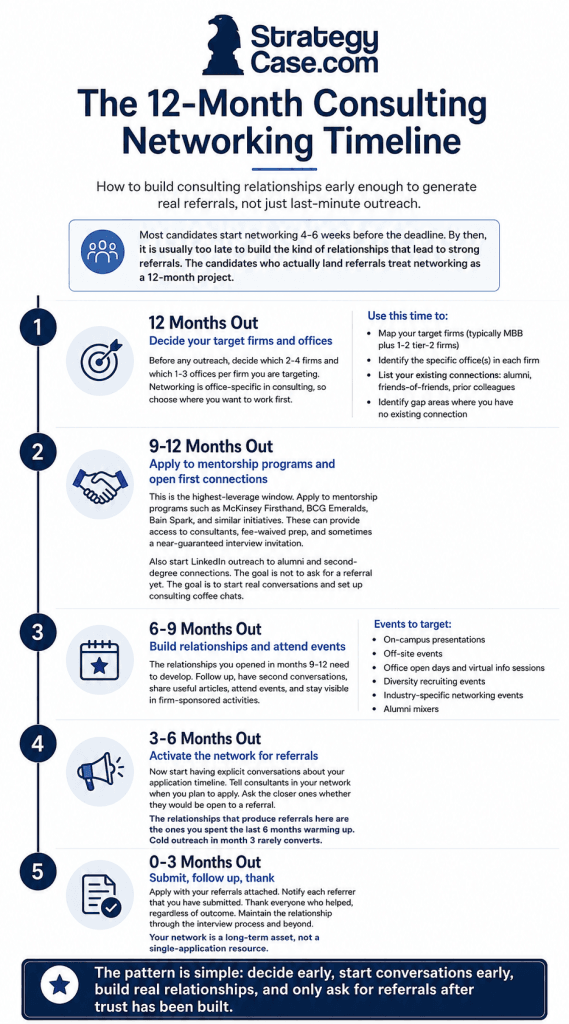
Most candidates think about networking 4-6 weeks before the application deadline. By then, it is too late to build relationships that will produce referrals; you can only do transactional outreach, which works less often.
Strong consulting applications are built before the resume screen. High-quality networking with consultants, alumni, recruiters, and senior professionals at your target firms can generate valuable leads, insider advice, and referrals. At the same time, every positive touchpoint, from asking sharp questions in webinars to engaging at firm events, creates observation points that make you more memorable. Together, leads and observation points can significantly improve your chances of landing a consulting interview.
The candidates who actually land referrals treat networking as a 12-month project. Here is the realistic timeline.
12 Months Out: Decide Your Target Firms and Offices
Before any outreach, decide which 2-4 firms and which 1-3 offices per firm you are targeting. Networking is office-specific in consulting, a McKinsey Munich referral does not help with a McKinsey London application in any material way. Pick where you want to work.
Use this time to:
- Map the firms you are targeting (typically MBB plus 1-2 tier-2 firms)
- Identify the specific office(s) in each firm
- List your existing connections to those firms/offices (alumni, friends-of-friends, prior colleagues)
- Identify gap areas where you have no existing connection
9-12 Months Out: Apply to Mentorship Programs and Open First Connections
This is the highest-leverage window. Mentorship programs (McKinsey Firsthand, BCG Emeralds, Bain Spark, Kearney Cosmopolitan Club, and others) have application deadlines 6-12 months before the main hiring cycle. Admission gives you access to consultants, fee-waived prep, and often a near-guaranteed interview invitation.
Also use this window to start LinkedIn outreach to alumni and second-degree connections. The goal is not to ask for a referral, it is to start a conversation and have a consulting coffee chat so they remember you when you eventually apply.
6-9 Months Out: Build Relationships and Attend Events
The relationships you opened in months 9-12 need to develop. This means follow-ups, second conversations, sharing useful articles, attending events the consultants flag, and being present in firm-sponsored activities.
Firm-sponsored events to target in this window:
- On-campus presentations (for university candidates)
- Off-site events
- Office open days and virtual info sessions
- Diversity recruiting events
- Industry-specific networking events sponsored by the firms
- Alumni mixers
3-6 Months Out: Activate the Network for Referrals
This is when you start having explicit conversations about your application timeline. Tell the consultants in your network when you plan to apply. Ask the closer ones whether they would be open to a referral. Use the referral-asking framework for the explicit ask.
The relationships that produce referrals in this window are the ones you spent the last 6 months warming up. Cold-message outreach in month 3 rarely converts to a referral.
0-3 Months Out: Submit, Follow Up, Thank
Apply with your referrals attached. Notify each referrer that you have submitted. Thank everyone who helped, regardless of outcome. Maintain the relationships through the interview process and beyond, your network is a long-term asset, not a single-application resource.
The 5 Networking Channels, In Priority Order
Not all networking channels are equal. Here are the five that matter, ranked by impact-per-hour spent.
Channel 1: Mentorship Programs (Highest Impact)
Mentorship programs are firm-run talent pipelines aimed at high-potential candidates from underrepresented backgrounds or non-traditional applicant pools. They are competitive to enter, but admission is the single highest-leverage networking move in consulting recruiting.
The flagship programs in 2026:
| Firm | Program | Typical Audience | Outcome |
|---|---|---|---|
| McKinsey | Firsthand, McKinsey Achievement Award, NextGen Women in Tech | Undergrads, MBAs, women, underrepresented minorities | Direct access to consultants, free prep, often interview invitations |
| BCG | Emeralds, BCG Pride at Work, Future Leaders | Diversity candidates, MBA/MBA-bound | Same model: access + prep + interview pipeline |
| Bain | Spark, Bain Build, Diversity Scholarships | Undergrads, MBAs, diverse candidates | Mentorship, prep support, interview access |
| Kearney | Cosmopolitan Club, Diversity Scholarships | International students, diverse candidates | Network access, application support |
| Oliver Wyman | Diversity Network programs | Women, underrepresented candidates | Coaching and interview access |
Admission rates are competitive (5-10% acceptance is typical for the flagship programs), but the candidates who get in routinely report that the program effectively serves as their referral pathway. If you are eligible for any of these programs based on your background, the application is the single highest-ROI networking activity available.
How to find the current year’s programs: search the firm’s careers page for “diversity programs,” “talent programs,” “mentorship,” and “fellowship.” Deadlines are typically 6-12 months before the main hiring cycle and vary by region. Some programs open earlier and already support you during your student years if you show promise.
Channel 2: Alumni Networks (High Impact, Underused)
Your university’s alumni network is the single most underused networking asset for most candidates. Alumni reply to messages from current students at meaningfully higher rates than cold LinkedIn outreach, often 30-50% reply rates vs 5-15% for cold outreach.
How to access the alumni network:
- LinkedIn alumni search: Go to your university’s LinkedIn page, click “Alumni,” filter by “Where they work” → McKinsey/BCG/Bain. Filter further by location to find alumni in your target offices.
- University career services: many universities have alumni databases accessible to current students. Often these include direct email contact info.
- Alumni mentorship platforms: tools like Protopia, PeopleGrove, and Mentor Collective connect students to alumni in their field. Many MBA programs and select undergrad programs have these.
- Specific affinity groups: women’s alumni networks, regional alumni clubs, fraternity/sorority alumni networks, religious or cultural affinity alumni groups.
The shared-alma-mater hook is real. A McKinsey associate is meaningfully more likely to reply to a message from a student at their old university than to a stranger. Use the alumni angle in your first message.
Channel 3: On-Campus and Off-Campus Events (High Impact for Students)
For university candidates, on-campus recruiting events are the single best in-person opportunity to meet consultants who actively want to be there. Consultants attending campus events are pre-disposed to network, that is literally why they are at the event.
The event hierarchy in priority order:
- Multi-day firm immersion programs (McKinsey Insight, BCG Bridge to Consulting, Bain Excel Days): 2-5 day intensive programs that include coaching, sample cases, and direct access to consultants, usually at an off-site location. Application required.
- Office visits: half-day to full-day visits to the firm’s office, typically organized by your university or a target firm directly. Consultants you meet during office visits will remember you.
- Coffee or networking dinners: smaller-format events (10-30 people) where you can have meaningful 5-10 minute conversations with consultants.
- Information sessions and presentations: larger-format (50+ people) events. Lower per-person ROI but still worth attending, especially if you can stay after to talk to specific consultants.
For each event you attend, the goal is the same: collect 2-3 specific consultant contacts you can follow up with afterward.
Channel 4: LinkedIn Cold Outreach (Medium Impact)
LinkedIn cold outreach is the default networking channel for most candidates. It works, but reply rates are meaningfully lower than alumni or warm-intro outreach (typically 5-15% reply rate for well-written messages).
The keys to making LinkedIn outreach work:
- Lead with a connection point: shared alma mater, shared previous employer, shared hometown, shared LinkedIn group membership. Cold-cold messages with no connection point reply at <5% rates.
- Keep the first message short (3-5 sentences max). Most candidates over-write the cold message.
- Make the ask small: a 15-20 minute virtual coffee chat, not a job referral.
- Personalize one specific detail: reference a recent project they posted about, a publication they shared, or something specific from their profile.
A working LinkedIn first-message template (adapt to your situation):
Hi [Name],
I’m a [current role] at [company/university] and noticed we share [specific connection: alma mater / previous employer / industry background]. I’m exploring the move into consulting and would love to learn about your experience at [firm], particularly in the [practice area] you mentioned in your recent [post / publication / profile detail].
Would you be open to a 20-minute virtual coffee chat in the next few weeks? Happy to work around your schedule.
Thanks for considering,
[Your name]
For the full coffee chat conversation playbook once they say yes, see the consulting coffee chat guide.
Channel 5: Firm-Sponsored Info Sessions (Lower Impact, Worth Attending)
Generic info sessions (large-format webinars, recruiting fairs, etc.) are the lowest impact-per-hour networking channel. The format does not allow for meaningful 1:1 conversation. They are still worth attending in two specific situations:
- You are early in your research and need a baseline understanding of the firm’s positioning and recruiting timeline.
- The session lists specific consultants by name and you can identify someone to follow up with afterward.
Do not over-invest in this channel. One info session per firm is typically enough.
The First-Touch Playbook: How to Open Relationships in 2026
The first message is the part most candidates over-engineer. The goal of the first message is one thing only: getting a “yes” to a coffee chat. Everything else is secondary.
Three First-Touch Formats That Work
1. The alumni hook (highest reply rates)
Hi [Name],
I’m currently a [year/role] at [your university] studying [program]. I noticed you’re now at [firm] in the [practice/office], congrats on the path. I’m exploring consulting for after graduation and would love to learn about your experience, particularly how [firm] differs from the other MBB firms in your view.
Would you be open to a 20-minute call in the next few weeks?
[Your name]
2. The shared-employer hook (for experienced hires)
Hi [Name],
I’m currently at [your current employer] in [your role] and noticed we share that connection. I’m exploring a move into consulting and would value your perspective on what the transition looked like for you, particularly how [firm] thinks about candidates from non-traditional backgrounds.
Would you be open to a 20-minute call in the next few weeks?
[Your name]
3. The post-engagement hook (after liking/commenting on their content)
Hi [Name],
Your recent post on [topic] resonated, I’ve been thinking about the same problem in [your industry/role]. I’m exploring consulting and would value learning about your work at [firm] more broadly.
Would you be open to a 20-minute call?
[Your name]
The 3 Rules of First-Touch Messaging
1. Make the connection point explicit in the first sentence. Cold messages without a connection point reply at low single-digit rates. With a connection point (alumni, previous employer, post engagement, mutual contact), reply rates jump to 15-40%.
2. Make the ask small and time-bounded. “20-minute call” is the right ask. “Coffee in person” is harder to schedule. “An hour to talk about your career” is too much to ask of a stranger. “A job referral” is way too much.
3. Make it easy to say yes. Offer specific scheduling flexibility (“happy to work around your schedule”), do not ask the consultant to propose times. Use a scheduling link (Calendly, Cal.com) if the conversation moves forward.
What Not to Do in First-Touch
- Do not attach your resume. Premature. Wait until the second conversation or until they ask.
- Do not ask for a referral in the first message. Premature. The referral comes after a relationship exists.
- Do not write a 6-paragraph message. Reply rates drop sharply past 5 sentences.
- Do not template-spam. Consultants can tell when they are message #50 of a copy-paste blast. Personalize the connection point and one specific detail. Use our samples above as starting point, not the end-all-be-all.
- Do not follow up more than once. After one follow-up with no response, move on. Aggressive follow-up annoys and hurts you.
The Relationship Maintenance Playbook
The first message gets the meeting. The second, third, and fourth touchpoints are what build the relationship that produces a referral.
Most candidates have one good coffee chat and then disappear for six months until the application deadline. By then, the consultant has forgotten them, and the relationship has gone cold. The referral does not happen.
The candidates who actually convert their network into referrals follow a deliberate cadence.
The 8-Week Cadence
After your initial coffee chat:
- Week 0: Send a thank-you email within 24 hours. Reference one specific thing from the conversation. Connect on LinkedIn with a personalized note.
- Week 4: Send a short update. “Wanted to share, I followed your advice on [X] and it was really useful. Also, I came across this article on [topic relevant to their work] and thought of you. Hope your project is going well.”
- Week 8: Another short touchpoint. Could be: another relevant article, a question about something specific they mentioned, an update on your application timeline.
- Week 16: Pre-application touchpoint. “I’m planning to apply in [month]. I’ll send you a heads-up when my application is in. Thank you again for your time and advice.”
- Application week: The notification + (depending on the relationship) the explicit referral ask.
This cadence is light. You are not bombarding them, you are staying memorable. Five touchpoints over 4 months is enough to keep you in their mind without being annoying.
What to Send in Touchpoints
The single most valuable thing you can send in a touchpoint is something useful to them, not a question or an ask. Examples:
- Relevant article or report on a topic they mentioned working on
- Introduction to someone in your network who might be useful to them (rare but powerful when you can do it)
- Update on the advice they gave you (“I followed your advice on X and here is what happened”)
- Industry news in their practice area
- Congratulations on a promotion or visible win (LinkedIn makes this easy to spot)
If you can not send something useful, send a short personal touchpoint. “Hope your project in [city] is going well. Wanted to keep in touch, will reach out again before my application.” That is enough.
How Non-Target School Candidates Should Network Differently
Non-target school candidates face a steeper screening filter. The networking strategy needs to be adjusted accordingly.
1. Apply to mentorship programs as your first move. The mentorship programs above (Firsthand, Emeralds, Spark) are deliberately structured to surface non-target talent. They are your single highest-leverage move.
2. Network 18-24 months out, not 12. Non-target candidates need more relationship runway because every connection counts more. Start in your sophomore year or earlier.
3. Pursue 1-2 internships before the full-time application. Even an internship at a tier-2 firm or a strategy team at a Fortune 500 company is a network multiplier. The colleagues you meet in that internship become future MBB contacts.
4. Use the non-traditional background framing strategically. Consultants respond well to candidates who can articulate why their unusual background is an asset, not an apology. Lead with the asset framing in your networking.
5. Multiple referrals are particularly valuable. A single referral from a Partner at a top school carries more weight than one from an Associate, but for non-target candidates, having 2-3 referrals across different practice areas signals broader network legitimacy.
For the broader strategy of breaking into consulting without the standard background, the non-traditional background guide covers the full strategy beyond networking.
The 6 Most Common Networking Mistakes
After hundreds of candidates coached and having been on the receiving end of networking requests at McKinsey, the same networking mistakes repeat. Avoid these and you will outperform the typical candidate.
Mistake 1: Treating Networking as a 4-Week Sprint
The candidates who try to “do networking” in the month before application deadlines almost never produce real referrals. Relationships take time. Start 6-12 months out, not 4 weeks out.
One of my most memorable clients, who scored offers at 2 MBBs in their NYC offices with a very difficult starting position, invested as much time into networking as he was using for case interview prep initially. It worked out beautifully for him against all odds.
Mistake 2: Cold-Messaging at Volume Without a Connection Point
Sending 200 generic LinkedIn messages produces fewer replies than 30 personalized messages with a clear connection point. Volume is not the answer, specificity is.
I once talked to someone who messaged every consultant from an MBB office until he got blacklisted by that firm. Don’t ignore personal boundaries and common sense in your frantic networking efforts.
Mistake 3: One Meeting, Then Disappearing
The most common pattern: candidate has a great coffee chat, gets useful advice, says thank you, and then is never heard from again. Six months later, the consultant has forgotten the conversation. The referral never happens because the relationship was a one-touch interaction. The 8-week cadence above exists to prevent this.
Mistake 4: Asking for a Referral in the First Message
Premature asks burn the relationship before it starts. The first message asks for a 20-minute conversation. The referral ask comes later, after a relationship exists.
Mistake 5: Treating Networking as Transactional
Consultants can tell when a candidate is networking for the sole purpose of extracting a referral. Genuine curiosity about the work, the firm, and the consultant’s career produces better conversations and better referrals. Read about the firm. Ask substantive questions. Care about the person on the other side of the call.
Mistake 6: Skipping the Thank-You
A short thank-you email within 24 hours of a coffee chat is the highest-ROI single message in the entire networking process. Send it. Reference one specific thing from the conversation. This is the difference between being “that person who had a meeting with me” and “that person I’d like to help.”
The Networking-to-Referral-to-Interview Funnel
Networking does not end with a referral. Here is what the full funnel looks like for a well-prepared candidate.
| Stage | Time investment | Output |
|---|---|---|
| Months 9-12 out: First-touch outreach | 10 hours total | 8-15 active relationships |
| Months 6-9 out: Relationship building | 1-2 hours every other week | 5-10 warm relationships, 1-3 mentorship program applications |
| Months 3-6 out: Activation | 1-2 hours every other week | 2-5 referral commitments |
| Months 0-3 out: Application | Variable | Application submitted with referrals attached |
| Interview cycle | Variable | Interview invitations from 2-3 firms |
| Post-offer | Ongoing | Network maintained for long-term career value |
The candidates who follow this funnel end up with multiple offers. The candidates who skip the first three stages and apply cold end up in the 60-80% screening rejection bucket.
Frequently Asked Questions
When should I start networking for consulting?
Start 9-12 months before your target application cycle. For mentorship programs, the deadlines are often 6-12 months before the main hiring cycle, so apply as early as possible. For non-target school candidates, 18-24 months out is not too early.
How many consultants should I be networking with?
Quality matters more than volume. Target a few active relationships across your target firms, with 2-4 deeper relationships at each. Most candidates over-invest in volume and under-invest in depth. Three warm relationships outperform 60 cold contacts.
What is the best way to find consultants to network with?
In priority order: mentorship programs (highest impact), alumni networks (highest reply rates), on-campus events (best for students), LinkedIn cold outreach (works but lower yield), and firm-sponsored info sessions (lowest impact). Start with the alumni network for your university, it is the single most underused channel.
How do I write a cold LinkedIn message to a consultant?
Lead with a specific connection point (alumni, previous employer, post engagement) in the first sentence. Keep the message under 5 sentences. Make the ask small (20-minute virtual coffee chat, not a job referral). Personalize one specific detail from their profile or recent activity. Templates above.
How often should I follow up after a coffee chat?
Send a thank-you within 24 hours. Then a light touchpoint every 4-6 weeks, sharing useful content or short updates. The goal is 4-6 touchpoints over the 4-6 months between the first conversation and your application. Aggressive follow-up annoys; complete silence loses the relationship.
Should I network with HR/recruiters or with consultants?
Both, but consultants matter more for referrals. HR and recruiters control the formal application process and can answer logistical questions. Consultants are the ones who can refer you internally and advocate for your application in screening. Prioritize consultant relationships, but do not ignore the recruiter who manages your target office.
How do mentorship programs like McKinsey Firsthand or BCG Emeralds actually work?
These are firm-run talent programs aimed at high-potential candidates from underrepresented backgrounds. Admission is competitive (5-10% acceptance rates typical). Once admitted, you get mentor pairings, free case prep resources, exclusive networking events, and (most importantly) a near-guaranteed interview invitation at the partnering firm. Applications open 6-12 months before the main hiring cycle and deadlines vary by region. Some programs open earlier and already support you during your student years.
What if I have no alumni or shared-employer connections to consultants?
Lead with mentorship programs first, those are designed for exactly this situation. Beyond that, use the post-engagement first-touch format (genuine comment on a consultant’s LinkedIn post → DM referencing the post). Reply rates are lower than warm intros but meaningfully higher than fully cold outreach.
Bottom Line
Effective consulting networking is a 9-12 month project, not a 4-week scramble. Start with the highest-impact channels first (mentorship programs and alumni networks), open relationships with specific outreach templates, maintain them with a deliberate 4-6 week touchpoint cadence, and activate the network for referrals 3-6 months before your application deadline. Three warm relationships beat 80 cold contacts.
The candidates who treat networking seriously end up with multiple interview offers from their target firms. The candidates who skip it end up in the 60-80% screening rejection bucket, regardless of how strong their case prep is.
For the specific tactic of running the coffee chat conversation that turns a LinkedIn reply into a relationship, see the consulting coffee chat guide. For the explicit mechanic of asking for the referral, see how to get a referral for McKinsey, BCG, or Bain. If you want feedback on your specific networking strategy and which channels to prioritize for your background, 1-on-1 coaching with Florian is the fastest way to identify the moves that will work for your situation.
About the author: Florian Smeritschnig is a former McKinsey Senior Consultant and the founder of StrategyCase. He spent five years at the firm and has since run more than 2,200 mock case interviews and coached hundreds of candidates into McKinsey, BCG, Bain, and other top firms.

2 Responses
Would you write directly to consultants email address that you can figure out with their name and the company ending?
Hi Valentin,
If you had no prior interaction with the person where they handed you their business card, I would never cold-email them. Rather go via a 3rd party introduction or LinkedIn.
All the best,
Florian