
Last Updated on July 9, 2026
Updated July 2026 · By Florian Smeritschnig, Former McKinsey Senior Consultant
The McKinsey Keep In Touch Program (KIT) is a re-engagement invitation McKinsey extends to candidates who came close to an offer but did not make it, typically due to a near-miss case, a borderline PEI, an experience gap, or timing within the recruiting cycle. It is not a job offer. It is a structured 6 to 12 month window to fix what held you back and reapply with momentum.
If you received the KIT email, you are not a “no.” You are a “not yet.” Most candidates squander that window by waiting passively for events. Having coached more than 700 candidates through MBB recruiting, I can tell you exactly what separates the ones who convert KIT into an offer from the ones who don’t.
This guide covers the criteria McKinsey uses to invite candidates, the timeline for re-application, what to fix in the months between, and the questions candidates ask me most often about what KIT actually delivers.
Key Takeaways
- KIT is an invitation-only program for near-miss McKinsey candidates, not a guarantee of any future interview round
- The typical reapplication window is 6 to 12 months from the rejection date
- Conversion to an offer depends on diagnosing your specific gap (case, PEI, profile, timing) and closing it deliberately
- Passive participation in events alone does not change the outcome, you must build real relationships with consultants and recruiters
- If you did not receive a KIT invite, networking and a referred reapplication still works, but your second application has to look qualitatively different from the first
What Is the McKinsey Keep In Touch Program?
KIT is McKinsey’s formal way of saying: “We see potential in you. Stay in our orbit so we can re-evaluate when the timing is right.”
McKinsey extends it by invitation only, usually via email from the recruiting team in the days or weeks after a final-round rejection. The invitation includes access to the firm’s curated content (industry reports, research, newsletters), event invites (webinars with consultants and partners), informal mentoring touchpoints with current consultants, and explicit encouragement to reapply.
Two things to be clear about:
- KIT does not bypass the standard application process. When you reapply, you will still resubmit your CV, go through screening, and run the full interview gauntlet, Solve assessment, case rounds, and PEI.
- It does not lock you into McKinsey. Many candidates use the KIT window to also pursue BCG, Bain, and Tier-2 offers. McKinsey expects this and does not penalize it.
What KIT does buy you is visibility. A KIT-invited candidate who reapplies through the same office is flagged in the recruiting system as a known, high-potential profile rather than a cold resubmission.
Who Gets a McKinsey Keep in Touch Program Invitation?
This is the question candidates ask me most after a rejection, and it is rarely answered honestly online. Based on the patterns I have seen across hundreds of coached candidates, here are the four most common reasons McKinsey extends a KIT invite:
1. A near-miss case performance. You demonstrated structured thinking, good business intuition, and strong math, but one element fell short, synthesis, hypothesis discipline, or the ability to handle pushback under pressure. The interviewer rated you borderline rather than below bar. For these candidates, work through the McKinsey case interview guide and rebuild from first principles.
2. A weak PEI story. You handled the case well, but one of your personal experience interview stories did not land, the dimension was not clearly demonstrated, the impact was not quantified, or the personal reflection felt rehearsed. PEI fails are a very common reason for KIT invites, especially for candidates from non-target backgrounds who underprepared for the fit interview. The McKinsey PEI guide walks through the four dimensions McKinsey scores.
3. Profile or experience gap. Your interview performance was strong, but your CV or experience level was a stretch for the role you applied to. McKinsey may believe you would be a better fit after another year of work experience, an MBA, or a specific industry stint.
4. Timing within the recruiting cycle. Some offices run out of headcount mid-cycle. Strong candidates who interviewed late in the season sometimes receive KIT invitations not because they failed, but because the office cannot extend the offer right now.
If you received a KIT invite and were not told which of these applied to you, ask for a debrief. McKinsey recruiters often share the reason if asked directly. Without that information, you are preparing blind.
Benefits of the McKinsey KIT Program
Let’s explore some advantages of the program in detail:
| Benefits | Description |
|---|---|
| Access to Industry Trends and Research | Participants receive exclusive access to McKinsey’s latest reports and newsletters, allowing them to stay ahead in their knowledge of emerging industry trends and global market insights. This information is vital for staying competitive in today’s rapidly evolving business world. |
| Exclusive Events and Webinars | The program provides opportunities to attend specially curated events and webinars. These platforms enable participants to engage with industry experts and McKinsey leaders, fostering a deeper understanding of various business landscapes and building valuable professional networks. |
| Mentoring and Coaching Opportunities | Members benefit from personalized guidance and coaching by experienced McKinsey professionals. This mentorship focuses on enhancing the participants’ skills, offering career advice, and providing insights into effective business strategies, thus facilitating personal and career growth. |
| Recruitment and Career Planning Support | The program offers comprehensive support in job search and career planning. This includes access to resources for resume building, interview preparation, and career advice, directly connecting participants with opportunities at McKinsey and paving the way for future career advancements. |
When Can You Reapply After KIT?
The standard McKinsey reapplication window is 12 to 18 months from the original rejection date. KIT-invited candidates are often allowed to return earlier, typically at the 6-month mark, though this is office-dependent and not guaranteed.
A few rules to keep in mind:
- The clock starts on the rejection date, not the application date. If you applied in September, interviewed in November, and were rejected in December, your earliest reapplication is usually June.
- Reapplying too early signals desperation. Even if you are technically eligible at 6 months, ask yourself: have I demonstrably closed the gap from my first attempt? If the honest answer is no, wait. A second rejection from the same office is much harder to recover from than the first.
The candidates who convert KIT into an offer almost always use the full 6 to 12 month window deliberately. They do not rush.
How to Convert KIT Into an Offer
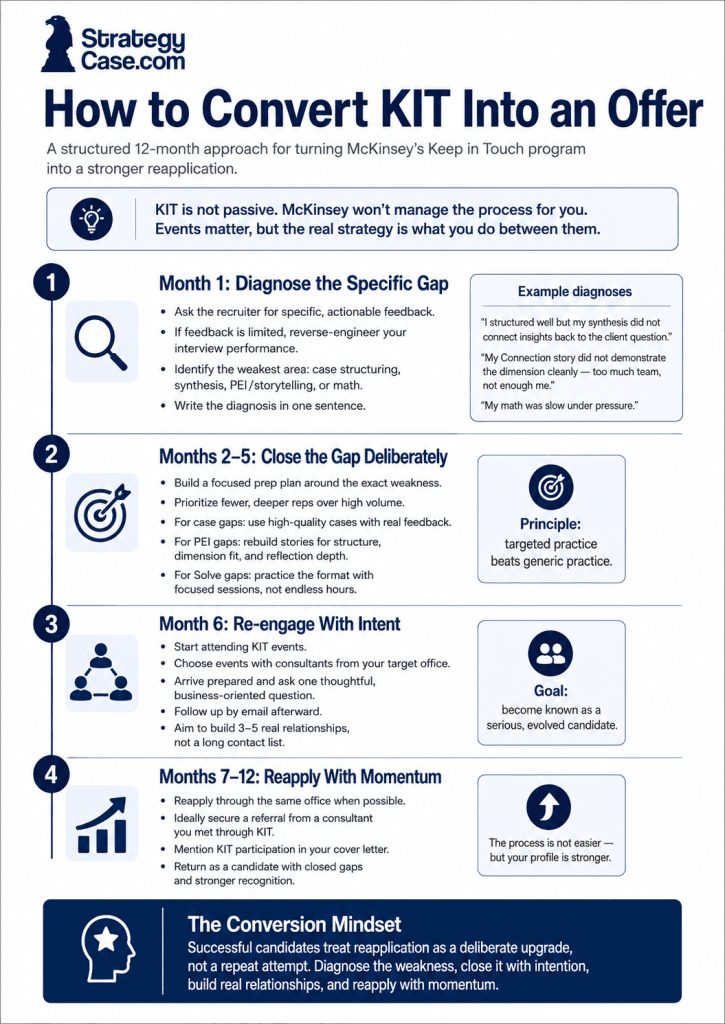
This is the part nobody talks about. KIT is not a passive program. McKinsey does not call you to check in. The events are available, but attending them is not the strategy, being intentional about the time between events is.
Here is the structured approach I recommend to coached candidates in their KIT window.
Month 1: Diagnose the Specific Gap
Get clarity on why you were rejected. Email the recruiter and ask for specific, actionable feedback. If they will not tell you, work backward from the interview yourself: which rounds felt strongest, which weakest? Which interviewers asked follow-up questions that revealed something you could not explain?
Write down the diagnosis in one sentence. Examples:
- “I structured well but my synthesis did not connect insights back to the client question.”
- “My Connection story did not demonstrate the dimension cleanly, too much team, not enough me.”
- “My math was slow under pressure.”
This sentence drives everything else.
Months 2-5: Close the Gap Deliberately
Design a focused consulting interview preparation plan. Apply the principle that fewer, deeper reps beat volume. If your gap was case structuring, work through the comprehensive case interview guide and run 15 to 20 high-quality cases with feedback, not 50 cases with peers who cannot diagnose your weakness.
If the gap was PEI, write better PEI stories. Stress-test the ones you have. Most candidates have three or four solid raw stories, the failure point is structure, dimension fit, and reflection depth, not the raw material. Rebuild each story against the dimension McKinsey is actually scoring.
If the gap was Solve, your tooling problem is different. The McKinsey Solve Game guide covers the format. Most candidates need 8 to 12 hours of focused practice, not 40.
Month 6: Re-engage With Intent
Begin attending KIT events. Pick the ones with consultants from your target office. Show up early, ask one specific question that demonstrates business thinking, and follow up by email afterward. Build three to five real relationships, not a contact list.
This is where the program actually delivers value: you become known as a serious, evolved candidate, not an anonymous applicant.
Months 7-12: Reapply With Momentum
Submit through the same office, ideally with a referral from a consultant you met at a KIT event. Mention KIT participation in your cover letter. The recruiting system will flag you as a returning candidate, and your referral lifts you above the noise.
The reapplication interview process is no easier, but you walk into it with diagnosed weaknesses closed and recognition in the room. That is the conversion.
The candidates who successfully convert a second opportunity are those who treat the reapplication as a deliberate upgrade, not a repeat attempt.
What If You Did Not Receive a KIT Invitation?
This is more common than candidates realize. Not every near-miss gets a KIT email. Sometimes the recruiter forgets, sometimes the office does not run a formal program, sometimes the rejection was further from the bar than the candidate believed.
If you did not get an invite but still want to pursue McKinsey:
- Wait out the full ban period. Usually 12 to 18 months. Do not try to reapply early through a different office or jurisdiction. McKinsey’s recruiting systems are global and they will see it.
- Build referrals independently. A referral from a current McKinsey consultant carries roughly the same weight as a KIT invite in the screening stage.
- Demonstrably address the gap in your CV. A new project, a promotion, an MBA admit, a quantified achievement, something that shows you are a meaningfully stronger candidate than last time.
- Consider a different office. If you applied to a saturated office (London, NY, Munich) and were a near-miss, applying to a smaller office in your home country during the next recruiting cycle sometimes works, especially if you have a language or market advantage.
The absence of a KIT invite is not a final verdict. The candidates I have coached through successful reapplications without KIT all had one thing in common: their second application looked qualitatively different from their first.
KIT vs. BCG and Bain Equivalents
McKinsey is the most formal of the MBB firms about post-rejection re-engagement. Quick comparison:
| Firm | Equivalent Program | Typical Reapply Window |
|---|---|---|
| McKinsey | Keep In Touch (KIT) | 6 to 12 months for KIT, 12 to 18 months standard |
| BCG | Informal touchpoints via recruiter, no branded program | 12 months standard |
| Bain | “Maintain Contact” status for near-miss candidates | 12 months standard |
BCG and Bain handle this less systematically. Strong near-miss BCG candidates often receive a personal email from the recruiter encouraging future application, but without curated content or events. Bain occasionally flags candidates for “Maintain Contact” status, which functions similarly to KIT but with less formal infrastructure.
If you are weighing where to focus your reapplication energy, KIT is the most structured path back into the firm. The other two require more independent networking.
Frequently Asked Questions
Is the McKinsey KIT program a guaranteed second interview?
No. KIT is an invitation to stay engaged, not a guarantee of any future interview round. You still go through the full standard application process when you reapply, CV screening, Solve assessment, and case rounds.
How long does the KIT program last?
There is no formal end date. Practically, KIT functions as a 6 to 12 month window during which the firm expects you to reapply. Candidates who do not reapply within roughly 18 months drift out of active program engagement.
Can I decline the KIT invitation and still reapply later?
Yes. Declining KIT does not bar you from reapplying through the standard channel. That said, accepting costs nothing, you can still pursue other firms and decline events that do not serve you. The invitation itself is a positive signal in McKinsey’s system.
What is the McKinsey KIT acceptance rate to an offer?
McKinsey does not publish this. The candidates who treat KIT as a passive program have a low conversion rate. The ones who diagnose their gap, close it, and reapply with a referral see significantly higher conversion, closer to the offer rate of fresh strong candidates.
Can I apply to a different McKinsey office during my KIT window?
No, the McKinsey re-application ban is global (in line with the typical consulting re-application ban). Going around the system without the fastest way to torpedo your candidacy. McKinsey’s recruiting database is global.
What if my KIT invite was due to a Solve assessment failure, not the interview?
If you failed at the Solve stage and still received a KIT-like invitation, that is unusual but does happen for strong-profile candidates. Reapplication will require you to retake Solve. Focus your prep on Solve specifically, not case interviews.
The Real Question
KIT is one of the few formal post-rejection structures in MBB recruiting that gives you a real second chance at McKinsey. Use it deliberately.
The candidates who convert KIT into an offer share three traits: they get specific feedback on why they were rejected, they close the diagnosed gap with focused practice rather than volume, and they reapply with a referral built during the KIT window.
If you are committed to landing the McKinsey offer and want a structured plan for your 6 to 12 month window, including a diagnosed weakness map, a calibrated case and PEI preparation path, and direct feedback from someone who has been on the other side of the table, book a 1-on-1 coaching session. For the broader interview arc, the Case Interview Academy covers everything from application through offer.
A near-miss is not the end. Done right, it is the start of a stronger application.
