
Updated November 2026. By Dr. Florian Smeritschnig, former McKinsey Senior Consultant
A HireVue interview is a recorded video interview with nobody on the other end: you answer usually 4 to 8 preset questions on camera, and many employers add a few minutes of short games. When HireVue’s AI scores your answers, it scores only the words you say, transcribed and rated on a five-level competency scale. It doesn’t analyze your face, your tone of voice, or your background.
That last point is where most HireVue advice goes wrong. The typical guide spends its energy on lighting, eye contact, and smiling at the lens. HireVue’s own 2025 Explainability Statement says the scoring model ignores all of that. So candidates polish the part the algorithm can’t see and neglect the part it reads word for word, and a weak recording can end an application before a single person talks to you.
I recruited candidates at McKinsey, and since 2020 I’ve delivered 2,300+ mock interviews and coaching sessions. From that side of the table, a HireVue interview looks familiar: it’s a fit interview with the interviewer taken out, and it’s scored much like a structured fit interview. This guide covers the format, which employers use it, how the scoring works, the questions and games you’ll face, and a prep plan you can finish in two days or a week.
Key Takeaways
- HireVue’s AI scores your words, not your face. It transcribes each answer and rates it on a five-level scale from Novice to Expert for one competency. Facial expressions, body language, and tone of voice aren’t scored.
- Humans still watch. Recruiters can review every recording, and if you opt out of AI scoring, a recruiter rates your answers on the same scale.
- Nobody asks follow-up questions. Whatever evidence you leave out doesn’t exist for the scorer, so each answer has to say what you did, why, and what changed.
- The games are short and adaptive. Each takes about 3 minutes, levels get harder as you succeed, and the whole game section usually runs 6 to 15 minutes.
- The employer sets the rules. Prep time, retakes, and whether games are included are all employer settings, so read your welcome screen before you record anything.
What Is a HireVue Interview?
Definition: A HireVue interview is an on-demand (one-way) video interview on HireVue’s hiring platform. You open a link, see each question on screen, and record your answer within a time limit the employer sets. Recruiters review the recordings later, and many employers also have HireVue’s AI score them.
HireVue sells employers a set of building blocks: video interviews, game-based assessments, and other tests that can be combined for a role. The company says it has hosted more than 40 million video interviews for over 1,100 customers. So one invite can mean a video interview only, games only, or both. HireVue’s own example of a combined assessment has 4 to 6 video questions plus 2 to 3 games, about 15 to 25 minutes in total.
HireVue interview format at a glance
| Element | What to expect | Source |
|---|---|---|
| Video questions | Usually 5 to 8; 4 to 6 when games are added | HireVue candidate FAQ; Explainability Statement |
| Prep time per question | Set by the employer: 0 to 5 minutes or unlimited (HireVue recommends at least 1 minute) | Explainability Statement |
| Answer time | Set by the employer; HireVue describes “several minutes” per question | HireVue prep guide |
| Retakes | Employer setting; HireVue recommends allowing them, but its “spontaneous” mode allows none | Explainability Statement; HireVue cheating white paper |
| Practice | A practice question before the real ones | HireVue interview tips |
| Total time | Most video interviews take under 20 to 30 minutes; HireVue says to set aside 45 | HireVue candidate FAQ |
| Games | About 3 minutes each, 6 to 15 minutes in total | HireVue prep guide; Explainability Statement |
| Devices | Computer, tablet, or phone; games run in a desktop browser or the HireVue app | Explainability Statement; HireVue prep guide |
| Lost connection | Reopen the same link and continue where you left off | HireVue candidate FAQ |
Interviewing with a consulting firm? The questions differ by employer, but the scoring logic doesn’t. StrategyCase’s Fit Interview Masterclass teaches how fit answers are evaluated and scored, and you can watch its first two lessons free.
Which Employers Use HireVue, and at Which Stage?
HireVue shows up wherever an employer wants to screen many applicants before spending interviewer time. Its client base is broad: in the latest rater study in HireVue’s Explainability Statement, retail, banking and finance, healthcare, and consulting services each supplied a share of the interviews. For consulting candidates, these are the uses we could confirm on the employers’ own careers pages in November 2026:
| Employer | Where HireVue appears | What the employer says |
|---|---|---|
| Bain & Company (US and Canada sophomore programs) | Video prompts after the application deadline for BEL, which shares one application with CREW and First Forward | Applicants “submit responses to video prompts via HireVue,” and there are no formal interviews for BEL (Bain BEL page) |
| Deloitte Canada | First-round interview | Candidates submit a “digital, on-demand video interview via HireVue” (Deloitte Canada FAQ) |
| Deloitte UK (professional careers) | Listed among Deloitte’s interview tools | “HireVue digital interviews” sit alongside case studies and other tests (Deloitte UK assessment support) |
| EY | Digital interviews, coding tests (CodeVue), and HireVue cognitive assessments | EY’s notice says the tool can replace lengthy application forms or pre-screening questions (EY HireVue privacy notice) |
For Bain’s BEL applicants, whose applications close November 30, 2026, this matters more than anywhere else on the list. Bain says there are no formal interviews for the program, so the HireVue recording is the interview. Those few minutes of video are the only place Bain hears from you directly. The Bain internship guide covers the rest of that application.
What isn’t HireVue
Consulting candidates often mix up the recorded and game-based screens, because they look alike. These are different tests:
- BCG’s one-way video interview runs on Spark Hire, a different platform with its own rules. See the BCG one-way video interview guide.
- McKinsey’s game-based screen is McKinsey Solve, McKinsey’s own assessment, not a HireVue game.
- Pymetrics games come from a different vendor, now part of Harver. BCG has used them in some offices; see the Pymetrics guide.
- Bain’s full-time and internship applicants who need to take an online test get Sova or TestGorilla, named in an email from Bain.
For the full map of screens by firm, see our guide to consulting assessment tests.
How HireVue Scores Your Video Interview
HireVue explains its AI scoring in the 2025 Explainability Statement, which it prepared with outside legal advisers to explain its AI under EU and UK data protection law. The process has three steps. Every practical tip later in this guide follows from them.
Step 1: Your speech becomes text
HireVue transcribes your answer with a third-party speech-to-text system, Rev.ai. HireVue reports an average word error rate under 10% for US English and says it tested the system on non-native speakers with a range of accents.
Two consequences follow. Words the system can’t hear don’t count. And if an answer contains too little content to score, because it’s very short, inaudible, or hit by a microphone problem, HireVue doesn’t score it with AI at all. It flags the answer for a human to review.
Step 2: A language model reads for meaning
HireVue’s language model, called CUSTARD and built on an open model named RoBERTa, turns each answer into a numerical representation of what it means. There’s a separate version for each competency.
HireVue says the model reads words in context, which makes it hard to “game” the interview by repeating particular words or phrases. Saying “teamwork” five times doesn’t score as teamwork. Describing what you did to get a stuck team moving does.
Step 3: Your answer is rated from Novice to Expert
A scoring model trained on expert human ratings places each answer on a five-level behaviorally anchored rating scale: Novice, Developing, Intermediate, Advanced, Expert. During training, two to three human raters scored each answer, and HireVue reports an average correlation of 0.69 between its models and those experts.
HireVue lists 19 interview competencies, including adaptability, problem solving, communication, and willingness to learn. The recruiter then sees how you scored on each competency and an overall tier, such as top, middle, or bottom. HireVue recommends that employers hide the raw numeric score.
What HireVue doesn’t score
HireVue’s statement says its AI relies only on what you say. It doesn’t assess facial expressions, body language, your background and surroundings, or tone of voice.
HireVue announced in January 2021 that it had dropped visual analysis, saying language had become far more predictive. Any guide that warns you about your facial expressions or tone of voice is describing scoring HireVue no longer uses. In November 2026, even Google’s AI Overview for “hirevue interview questions” still claimed the AI analyzes tone and body language.
Humans still see the video
Whether AI scores you at all is the employer’s choice. HireVue sells human-reviewed interviews too, and before an AI-scored interview you see a consent screen where you can opt out. If you do, a recruiter rates your answers on the same five-level scale, and HireVue says opting out doesn’t exclude you from the process. Even when AI scoring is on, recruiters and hiring managers can watch the recordings before they decide, and the decision stays with the employer.
So your recording has two audiences. One reads your transcript and rewards evidence. The other watches you and notices delivery.
Content wins with both. Delivery matters only to the second.
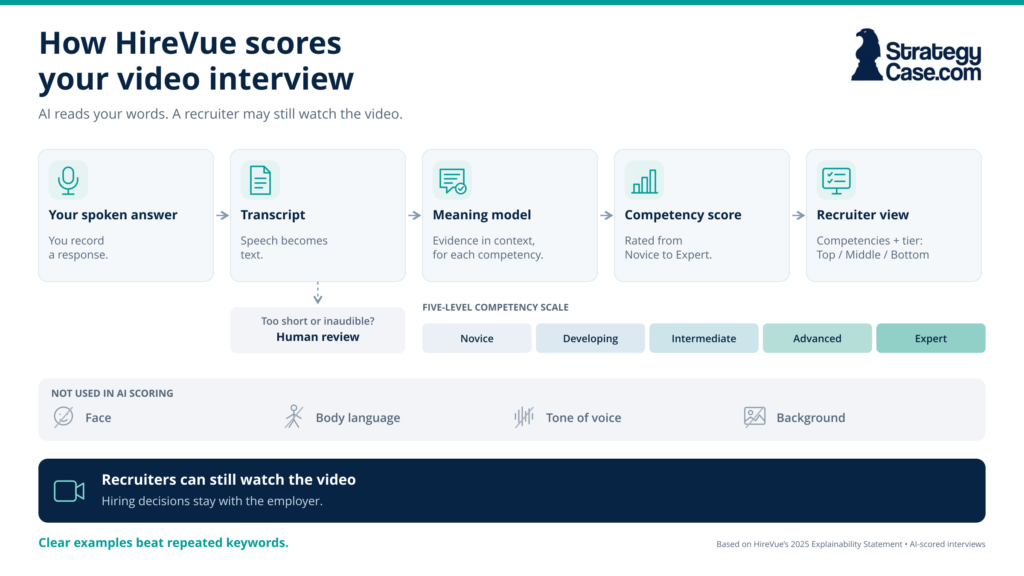
HireVue’s AI reads your words. A recruiter may still watch the video.
A HireVue Interview Is a Fit Interview Without Follow-Up Questions
When I evaluate candidates for top consulting roles, a fit answer is judged on evidence: what the candidate did, why they chose that path, and what changed because of it. Polish never rescued a story that lacked those three. HireVue built its scoring the same way, by training models to match the judgment of trained raters working against defined behavioral anchors. That’s the core of the StrategyCase view of fit: it’s scored, not chatted.
The difference is follow-ups. In a live consulting fit interview, an interviewer who hears a vague story asks, “What did you do, specifically?” The McKinsey PEI goes further and probes one story with follow-up after follow-up.
HireVue’s independent auditor called its video interview “highly structured”: standardized questions, no follow-ups, identical scoring (Landers Workforce Science audit, 2020). Nobody rescues a thin answer.
| HireVue video interview | Live consulting fit interview | McKinsey PEI | |
|---|---|---|---|
| Who evaluates | AI on your transcript, a recruiter watching later, or both | The interviewer in the room | The interviewer in the room |
| Follow-up questions | None | Some | Many, all on one story |
| What gets scored | Evidence of one competency per question, on a five-level scale | Traits, motivation, and how you’d work with the team | Leadership, Connection, Growth, and Drive |
| Most common way to fail | Leaving the evidence unsaid | A flat or generic story | A story that thins out under probing |
Two patterns show up again and again when I work on fit answers with clients. Their stories describe tasks rather than the trait the question tests, and the point of the answer arrives last. In a live interview, a good interviewer partly repairs both by steering you. On HireVue, nobody steers.
The fix is to answer the follow-ups before anyone asks them. Before you record, check that each story answers three questions out loud:
- What exactly did I do? Your actions, with “I,” not “we.”
- Why that, and not something else? The reason behind each decision.
- What changed because of it? The result, with a number if you have one.
HireVue Interview Questions (and How to Answer Them)
HireVue writes structured questions for each competency, and employers pick from that library or add their own. One example from HireVue’s question builder, for adaptability: “Tell me about a time when you had to adapt to a change at work.” Expect behavioral questions like that, plus motivation questions such as “Why this company?” and an opener like “Tell me about yourself.”
The table maps HireVue’s competency names to typical phrasings. The adaptability and dependability questions paraphrase examples in HireVue’s own documents. The rest are typical phrasings, not leaked questions.
| HireVue competency | Question you might hear | What an Expert-level answer shows |
|---|---|---|
| Adaptability | A time you had to adapt to a change at work | You spotted the change early, changed your own approach, and can name what you learned |
| Dependability | A time you struggled to keep a commitment because of competing priorities | How you delivered or renegotiated, and how you kept people informed |
| Communication | A time you explained something complex to a non-expert | You tailored the message to the listener and checked they understood |
| Team orientation | A time you worked with someone difficult | The specific move you made that got the team working again |
| Drive for results and initiative | A goal you set yourself and pursued without being asked | A self-set target, the obstacle, and a measurable result |
| Problem solving | A problem you solved with incomplete information | How you broke it down and what you decided |
| Willingness to learn | Something you had to learn quickly | Your method and how fast you put it to use |
Structure each answer with the SCORE framework: Situation, Complication, Outcome expectation (what was at stake), Remedial action, End result. On HireVue, open with a one-sentence headline, so the point arrives in the first ten seconds instead of the last.
A sample answer, annotated
The answer below is illustrative, written for this guide to show the structure. It runs about 1 minute 30 seconds spoken.
Question: “Tell me about a time when you had to adapt to a change at work.”
Sample answer: “Three weeks before our busiest season, the delivery schedule I ran stopped working, and I rebuilt it in four days. I was working part-time at a regional food bank, planning weekly routes for about 40 volunteer drivers. Our largest grocery donor switched from one Friday drop-off to two smaller ones, on Tuesday and Friday. If we’d kept the old plan, the Tuesday food would have sat in the warehouse until Friday, and some of it would have spoiled before it reached the pantries.
I did three things. First, I mapped which routes depended on the Friday delivery. Only 6 of our 14 routes needed to change, so I didn’t touch the rest.
Second, instead of asking every driver to move, I called the 12 who had told us their hours were flexible and built a Tuesday shift from them. Third, I replaced our email chain with a shared sign-up sheet, so drivers could swap shifts without going through me.
We covered both drop-offs for all six peak weeks without missing a delivery, and the food bank kept the two-shift model afterwards. What I took from it: when something changes, I first find out how much of the system it actually touches before I redesign anything.”
Why it works for both audiences:
- The headline comes first. The listener knows the outcome in ten seconds and hears everything after it as evidence.
- The stakes are explicit. Spoiled food is a concrete cost, so the change clearly mattered.
- Each action carries “I” and a reason. That answers the follow-ups nobody will ask.
- The result has numbers. 6 of 14 routes, 12 drivers, six weeks, no missed deliveries.
- The word “adapt” barely appears. The answer shows adaptive behavior instead of claiming it, which is what a model that reads for meaning picks up.
What HireVue’s own scored example shows
HireVue’s Explainability Statement includes one real scoring example: an answer to a question about struggling to keep a commitment because of other priorities. It ran 2 minutes 35 seconds and scored 4 of 5 on Communication and 5 of 5 on Dependability. The raters tagged evidence across the whole answer, from 30 seconds in until the final seconds.
That’s useful for timing. The strong answer ran well past two minutes, with evidence arriving throughout, not only at the start. If your answer window allows it, don’t stop at 60 seconds with half the story untold.
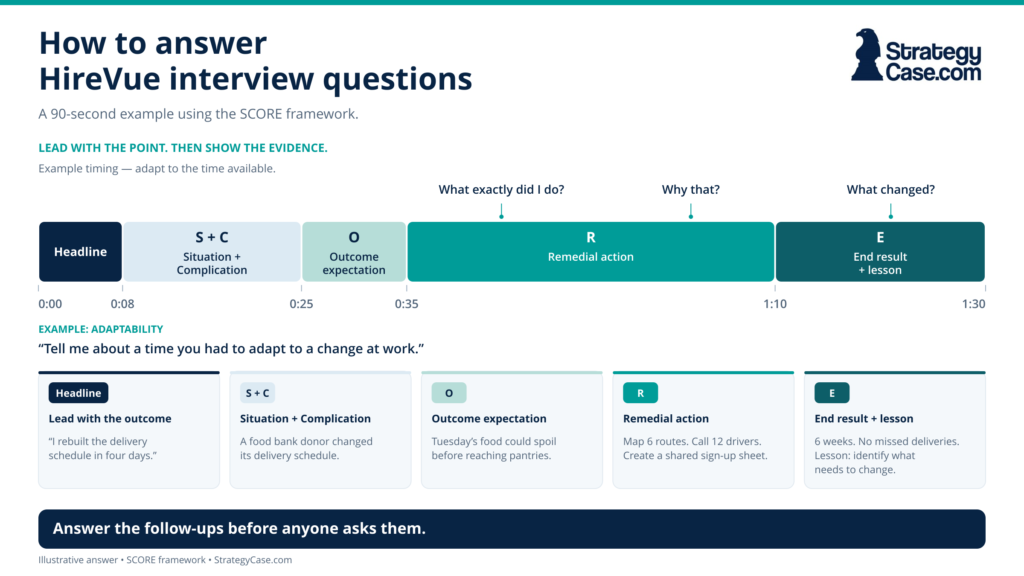
Answer the follow-ups before anyone asks them.
HireVue Games: What They Test and How to Prepare
The most detailed public list of HireVue’s games comes from an independent audit HireVue commissioned in October 2020, which HireVue still hosts on its site. The lineup may have changed since then, but HireVue’s 2025 statement still names two of these games (Digitspan and Portrait).
| Game family | Games named in the audit | What it measures | Format |
|---|---|---|---|
| Cognitive ability | Digitspan, Disconumbers, Puzzlepicture, Pathfinder, Symbolspan, Flashback, Colortracks, Numerosity, Singularity, Shapedance | General cognitive ability; Digitspan targets working memory | Game versions of classic tests such as Raven’s matrices and working-memory tasks, packaged in sets of 2, 3, or 4 games |
| Emotional intelligence | TeamChat, LeaderChat, E-motions, Pulse | Influence and collaboration, empathy, impulse control | Chat games are text-message situational judgment tests; E-motions is emotion recognition; Pulse is a go/no-go reaction task |
| Personality | Portrait | The Big Five traits | Forced choice between image pairs, prompted with “I am more like…” |
The cognitive games adapt in real time. Clear a level and the next one is harder; fail one and you get an easier task. Your score draws on your win-loss ratio, how many levels you played, and the highest level you reached. Everyone hits levels they can’t clear, so failing one doesn’t mean you’re doing badly.
HireVue’s prep guide says each game starts with easy levels to teach you the format, and that there are no “cheat codes” for the games.
How to prepare without wasting time:
- Learn the rules, not answer keys. Each game comes with its own instructions. Read them fully and use the easy opening levels to settle in.
- Take it in one sitting, when you’re sharp. HireVue’s own tips: charge your device and pick the time of day you’re most alert.
- Use the screen you’re comfortable with. In HireVue’s device study, mobile players had a small advantage over desktop that wasn’t statistically significant.
- Don’t try to engineer Portrait. Employers pick the traits that matter for the role and you can’t see which, so there’s no target profile to aim for.
- Ask about accommodations early. In the sample accommodation screen HireVue publishes, candidates who get extra time for a qualifying disability skip the game section, because the games depend on strict timing. Employers can configure this differently, so ask yours.
Realistically, a few hours of familiarity with game formats removes the surprise factor. It won’t raise your underlying working memory or reasoning in a week, and HireVue’s adaptive design is built to find that level wherever it is.
Prepare for the fit interview with our
Consulting Fit Interview Masterclass
- 27 video lessons (5 hours) on how fit answers are evaluated and scored
- Sample answers for every question type, plus a McKinsey PEI section
- 4.8 out of 5 from verified buyers
Built by a former McKinsey Senior Consultant and top global case coach. One-time payment, 1 year of access, full refund within 24 hours. The first two lessons are free to watch.
HireVue Practice and Tips: A Prep Plan
The video interview is where preparation changes your result. If you have 48 hours, do steps 1, 2, 4, and 6. With a week, do all eight.
- Read your invite and the welcome screen. Note whether games are included, the prep time, whether retakes are allowed, the deadline, and whether you see an AI consent screen. Make sure the link came from the employer’s recruiting email.
- Build a story bank of 6 to 8 experiences. Map each one to two or three competencies from the table above. One strong story about a turnaround can cover adaptability, problem solving, and drive.
- Outline each story as bullets, not sentences. HireVue’s cheating white paper notes that answers read from a script sound different: more formal words, fewer natural fillers, and an irregular rhythm a human reviewer notices.
- Rehearse out loud on camera at the real settings. Use your phone and a timer. Aim for 90 seconds to 2.5 minutes per answer. Watch each take twice: once for content (did the actions and the result come out?), once for delivery.
- Pre-answer the three follow-ups. For every story, check you’ve said what you did, why, and what changed.
- Do the practice question to test your setup. Camera at eye level, light in front of you, a quiet room, and a microphone that picks you up clearly, since transcription is step one of the scoring.
- During the real interview, keep three cue words per story on paper. HireVue’s own interview tips say you can keep notes next to you. Look at the lens, not the screen.
- Leave buffer before the deadline. If your connection drops, reopen the same link and continue.
Your stories are the bottleneck, not your webcam. Building a story bank that survives probing is the part most candidates rush. The Fit Interview Masterclass, linked above, walks through preparing answers in advance and covers every major question type with sample answers.
A note on ChatGPT
Don’t paste in AI-written answers. HireVue’s data science team tested ChatGPT 3.5 on its AI-scored questions. Given only the question, ChatGPT’s answers scored like an average candidate, 3 on the five-point scale. Better prompts occasionally reached 5 but mostly stayed average, and the answers were generic, so they still needed the candidate’s real experience to work.
Employers can also disable copy and paste and take snapshots of you during the interview. A generic answer can’t carry your specifics, and the specifics are what score.
HireVue Interview FAQ
Is a HireVue interview scored by AI or by a person?
It depends on the employer. HireVue offers both human-reviewed and AI-scored interviews. With AI scoring, a model rates the transcript of each answer on a five-level scale, but recruiters can still watch the video, and the employer makes the decision. If you decline AI scoring on the consent screen, a recruiter rates your answers on the same scale.
Can HireVue tell if you’re reading your answers or using ChatGPT?
The AI only scores your words. But HireVue says human reviewers can often tell when someone reads a script: more formal vocabulary, fewer fillers, and an unnatural rhythm. In HireVue’s own test, ChatGPT 3.5 answers mostly scored average and came out generic. Employers can also disable copy and paste.
Can HireVue see your screen?
HireVue’s documentation doesn’t describe screen recording for video interviews. It does describe employer options to disable copy and paste and to take snapshots of you during the interview. Its cheating white paper lists tab-switch warnings and records of browser-tab changes as features HireVue was exploring. Assume the session is monitored and answer from your own notes.
Can you redo an answer in a HireVue interview?
Only if the employer allows it. Retakes are an employer setting. HireVue recommends allowing them for AI-scored interviews, but its “spontaneous” question mode allows no retakes and little prep time. Your welcome screen tells you which version you have, so check before the first question.
How long does it take to hear back after a HireVue interview?
The employer decides, not HireVue. HireVue’s template confirmation email just says a company representative will contact you about next steps. Some employers also send a candidate feedback report. HireVue words it positively and doesn’t tell you whether you scored low, average, or high.
Can you practice the HireVue games?
You can learn the formats, and you should read every instruction screen carefully. Each game starts with easy levels to teach you the rules. Because the cognitive games adapt to your performance, drilling won’t move your score much. Rest, focus, and one uninterrupted sitting matter more.
The Bottom Line on HireVue Interviews
A HireVue interview tests the same thing a consulting fit interview tests, without anyone there to help you get it out:
- Content is scored, delivery is watched. HireVue’s AI reads your transcript; a recruiter may watch the video.
- There are no follow-up questions. Say what you did, why, and what changed, in every answer.
- The games are short and adaptive. Learn the formats and take them rested; don’t try to cram them.
- The employer sets the rules. Read the welcome screen before you record.
Start with your story bank tonight. Six to eight solid stories, each outlined in SCORE and rehearsed on camera, will carry most HireVue interviews.
Get StrategyCase’s Fit Interview Masterclass. It’s a self-paced video course on how consulting fit answers are evaluated, with sample answers for every major question type and a section on McKinsey’s PEI. The first two lessons are free to watch.
See the Fit Interview Masterclass →
If the video gets you through, the next round at a consulting firm is usually a case interview, which tests a different set of skills. StrategyCase’s free Case Interview Foundations course is the place to start on those.
Related Guides
- How to Answer “Why Consulting?” and “Why Our Firm?”
- How to Answer Leadership Questions in a Consulting Interview
- BCG Fit Interview Guide
- AI in Consulting Interviews
About the author: Dr. Florian Smeritschnig is the founder of StrategyCase.com and a former McKinsey Senior Consultant who recruited candidates for the firm. Since 2020 he has delivered 2,300+ mock interviews and coaching sessions, and his clients have secured 700+ consulting offers, 340 of them at McKinsey, BCG, and Bain. He is the author of three books on consulting interviews and careers, including The 1%: Conquer Your Consulting Case Interview.
