

Last Updated on July 16, 2026
Updated July 2026. By Florian Smeritschnig, former McKinsey Senior Consultant.
Consulting terms and jargon are the shorthand management consultants use to move fast: terms like MECE, deck, deliverable, boiling the ocean, and buy-in that pack a whole idea into two words. You do not need to memorize all of it to break into consulting. But you do need to recognize it, because a blank stare at the wrong moment in an interview reads as “not one of us.”
This glossary defines 130+ of the most common consulting terms and buzzwords, grouped by where you will actually meet them. And because I spent five years at McKinsey and evaluated real candidates there, I flag the handful that genuinely help you in an interview, and the ones that make you sound like you are bluffing.
Key Takeaways
- Consulting jargon exists for speed and signaling, not decoration. The strongest consultants tend to use less of it, not more.
- This glossary defines 130+ consulting terms grouped into six buckets: everyday office speak, structuring, project and staffing, client and strategy, numbers and data, and firms and frameworks.
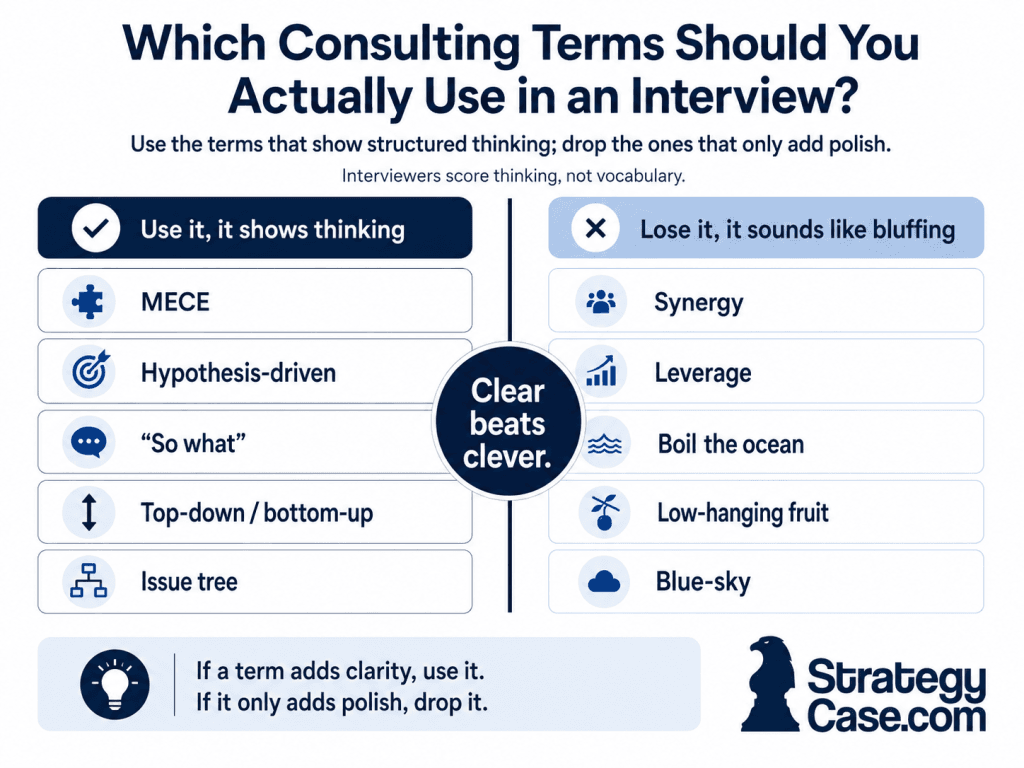
- In a case interview, structuring terms like MECE, “hypothesis,” and “so what” signal real thinking. Filler buzzwords like synergy, “leverage,” and “boil the ocean” usually signal the opposite.
- Evaluators who have assessed hundreds of candidates can tell the difference between understanding a term and dropping it to impress. That gap is where a lot of candidates lose points.
- Learn the vocabulary so you can follow your team and clients. Win the offer with structure and clarity, not by sounding fancy.
What Is Consulting Jargon?
Consulting jargon is the specialized vocabulary management consultants use to communicate complex ideas quickly: acronyms (MECE, KPI), metaphors (boiling the ocean, low-hanging fruit), and shorthand (deck, deliverable, on the beach). It speeds up communication among insiders and signals industry fluency. Overused or misapplied, it obscures meaning and exposes a shallow grasp of the underlying idea.
That double edge is the whole story of this glossary. Every term below does real work when you understand it, and every term becomes a liability when you use it to paper over a gap in your thinking. Keep that in mind as you scan the lists, especially if you are preparing for interviews at McKinsey, BCG, and Bain.
Everyday Consulting Speak
This is the ambient language of a consulting team: the words you will hear in your first hour on a project, mostly borrowed from corporate life and sharpened for speed. None of it is complicated. All of it is expected.
| Term | What it means |
|---|---|
| Action item | A specific task assigned to someone, with an owner and usually a deadline. |
| Action title | The headline of a slide that states its conclusion, not its topic. “Sales fell 12% in the North region,” not “Regional sales.” |
| Actionable | A recommendation the client can realistically execute given their resources and skills. |
| AOB (any other business) | The catch-all slot at the end of a meeting agenda. In practice, the delicate topics often surface here. |
| Ballpark | A rough estimate. “Give me a ballpark” means an approximate number is fine for now. |
| Bandwidth | Your capacity to take on more work. “No bandwidth” and “my plate is full” both mean you are stretched thin. |
| Blanks | Missing pieces in a document. Junior team members are often asked to “fill in the blanks.” |
| Buttoned-up | Work that is polished, accurate, and ready to withstand scrutiny. |
| Circle back | Return to a topic later. Often a polite way to park a question that has no answer yet. |
| Deck | A slide presentation, almost always in PowerPoint. The core output of most consulting teams. |
| Double click / drill down | Go one level deeper on a point. “Let’s double click on the pricing driver” means examine it in detail. |
| EOD | End of day. In consulting, “by EOD” often means before the client sees it tomorrow morning, not 5 p.m. |
| Facetime | Visible time spent with colleagues or superiors to show commitment, even when it adds no real output. |
| Firefighting | Reacting to urgent, unplanned problems instead of doing proactive work. |
| Hard stop | A fixed, non-negotiable end time. “I have a hard stop at 3” means the meeting ends at 3. |
| Hit the ground running | Start contributing effectively from day one, with no ramp-up. |
| On the beach | Between projects, without a client to bill. Not the vacation it sounds like. |
| On the same page | Shared understanding across a group. “Let’s get on the same page” means align before moving on. |
| Onboard | Bring someone up to speed on a project’s history and current status. |
| Ping | Send a quick message. “Ping me when you’re done.” |
| Playback | Repeat information back to confirm you understood it correctly. |
| Pre-wire | Socialize a recommendation with key people privately before the formal meeting, so there are no surprises in the room. |
| Pushback | Resistance or objection to a proposal. Getting pushback is normal and often useful. |
| Quick win | An easy, fast result that builds momentum and credibility early in a project. |
| Socialize | Float an idea informally to gather reactions before you commit to it. |
| Touch base | A short check-in to align or update. |
Notice how much of this list is about managing people and time rather than solving problems. That is not an accident. A large part of consulting is coordinating a team under deadline pressure, and the vocabulary reflects it.
Structuring and Problem-Solving Jargon
These are the terms that describe how consultants actually think. They matter more than the rest of the glossary combined, because they map directly to the skills firms test in a case interview. If you only learn one section, learn this one.
| Term | What it means |
|---|---|
| Answer-first | Leading with your recommendation or hypothesis, then supporting it, instead of building up to it. Central to how firms like Bain evaluate communication. See our guide to the answer-first approach. |
| Bird’s-eye view / 10,000-foot view / helicopter view | The big picture, deliberately ignoring detail. The opposite of drilling down. |
| Blue-sky thinking | Brainstorming with no constraints, before you filter for feasibility. |
| Boiling the ocean | Taking on a scope so vast it becomes unmanageable. “Let’s not boil the ocean” means focus on what matters most. |
| Bottom-up | Building an estimate or plan from granular detail upward. The counterpart to top-down. |
| Buckets | Categories used to group ideas or drivers. “Three buckets” is a very common way to frame a structure. |
| First-principles thinking | Reasoning from fundamental truths rather than analogy or a memorized template. The skill modern case interviews reward most. |
| Framing | How you set up a problem or a message to guide the reader toward a conclusion. |
| Granularity | The level of detail. “More granular” means break it down further. |
| Hypothesis-driven | Starting with a testable answer and then seeking data to confirm or reject it, rather than analyzing everything blindly. |
| Issue tree | A branching breakdown of a problem into MECE components. The backbone of most case interview frameworks. |
| MECE | Mutually Exclusive, Collectively Exhaustive. Categories that do not overlap and together cover the whole problem. Learn how to structure issues MECE. |
| North star | The single guiding objective everything else ladders up to. |
| Out-of-the-box | Unconventional thinking that breaks the obvious pattern. |
| Out of thin air | An argument with no supporting logic or data. Something to avoid in a case. |
| So what | The implication of a fact. “What’s the so what?” asks you to move from data to insight. |
| Top-down | Starting from the high-level picture and breaking it into detail. The counterpart to bottom-up. |
| 80/20 rule (Pareto principle) | Roughly 80% of results come from 20% of the drivers. The instinct to find that vital 20% fast. See our breakdown of the 80/20 rule in consulting. |
| 5 Whys | Asking “why” repeatedly to trace a problem to its root cause instead of its symptom. |
Project, Engagement, and Staffing Terms
Every consulting project runs on a shared operating vocabulary: what the work is called, how it is divided, and how your time gets tracked and billed. Here is the machinery.
| Term | What it means |
|---|---|
| Billable / chargeable | Time or tasks the client pays for, as opposed to internal work. |
| Charge code | The internal code you log hours and expenses against for a given project. |
| Critical path | The sequence of tasks that determines the shortest possible time to finish a project. |
| Deliverable | A defined output handed to the client, such as a report, model, or final deck. |
| Engagement | A consulting project. The standard word for a single piece of client work. |
| Fact pack | A compiled set of key data and facts on a topic, used as reference material. |
| Headcount | The number of employees, usually counted as full-time roles. |
| Milestone | A significant checkpoint in a project timeline. |
| Pipeline | Potential future projects or clients not yet sold. |
| Progress review | A scheduled check-in on how the work is tracking against the plan. |
| RACI | A responsibility chart marking who is Responsible, Accountable, Consulted, and Informed for each task. |
| Roadmap | A sequenced plan for reaching a longer-term goal. |
| Scope | The agreed boundaries of a project: what is included and what is not. |
| SME (subject matter expert) | A specialist brought in for deep knowledge of a specific area. |
| Staffing | How consultants get assigned to projects. Also the act of building a team for one. |
| SteerCo (steering committee) | The senior client group that oversees and signs off on a project. |
| Study | Another word for a project, used especially at McKinsey. |
| Swim lane | A band in a process diagram showing who owns which part of a workflow. |
| Utilization rate | The share of your time that is billable. A core metric for how consultants are measured. |
| Workstream | A distinct strand of work within a larger project, usually with its own owner. |
| 360-degree feedback | Confidential feedback collected from the people above, below, and alongside you. |
Client, Strategy, and Commercial Terms
When consultants talk to clients or frame a strategy, a different register kicks in. These are the words that show up in proposals, on slides, and in the boardroom.
| Term | What it means |
|---|---|
| Benchmarking | Comparing a company’s performance against industry peers or best practice. |
| Best of breed | The strongest available solution in a specific category. |
| Blue ocean strategy | Creating new, uncontested market space instead of fighting rivals in a crowded market. Coined in the book of the same name (see Blue Ocean Strategy). |
| Buy-in | Genuine agreement and support from the people who need to back a decision. |
| C-suite / C-level | The top executives: CEO, CFO, COO, and the rest. |
| Capability | The skills, tools, and resources a company can draw on to compete. |
| Change management | The discipline of guiding an organization through a major transition. |
| Client-facing | Work or roles that involve direct contact with the client. |
| Competitive landscape | The set of rivals in a market and how they stack up. |
| Core competencies | The distinctive strengths that set a company apart. |
| Due diligence | A thorough review of a business, often before an acquisition. “Commercial due diligence” focuses on the market and revenue case. |
| Elevator pitch | A persuasive summary short enough to deliver during an elevator ride. |
| Go-to-market | The plan for launching a product or service into a market. |
| Inflection point | A moment when the trajectory of a business changes sharply. |
| Mission-critical | Essential to achieving the objective. Without it, the plan fails. |
| Optics | How a decision or situation looks to others, separate from its substance. |
| Right-size | A softer word for cutting jobs or shrinking a function. |
| Scalable | Able to grow without a proportional rise in cost. |
| Stakeholder | Anyone with an interest in the outcome: executives, employees, customers, regulators. |
| Synergy | The extra value created when two parts combine. Genuine when quantified, hollow when not. |
| Thought leadership | Published ideas and research a firm uses to demonstrate expertise. |
| Value proposition | The specific reason a customer chooses one offer over another. |
| Zero-based budgeting | Rebuilding a budget from zero each period, justifying every expense rather than adjusting last year’s. |
Numbers, Data, and Analysis Terms
Consulting runs on quantification, and it has its own dialect for the math. Most of these come from finance and land straight in your Excel model. If numbers make you nervous, our case interview math guide covers the mechanics.
| Term | What it means |
|---|---|
| Burn rate | How fast a company spends its cash reserves. |
| CAGR | Compound Annual Growth Rate. The smoothed annual growth rate over several years. |
| Crunching numbers / number crunching | Working through data and calculations, usually in Excel. |
| Dashboard | A visual summary of key metrics and KPIs in one view. |
| Delta | The difference or change between two values. “What’s the delta?” asks for the gap. |
| Executive summary | A one-page distillation of a report for readers who will not read the rest. |
| Guesstimate / educated guess | A reasoned estimate from limited data. The core skill in market sizing. |
| KPI | Key Performance Indicator. A metric that tracks progress toward a goal. |
| 1-pager | A single-page summary of a proposal, project, or analysis. |
| Run rate | Projecting current performance forward as if it holds steady. |
| Run the numbers | Build or use a model to test how the math plays out under different assumptions. |
| Sanity check | A quick test of whether a result is roughly reasonable before you trust it. |
| T-shirt sizing | A rough estimate of scale in broad buckets: small, medium, large. |
Firms, Frameworks, and Acronyms
Finally, the vocabulary for the industry itself: who the players are, and the classic frameworks whose names get used as shorthand.
| Term | What it means |
|---|---|
| B2B / B2C | Business-to-Business and Business-to-Consumer. Who the company sells to. |
| Big 3 / MBB | The three leading strategy firms: McKinsey, BCG, and Bain. The reference point for “top-tier” strategy consulting. |
| Big 4 | The four large audit and advisory firms: Deloitte, EY, KPMG, and PwC. See what the Big 4 are. |
| Tier-2 | Respected firms below MBB in brand reach, often with deep specialisms: Kearney, Oliver Wyman, Roland Berger, LEK, Strategy&. |
| Bleeding edge | Technology so new it carries real risk, one step past cutting edge. |
| Disruptor | A company that upends an established market with a new model. |
| Greenfield / brownfield | A greenfield project starts from scratch with no legacy constraints. A brownfield one builds on existing systems. (The original pairing, often misremembered as “whitefield.”) |
| 3C’s | Company, Customers, Competitors. A basic strategy lens. |
| 4P’s | Product, Price, Place, Promotion. The classic marketing mix. |
| SWOT | Strengths, Weaknesses, Opportunities, Threats. A standard situational scan. |
| Six Sigma / Lean | A methodology for reducing process defects and waste (see ASQ on Six Sigma). |
| 24/7 client | A client that expects round-the-clock responsiveness. |
| Golden handcuffs | Financial incentives designed to keep a valuable employee from leaving. |
Which Consulting Terms Should You Actually Use in an Interview?
Here is the part no glossary tells you, and the reason I rewrote this one.
Having evaluated candidates at McKinsey, I can tell you that interviewers are not scoring you on vocabulary. They are scoring you on thinking. Jargon is only useful in an interview when it is the fastest accurate way to say something you genuinely understand. The moment it becomes a costume, it works against you.
Use the structuring terms, because they show how you think. When you say your structure is MECE, or that you want to start with a hypothesis, or you ask “so what” of a chart, you are demonstrating the exact skills the case is built to test. These terms are load-bearing. They earn their place.
Go easy on the buzzwords, because they show the opposite. Peppering your answers with “synergy,” “leverage,” “boil the ocean,” and “low-hanging fruit” does not make you sound experienced. To someone who has heard it a thousand times, it sounds like you are reaching for the vocabulary because you do not yet have the substance. Two or three buzzwords stacked in one sentence is a tell, not a flex.
This is the whole StrategyCase thesis in miniature. Most preparation teaches candidates to imitate the surface of consulting, the words and the frameworks, instead of building the underlying skill. Firms adapted years ago. They now design cases specifically to expose candidates who pattern-match rather than reason. The fix is not more jargon. It is genuine structured thinking, expressed in plain language, which is exactly what we drill in the StrategyCase All-in-One Case Interview Preparation program.
So treat this glossary as a comprehension tool first. Learn the terms so you follow every word in the room. Then, when you speak, reach for the plainest phrasing that is still precise. If a term adds clarity, use it. If it only adds polish, drop it. Clear beats clever, every time you communicate in a case interview.
Why Do Consultants Use So Much Jargon?
Three reasons, and they are worth understanding because they tell you when the jargon is real and when it is noise.
Speed. On a tight timeline, “let’s not boil the ocean” is faster than “we should focus on the highest-impact areas rather than analyzing everything.” Compression is the point. Good jargon is a genuine shortcut between people who share the same reference.
Belonging. Shared language marks the tribe. Fluency signals that you have been inside the work, which is why it carries weight in interviews and why outsiders can feel shut out of a conversation that is 40% acronyms.
Cover. Some jargon exists to soften uncomfortable truths. “Right-sizing” is easier to say than “layoffs.” “Optics” lets a room discuss appearances without admitting that is what they are doing. This is the category to watch, in others and in yourself.
The practical takeaway holds across all three: jargon is a tool, not a qualification. The best consultants I worked with used less of it than the juniors trying to prove themselves. Once you no longer need to signal that you belong, you stop performing the language and start just using it.
Frequently Asked Questions
What is consulting jargon?
Consulting jargon is the specialized shorthand consultants use to communicate complex ideas quickly, including acronyms like MECE and KPI, metaphors like boiling the ocean, and terms like deck, deliverable, and on the beach. It speeds up communication among insiders but can obscure meaning when it is overused or misunderstood.
What does “deep dive” mean in consulting?
A deep dive is a detailed analysis of one specific issue, sometimes called a “double click.” If a broader analysis raises a question about, say, a competitor’s pricing, the team does a deep dive to examine that single point in depth rather than staying at the surface.
What does “boiling the ocean” mean?
Boiling the ocean means taking on a scope so large or unfocused that it becomes impossible to finish well. Consultants use the phrase as a warning: “let’s not boil the ocean” is shorthand for narrowing the work to the few areas that will actually move the outcome.
Do I need to know consulting jargon to pass a case interview?
You need to understand it, not perform it. Recognizing the terms lets you follow the interviewer without hesitation. But your score comes from structured thinking and clear communication, not from how many buzzwords you use. In fact, overusing jargon to sound impressive tends to hurt strong candidates more than it helps.
What is MECE in consulting?
MECE stands for Mutually Exclusive, Collectively Exhaustive. It describes a way of breaking a problem into categories that do not overlap (mutually exclusive) and together cover the entire problem (collectively exhaustive). It is one of the most important structuring concepts in case interviews and consulting work.
What’s the difference between the Big 3 and the Big 4?
The Big 3, also called MBB, are the top strategy firms: McKinsey, BCG, and Bain. The Big 4 are the large audit and advisory firms: Deloitte, EY, KPMG, and PwC. The Big 3 are known primarily for strategy consulting, while the Big 4 built their names on audit and accounting before expanding into consulting.
Related Guides
- Consulting Case Interviews: A Comprehensive Guide: the full pillar on how case interviews actually work.
- How to Get Into Consulting: the full path from application to offer.
- Consulting Career Secrets: what the jargon looks like once you are actually on the job.
- Consulting Networking: where you pick up most of this vocabulary before you ever start.
- Brainstorming in a Case Interview: turning “blue-sky thinking” into structured ideas.

The Bottom Line on Consulting Lingo
Consulting terms are worth learning, but not for the reason most candidates think. The vocabulary is a comprehension key, not a credential. Master it and you will follow every conversation, catch every acronym, and never lose a beat because someone said “let’s take this offline to the SteerCo.”
Then set most of it aside when you speak. The candidates who get offers, and the consultants who get promoted, are the ones who make complicated things simple, not the ones who make simple things sound complicated. Learn the language so you understand the room. Win with structure and clarity.
If you want to build that structured thinking the way firms actually test it, start with the StrategyCase Case Interview Academy. It is the fastest way to sound like a consultant for the right reason: because you have learned to think like one.
About the author: Florian Smeritschnig spent five years at McKinsey as a Senior Consultant, where he evaluated candidates, and has since delivered 2,200+ mock interviews and coaching sessions. He founded StrategyCase.com and has helped clients secure 700+ offers at McKinsey, BCG, Bain, Tier-2, and Big 4 firms. He is the author of “The 1%: Conquer Your Consulting Case Interview,” “The 1%: Case Interview Workbook,” and “Consulting Career Secrets.”

One Response
[…] https://strategycase.com/consulting-lingo-and-buzzwords/ […]