
Updated July 2026 · By Florian Smeritschnig, former McKinsey Senior Consultant
The Revolut interview process runs five to six stages over roughly four weeks, and for strategy, operations, and business analyst roles the stage that decides your offer is the problem-solving interview: a 30 to 40 minute, candidate-driven business case. Revolut publishes the stage count and the timeline on its careers site. Everything more granular than that comes from candidate reports, not from Revolut.
Most candidates prepare for that round as though it were a McKinsey case. That’s precisely why they lose it.
I spent five years at McKinsey as a Senior Consultant and evaluated candidates there. Since then I have delivered 2,200+ mock interviews and coaching sessions, and a growing share of the people I work with are not only chasing MBB. They are running Revolut, Wise, and Monzo processes in parallel. The pattern in their debriefs is consistent enough to write down: the habits that earn points in an MBB case cost points at Revolut.
This guide breaks down every stage of the Revolut interview process, what the problem-solving round actually tests, and the four specific ways MBB-trained candidates sabotage themselves in it.
Key Takeaways
- Revolut states its recruitment process is five or six stages and takes about four weeks. Stage-level detail beyond that is candidate-reported, not published by Revolut.
- The problem-solving interview is a 30 to 40 minute live case and is where most business-role candidates are eliminated.
- The Revolut case is candidate-driven, not interviewer-led. Nobody hands you the next exhibit or nudges you back on track.
- Four MBB habits actively hurt you here: waiting for prompts, building exhaustive trees, saving the recommendation for the end, and defaulting to strategy over execution.
- The bar raiser round is run by a leader outside your hiring team and weights quantified ownership over polish. Vague outcomes fail it.
What the Revolut Interview Process Actually Looks Like
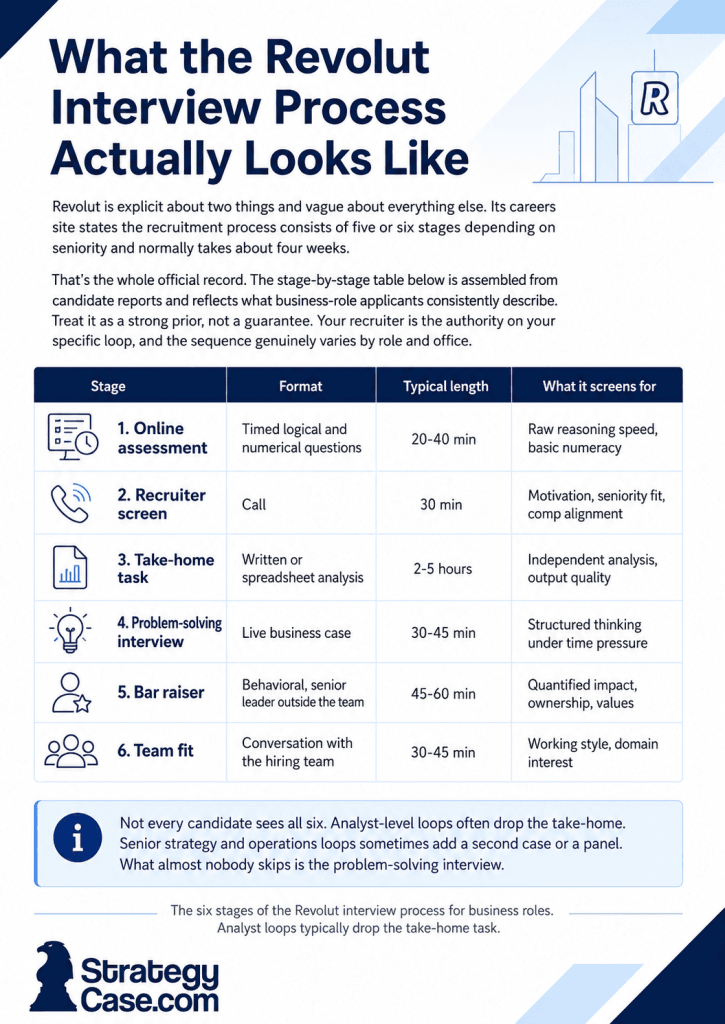
Revolut is explicit about two things and vague about everything else. Its careers site states the recruitment process consists of five or six stages depending on seniority and normally takes about four weeks.
That’s the whole official record. The stage-by-stage table below is assembled from candidate reports and reflects what business-role applicants consistently describe. Treat it as a strong prior, not a guarantee. Your recruiter is the authority on your specific loop, and the sequence genuinely varies by role and office.
| Stage | Format | Typical length | What it screens for |
|---|---|---|---|
| Online assessment | Timed logical and numerical questions | 20-40 min | Raw reasoning speed, basic numeracy |
| Recruiter screen | Call | 30 min | Motivation, seniority fit, comp alignment |
| Take-home task | Written or spreadsheet analysis | 2-5 hours | Independent analysis, output quality |
| Problem-solving interview | Live business case | 30-45 min | Structured thinking under time pressure |
| Bar raiser | Behavioral, senior leader outside the team | 45-60 min | Quantified impact, ownership, values |
| Team fit | Conversation with the hiring team | 30-45 min | Working style, domain interest |
Not every candidate sees all six. Analyst-level loops often drop the take-home. Senior strategy and operations loops sometimes add a second case or a panel. What almost nobody skips is the problem-solving interview.
A note on the online assessment. The “Revolut test” is a standard timed reasoning screen, not a bespoke Revolut-built simulation like the McKinsey Solve. Speed matters more than cleverness. If your mental math is slow, that’s a fixable mechanical problem, and our case interview math guide covers the drills that fix it.
The Problem-Solving Round Is the Real Gate
The problem-solving interview is where business-role candidates get cut. Candidates describe a 30 to 40 minute live case built on a real or realistic Revolut business problem: a payment flow leaking users, a support queue that won’t scale, a new market where unit economics don’t close.
You’re expected to structure the problem, request and interpret data, do the arithmetic, generate solutions, and say how you would implement and monitor them. All of it inside 35 minutes.
Candidates consistently report that Revolut recruiters send McKinsey and Bain case prep material as recommended reading before this round. That single detail tells you two useful things. Revolut knows it’s running a consulting-style case. And it’s benchmarking you against people who trained for MBB.
It also sets a trap, because the case Revolut actually runs is not the case that some of the recommended material prepares you for.
The Format Difference That Catches People
A McKinsey case is interviewer-driven, as are more and more Bain cases. The interviewer asks you a sequence of questions and steers you back when you drift. That collaboration is real, and good McKinsey prep teaches you to use it.
The Revolut case is candidate-driven (similar as for BCG). You’re expected to move on your own. There’s no partner across the table gently redirecting you toward the branch that matters. Candidates who trained on interviewer-led cases describe the same feeling afterward: a long, quiet stretch where they waited for a prompt that never came, and then ran out of clock.
The clock is the second difference. A McKinsey or Bain case runs 25 to 30 minutes inside a 45 to 60 minute interview with fit questions around it. The Revolut case is 30 to 40 minutes of case, end to end, with more ground to cover.
If you have a Revolut loop coming up and you have never done a candidate-led case, that is the single highest-value thing to fix this week. Our comprehensive case interview guide covers both formats and explains where they diverge.
Why McKinsey Case Prep Backfires at Revolut
Every guide out there says the Revolut case is “comparable to a BCG or Bain first round.” That comparison is true about difficulty and badly misleading about preparation. Four specific MBB habits are liabilities here.
Habit 1: Waiting for the interviewer to hand you the next thing. In a McKinsey or Bain case, pausing after a branch is correct. The interviewer fills the space. At Revolut, the silence is yours to fill, and filling it late reads as a candidate who needs managing. Name your next move out loud before you make it.
Habit 2: Building the exhaustive tree. MBB prep rewards a clean, MECE structure across the full problem space. In 35 minutes on an operational problem, a five-branch tree is a time sink. Revolut’s interviewers want you to identify the two branches that carry the value and say why you are ignoring the rest. That’s still MECE thinking, applied with a scalpel instead of a net.
Habit 3: Saving the recommendation for the end. Candidates trained to deliver a crisp synthesis in the final two minutes routinely never get there, because the clock runs out mid-analysis. Lead with your hypothesis, update it out loud as data arrives, and make sure a defensible answer exists at every minute of the case.
Habit 4: Reaching for strategy when the question is execution. This is the deepest one. MBB prep trains you toward strategy and related frameworks (although more and more implementation and operations cases are included as well). Revolut’s business cases skew operational: process efficiency, root cause, KPI design, scaling a function without scaling headcount. A candidate who answers “should we launch this product” when the question is “why is this queue backing up” has answered a different case well.
That fourth habit is the “prep is broken” problem in miniature. Candidates practice the archetypes their materials contain, then meet a problem their materials never modeled, and conclude they are bad at cases. They’re not. They rehearsed the wrong thing.
How to Prepare for the Revolut Case Interview in Two Weeks
Most Revolut candidates get two to three weeks of notice. That’s enough, if you spend it on the gap rather than on volume.
Days 1-3: Establish your baseline. Do two candidate-led cases under a real 35 minute clock, recorded. Watch them back. You are looking for one thing: how many seconds of dead air are there, and where. That number is your actual problem.
Days 4-8: Drill the operational archetypes. Work process efficiency, root cause, and unit economics problems specifically. Skip market entry. Build the reflex of asking “what would I need to see to believe this” before requesting any data.
Days 9-11: Fix the arithmetic. Under a candidate-led clock, slow math is fatal because nobody is waiting for you. Percentage changes, breakevens, and per-unit economics should be automatic. A calculator or spreadsheet is often permitted, but candidates report this varies by interviewer, so don’t build your plan around having one.
Days 12-14: Build the bar raiser inventory. Six stories, each with a number attached. More on this below.
If you are an experienced hire, the compression is different. Your domain fluency is an asset Revolut actively wants, but the case still tests structure, and senior candidates are the most likely to narrate experience instead of solving the problem in front of them. Our guide on case interviews for experienced hires covers that failure mode directly.
If you are applying to the Rev-celerator internship, expect a lighter loop and a heavier weight on values and motivation. Revolut runs this programme out of its hubs in Poland, Portugal, the UAE, and the UK, and details sit on the internship programme page.
At StrategyCase, this is exactly how we sequence preparation: establish a baseline first, diagnose the specific gap, then drill against it. Working through 40 generic cases wouldn’t have fixed a single one of the four habits above.
The Bar Raiser and Values Rounds
The bar raiser is run by a senior leader outside your hiring team. Its stated purpose is to check whether you raise the average bar rather than fill a seat, which means this interviewer has no incentive to like you and every incentive to probe.
Candidates report questions along these lines:
- What was the mission of your last role, and which metrics did you own?
- How would your last employer rate your performance out of ten?
- Were you promoted on the same timeline as your peers?
- Tell me about an inefficiency you found and removed.
- What is the most elegant, simple solution you have built for a hard problem?
Two things separate the people who pass. Every answer carries a number, and every story shows ownership rather than participation. “I improved the onboarding flow” fails. “I cut onboarding drop-off from 34% to 21% in one quarter by removing two verification steps” passes.
Expect pushback. Interviewers challenge answers deliberately to see whether you defend a decision with evidence or fold. Holding your position politely, with data, is the behavior being measured.
Revolut’s five values sit underneath all of this: Never Settle, Get It Done, Think Deeper, Dream Team, and Deliver WOW, published on the company’s culture page. You don’t need to recite them. You do need stories that would obviously map to them, which is the same discipline behind a strong consulting fit interview.
Is Revolut Worth It If You’re Aiming for MBB?
Honest answer: it depends on what you want from the next three years, and the two paths are less interchangeable than candidates assume.
The case for Revolut is strong on substance. The company reported $6.0bn in revenue and $2.3bn in pre-tax profit for 2025, a fifth consecutive profitable year, with headcount up only 10% against 46% revenue growth. That last ratio is the interesting one for a candidate. It means small teams carrying large scope, which is real ownership early.
The tradeoff is breadth. Consulting gives you many industries in three years and a credential that opens doors you haven’t thought about yet. Revolut gives you one company, deeply, and a track record in a single sector. Neither is better. They’re different bets, and our guide to consulting exit opportunities maps where each one leads.
One practical note: interviewing at Revolut while preparing for MBB is efficient, because roughly 90% of the underlying skill transfers. Budget a few focused hours for the 10% that does not, rather than treating them as the same interview.
Frequently Asked Questions
Does Revolut do case interviews?
Yes, for business roles. Strategy, operations, and business analyst candidates report a live problem-solving interview that functions as a consulting-style case. Engineering and product loops follow a different structure with technical and system design rounds instead.
How hard is the Revolut case interview compared to McKinsey?
Comparable in difficulty to an MBB first round, but different in shape. It’s shorter, fully candidate-driven, and weighted toward operational execution rather than strategic framing. Many candidates find the format harder than the content.
How long does the Revolut interview process take?
Revolut states the process normally takes about four weeks across five or six stages. Candidate reports cluster around three to five weeks, with the take-home task and scheduling gaps as the usual sources of delay.
What is the Revolut bar raiser interview?
A behavioral round run by a senior leader outside your hiring team, designed to check whether you would raise the company’s average performance level. It rewards quantified impact and evidence of ownership, and it punishes vague outcomes.
Can I use a calculator in the Revolut problem-solving interview?
Often, but not reliably. Candidates report that calculators and spreadsheets are frequently permitted and that this varies by interviewer. Prepare to do the arithmetic mentally so the answer doesn’t depend on the tooling.
Is Revolut a good move after consulting?
It suits people who want depth, scope, and ownership inside one fast-growing company. It suits people who want industry breadth and optionality less well. The financial trajectory is strong, but you’re concentrating your bet on one firm and one sector.
Related Guides
- Consulting case interviews: the comprehensive guide
- Real case interview examples from McKinsey and others
- Why candidates fail their case interviews
- Case interview preparation plan
The Bottom Line
The Revolut interview process is winnable, and it’s winnable faster than most candidates expect, because the gap between MBB preparation and Revolut performance is narrow and specific.
Five things to take with you:
- Five or six stages, roughly four weeks. Only that much is official. Confirm your loop with your recruiter.
- The problem-solving interview is the gate. Everything else is a filter around it.
- The case is candidate-led. Nobody will rescue you from silence, so narrate your next move before you make it.
- Go operational, not strategic. Process, root cause, and KPIs beat generic frameworks here.
- Attach a number to every bar raiser story. Unquantified impact reads as no impact.
If you want to know where you actually stand before the clock starts, that’s what a StrategyCase diagnostic coaching session is built for: a real case under real conditions, a specific read on which of the four habits is costing you, and a plan that targets it. If you’d rather build the foundation yourself first, the Case Interview Academy covers the structuring, math, and chart work that both Revolut and MBB test.
Prepare for the case Revolut actually runs, not the one your prep materials describe. That distinction is worth more than another twenty practice cases.
About the author: Written by Florian Smeritschnig, former McKinsey Senior Consultant. Florian spent five years at McKinsey, where he evaluated candidates, and has since delivered 2,200+ mock interviews and coaching sessions, helping 700+ candidates secure offers at McKinsey, BCG, Bain, and other top firms.
Last updated: July 31, 2026
