

Last Updated on September 24, 2026
Updated September 2026. By Florian Smeritschnig, former McKinsey Senior Consultant
Tier 2 consulting firms are the strategy firms that sit directly below McKinsey, BCG, and Bain: Oliver Wyman, L.E.K. Consulting, Kearney, and Roland Berger as independents, Strategy&, EY-Parthenon, and Monitor Deloitte as corporate-owned strategy arms.
The problem with that answer is that it treats a dozen very different businesses as one rank. They aren’t one rank. A pricing specialist in Bonn, a restructuring firm in New York, and PwC’s strategy arm share a label and almost nothing else. Candidates who apply to “tier 2” as a category, rather than to distinct firms, write the wrong cover letter and blow the one question these firms care most about.
This is the tier list with the differences kept in. Who belongs in each group, what each firm actually pays in 2026, how the work and exits differ from MBB, and how to decide whether to take the offer. I spent five years at McKinsey, where I evaluated candidates, and I have delivered 2,200+ mock interviews and coaching sessions since, helping candidates break into and excel in consulting.
Key Takeaways
- “Tier 2” covers two different businesses: independent strategy firms and corporate-owned strategy arms. They differ more from each other than tier 2 differs from MBB.
- Median post-MBA total compensation at the strongest tier 2 firms runs about $200K to $228K, against roughly $230K to $245K in base plus bonus at MBB. The gap is real, and smaller than the prestige gap implies.
- At undergraduate entry the pay gap nearly disappears. Oliver Wyman, Kearney, and L.E.K. all land within striking distance of MBB’s ~$140K.
- Offer rates once you reach the case rounds are roughly 15 percent at tier 2 firms, against 10 percent at MBB. Better odds, not easy odds.
- The case bar is close to MBB. The real difference is the “why this firm” question, and that is where many tier 2 candidates get cut.
What counts as a tier 2 consulting firm?
Definition: A tier 2 consulting firm is a strategy consultancy that competes with McKinsey, BCG, and Bain for the same clients and candidates, but at smaller scale, narrower global coverage, or with a sharper functional focus. The label is a recruiting convention, not an official ranking. No firm calls itself tier 2.
Nobody publishes this list. It emerged from campus recruiting, business school clubs, and candidate forums, which is why it shifts depending on who you ask and where they sit.
In practice, four tests decide whether a firm gets counted:
- Client work. Does the firm sell board-level strategy, or mainly implementation and staffing?
- Scale and geography. Does it have real global coverage, or three strong offices and a network of small ones?
- Candidate overlap. Does it lose candidates to MBB, and occasionally win them?
- Exit strength. Does private equity, corporate strategy, and the MBA pipeline treat the brand as strategy experience?
A firm that passes all four is tier 2 almost everywhere. A firm that passes two is argued about, which is exactly why “is Accenture tier 2 or tier 3” a common question on this topic.
One caveat worth holding onto: tier is geographic. Roland Berger is a genuine top-tier alternative in Germany, Austria, and Switzerland, and a much smaller consideration in the US. Kearney and Strategy& carry more weight in the Middle East than their US profile suggests, which is why the top consulting firms in the Middle East rank differently from the US list. Your local market matters more than any global ranking.
Want to see where tier 2 consulting firms fit in the wider market? Our breakdown of the four types of management consulting firms maps the whole market, from the Big 3 down to specialist shops.
Comparing specific offers rather than browsing? Every firm in the table below links through to its full StrategyCase pay and career guide.
The tier 2 consulting firms list for 2026
Here is the list as it actually stands this recruiting season, sorted into the three groups that matter.
| Firm | Group | Known for | Strongest ground |
|---|---|---|---|
| Oliver Wyman | Independent strategy | Financial services, insurance, healthcare | US, UK, Middle East |
| L.E.K. Consulting | Independent strategy | Commercial due diligence, life sciences | US East Coast, UK, Australia |
| Kearney | Independent strategy | Operations, supply chain, procurement | US, DACH, Middle East |
| Roland Berger | Independent strategy | Industrials, automotive, restructuring | Germany, wider Europe, Asia |
| Strategy& (PwC) | Corporate-owned arm | Deals, tech and digital strategy | Global, strong in Europe and the Gulf |
| EY-Parthenon (EY) | Corporate-owned arm | Transaction strategy, education, diligence | US, UK |
| Monitor Deloitte | Corporate-owned arm | Strategy plus implementation at scale | Global |
| Accenture Strategy | Corporate-owned arm | Technology-led strategy at scale | Global |
Two firms are missing on purpose. Accenture’s consulting business is not tier 2 (one could argue about Accenture Strategy though). And Deloitte, PwC, EY, and KPMG as a whole belong in the Big 4 category, which is a different animal from their strategy arms. That distinction matters when you apply, because the entity on your offer letter decides your work, your pay, and your exits.
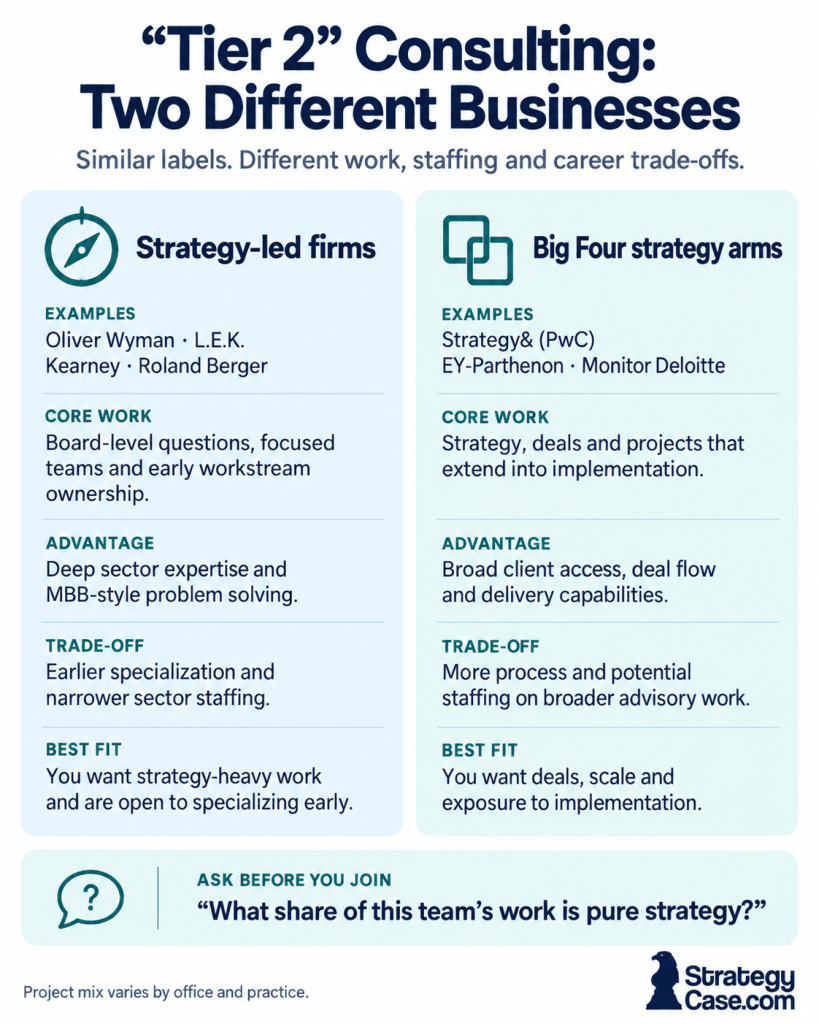
“Tier 2” is really two different businesses
Independent strategy firms
Oliver Wyman, L.E.K., Kearney, and Roland Berger are partner-owned or independently held, sell strategy as their core product, and answer to nobody’s audit practice. Kearney has been independent since its 2006 buyout from EDS. Roland Berger was founded in Munich in 1967 and is still run from there, the only firm in this group that drives its global strategy business from continental Europe.
The work is closest to MBB. Small teams, board-level questions, and a real chance of owning a workstream in your first year. The trade-off is depth over breadth: these firms are strong in specific sectors rather than everywhere, so your staffing is narrower than at McKinsey.
Pick this group if you want MBB-style work and are willing to specialize earlier.
Corporate-owned strategy arms
Strategy&, EY-Parthenon, and Monitor Deloitte sit inside much larger parents. Strategy& came from PwC’s 2014 acquisition of Booz & Company, EY-Parthenon from EY’s purchase of the Parthenon Group the same year, and Monitor Deloitte from Monitor Group in 2013.
Being owned by a Big 4 or a technology giant cuts both ways. You get deal flow, a client base the independents can’t touch, and genuine end-to-end projects that run from strategy into implementation. You also get more process, larger teams, and the risk of being staffed on work that sits closer to advisory than strategy.
That risk is the single most important thing to test in your interviews. Ask precisely what share of the team’s time goes to pure strategy cases.
Pick this group if you want deals, scale, and a shorter path into industry.
Tier 2 vs MBB: what actually differs
Candidates assume the gap is everywhere. In reality it shows up in four places and barely registers in the rest.
| Dimension | MBB | Tier 2 | Honest read |
|---|---|---|---|
| Post-MBA pay | ~$230K to $245K base plus bonus | ~$200K to $228K median | Real gap, usually $15K to $40K |
| Undergrad pay | ~$139K to $140K total | ~$125K to $160K depending on firm | Effectively parity |
| Partner economics | $1M+ for established partners | Lower ceiling at most firms | The gap widens with seniority |
| Staffing breadth | Almost any sector, any geography | Narrower, sector-led | Depends how decided you are |
| Exit brand | Opens nearly every door | Opens most doors, some with a conversation | Matters most for PE and top MBA |
| Case interview bar | Very high | Close behind | Smaller gap than candidates expect |
The pay picture, drawn from Levels.fyi 2026 data across the firm guides on this site, looks like this at post-MBA entry:
| Firm | Median post-MBA total comp (US, 2026) |
|---|---|
| MBB (base plus bonus, steady state) | $230,000 to $245,000 |
| L.E.K. | ~$228,000 |
| Kearney | ~$209,000 |
| Oliver Wyman | ~$206,890 |
| Strategy& | ~$200,000 to $220,000 |
| Roland Berger (US) | $168,000 to $237,000 |
Three things in that table are worth more than the headline numbers.
At undergraduate entry, the gap nearly closes. Oliver Wyman’s ~$120K base is competitive with or slightly above MBB undergrad pay. Kearney and L.E.K. land close behind. If you’re graduating next spring, choosing MBB over a tier 2 offer for money alone is the wrong reason.
The gap opens with seniority, not with entry. MBB partner economics run well past $1M. Most tier 2 firms have a lower ceiling. If you plan to stay a decade, that is the number that matters, not your first-year offer.
Currency comparisons mislead in Europe. A €70,000 base in Munich is not a $76,000 base in New York. German pension contributions, health cover, and statutory leave add roughly 25 to 35 percent in non-cash value, which is why Roland Berger Munich sits much closer to McKinsey Munich than raw USD tables suggest.
How hard is it to get a tier 2 offer?
Better odds than MBB. Not good odds.
Once you reach the case rounds, offer rates run roughly 15 percent at tier 2 firms against 10 percent at MBB, and 20 percent at Big 4 strategy divisions. Firms don’t publish these numbers, so treat them as calibrated estimates built from application and hiring volumes plus first-hand evaluation experience. The full method sits in the StrategyCase breakdown of case interview success rates by firm.
A five point difference in offer rate does not make these interviews easy, and it is not where most candidates lose. Across 2,200+ mock interviews and coaching sessions, the same pattern repeats: people prepare hard for McKinsey, treat tier 2 as the safety net, and get cut for two reasons.
The first is the case itself. The structuring, math, and synthesis bar at Oliver Wyman or L.E.K. sits close enough to MBB that reduced preparation shows inside the first five minutes. A candidate who is 80 percent ready for McKinsey is not comfortably ready for Kearney.
The second is the question these firms weight far more heavily than MBB does: why this firm. Tier 2 firms lose candidates to MBB every season, so they screen hard for genuine interest. “You are a great firm and I want strategy experience” reads as a fallback answer, because it is one. What works is specific: the sector, the practice, the type of project, personal connections and why this firm rather than the one across the street.
The screens differ too, and you can’t prepare for them generically. Kearney runs its own recruitment test.
L.E.K. uses a numerical reasoning test that catches candidates who never drilled speed math. Treat each as its own workstream.
Exit opportunities from tier 2 consulting
This is where the tier label costs you the least and the group label costs you the most.
Two years at Oliver Wyman in financial services opens banking, fintech, and corporate strategy the same way a McKinsey stint does. Two years at L.E.K. on commercial due diligence is a strong private equity signal, because you have already done the work PE firms need. Kearney operations experience travels directly into supply chain and industrial roles.
Where tier 2 lags is the one path that runs on brand recognition alone: the recruiter who screens by logo, and the megafund process that shortlists MBB by default. You can still get there. You’ll just need a referral and a sharper story rather than a name that does the work for you. The broader picture sits in the guide to consulting exit opportunities.
Should you take a tier 2 offer or hold out for MBB?
The verdict depends on where you are in your career, not on the ranking.
Graduating undergraduates: take the offer. Pay is near parity, the work in your first two years is closer than the tier gap suggests, and a business analyst seat at Oliver Wyman beats a year of unemployed reapplication. You can move later, and many do.
MBA candidates: it is closer. The $15K to $40K annual gap is small, but MBB’s recruiting brand does more work for you in the two years after you leave, which is when most MBA hires actually move. If you have a second shot at MBB during your program and a tier 2 offer in hand with a real deadline, take the offer and keep interviewing where the timing allows.
Experienced hires: favor fit over tier. You are hired for a sector or a function, not as a generalist, so the firm that already sells into your industry is worth more than the firm with the better logo. The route into MBB from industry is its own process, covered in the guide to experienced hires at McKinsey, BCG, and Bain.
Anyone outside the US: weight your local market heavily. Roland Berger in Munich, Kearney in Dubai, and Strategy& in the Gulf compete for the same work MBB does. The US tier list doesn’t describe your market.
If your goal is MBB specifically: tier 2 is a legitimate route in, not a dead end. It works far better after two to three years, with a clear promotion and a strong internal advocate, than after eight months of panic. The mechanics are in the guide on moving from tier 2 to MBB.
One more piece of timing. It’s late September, fall recruiting is live, and tier 2 deadlines often sit a few weeks behind MBB. That sequencing is a gift if you use it deliberately and a trap if you treat the later deadline as an excuse to prepare later.
How to prepare for tier 2 interviews
Three moves, in order.
Build the case skill first. Structuring, math, chart reading, and synthesis transfer across every firm on this list. Nothing firm-specific makes up for a weak core, and the fundamentals live in the complete case interview guide.
Then get specific about the firm. Read the practice pages, find the sectors, and be able to name the kind of project you want to be staffed on. Engage with current consultants from each firm to learn more and use them as references. This is what turns a generic “why this firm” answer into a credible one.
Then handle the screens separately. Online tests are their own workstream with their own timing, and candidates lose offers to them before a human ever sees a case.
If you’re not sure which of the three is actually your weak link, that’s a diagnosis problem rather than a practice problem. A single baseline case against the real bar will tell you more than another 10 unguided practice cases.
Frequently asked questions
What are tier 2 consulting firms?
Tier 2 consulting firms are the strategy consultancies ranked directly below McKinsey, BCG, and Bain. The group covers independents such as Oliver Wyman, L.E.K., Kearney, and Roland Berger; corporate-owned strategy arms such as Strategy&, EY-Parthenon, and Monitor Deloitte. No firm uses the label itself.
Is Accenture a tier 2 consulting firm?
Accenture Strategy is sometimes considered as tier 2. Accenture’s much larger core consulting and technology business is not. The two hire differently, pay differently, and staff differently, so the entity named on your offer letter matters more than the brand on the building.
Is Deloitte tier 1 or tier 2?
Neither, as a whole. Deloitte is one of the Big 4, and the tier system describes strategy firms. Its strategy practice, Monitor Deloitte, competes in the tier 2 group. The rest of Deloitte Consulting sits in a different category and a different pay band.
Do tier 2 consulting firms pay less than MBB?
At post-MBA entry, yes, by roughly $15,000 to $40,000 in annual total compensation. At undergraduate entry the gap nearly disappears, and Oliver Wyman is competitive with MBB on base pay. The gap widens most at partner level, where MBB profit sharing pushes total compensation well past $1M.
Are tier 2 case interviews easier than MBB?
Marginally, and not enough to prepare less. Offer rates once you reach the case rounds run about 15 percent at tier 2 against 10 percent at MBB, and the structuring and math bar is close behind MBB’s.
Can you move from a tier 2 firm to McKinsey, BCG, or Bain?
Yes, and it’s a common route. It works best after two to three years, with a visible promotion, a specific sector story, and an internal referral. What matters most is positioning tier 2 project work as strategy work on the application, which is covered in the switching guide linked below.
Related guides
- Moving from tier 2 to MBB: the switching route, step by step
- The Big 3 consulting firms: what tier 2 is measured against
- Boutique consulting firms: another set of consulting firms
- Case interview success rates by firm: the odds behind the offer
- Consulting exit opportunities: where each path leads next
The bottom line
Tier 2 consulting firms aren’t a consolation prize, and they aren’t one tier. They are two different businesses sharing a label: independents that do MBB-style work in narrower lanes and corporate-owned arms that trade purity for deal flow and scale. The right question is never “is this firm tier 2.” It is “which of these am I actually applying to, and is that the career I want?”
Answer that, and the rest gets easier. Your “why this firm” answer writes itself, your offer comparison stops being about prestige, and your preparation aims at the right target.
Start with the case skill, because it is the one thing every firm on this list tests. Our Case Interview Academy builds the structuring, math, and synthesis the whole tier list is screening for. If you want to know where your preparation actually stands before the recruiting deadlines close, book a baseline coaching session and find out while you can still act on the answer.
About the author: Florian Smeritschnig is a former McKinsey Senior Consultant who spent 5 years at the firm, conducted more than 2,200 interviews, and has coached candidates to 700+ offers at McKinsey, BCG, Bain, and other top firms. He is the founder of StrategyCase.com and the author of three prominent consulting interview and career books.
