
Last Updated on June 15, 2026
By Florian Smeritschnig, former McKinsey Senior Consultant · Updated June 15, 2026
The BCG fit interview is the personal, behavioral part of each live interview, run alongside the case, and BCG uses it to test your motivation, leadership, teamwork, and whether you fit its collaborative culture. Candidates pour weeks into the BCG case and treat the fit conversation as small talk. That is how strong case performers lose offers.
Unlike McKinsey’s rigid PEI, BCG’s fit is more of a conversation, and “why BCG” carries real weight. I evaluated candidates at McKinsey and have coached hundreds into McKinsey, BCG, and Bain, so this guide covers what BCG actually wants, the questions it asks, and how to answer them.
Key Takeaways
- The BCG fit interview is woven into every live interview, paired with the case, not run as a separate stage.
- BCG screens for a “BCGer”: collaborative, curious, driven by impact, and authentic, not a lone-wolf genius.
- “Why BCG” matters more than at McKinsey. A generic, prestige-based answer is a real weakness here.
- BCG’s fit is conversational, not McKinsey’s structured PEI deep-dive, so prepare stories you can deliver naturally across questions.
- The fit interview is distinct from BCG’s one-way video interview and its real-life experiential interview; do not confuse the three.
What the BCG fit interview is (and where it sits in BCG’s process)
The BCG fit interview is the behavioral conversation an interviewer runs alongside the case in each live interview round. There is no standalone “fit round” at most BCG offices; instead, every interview pairs a BCG case with personal and motivational questions. It is the firm’s read on who you are, why you want BCG, and whether clients and teams will want you in the room.
BCG runs several distinct assessments, and candidates routinely confuse them, as you can see on BCG’s own interview process page. Here is where the fit interview fits:
| Stage | What it is | Is it the fit interview? |
|---|---|---|
| Application + one-way video (some roles and offices) | Resume, cover letter, and in some offices a recorded video interview | No, a separate async screen |
| Online screening | Casey online case, consulting career asessment, the cognitive test, or Pymetrics | No |
| First round | Usually 2 live interviews, each a case plus fit | Yes, this is the fit interview |
| Final round | 2-3 interviews with senior leaders, case plus fit, sometimes the real-life experiential interview | Yes, plus the case and any experiential format |
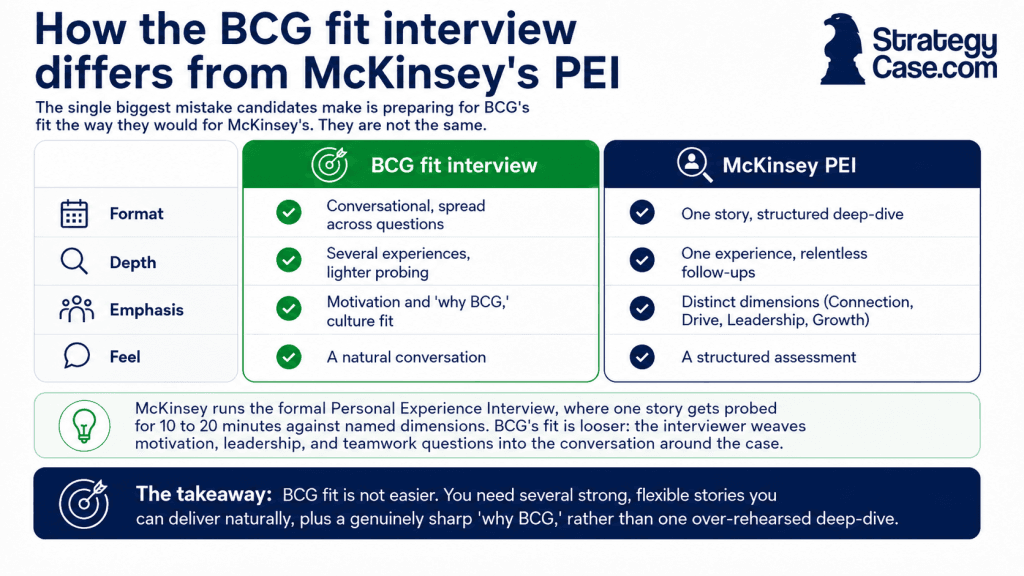
The takeaway: at BCG, fit is not a hurdle you clear once. It is assessed in every live interview, by every interviewer, right next to your problem-solving.
What BCG looks for in the fit interview
BCG is screening for what insiders half-jokingly call a “BCGer”: someone collaborative, intellectually curious, driven by impact, and comfortable being themselves. The firm leans more openly into culture and personality than its peers, and its own behavioral interview guidance tells candidates to show their personality and tie their reasons for wanting BCG to the role.
Four signals carry the most weight:
- Genuine motivation for BCG specifically. Not consulting in general, and not prestige. A real, specific reason.
- Collaboration over individual heroics. BCG sells a team-oriented culture, so stories where you lifted a team beat stories where you saved the day alone.
- Drive and impact. Evidence you make things happen and care about outcomes, not just effort.
- Authenticity and rapport. BCG interviewers genuinely assess whether the conversation feels natural, because client work is relationship work.
This is the foundation that the generic consulting fit interview guide covers in depth; what is distinctive at BCG is how much the motivation and culture-fit pieces matter.
How the BCG fit interview differs from McKinsey’s PEI
The single biggest mistake candidates make is preparing for BCG’s fit the way they would for McKinsey’s. They are not the same.
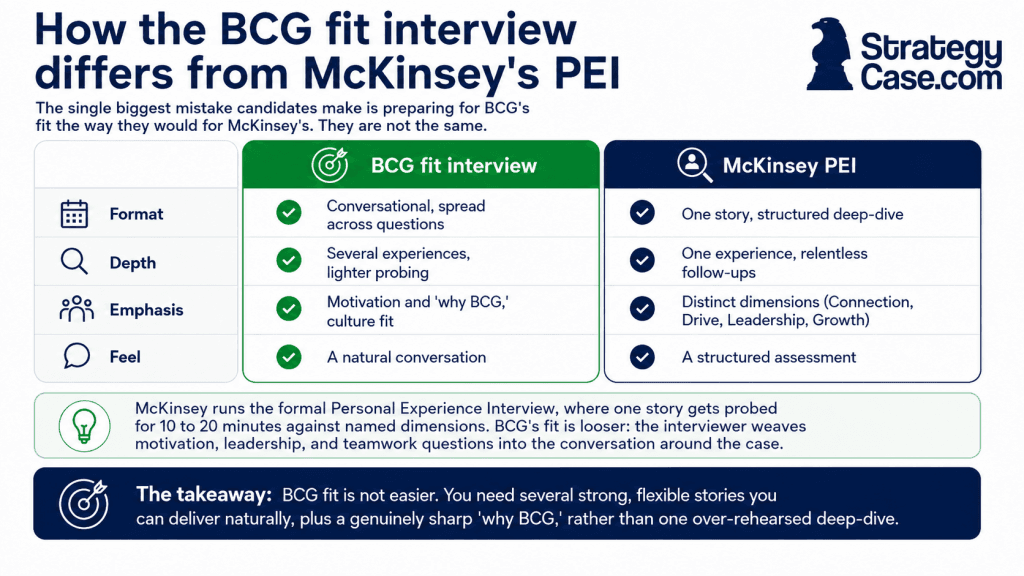
McKinsey runs the formal Personal Experience Interview, which the firm describes on its own interviewing page, where one story gets probed for 10 to 20 minutes against named dimensions. BCG’s fit is looser: an interviewer weaves motivation, leadership, and teamwork questions into the conversation around the case.
That does not make it easier. It means you need several strong, flexible stories you can deliver naturally, plus a genuinely sharp “why BCG,” rather than one over-rehearsed deep-dive.
The BCG fit questions you’ll face
BCG’s fit questions fall into a handful of categories. Prepare one or two strong stories for each, and note that several of these questions have their own dedicated playbook.
| Question type | Example | Where to go deeper |
|---|---|---|
| Introduction | “Tell me about yourself” / “Walk me through your resume” | Tell me about yourself and walk me through your resume |
| Motivation | “Why consulting?” and “Why BCG?” | Why consulting |
| Leadership | “Tell me about a time you led a team” | Tell me about a team leadership situation |
| Teamwork / conflict | “Describe a difficult team situation” | SCORE framework |
| Self-awareness | “What are your strengths and weaknesses?” | Strengths and weaknesses |
The one that is genuinely BCG-specific is “why BCG.” It is also the one candidates most often fluff. A strong answer names something concrete and true: a practice area you want to work in, the collaborative culture you experienced talking to BCGers, a specific aspect of how BCG works, or people you connected with during recruiting.
“BCG is a top firm” is not an answer; it is the absence of one.
The BCG fit interview twist
One BCG fit interview twist candidates often underestimate is that interviewers may probe quite deeply into failures, weaknesses, and moments where things did not go well, sometimes more directly than other firms. This is not a trap, but it is also not a place for fake weaknesses or polished success stories disguised as failures.
BCG wants to see authenticity, self-awareness, and whether you can reflect honestly on real issues.
The best answers usually have three parts:
- a genuine weakness
- a concrete example of where you noticed it in action
- and the specific steps you have taken to improve it since.
How to answer BCG fit questions
Because “why BCG” is the firm-specific question, here is what a strong version sounds like:
“Two things pull me specifically to BCG. First, I want to work in its consumer practice; the pricing work BCG published on private-label strategy is exactly the kind of problem I spent my internship on, and I want to do it at scale. Second, every BCGer I spoke with during recruiting described the same collaborative, low-ego way of working, and after rowing in a crew for four years, that is the environment I do my best work in. McKinsey and Bain are excellent firms, but BCG is the one whose work and people I keep coming back to.”
That answer is specific, it is true, it names real BCG work and real people, and it quietly handles the “why not McKinsey or Bain” subtext. That is the bar.
Mention the conversations you had, the people you met (and their names), and what really stood out during the process.
Structure every longer behavioral answer the same way, then deliver it conversationally. The method is the SCORE framework: Situation, Complication, Outcome expected, Remedial action, End result. It keeps your stories tight and outcome-focused without sounding scripted, which matters more at BCG than at firms with a rigid format.
Common mistakes in the BCG fit interview
After thousands of coaching sessions, the same BCG-specific errors recur:
- A generic “why BCG.” Prestige, “great culture,” and “smart people” are non-answers. Name something only BCG offers you based on YOUR personal experience with its people.
- Preparing it like McKinsey’s PEI. Over-rehearsing one deep-dive story leaves you flat-footed when BCG’s conversation roams across topics.
- Lone-hero stories. Answers where you single-handedly saved the project clash with BCG’s collaborative pitch. Show how you worked through a team.
- Treating fit as a formality. BCG weighs it in every interview. A case-strong, fit-weak candidate gets dinged.
- No energy or rapport. Because BCG’s fit is a conversation, a flat, transactional delivery reads worse here than at firms with a rigid format.
- Getting stumped when the interviewer probes failures or weaknesses. BCG interviewers can go surprisingly deep on what went wrong, what your role was, and what you learned from it. I experienced this myself when interviewing with BCG, and most of my candidates report the same. Prepare a real failure or genuine weakness, be ready to discuss it honestly, and show clearly what you learned and how you have improved since.
Frequently asked questions
Does BCG have a fit interview?
Yes. BCG assesses personal fit in every live interview, paired with the case, rather than in a separate round. Interviewers weave motivation, leadership, failure/weakness, and teamwork questions into the conversation, so you face fit questions in both the first and final rounds.
What does BCG look for in the fit interview?
Genuine motivation for BCG specifically, a collaborative rather than lone-wolf style, drive and impact, and authentic rapport. BCG leans into culture fit more openly than its peers, so “why BCG” and your ability to hold a natural conversation matter a great deal.
How is the BCG fit interview different from McKinsey’s PEI?
McKinsey runs a structured Personal Experience Interview that probes one story in depth against named dimensions. BCG’s fit is more conversational and spread across several questions, with heavier weight on motivation and “why BCG.” Prepare several flexible stories for BCG rather than one rehearsed deep-dive.
How do you answer “why BCG”?
Name something concrete and true: a specific practice or piece of BCG work, the collaborative culture you experienced talking to BCGers, or people you connected with in recruiting. Avoid prestige and generic praise, and implicitly address why BCG over McKinsey or Bain.
What behavioral questions does BCG ask?
Expect introduction questions (tell me about yourself, walk me through your resume), motivation (why consulting, why BCG), leadership, teamwork and conflict, and strengths and weaknesses. Prepare one or two strong stories per category, structured with the SCORE method.
Is the BCG one-way video interview the fit interview?
No. The BCG one-way video interview is a separate, asynchronous screen where you record answers to set questions early in the process. The fit interview happens live, with an interviewer, in the first and final rounds alongside the case.
Related guides
- How to get into consulting: the full BCG application and recruiting picture
- Experienced hires at McKinsey, BCG, and Bain: how the fit interview shifts for lateral candidates
- Questions to ask at the end of your interview: close your BCG fit conversation strongly
- The BCG cognitive test: One of the the screening steps before you reach the interview rounds
Final word
The BCG fit interview rewards what its case alone cannot show: genuine motivation, a collaborative style, and a conversation that feels natural. Prepare a sharp, specific “why BCG,” build several flexible stories with the SCORE method, and deliver them like a person, not a script. Treat fit as half the interview, because at BCG it effectively is.
If you want to master the BCG fit interview alongside every other behavioral question, StrategyCase’s Consulting Fit Interview Masterclass breaks down exactly what firms evaluate and how to deliver structured, authentic answers, and 1-on-1 coaching with a former MBB interviewer pressure-tests your stories before the real thing.
About the author: Florian Smeritschnig is a former McKinsey Senior Consultant and the founder of StrategyCase. He spent five years at the firm, evaluated candidates at McKinsey, and has since delivered 2,200+ mock interviews and coaching sessions, helping hundreds of candidates land offers at McKinsey, BCG, Bain, and other top firms.
