
Last Updated on September 22, 2026
By Florian Smeritschnig, former McKinsey Senior Consultant. Updated September 2026.
AI consulting jobs come through three separate doors: a firm’s AI-native unit such as QuantumBlack or BCG X, the generalist consulting track that staffs AI projects, and enterprise implementation roles at Accenture and the Big 4. Each door has a different skill bar and a different interview, and applying to the wrong one is a common reason strong candidates limit their career trajectory.
You already know the problem, because you just met it. Searching for AI consulting jobs returns Indeed, LinkedIn, ZipRecruiter, and a freelance marketplace, and every one of them hands you a list of postings instead of an answer. What none of those pages tell you is that the title “AI consultant” covers several unrelated jobs with different hiring processes.
So people apply broadly, get rejected quietly, and never learn which door they were actually standing in front of. I spent five years at McKinsey as a Senior Consultant, evaluated candidates there, and have since delivered 2,200+ mock interviews and coaching sessions. This guide maps the three doors, the real requirements behind each, and what the interview looks like once you are through.
Key Takeaways
- “AI consultant” is not one job. Job boards blend firm AI units, generalist strategy roles, enterprise rollout work, and freelance gigs into one title.
- The technical door at McKinsey, BCG, and Bain still puts you through a case interview. A strong model portfolio alone does not get you hired.
- You don’t need a PhD for most of these roles, but you do need one verifiable technical specialty and proof you have shipped something.
- Demand is real and measurable: 2.6% of all US job postings required AI skills in 2025, and professional services is one of the two highest-intensity sectors.
- The skill that is losing value fastest is prompting. The skills gaining value fastest are deployment and orchestration.
What an “AI Consulting Job” Actually Means
AI consulting job (definition): A role where you are paid to help a client organization decide on, build, or deploy artificial intelligence. Inside consulting firms it splits into three tracks: technical delivery (data science and AI engineering), strategy (AI cases on the generalist track), and implementation (large enterprise rollouts).
The reason your search felt useless is that job boards index by title, and four very different jobs share that title. Here is what sits behind each one.
| What the posting says | What the work actually is | Who hires for it | What they test |
|---|---|---|---|
| AI Consultant (strategy) | Advising executives on where to invest in AI and what it is worth | MBB, tier-2 strategy firms | Case interview, business judgment |
| Data Scientist / AI Engineer (consulting) | Building and deploying models inside client environments | QuantumBlack, BCG X, Bain AIS | Case interview plus a technical screen |
| AI Implementation Consultant | Rolling out platforms and tooling at enterprise scale | Accenture, Deloitte, PwC, EY, KPMG | Systems knowledge, delivery experience |
| AI Consultant (freelance) | Project work sold per engagement on marketplaces | Independent clients | Portfolio and references |
A hiring manager at an AI-native consulting unit and a client looking for a freelancer on a marketplace are not evaluating the same person, and neither is evaluating the person the generalist track wants.
Pick the door first. Everything else follows from it.
Not sure which door fits your background? The complete guide to case interviews is the right starting point for doors one and two, because both of them run on the case.
The Three Doors Into AI Consulting Jobs
Decision diagram comparing the three routes into AI consulting jobs: firm AI unit, generalist track, and enterprise implementation
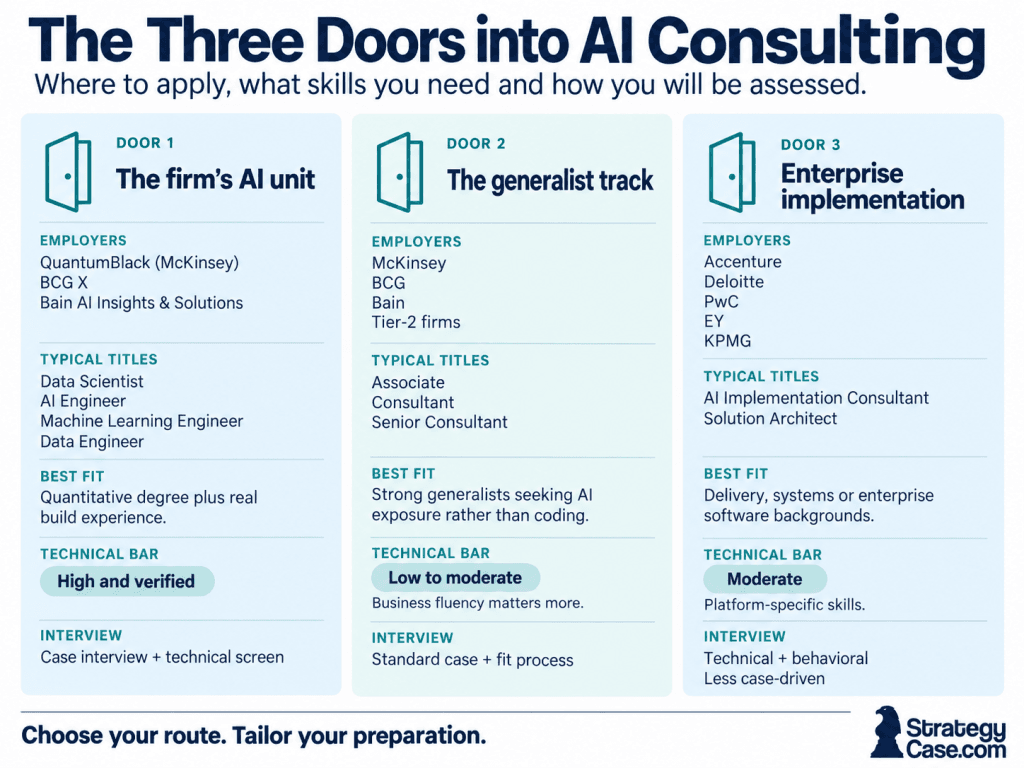
The three doors into AI consulting jobs, with the skill bar and interview shape behind each.
Door 1: The Firm’s AI-Native Unit
This is the door most people mean when they search for AI consulting jobs at a brand-name firm. McKinsey runs QuantumBlack, whose own careers page describes engineers, product managers, designers, and data scientists working together on client AI problems. BCG runs BCG X, which it describes as “over 3,000 of the best tech, design, and entrepreneurial minds.” Bain runs AI, Insights & Solutions, organized into role families that include data science and machine learning, AI and engineering, advanced analytics, and product management.
These units are not research labs. You are staffed on client engagements, you travel, and your model has to survive contact with a client’s messy data and a partner’s questions. That last part is why the case interview does not disappear when you apply here.
One detail worth noticing if you want to judge whether a unit is serious about engineering: QuantumBlack donated Kedro, its Python data-pipeline framework, to the Linux Foundation. Units that ship open-source tooling tend to hire people who write production code, not people who write notebooks.
Door 2: The Generalist Track That Staffs AI Work
This is the door candidates overlook, and for most readers it is the realistic one. You join McKinsey, BCG, or Bain as a regular consultant and get staffed on AI strategy work: where to invest, what the business case is, how to reorganize around it.
The firms are pushing AI fluency across the whole organization rather than quarantining it in the technical unit. BCG’s careers in AI page quotes its CEO saying the firm has “given access to a suite of A.I. tools to every one of our 33,500 employees,” alongside an internal AI Academy.
In practice, that means you don’t need to be an engineer to spend most of your career on AI topics. You need to get into the firm first.
The case type you will meet most often on this track is the AI or digital transformation case, which is worth preparing specifically. Our guide to the digital transformation case interview covers how these cases differ from a standard profitability or market entry case.
Door 3: Enterprise Implementation
Accenture and the Big 4 hire at far greater volume than MBB, and their AI work skews toward large-scale rollout: platform selection, integration, change management, and keeping a deployment running after the strategy deck is closed.
The skill bar is different rather than lower. Nobody at this door cares whether you can derive an algorithm. They care whether you have delivered something inside a large organization and survived it. If your background is enterprise software, systems integration, or IT program delivery, this door is more open to you than either of the other two.
Who Actually Gets Hired Into AI Consulting Jobs
Three honest answers to the questions candidates ask most.
Do you need a PhD? No, except at the deepest research end of Door 1. What you need is one specialty a technical interviewer can verify in twenty minutes. Broad familiarity with many tools reads as weaker than depth in one.
Does prompt engineering count as a credential? Less every quarter. The Stanford AI Index 2026 found that mentions of generative AI skills in job postings grew 111% from 2024 to 2025, yet their share of all AI postings fell by 5%. Over the same period, postings referencing agentic systems and orchestration frameworks rose while postings mentioning ChatGPT and chatbots declined. Employers have moved past “can you use the tool.”
What is rising instead? Deployment. The same report shows the fastest long-term growth in the skills needed to run systems at scale: workflow management up 818%, scalability up 733%, and Amazon Web Services up 1,358% against the 2013 to 2015 baseline. Python remains the single most requested specialized skill, appearing in 258,674 postings.
The demand behind all of this is real and measurable rather than hype. In 2025, 2.6% of all US job postings required AI skills. Singapore led globally at 4.69%, followed by Hong Kong at 3.5%, Luxembourg at 3.4%, and Spain at 3.3%. The UK sat at 1.9%.
If you’re targeting Europe or Asia, those numbers should shape where you apply. Professional, scientific, and technical services, the sector that contains consulting, ranks second only to the information sector in AI posting intensity.
The Two Failure Patterns I See Most
Across 2,200+ mock interviews and coaching sessions, candidates targeting these roles fail in two recognizable ways, and they are mirror images of each other.
The technical candidate treats the case like a modeling problem. Asked why a client’s revenue fell, they reach for data quality, feature selection, and what they would build. The interviewer wanted a structured breakdown of the business first. These candidates are usually the strongest people in the room technically and still get rejected, because the firm is testing whether they can be put in front of a client.
The generalist candidate does the opposite. They talk about AI in slogans, cannot say what a model actually does, and fold the moment a technical interviewer asks a follow-up. Door 2 doesn’t require you to code. It does require you to be specific.
Both failures come from the same root: preparing for the job you want rather than the interview that stands in front of it.
What the Interview Looks Like for AI Consulting Jobs
The technical door still runs a case interview. If you apply to QuantumBlack, BCG X, or Bain’s AI team, expect a business case alongside your technical screen. Firms do this deliberately. A data scientist who cannot structure a client problem, prioritize, and defend a recommendation is a liability on an engagement, no matter how good the model is.
When I evaluated candidates at McKinsey, the question underneath every case was simple: can I put this person in a room with a client next month? Technical brilliance didn’t answer that question. Structure and communication did.
The rest of the process varies by firm and by door:
- Screening. Resume and cover letter, and for technical roles a portfolio or code sample. Your consulting resume still needs to read like a consulting resume, with quantified impact rather than a tool inventory.
- Technical screen (Door 1 only). A live coding exercise, a modeling discussion, or a take-home. Expect questions on how you would deploy and monitor what you built, not only how you would train it.
- Case interview (Doors 1 and 2). The same format the generalist track uses, sometimes with a data-heavy or AI-themed prompt.
- AI-assisted stages. Several firms now run AI-supported steps in the process itself. See our guides to the McKinsey AI interview and the Bain AI interview for what those look like in practice.
- Fit and experience interviews. If you are coming in as a specialist rather than a generalist, McKinsey’s Technical Expertise Interview is the stage that decides whether your depth translates into client value.
Preparing for a case interview on top of a technical screen is a real time cost. Our Case Interview Academy exists for exactly this problem: it covers structuring, math, and charts in one place so you can spend your remaining hours on the technical side rather than assembling a case curriculum from scratch.
Where the Jobs Are and What They Pay
Three things are worth knowing before you set a target list.
Location still matters, even for remote-friendly roles. AI consulting jobs cluster in the same places AI investment does. The posting-share data above gives you a usable ranking: Singapore and Hong Kong are unusually strong relative to their size, Spain and Luxembourg outperform the UK, and the US remains the deepest single market.
Entry-level exists, but it is narrower than the job boards suggest. Many postings labeled entry level are asking for two or three years of applied experience. Internships and structured graduate programs inside the AI units are the cleaner route for students.
On pay, treat the consulting ladder as your anchor. Compensation in a firm’s AI unit tracks the firm’s own levels rather than a separate technology scale, so the most reliable reference point is the standard progression. Our McKinsey salary data shows what that ladder looks like by level.
Freelance marketplace rates are a different market entirely and should not be used to benchmark a firm offer.
How to Position Yourself in the Next 90 Days
A plan you can actually run, by starting point.
If you are a student or recent graduate: Target Door 2 and the AI unit’s internship programs in parallel. Build one shippable project with a deployment story attached, not five notebooks. Start case preparation now, because it is the binding constraint for both doors and takes longer than people expect.
If you are a career switcher from engineering or data: Target Door 1. Pick your single strongest specialty and make it defensible under questioning. Then spend your preparation time almost entirely on the case, because that is where technically excellent candidates lose. Our guide to experienced hires at McKinsey, BCG, and Bain covers how the process differs when you are not coming from campus.
If you are coming from enterprise software or IT delivery: Target Door 3 first. Your delivery record is the asset. Lead with scale, not with algorithms.
Everyone, in week one: Write down which door you are applying to and why, in two sentences. If you can’t, you’re not ready to apply.
If you want someone to pressure-test that plan against your actual background, 1-on-1 coaching with Florian starts with a baseline assessment of where you stand before any practice begins.
Frequently Asked Questions
Is AI consulting a good career in 2026?
Yes, with a caveat. Demand is genuine: AI skills appeared in 2.6% of all US job postings in 2025, and professional services is one of the two most AI-intensive sectors. The caveat is that the entry-level base of consulting is shrinking at the same time. Our analysis of AI’s impact on consulting careers and hiring covers what that means for your timeline.
Do I need to know how to code to get an AI consulting job?
Only for Door 1 and parts of Door 3. The generalist strategy track at McKinsey, BCG, and Bain does not require coding. It requires you to be precise about what AI systems can and cannot do, which is a different skill and easier to build.
How do I become an AI consultant without an AI background?
Enter through Door 2. Get into a consulting firm on the standard track, then steer your staffing toward AI engagements from inside. This is the most common path and the one least visible from the outside, because nobody posts a job ad for it.
Are AI consultants going to be replaced by AI?
Not in the way the headlines suggest, though the shape of junior work is changing quickly. We covered the evidence in detail in will AI replace consultants.
Is a freelance AI consulting gig a good way to start?
It builds a portfolio, but it does not substitute for the credential a firm role gives you, and the two markets price work very differently. Treat marketplace work as proof of delivery rather than as a career path into MBB.
What should I build to stand out?
One project that went into production and stayed there, with a story about what broke and how you fixed it. Postings are shifting toward deployment and orchestration skills, so a running system beats a higher benchmark score on a static dataset.
Related Guides
- AI in consulting interviews: how AI now sits inside the recruiting process itself
- Can AI do consulting work?: the benchmark evidence on what AI actually completes
- The junior consultant in the AI era: what happens to entry-level work
- Preparing cases with AI: what AI prep tools are good for, and where they mislead
- The consulting job market: hiring conditions across the industry right now
The Bottom Line
AI consulting jobs are one of the few genuinely growing lanes in consulting recruiting right now, and the biggest advantage available to you is not technical. It’s knowing which of the three doors you’re walking through before you apply.
Pick the door. Door 1 if you have verifiable technical depth and are willing to prepare for a case interview on top of it. Door 2 if you are a strong generalist who wants to spend a career on AI problems without writing the code. Door 3 if your record is delivery at enterprise scale.
Then prepare for the interview that door actually runs, not the job description. Technical candidates lose on structure. Generalists lose on specificity. Both are fixable, and both take longer to fix than candidates plan for.
Start with the door, then build the case skills underneath it. The StrategyCase article library covers every stage of the process for free, and if you want a diagnosis of where you stand before you spend months preparing, that is what our coaching baseline is for.
About the author: Florian Smeritschnig is a former McKinsey Senior Consultant who spent 5 years at the firm, conducted more than 2,200 interviews, and has coached candidates to 700+ offers at McKinsey, BCG, Bain, and other top firms. He is the founder of StrategyCase.com and the author of three prominent consulting interview and career books.
