

Last Updated on July 9, 2026
Updated July 2026 · By Florian Smeritschnig, Former McKinsey Senior Consultant
The realistic preparation time for McKinsey, BCG, or Bain interviews ranges from 50 hours (for candidates with business backgrounds and prior case practice) to 150 hours (for career switchers with no business exposure), typically spread across 6-12 weeks.
The single biggest variable of how long to prepare for consulting interviews is your starting point: an undergraduate from a target school majoring in economics or finance can be interview-ready in 50-80 hours; a PhD in a non-business field needs 100-150 hours; a working professional career-switcher with no consulting exposure typically needs 80-120 hours. Below is the full hour-by-hour breakdown by profile type, the 8-week structured plan that consistently produces offer-ready candidates, the signals that you are actually ready (it’s not the hour count), and the common mistakes that waste preparation time.
After 5 years at McKinsey and 6+ years coaching candidates through MBB recruiting, I can tell you which 50 hours produce more impact than 200 hours of unfocused practice, and how to allocate your specific preparation budget across structuring, math, case practice, PEI, and mock interviews.
Key Takeaways
- Total prep time: 50-150 hours, depending on your starting profile
- Typical sweet spot: 80-120 hours over 6-10 weeks for most candidates
- Daily commitment: 2-3 hours/day part-time, or 6-8 hours/day full-time intensive
- Quality beats quantity: 60 hours of focused, feedback-driven prep beats 200 hours of cases with bad peers
- The 5 prep categories: structuring drills, math drills, chart drills, full cases, PEI / fit interview
- You’re ready when: you have a fully internalized method that allows you to know what to do and when during the case, how to think about the different elements (e.g., can structure any new probiem in 90 seconds from first-principles), and how to communicate top-down and confidently; you also have your narrative and polished stories ready and practiced for the fit interviews
- Most candidates underprep fit: allocate 10 hours specifically to fit interview preparation
The Honest Answer: 4 Variables Determine Your Number
There is no single “correct” prep time. The candidates who try to apply a generic 100-hour template often end up either over-preparing (burnout, stale by interview day) or under-preparing (skipping the categories they didn’t realize they needed). Your specific number depends on four variables.
1. Business background. If you majored in economics, finance, business administration, or worked in finance/strategy/PE/consulting, you have a meaningful head start on business intuition, common case patterns, and financial vocabulary. This can reduce prep time by 30-50%.
2. Quantitative comfort. Engineers, scientists, math majors, and finance professionals start with stronger math fluency. The “math under time pressure” portion of case prep is significantly shorter for these candidates. Conversely, candidates from humanities, social sciences, or law backgrounds typically need more hours specifically on math.
3. Prior case interview exposure. Candidates who did MBA case prep, attended consulting club workshops, or interviewed at consulting firms previously (even unsuccessfully) have internalized the format. This can save 20-40 hours.
4. Time availability. Available hours per week determines the total calendar duration. A candidate with 20 hours/week of prep capacity covers 80 hours in 4 weeks; a working professional with 8 hours/week covers the same in 10 weeks.
The intersection of these four variables gives your specific number.
Timeline by Candidate Profile
The five most common candidate profiles and their realistic prep ranges:
| Profile | Business Background | Time Per Week | Total Hours | Calendar Weeks |
|---|---|---|---|---|
| Undergrad / Master’s, target school, business major | Strong | 15-20 hrs | 50-80 | 3-8 weeks |
| MBA, post-finance / consulting prior career | Strong | 15-25 hrs | 50-80 | 3-8 weeks |
| MBA, career switcher, non-business prior | Limited | 20-30 hrs | 60-100 | 3-8 weeks |
| Engineering / STEM undergrad, no business | Limited | 12-20 hrs | 80-120 | 4-10 weeks |
| PhD / advanced degree, no business exposure | None | 10-20 hrs | 80-150 | 4-15 weeks |
| Working professional career switcher | Limited | 6-12 hrs | 50-150 (I have seen the biggest variety in candidate performance here) | 5-25 weeks |
Critical caveat: these are total hours from “starting from scratch” to “fully interview-ready.” If you have done any prior case prep (consulting club, MBA workshop, prior unsuccessful interview), subtract 20-40 hours from your estimate.
Why the wide ranges within profiles: individual variation in learning speed, natural business intuition, and the quality of practice partners. A candidate with strong analytical capability and good practice partners reaches the bar 30% faster than a candidate with equal capability but solo / peer-only practice.
For more on what determines who gets MBB offers at an earlier stage of the application funnel, see what degree do you need for management consulting and MBB target schools.
The 4 Prep Categories (And Hour Allocation)
Your total prep budget gets split across four categories. Most candidates underweight at least one of them.
| Category | Hours (Median) | Range | What It Covers |
|---|---|---|---|
| Structuring theory and drills | 20-30 | 15-50 | Building MECE frameworks, hypothesis-driven thinking, brainstorming exercises (all from first principles) |
| Exhibit theory and drills | 10-15 | 5-25 | |
| Math theory and drills | 20-40 | 15-80 | Multiplication tables, percentages, mental math speed, math under pressure |
| Full case practice | 15-30 | 10-50 | Complete cases (with feedback), mock interviews, integrated practice |
| Fit and behavioral | 5-10 | 5-20 | Story development, story rehearsal, dimension fit, behavioral question prep |
Typical underweighting: most candidates do too many full cases and too little drilling of individual elements. The result is candidates who can pattern-match to familiar cases but struggle when an interviewer presents a novel structuring challenge, several densely populated exhibits, or a math-heavy curveball.
Most candidates never learn the fundamentals. They just go through the motions of case practice without the initial learning effort, which leads to limited development and improvement. For more on how to built the right case interview fundamentals, see our article on the gap between applicants and consulting firms, and our free Case Interview Foundations course.
The right balance: spend the first 30-40% of your prep on isolated theory and drills for the different elements of the case (structuring, charts, and math) before doing many full cases, then move between drills and full case practice. By the time you start full cases, your structuring should be reflexive and your math/chart analysis should be automatic, so the case is testing integration, not basic skills.
For specific drills:
- Case interview math covers the math fluency foundation for a typical case
- Case interview frameworks covers structuring patterns and techniques from first principles
- How to be MECE in a case interview covers the foundational structuring principle
- Brainstorming in a case interview covers idea generation
- Chart and exhibit interpretation covers the data interpretation skill for case interviews
The Standard 8-Week Preparation Plan
For most candidates (target school undergrad or MBA with some business background, 10-15 hours/week available), the right plan is 8 weeks. This produces ~80-120 hours total, comfortably within the offer-ready zone (with a signifcant buffer that is likely not needed).
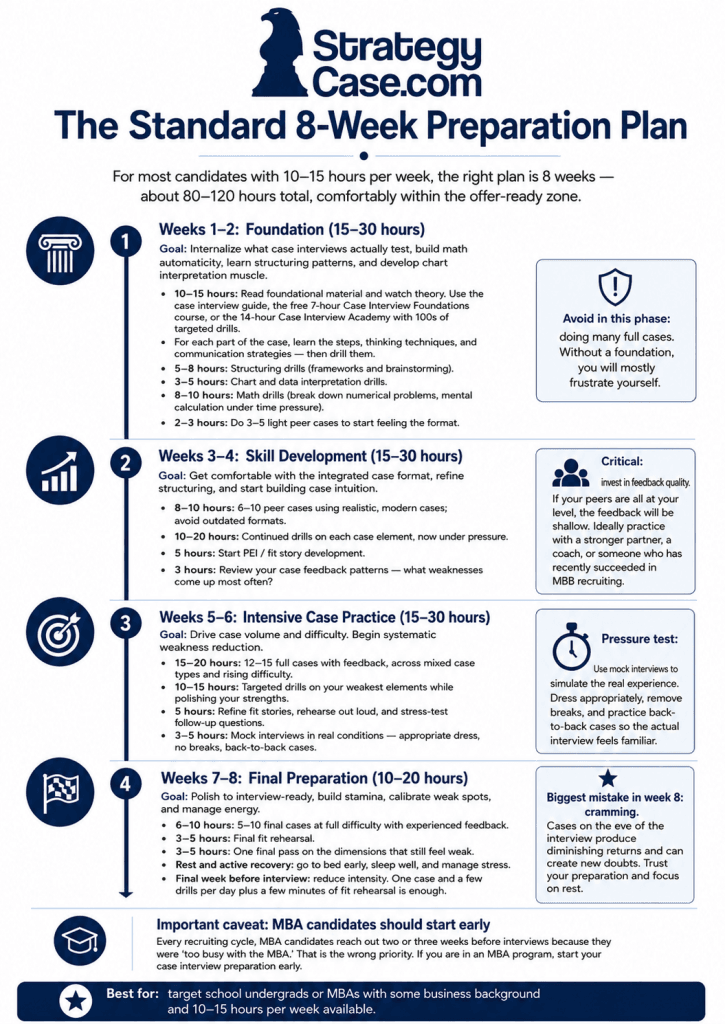
Weeks 1-2: Foundation (15-30 hours)
Goal: Internalize what case interviews actually test, build math automaticity, learn structuring patterns, develep your chart interpretation muscle.
- 10-15 hours: read foundational material and watch relevant theory. The case interview guide covers the fundamentals in a short text. Our free Case Interview Foundations course covers the basics in a 7-hour video course. Our Case Interview Academy covers cases end-to-end in a 14-hour video series, which comes with 100s of targeted practice drills
- For each part of the case, learn the steps, thinking techniques, and communication strategies, then drill it (also the communication aspect)
- 5-8 hours: structuring drills (build frameworks and brainstorming answers)
- 3-5 hours: chart and data interpretation drills
- 8-10 hours: math drills (breaking down numerical problems into its parts, mental calculation under timed conditions)
- 2-3 hours: do 3-5 light cases with peers to start feeling the format
Avoid in this phase: doing many full cases. You will frustrate yourself by underperforming when the foundation isn’t built yet.
Weeks 3-4: Skill Development (15-30 hours)
Goal: Get comfortable with the integrated case format. Refine structuring and start building case intuition.
- 8-10 hours: 6-10 cases with peers (focus on realistic and modern cases and problems; avoid outdated cases and formats)
- 10-20 hours: continued drills on each case element, under pressure
- 5 hours: start PEI / fit story development
- 3 hours: review your case feedback patterns, what specific weaknesses come up most often?
Critical: invest in feedback quality. If your peers are all at your level, your feedback will be shallow. Ideally pair with a more experienced practice partner, a coach, or someone who has been through MBB recruiting recently (successfully).
Weeks 5-6: Intensive Case Practice (15-30 hours)
Goal: Drive case volume and difficulty. Begin systematic weakness reduction.
- 15-20 hours: 12-15 full cases with feedback (mix of case types, increasing difficulty and more wildcard cases)
- 10-15 hours: targeted drills on your weakest elements to become robust enough while polishing your strengths (it’s all about creating the right profile interviewers want to hire)
- 5 hours: refine fit stories, rehearse out loud, stress-test against follow-up questions
- 3-5 hours: mock interviews simulating real interview conditions (dress appropriately, no breaks, back-to-back cases)
Weeks 7-8: Final Preparation (10-20 hours)
Goal: Polish to interview-ready, build stamina, calibrate against weakness areas, manage energy.
- 6-10 hours: 5-10 final cases at full difficulty with experienced feedback
- 3-5 hours: final fit rehearsal
- 3-5 hours: targeted weakness work (one final pass at the dimensions that still feel weak)
- Rest and active recovery, go to the gym, sleep well, manage stress
- Final week before interview: reduce intensity. 1 case and a few drills per day plus a few minutes of fit rehearsal is enough.
The biggest mistake in week 8: cramming. Cases at the eve of the interview produce diminishing returns and can introduce new doubts. Trust your preparation; focus on rest.
Important caveat: If you are in an MBA program, start your case interview preparation early.
Every recruiting cycle, I speak with MBA candidates who reach out for coaching two or three weeks before their interviews because they were “too busy with the MBA.” That is the wrong priority.
If you invest six figures into an MBA largely to change careers and break into consulting, then interview preparation cannot be an afterthought. The interviews are the gate you need to pass through to get the job you paid the MBA for in the first place.

The 4-Week Intensive Plan (Late Starters)
If you have an interview locked in 4 weeks out and haven’t started, the compressed plan is:
- Week 1: 25-30 hours. Foundations + drilling + first 5 cases.
- Week 2: 20-30 hours. 10-12 cases + fit and behavioral story development + continued drilling.
- Week 3: 20-30 hours. 12-15 cases at increasing difficulty + PEI rehearsal + mock interviews.
- Week 4: 15-20 hours. Final 8-10 cases + final fitrehearsal + recovery.
Total: 80+ hours. This works for candidates with strong business backgrounds or prior case exposure. Without those, 4 weeks is too compressed, request to push the interview if possible.
How to Know You’re Actually Ready
Hours alone don’t measure readiness. The candidates who walk into MBB interviews ready share seven specific signals. If you can check most of these, you are ready regardless of how many hours you’ve spent.
1. You can structure any new problem or case in under 90 seconds. Interviewer reads the prompt; you take 90 seconds to think; you produce a clean, MECE-ish framework or brainstorming answer without freezing built around the right principles and structuring techniques. If you still freeze on novel prompts after weeks of prep, you’ve done too many cases and too little structuring theory and drills. Go back to this guide on case interview framework creation.
2. Your chart analysis produces consistent results because it follows a systematic approach. Every consulting chart ever -> Insights = what do I see? Implications = What does it mean for the case? Next steps: What should I do next? If you still struggle to see what’s going on on a chart, see our chart interpretation guide.
3. Math logic is instant and mental math is reflexive, not calculated. You break down math problems like a case framework within 60 seconds. You know what to calculate and how. As for mental math, 14% of 250 should produce an answer in 2-3 seconds (rough: 14% ≈ 1/7, so 250/7 ≈ 35). If it takes you more than 10 seconds to calculate this, you need more math drilling, not more cases. For more on math, see our case interview math guide.
4. You can identify the high-impact branch quickly. After structuring a case, you can confidently say “I’d start here because [specific reason]” rather than wandering through all branches equally. This is 80/20 thinking applied to case structure (see the 80/20 rule in consulting).
5. You can synthesize top-down without notes. End-of-case synthesis comes out as “Recommendation: [X]. Three reasons: [Y1], [Y2], [Y3]. Next steps: [Z].” Done in 60-90 seconds. Not narrating your analytical journey.
6. You have your fit stories and answers ready to deliver. Without notes. Without pausing to remember. With the ability to answer follow-up questions. The stories cover the dimensions the firm actually tests, e.g., for McKinsey, see the McKinsey PEI guide.
7. You can handle a curveball. When an interviewer goes off-script (“instead of revenue, let’s look at customer experience”), you adapt smoothly rather than freezing. This is the integration signal that says you have built genuine flexibility, not pattern-matched to specific case types.
You will likely never feel “fully ready”, even strong MBB candidates report 70-80% confidence going into final rounds. That’s normal. The signals above are objective; trust them rather than the feeling.
Common Mistakes That Waste Preparation Time
After hundreds of coached candidates, the patterns that quietly waste prep hours:
1. Hour counting instead of skill building. Logging 200 hours of cases with poor feedback is worse than 60 hours of focused drilling with strong feedback. Track what you can do, not how many hours you’ve spent.
2. Practicing only with peers at your level. Peer practice is necessary but insufficient. Without at least some practice with someone who has been through MBB recruiting recently (or a coach if you can.want to afford it), you reinforce bad habits without knowing it.
3. Doing too many full cases too early. Full cases test integration. If your structuring is shaky and your math or chart interpretation is slow, full cases will frustrate you without building targeted skill. Drill isolated skills first.
4. Underprepping PEI / fit interviews. Most candidates spend 98% of prep on cases and 2% on fit. You need to pass both parts of the interview. A strong case performance does not balance a bad fit performance. Underprepping it costs offers.
5. Skipping math drills because “math isn’t my weakness.” Math under pressure is different from math at leisure. Almost every candidate I have coached benefits from at least 10-20 hours of dedicated speed-math drilling, regardless of background. Even confident calculators often lose their footing in a stressful interview situation. Prepare for it by becoming bulletproof in your math approach and execution.
6. Practicing without a feedback loop. Cases without specific feedback (“you did fine”) produce no learning. Cases with structured feedback on dimensions (“your synthesis was weak; here’s what you missed”) drive improvement.
7. Burning out in week 7. Intensive cramming the week before the interview compresses sleep, raises anxiety, and produces worse performance than moderate prep plus rest. Plan recovery into the schedule.
8. Practicing with low quality cases. Most cases you find online are not up to par with current interview standards. For that matter, I have created a curated free collection of consulting firm cases and rated MBB case books. You can also find high-quality problems and drills in our Case Interview Academy or The 1%: Case Interview Workbook.
9. Tailoring prep too narrowly to one firm. McKinsey and BCG cases overlap heavily; firm-specific differences matter mostly at the margin. Spending 80 hours on McKinsey-specific prep when you’re also interviewing at BCG and Bain is wasted effort.
When Coaching Changes the Math
The honest answer on coaching: it isn’t mandatory. But it changes the preparation equation in ways most candidates underestimate.
Without coaching
- Average prep time: 100-150 hours
- What it usually looks like:
- No clear plan
- No structured path through structuring, math, charts, fit, and PEI
- Random cases with inconsistent feedback
- Weaknesses that stay undiagnosed
- Stagnation at some point without knowing why
- Fit and PEI stories that are generic, descriptive, or poorly structured
Result: Candidates work hard, not efficiently. They burn dozens of hours “doing cases” without building the profile, the skills, or the communication style interviewers actually want to see.
With coaching
- Typical investment: $1,000-1,800
- What it usually looks like:
- An effective preparation plan from day one
- The right materials and drills, in the right order
- A clear diagnostic of strengths and weaknesses
- Targeted improvement instead of random practice
- Cases that reflect the actual interview standard
- Real interviewer-style feedback
- Sharper structuring, communication, and synthesis
- Insider view into how fit and PEI are evaluated
- Profile positioning aligned with what consulting firms want to see
Result: Preparation becomes focused, realistic, and far harder to fool yourself with.
Across my own coaching work, the numbers are clear. Among candidates who reach the interview stage and prepare with me, the MBB offer rate is above 80%. Across all consulting firms, it sits around 95%.
The math is simple. A $1,000-1,800 coaching investment sits next to a first-year MBB package worth many times more. But the real number is bigger than year one. An MBB offer reshapes your entire lifetime earnings trajectory — faster promotions, stronger exits, top MBA admissions, private equity and leadership doors that don’t open otherwise, and a career brand that compounds for decades.
Frequently Asked Questions
How long does it take to prepare for a McKinsey interview?
The realistic preparation time for a McKinsey interview is 50-150 hours, depending on your background. Target-school undergrads with business majors typically need 50-80 hours; career switchers without business backgrounds need up to 150 hours. Most candidates fall in the 80-120 hour range across 6-12 weeks of preparation.
How many hours should I prepare for case interviews?
Most successful case interview candidates spend 50-150 hours on case-specific preparation, allocated across structuring theory and drills (15-30 hours), chart theory and drills (10-20) math theory and drills (15-40 hours), full case practice (15-40 hours), and PEI/fit interview preparation (10-15 hours). The exact number depends on starting background and prior case exposure.
Can I prepare for a consulting interview in 4 weeks?
Yes, if you have a strong business background and can commit 25-30 hours/week. The compressed 4-week plan produces 80+ total hours, which is enough for candidates with prior case exposure or strong analytical foundations. Career switchers or candidates without business backgrounds typically need 8-12 weeks.
How many cases should I do before my consulting interview?
Most successful MBB candidates complete 20-40 full cases during preparation, with the higher end reflecting candidates who needed more reps to build pattern recognition. The number is less important than the quality of feedback you get on each case. 25 cases with strong feedback beats 60 cases with peer-only feedback. 5 cases with a coach and deep feedback beat 30 peer practice cases.
What is the minimum preparation time for an MBB interview?
The absolute minimum is roughly 50 hours, achievable only by candidates with strong business backgrounds, prior case exposure, and disciplined practice with experienced partners. This is a “preparing for your second interview after a first attempt” range. First-time candidates should plan on 80-120 hours minimum.
How long do MBA students prepare for consulting interviews?
MBA students typically prepare 60-150 hours over 8-15 weeks, depending on prior background. MBAs with finance, consulting, or strategy prior careers prepare 60-100 hours; MBA career switchers (from non-business fields) typically need 100+ hours. Most M7 MBA programs have consulting clubs that provide structured practice during MBA Year 1.
How long should I prepare for the McKinsey Solve Game / BCG Cognitive Test / Bain SOVA?
The online assessment portion of consulting recruiting requires roughly 10-15 hours of focused preparation in addition to case interview prep. The McKinsey Solve Game guide, BCG Cognitive Test guide, and Bain SOVA guide cover the specific test formats. These are separate from case interview preparation.
How much time should I spend on PEI / fit interview prep?
Allocate 10-15 hours specifically to PEI / fit interview preparation. This includes 4-6 hours writing and refining stories matching firm dimensions and common questions, 5-8 hours rehearsing stories out loud, including stress-testing under follow-up questions. Most candidates underprep this category. For more on the fit interview, see our consulting fit interview guide.
Is 100 hours enough to prepare for consulting interviews?
For most candidates, 100 hours of focused, feedback-driven preparation is sufficient to reach the MBB interview bar. Candidates with strong business backgrounds and prior case exposure may need only 50-80 hours. Career switchers, STEM PhDs, or candidates from non-business backgrounds typically need more time
When should I start preparing for consulting interviews?
Start preparing 8-12 weeks before your interview if you have a typical background, or 12-15 weeks before if you are a career switcher with no prior business exposure. Internship recruiting cycles start 9-12 months before the actual internship summer, so apply that timeline backward from your target interview date.
The Bottom Line
The realistic preparation time for McKinsey, BCG, or Bain interviews is 50-150 hours depending on background, with the typical sweet spot at 80-120 hours over 6-10 weeks. The single biggest variable is your starting profile (business background, quantitative comfort, prior case exposure), not your innate ability.
The candidates who pass MBB interviews are not the ones who logged the most hours, they are the ones who allocated time across the right four categories (structuring drills, chart drills, math drills, full cases, fit and PEI), used quality feedback, and stopped before they burned out.
Seven specific signals indicate you are interview-ready: you can structure any case in under 90 seconds, your chart analysis produces consistent results, your math is reflexive, you can identify the high-impact branch quickly, you can synthesize top-down without notes, you have polished fit stories, and you can handle curveballs without freezing. If you can check these boxes, you are ready, regardless of whether you hit a specific hour count.
If you want a calibrated assessment of your specific starting point and a customized prep plan with realistic hour estimates, book a 1-on-1 coaching session. For the full case prep curriculum, the Case Interview Academy provides the structured approach and practice opportunities.
You will likely never feel fully ready, that’s normal. The hours are a means, not the goal. Trust the skill signals, plan recovery into the schedule, and don’t waste your final week cramming.

