
Last Updated on September 18, 2026
By Florian Smeritschnig, former McKinsey Senior Consultant · Updated September 2026
Most experienced hires walk into the case interview assuming their track record will carry them. It won’t. The case interview for experienced hires runs to a higher bar than the entry-level version, with less margin for error and less hand-holding, and it rejects more strong candidates than any resume gap ever does.
I spent five years at McKinsey evaluating candidates, and I have coached hundreds of experienced hires since. Here is exactly what changes, and how to prepare when you have a full-time job.
Key Takeaways
- Yes, experienced hires do full case interviews at McKinsey, BCG, and Bain. Seniority does not exempt you, and the bar is higher, not lower.
- The case, not your resume, is where most experienced hires get rejected. Firms expect consultant-level structuring and judgment from the first minute.
- Your biggest risk is the “curse of expertise”: over-engineering, hedging like a manager, and trusting intuition instead of explicit structure.
- You probably won’t get a case in your own industry, so deep domain knowledge helps far less than you would hope. Transferable structuring, smart analysis, and quick case math win.
- Most working professionals need 6 to 10 weeks of focused prep around a job. Condensed, high-signal reps beat grinding 50 full-length cases.
Do Experienced Hires Really Have to Do Case Interviews?
Yes. Every candidate at McKinsey, BCG, and Bain solves cases, regardless of seniority, and the experienced-hire case is held to a higher standard. The shift is simple to state and hard to clear: at the entry level, interviewers assess whether you could become a consultant. As an experienced hire, they assess whether you can already perform at or near consultant level on day one.
That is the whole game. You are no longer judged on potential. You are judged on proven capability, demonstrated live, in 30 minutes, against a problem you have never seen.
This guide covers the case interview specifically. The level you enter at, the generalist versus specialist track, referrals, and how lateral recruiting actually runs are a separate topic, and I cover them in the experienced-hire consulting guide. For the mechanics of how a case works at all, start with the comprehensive case interview guide. Here, the focus is what changes when the candidate is you, mid-career, and what to do about it.
What’s Actually Different About the Case Interview for Experienced Hires
The cases themselves are not more complex. A profitability case is a profitability case. What changes is the standard you are measured against and the safety net you no longer get.
At the entry level, interviewers guide you, tolerate a wrong turn, and reward a fast learner. For experienced hires, that cushion disappears. Interviewers step in less, challenge more directly, and expect you to run the case with independence and precision from the first minute. A small slip in logic or a vague structure reads differently from a senior candidate.
It signals a gap in professional maturity, not a lack of exposure, and it is penalized harder.
Here is the practical difference, side by side.
| Dimension | Entry-level candidate | Experienced hire |
|---|---|---|
| What firms test | Potential and trajectory | Proven, consultant-level capability now |
| Structure | Some leeway, can be generic | Must be sharp, tailored, issue-driven |
| Interviewer support | More guidance, gentle nudges | Minimal; you drive |
| Margin for error | Minor mistakes forgiven | Little tolerance; errors read as maturity gaps |
| Answers | Broad, well-organized is enough | Prioritized, decisive, business-grounded |
Read the table top to bottom and the theme is the same in every row: less room, higher expectation. Most experienced hires who miss do not miss because they lack business knowledge. They miss because they approach the case like a junior candidate, or worse, like a manager defending a decision in a boardroom. Neither is what the firm is testing.
The Curse of Expertise: Senior Habits That Read as Junior
This is the part almost no other guide names, and it is the single most useful thing I can tell you. The instincts that made you good at your job are often the exact instincts that sink an experienced hire in a case.
After 2,200+ mock interviews and coaching sessions, the pattern is consistent. Accomplished professionals do not fail on intelligence. They fail because seniority trained habits that the case rewards in reverse. You spent years adding nuance, hedging risk, and speaking the dense internal language of your function. The case wants the opposite: a crisp structure, a clear stance, and plain synthesis a partner could repeat to a client.
The scorecard below is what I actually watch for when I evaluate an experienced candidate’s case. Treat the left column as the habits to unlearn.
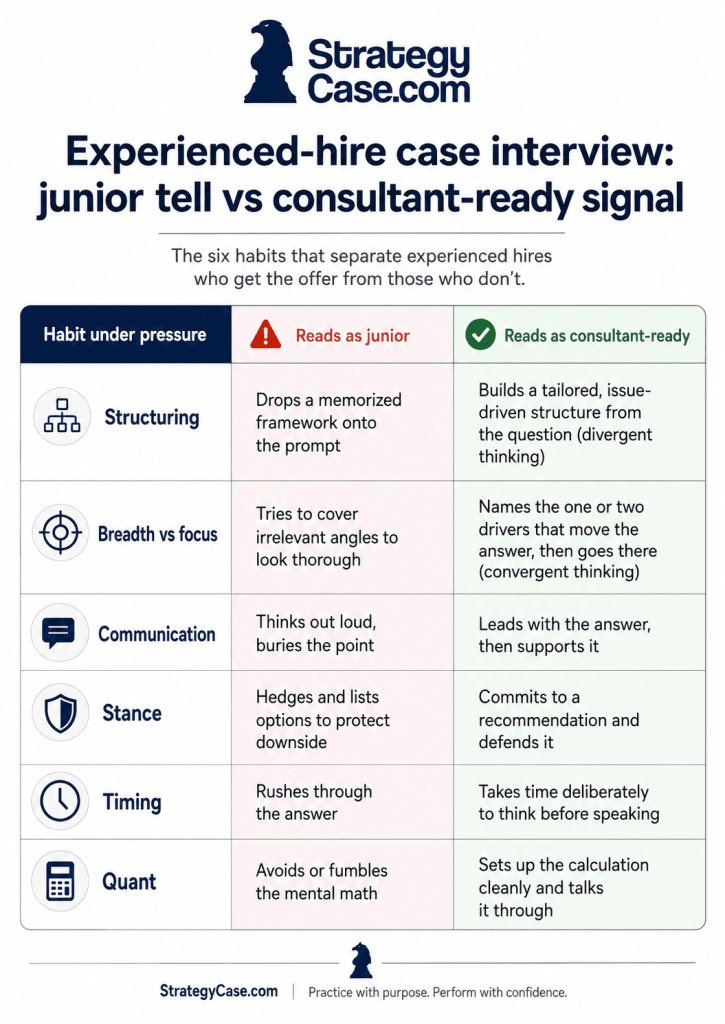
A few of these deserve a closer look, because they are the ones experienced hires resist most.
Over-reliance on frameworks. Many experienced candidates, coming to cases for the first time, grab a framework from a book and apply it whole. A generic profitability, market entry, or “3C” template dropped onto a tailored problem is the clearest junior tell there is. At this level, interviewers want a structure you build from first principles for the specific question, not one you recalled.
Over-engineering the problem. In your day job, depth is a virtue. In a case, trying to demonstrate intelligence with an elaborate structure and a dozen branches works against you. Strong candidates simplify hard, name what matters, and ignore the rest. Clarity beats complexity every time.
Hedging like a manager. Senior people are trained to qualify, caveat, and present balanced options. In a case, that reads as indecision. The interviewer wants a recommendation with a reason, delivered the way you would brief a client who has 90 seconds.
None of these are knowledge gaps. They are reflexes, and reflexes are trainable once you can see them.
The Industry-Case Myth That Trips Up Lateral Hires
Here is a misconception I correct in almost every first session with an experienced hire: the assumption that your case will come from your industry, so your domain expertise will do the heavy lifting.
It usually won’t. Cases are assigned without much regard for your background, and getting a prompt squarely in your field is more chance than design. A pharma executive can get a retail pricing case. A banker can get an operations problem in manufacturing. Firms do this because they are testing general problem-solving, not whether you can recite facts about a sector you already know.
Two consequences follow. First, do not bank on industry knowledge to rescue you. Light, well-placed sector insight can sharpen an answer, but structured thinking and case math under time pressure carry far more weight.
Second, when you do land a case in your domain, resist the urge to flex. Dumping technical detail or insider jargon distracts from the structure and often reads as showing off. Use just enough context to make a sharper assumption, then get back to the logic.
How to Prepare for the Case Interview Around a Full-Time Job
Your constraint is not capability. It is time.
You are preparing in the evenings and on weekends while holding down a demanding role, which means the strategy that works for a final-year student with months free does not work for you. The goal is not to accumulate knowledge or grind 50 full-length cases. It is to build performance under pressure across a small set of core skills, with the highest-signal reps you can find.
Here is the sequence I run with experienced hires.
1. Train the core skills, not framework lists. Four capabilities decide most cases: structuring an ambiguous problem, doing case math under pressure, reading charts and exhibits quickly, and top-down communication. These are transferable across any case type and any industry, which is exactly why memorized frameworks fail the moment a case breaks the standard pattern, and it always does.
2. Use condensed cases for volume, full cases for feel. Long 25-minute cases are time-expensive when you have ninety minutes a night. Condensed, high-signal drills (a tight prompt, a structure, the key analysis, a model answer, and a “how a strong candidate thinks” note) give you more repetitions and faster feedback loops per hour. Run a handful of full-length cases too, so you experience case leadership and stamina, but make the condensed reps your engine.
3. Be hypothesis-driven from the first minute. Form an early point of view and use your analysis to confirm or kill it, rather than exploring every branch hoping the answer appears. This is what produces the fast prioritization the experienced-hire bar demands.
4. Simulate real conditions. Practice out loud, on a timer, speaking while you think, with no chance to restructure after the fact. Reading solutions silently builds false confidence. You can rehearse with peers using our free collection of case interview examples.
5. Get calibrated feedback. The biggest risk in self-prep is the blind spot you cannot see: weak prioritization, a buried conclusion, a structure that looked fine in your head. An interviewer-calibrated second opinion catches these in one session and saves you weeks of plateau. This is where targeted, interviewer-calibrated coaching earns its place for time-poor candidates.
On timeline, most working professionals need roughly 6 to 10 weeks of consistent preparation, and longer if your role does not involve structured problem-solving day to day. If you can protect 10 to 15 focused hours a week, the lower end is realistic. For a fuller breakdown by starting point, see how long to prepare for consulting interviews.
If you want the whole method in one place, the StrategyCase Case Interview Academy packages the core-skill training and the condensed drills experienced hires actually have time for. A large share of the candidates we coach into MBB are experienced hires, and this is the exact progression we work through.
A Condensed Example: How a Strong Experienced Hire Cracks a Case
Theory is cheap, so here is what “consultant-ready” looks like on a real prompt.
Prompt. A mid-sized European airline has seen a 15% decline in profits over the past 12 months despite stable passenger volumes. The CEO wants to understand the drivers and decide what to do.
Frame it in the first 30 to 60 seconds. The candidate clarifies the objective and reframes immediately: profits are down while volume is flat, so the issue sits in price, cost, or mix. They say this out loud and align on the goal before touching a number. That single move signals seniority.
Build a tailored structure, not a template. Instead of a generic profitability tree, they draw a lean, issue-driven structure: revenue per passenger (pricing, ancillary revenue, route mix), cost per flight (fuel, labor, airport fees), and operational efficiency (load factor, fleet utilization). It is focused and pointed at the likely drivers.
Lead with a hypothesis and follow the signal. They commit early: “Volume is stable, so I would start with cost, and fuel or specific routes look most likely.” Then they interpret the data, run the math cleanly, find rising fuel costs, and segment routes to expose margin pressure on short-haul. They do not explore everything. They double down where the impact is.
Synthesize as they go. After each step, a one-line summary keeps the case directional: “Fuel explains a large part of the decline, but short-haul routes also look structurally unprofitable.”
Recommend with conviction. They close with a prioritized answer: trim or restructure unprofitable short-haul routes, lift ancillary revenue per passenger, and manage fuel exposure through efficiency or hedging. They name the main risk and one implementation step, and they stop. No hedging, no laundry list.
What makes this an experienced-hire answer is not the content. It is the posture: tailored structure, a clear stance, ruthless prioritization, and synthesis a partner could carry straight into a client room.
How to Position Your Experience Without Overselling It
Experienced hires often ask how to “use” their background in the case. Mostly, you don’t. The case is a problem-solving test, and importing war stories or sector trivia tends to clutter it. Let your experience show up as judgment and maturity, not as a highlight reel.
Where your track record does its real work is the fit interview, which carries equal weight for laterals. Firms want proven impact, told in the language of decisions and outcomes. Swap job descriptions for results: not “I worked on a pricing project,” but “I led a pricing initiative that lifted margins by 8% across our core line.” Quantify the impact, name what you owned, and skip the technical detail that does not connect to business value.
That is a discipline of its own, and I have a full playbook for it. Prepare the behavioral side properly with the fit interview guide, and structure each story so it lands in the first sentence.
Final Verdict: Is the Case Interview Harder for Experienced Hires?
Yes, but not because the cases are tougher. It is harder because expectations are higher, the margin for error is thinner, and you are benchmarked against people who already do this for a living. The difficulty lives in the standard, not the problem.
It also gets much easier once you prepare for the right thing. Candidates who struggle prepare like entry-level applicants, memorizing frameworks and chasing case volume. Candidates who get offers train the core skills, unlearn the senior habits that read as junior, and practice until they think and speak like a consultant already on the job. Seniority gets your CV read. The case is what gets you the offer.
FAQ: Case Interview for Experienced Hires
Do experienced hires have to do case interviews?
Yes. Every candidate at McKinsey, BCG, and Bain does case interviews, regardless of seniority, and most experienced-hire processes include several case rounds alongside the fit interview. There is no seniority exemption, and the case bar is generally higher for laterals because firms expect you to perform near consultant level immediately.
Are case interviews harder for experienced hires?
Yes, though not because the cases are more complex. The expectations are higher, there is less interviewer guidance, and small mistakes are penalized more because they read as a maturity gap rather than inexperience. You are measured against a consultant-level benchmark from the first minute.
I’ve never done a case interview before. Can I still get up to speed?
Yes, and you are in good company, since many experienced hires meet the case format for the first time when they apply. The skills are trainable with focused practice. Start with the core skills (structuring, math, charts, communication), use condensed drills for volume, and get calibrated feedback early so you are not practicing the wrong habits.
Will I get a case in my own industry?
Usually not. Cases are assigned with little regard for your background, so landing a prompt in your exact field is more luck than design. Firms test general problem-solving, so transferable structuring and math matter far more than domain knowledge. When you do get a case in your sector, use light context to sharpen assumptions and avoid showing off with technical detail.
How long should an experienced hire prepare for case interviews?
Most working professionals need roughly 6 to 10 weeks of consistent preparation around a full-time job, and longer if your role is not built on structured problem-solving. With 10 to 15 focused hours a week, the lower end is realistic. Prioritize repetition and feedback over passively reading solutions.
Do I need to memorize frameworks?
No. Memorized frameworks are a junior tell and break the moment a case deviates from the standard pattern, which it always does. Learn to build a tailored structure from first principles for the specific problem in front of you. Frameworks can orient your early thinking, but they are not a substitute for independent structuring.
Related Guides
- Experienced-hire consulting: levels, tracks, and the lateral process: the pillar above this guide, for everything beyond the case (the level you enter, generalist vs specialist, referrals, the full process).
- The Big 3 consulting firms: McKinsey, BCG, and Bain: how the three firms differ in the work, culture, and interview style you are signing up for.
- The McKinsey case interview: a firm-specific guide if McKinsey is your main target.
- The BCG case interview: a firm-specific guide if BCG is your main target.
- The Bain case interview: a firm-specific guide if Bain is your main target.
- The consulting resume guide: how to position years of experience as quantified impact instead of a job description.
The Bottom Line
Joining McKinsey, BCG, or Bain as an experienced hire is realistic, and the case interview is the part that decides it. Take it as seriously as a fresh graduate would, train the core skills instead of memorizing frameworks, and unlearn the senior reflexes that read as junior under pressure. Your experience earns you the look. Your case earns you the offer.
That is exactly where StrategyCase comes in. The Case Interview Academy was built by former MBB interviewers around the condensed, high-signal practice that time-poor experienced hires need, and 1-on-1 coaching with Florian gives you feedback calibrated to the exact level you are targeting.
Book a free StrategyCase consultation and we will pressure-test your case approach and map the fastest route to your offer.
