
Updated October 2026. By Dr. Florian Smeritschnig, former McKinsey Senior Consultant
No consulting firm publishes an MBB internship-to-full-time conversion rate. The closest thing to an official number comes from Bain: in 2018, its global head of consultant recruiting said the firm makes offers to “about 90%” of its interns. This number aligns broadly with what I have seen at McKinsey. Across all employers, NACE puts the average intern-to-full-time conversion rate at 63.1%. McKinsey and BCG have published nothing comparable, so treat any precise MBB return-offer rate without a source as a guess.
If you’re still eligible for an internship, recruit for it. The interviews aren’t easier, but the route gives you two attempts: if the internship round fails, McKinsey, BCG, and Bain all let you try again in full-time recruiting. And the full-time door is wider than most candidates assume. MIT Sloan’s reports show McKinsey hired 20 graduates of the class of 2025, a class that had sent it only 11 summer interns.
I went through the second door myself. My McKinsey internship interview didn’t go to plan, and 14 months later I applied for a full-time role and got the offer. I then spent five years at the firm, where I screened applications and evaluated candidates, and since founding StrategyCase.com in 2020 my coaching clients have secured 700+ consulting offers. Below: every published number, what each one measures, and which door fits your situation.
Key Takeaways
- No firm publishes a return-offer rate. Bain’s recruiting head said in 2018 that Bain makes offers to about 90% of its interns. McKinsey and BCG have published no figure.
- “Conversion rate” hides three numbers: the offer rate, the acceptance rate, and the share of interns who end up joining. Bain’s 2018 figure is an offer rate.
- The selection happens before the summer. Bain says successful Summer Associates return without additional assessments or separate interviews.
- The internship’s real edge is a second attempt. All three MBB firms let candidates rejected for an internship apply full-time.
- Full-time recruiting is a real door at the MBA level. At MIT Sloan, MBB took 45 interns from the class of 2025 and hired 58 of its graduates full-time.
Definition: An internship-to-full-time conversion rate, also called a return-offer rate, is the share of interns who receive or accept a full-time offer from the firm they interned with. NACE, the US association of college career offices and employers, counts it as accepted offers divided by interns who are graduating and looking for a job.
What Is the MBB Internship-to-Full-Time Conversion Rate?
Only one MBB firm has put a number on it publicly that we could find, and that number is eight years old. Here is everything published:
| Source | What it measures | Figure | Date |
|---|---|---|---|
| Bain: Keith Bevans, then global head of consultant recruiting, on the Accepted.com podcast | Interns who receive a full-time offer | “About 90%,” and “the overwhelming majority accept them” | March 2018 |
| Bain: Bevans to Clear Admit | MBA summer interns who return to Bain full-time | 90% | March 2017 |
| McKinsey | Nothing published | Checked October 2026 | |
| BCG | Nothing published | Checked October 2026 | |
| NACE, 2026 Internship & Co-op Report | Accepted offers ÷ eligible interns, all employers | 63.1% average | 2026 |
Bain’s figures are the only ones that come from inside an MBB firm. Two caveats apply. Both predate the drop in MBB intern numbers at MIT Sloan shown below. And the 2017 figure covers MBA summer interns only.
NACE’s 63.1% covers employers across industries. It’s a benchmark for what “good” looks like in campus recruiting, not an estimate for McKinsey, BCG, or Bain.
Why the Numbers Online Don’t Agree
Search for an MBB return-offer rate and you’ll find 75-85%, 90-95%, or “20-30% of interns don’t convert.” I couldn’t trace any of them to a firm, a school, or a survey. Prep sites and forum threads repeat one another.
The firms have little reason to publish. The rate moves by office, by year, and with each office’s hiring needs. It also mixes two very different outcomes: interns who weren’t offered a job, and interns who were offered one and said no. Bevans described Bain’s non-returners as usually “more of a mutual thing,” often people who tried consulting and decided it wasn’t for them.
Offer Rate vs. Acceptance Rate vs. Conversion Rate
“Conversion rate” gets used for three different numbers. Only one of them tells you your odds.
| Metric | Formula | What it tells you | Published example |
|---|---|---|---|
| Offer rate | Interns who get an offer ÷ all interns | Your odds after a summer at the firm | Bain: about 90% (2018) |
| Acceptance rate | Offers accepted ÷ offers made | How many interns want the job | Bain: “the overwhelming majority” |
| Conversion rate | Offers accepted ÷ eligible interns | How well the internship feeds the firm’s hiring | NACE: 63.1% average |
For your decision, the offer rate is the one that matters. A firm can have a high offer rate and a lower conversion rate because interns leave for private equity, a startup, or a sponsoring employer. When someone quotes you a single “conversion rate,” ask which of the three they mean.
What MBA Employment Reports Show About Conversion
Business schools don’t publish return-offer rates by firm either. But MIT Sloan publishes how many students each top employer took as summer interns and as full-time hires, which lets you follow one class through both. Both counts exclude sponsored students returning to their employer.
| MIT Sloan MBA class | MBB summer interns (BCG / McKinsey / Bain) | MBB full-time hires (BCG / McKinsey / Bain) | Consulting’s share of internships | Consulting’s share of full-time jobs |
|---|---|---|---|---|
| Class of 2024 | 51 (24 / 14 / 13) | 48 (21 / 17 / 10) | 25.6% | 32.1% |
| Class of 2025 | 45 (25 / 11 / 9) | 58 (26 / 20 / 12) | 23.4% | 32.3% |
| Class of 2026 | 36 (21 / 8 / 7) | Not yet reported | 16.0% | Not yet reported |
Sources: MIT Sloan MBA Employment Reports 2023-2024, 2024-2025, and 2025-2026. Each class’s internships appear in the report published the year before it graduates.
Three things stand out:
- Full-time recruiting is a real door for MBAs. In both reported classes, consulting’s share of full-time jobs ran 6 to 9 points above its share of internships. McKinsey hired 20 members of the class of 2025 after taking 11 as interns, so at least 9 of its hires spent the summer somewhere else.
- The counts can’t give you a conversion rate. Some interns declined their offers, and some full-time hires had interned at another firm. For the class of 2024, 51 MBB interns and 48 MBB hires look like near-full conversion, but the data can’t tell you who went where.
- The internship door got narrower. MBB took 36 MIT Sloan interns in summer 2025, down from 51 two summers earlier. Consulting fell from a quarter of the class’s internships to 16%.
Across industries, the summer employer is still the biggest single source of jobs. Summer internships (school- and student-sourced combined) accounted for 55.5% of the accepted offers of MIT Sloan’s class of 2024 and 44.2% for the class of 2025. At Texas McCombs, 56% of the class of 2025 secured full-time offers through internship conversions. One school’s numbers are small, and none of this covers undergraduates, so read it as a signal, not a rule.
Is a Consulting Internship Easier to Get Than a Full-Time Offer?
Nobody can answer that from data, because no firm publishes acceptance rates by track. Any “3-5% vs. 1%” comparison you read has no published source.
What the firms do publish points to the same bar. Bain’s Summer Associate page says interns who succeed get a full-time offer and “won’t be required to take additional assessments or complete separate interviews.” A firm that skips re-interviewing its interns treats the internship interview as the full-time interview. Bevans put the logic plainly in 2018: Bain aims to be “very selective on the front end” and then to give offers to every one of its summer associates.
So the hard part of the internship route is getting in. Once you’re in, the summer works more like a confirmation than a second cut. The steps match too: at McKinsey, intern candidates take Solve and then the same two interviews as full-time candidates, the Personal Experience Interview and the case. What changes is how much evidence the firm gets before it decides.
The Internship’s Real Advantage: Two Attempts
The internship route gives you a second shot that the full-time route doesn’t. All three MBB firms say a failed internship application doesn’t close the full-time door:
| Firm | Rejected for the internship: can you apply full-time? | Source |
|---|---|---|
| McKinsey | Yes. It encourages you to reapply in your campus’s full-time recruiting window. | Careers FAQ |
| BCG | Yes. Its UK page makes unsuccessful summer internship candidates applying full-time an exception to the usual wait of about a year. | UK careers page |
| Bain | Yes. A failed Summer Associate application or interview “will not affect your candidacy” in full-time recruiting, and Bain reviews all Summer Associate applicants again. | Summer Associate page |
Two smaller advantages come with it. You get 8 to 12 weeks of real client work in front of the people who decide, instead of a handful of interviews. And if it goes well, you start your final year with an offer in hand.
The cost is timing. For summer 2027, McKinsey’s US undergraduate internship applications closed on March 29, 2026, and BCG’s on June 2; Bain ran two windows that closed on March 29 and August 31. That’s during or right after most students’ sophomore year, so you need to be interview-ready about a year before full-time candidates are.
Consulting Internship or Full-Time: Which Should You Apply For?
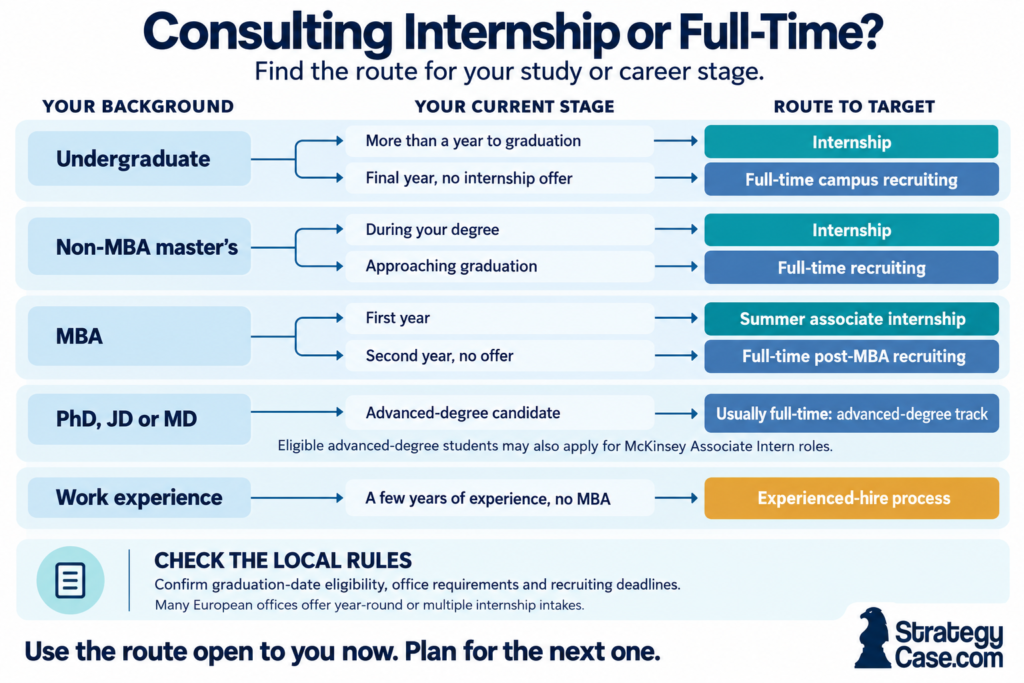
Your year of study usually decides it. Use the door that’s open to you now, and plan for the next one.
| Your situation | Your door | What to know |
|---|---|---|
| Undergraduate, more than a year from graduating | Internship | US summer 2027 deadlines closed between March and August 2026; check the next cycle early |
| Undergraduate in your final year, no internship offer | Full-time campus recruiting | McKinsey’s US undergraduate full-time deadline was August 11, 2026; Bain’s Associate Consultant round closed July 19, 2026 |
| Non-MBA master’s student (common in Europe) | Internship during the degree, or full-time at the end | Many European offices hire interns year-round or several times a year: BCG’s Visiting Associate, Bain’s German-speaking offices, McKinsey Germany’s Fellow Intern |
| First-year MBA | Summer associate internship | McKinsey’s US Associate Intern deadline is November 12, 2026 |
| Second-year MBA without an offer | Full-time post-MBA recruiting | The MIT Sloan numbers above show this door is real |
| PhD, JD, or MD | Usually full-time through an advanced-degree track; McKinsey’s Associate Intern is also open to advanced-degree students | See our guide to moving from academia to consulting |
| A few years of work experience, no MBA | Experienced-hire process | See our guide for experienced hires at McKinsey, BCG, and Bain |
For each firm’s programs, deadlines by country, and application steps, use the StrategyCase guides to the McKinsey internship, the BCG internship, and the Bain internship. For every firm’s dates side by side, see the consulting recruiting timeline.
What Decides Whether an Intern Gets the Full-Time Offer?
The summer is the evaluation, so your team’s view at the end decides the offer. Bain makes the mechanics explicit: successful Summer Associates get an offer to return to the office they worked in. BCG’s mechanics vary by office. London evaluates interns for a full-time graduate offer at the end of its eight-week program, and strong interns in Germany and Austria can join a retention program, FAST FORWARD, that includes a full-time offer.
The question your team answers is close to this: would we want this person on our next case? That comes down to things your team sees every day:
- The quality of your piece of the work. Accurate numbers and clean pages, delivered when promised.
- How you take feedback. Act on it fast, so the same comment never comes back twice.
- Judgment. Knowing when to push through a problem alone and when to flag it early to your manager.
Some of it isn’t in your hands. An office’s hiring needs can shift between the spring you’re hired and the August you finish. That’s one more reason to treat the summer as a full evaluation rather than a formality. If you’re heading into an internship now, my book Consulting Career Secrets covers how interns earn the return offer.
What If You Don’t Get the Internship or the Return Offer?
If you were rejected for the internship, the table above applies: apply full-time in your next window. That’s what I did. My McKinsey internship case interview didn’t go to plan. In the 14 months before I applied for a full-time role, I did an internship at Kearney and a master’s degree, and I approached case interviews completely differently. During my time in Hong Kong, I had also spent 10 minutes helping a McKinsey Engagement Manager with a local recruiting matter, and when I reapplied, my application was fast-tracked. The favor helped, but it wasn’t the whole story.
If you interned but didn’t get a return offer, none of the three firms publishes a rule for your case, so ask your recruiter what applies to you. Your realistic options are full-time recruiting at other firms, where a summer at a top firm still counts as consulting experience, and reapplying to the same firm later. Our guide to ban periods in consulting applications covers each firm’s published waiting rules.
A second try is common. Based on my experience, around 1 in 5 MBB consultants got in on their second try. No firm publishes this, so treat it as one insider’s estimate, not an offer rate for reapplicants.
How Much Do MBB Interns Earn Compared With Full-Time Hires?
Interns are paid at or close to the full-time rate for the role they would convert into, at least in the US, where the firms publish pay:
| Program (US) | Intern pay in the firm’s posting | About 10 weeks, before tax | Full-time base for the same level |
|---|---|---|---|
| McKinsey Business Analyst Intern | $108,000 annual rate | $20,800 | $112,000 to $125,000 (Business Analyst) |
| McKinsey Associate Intern | $189,000 annual rate | $36,300 | Not listed in the intern posting |
| Bain Associate Consultant Intern | $9,000 a month | $20,800 | $120,000 (Associate Consultant) |
| Bain Summer Associate (MBA) | $16,000 a month | $36,900 | $200,000 (Consultant) |
| BCG Consultant intern (MBA) | $200,000 base | $38,500 | $200,000 (Consultant) |
Sources: the firms’ US job postings, October 2026. Ten-week figures are our arithmetic.
Frequently Asked Questions
What percentage of MBB interns get return offers?
No firm publishes a current figure. In 2018, Bain’s global head of consultant recruiting said Bain makes offers to about 90% of its interns, and that the overwhelming majority accept. McKinsey and BCG have published no rate, but from my time at McKinsey that number broadly tracks. For comparison, NACE’s 2026 report puts the average intern-to-full-time conversion rate across employers at 63.1%.
Is it harder to get an MBB internship or a full-time offer?
No firm publishes acceptance rates by track, so nobody can say from data. What the firms publish suggests the same bar: Bain converts successful Summer Associates without additional assessments or interviews, which treats the internship interview as the full-time interview. The internship’s edge is a second attempt, since all three firms let rejected internship candidates apply full-time.
Can I apply full-time if I was rejected for the internship?
Yes, at all three. McKinsey’s careers FAQ encourages you to reapply in your campus’s full-time window. BCG’s UK page makes unsuccessful summer internship candidates an exception to its usual wait of about a year. Bain says a failed Summer Associate application won’t affect your full-time candidacy.
Do I have to interview again to convert my internship?
Not at Bain. Its Summer Associate page says successful participants get a full-time offer for the office they worked in without additional assessments or separate interviews. McKinsey and BCG don’t publish their conversion steps in the same detail. In BCG’s London office, interns are evaluated for a full-time graduate offer at the end of the eight-week program.
What are my chances of a full-time offer after a BCG internship?
BCG publishes no conversion rate. It calls its internships a common pathway into full-time consulting, and the mechanics vary by office: London evaluates interns for a graduate offer at the end of the summer, and strong interns in Germany and Austria can join the FAST FORWARD retention program, which includes a full-time offer.
What happens if I don’t get a return offer?
You can recruit full-time at other firms, where the summer still counts as consulting experience, or reapply to the same firm later. None of the three firms publishes a rule for interns who finish without an offer, so ask your recruiter what applies to you.
Related Guides
- MBA summer associate recruiting: how the MBA internship works across McKinsey, BCG, and Bain
- What entry-level consultants actually do: the work you’d do as an intern and as a new hire
- Consulting resume guide: the document that decides whether you get to interview for either door
- Getting a referral at McKinsey, BCG, and Bain: how to get noticed before you apply
The Bottom Line
Nobody outside the firms knows the exact MBB internship-to-full-time conversion rate. The best published figure is Bain’s “about 90%” from 2018, and the numbers you’ll see elsewhere don’t trace back to a source. What is clear: the internship and full-time routes test the same skills, the internship gives you two attempts instead of one, and missing it doesn’t end your chances, at the MBA level or after it.
Whichever door you’re facing, the deadline comes earlier than most candidates expect, and the bar doesn’t move. Your timing is a starting point, not a verdict, so find out where you actually stand now. Take the StrategyCase 2-minute case interview readiness diagnostic. If it shows gaps and your deadline is close, book a free intro call with me and we’ll build your plan from your baseline.
About the author: Dr. Florian Smeritschnig is the founder of StrategyCase.com and a former McKinsey Senior Consultant who evaluated candidates for the firm. Since 2020 he has delivered 2,200+ mock interviews and coaching sessions, and his clients have secured 700+ consulting offers, 340 of them at McKinsey, BCG, and Bain. He is the author of three books on consulting interviews and careers, including The 1%: Conquer Your Consulting Case Interview.
