

Last Updated on June 11, 2026
By Florian Smeritschnig, former McKinsey Senior Consultant · Updated June 2026
McKinsey’s values are organized in three commitments: adhere to the highest professional standards, improve clients’ performance significantly, and create an unrivaled environment for exceptional people, backed by 17 specific values. Its stated purpose is “to help create positive, enduring change in the world.” And since around 2023, McKinsey has tested whether candidates genuinely share all of this in a dedicated interview: the McKinsey Values and Purpose Interview (VPI).
I spent five years inside that value system, including the annual Values Day the firm dedicates to it, and I have since coached many candidates through McKinsey’s interviews (and generated more than 200+ offers with the firm). This page gives you both halves: the full values catalog as a reference, and how to prepare when the VPI shows up in your interview invite.
Key Takeaways
- McKinsey’s value catalog has three commitments and 17 values; its purpose is “to help create positive, enduring change in the world.”
- The Values and Purpose Interview (VPI) is a story-based conversation about values alignment, run office-by-office on top of the case interview and PEI. McKinsey tells you in advance if you will face it.
- The format is unusual: the interviewer shares their own values story first, then asks for yours.
- Prepare like a focused PEI: two or three short stories where you genuinely lived a value from the catalog, structured with stakes and specific actions.
- The value candidates misread most is the obligation to dissent. It is the one I saw lived most concretely inside the firm.
What are McKinsey’s purpose, mission, and values?
McKinsey publishes its purpose, mission, and values openly on its official values page. Here is the reference version:
| McKinsey’s official statement | |
|---|---|
| Purpose | “To help create positive, enduring change in the world” |
| Mission | To help clients make distinctive, lasting, and substantial improvements in their performance, and to build a great firm that attracts, develops, excites, and retains exceptional people |
| Values | 17 values organized under three commitments (full list below) |
| Vision statement | McKinsey does not publish a separate vision statement; the purpose statement fills that role |
These are not wall posters. The firm runs an annual Values Day, a day when offices worldwide pause client work to discuss what the values mean in practice. I sat through them during my years at the firm, and the discussions were genuinely contentious: real cases, real trade-offs, partners disagreeing in front of analysts. That memory is useful for candidates, because it tells you what the firm wants to hear about in the VPI: values under pressure, not values as decoration.
The full McKinsey values list
McKinsey’s core values catalog has three commitments with 17 values in total. This is the list your VPI stories should connect to.
1. Adhere to the highest professional standards
- Put client interests ahead of the firm’s
- Maintain high standards and conditions for client service
- Observe high ethical standards
- Preserve client confidences
- Maintain an independent perspective
- Manage client and firm resources cost-effectively
2. Improve our clients’ performance significantly
- Follow the top-management approach
- Use our global network to deliver the best of the firm to all clients
- Bring innovations in management practice to clients
- Build client capabilities to sustain improvement
- Build enduring relationships based on trust
3. Create an unrivaled environment for exceptional people
- Be non-hierarchical and inclusive
- Sustain a caring meritocracy
- Develop one another through apprenticeship and mentoring
- Uphold the obligation to engage and dissent
- Embrace diverse perspectives with curiosity and respect
- Govern ourselves as a “one firm” partnership
One insider note on this list. The value outsiders find hardest to believe, and the one I saw lived most concretely, is the obligation to dissent. At McKinsey, a first-year analyst is expected to push back on a senior partner when the data supports it. If you pick one value to understand deeply before any McKinsey interview, pick that one. It also strengthens your answer to “Why consulting, and why McKinsey?”.
What is the McKinsey Values and Purpose Interview (VPI)?
The McKinsey Values and Purpose Interview (VPI) is a story-based conversation in which a senior McKinsey interviewer assesses whether your personal values align with the firm’s catalog. You discuss values that matter to you and recount situations where you lived them, the same evidence-based logic as the Personal Experience Interview (PEI), aimed at alignment instead of competencies.
| VPI logistics | What to expect |
|---|---|
| Status | Piloted from around 2023; runs office-by-office, not globally |
| Heads-up | McKinsey tells you in advance if the VPI is part of your process |
| When | In the same loop as the case interview and PEI |
| Who | Usually a more senior consultant or partner |
| Format | The interviewer shares one of their own values stories first, then asks for yours |
| Follow-ups | PEI-style probing: “What did you feel?”, “What motivated that decision?” |
The opening format is the part that surprises candidates: your interviewer goes first. They name a McKinsey value that matters to them and tell you how a real situation brought it to life. Then they hand the format to you. Candidates I have coached through VPI processes consistently report the same thing: the conversation feels warmer than the PEI, and is judged just as seriously.
McKinsey outlines the broader interview loop on its careers page.
Why McKinsey added a values interview
McKinsey introduced the VPI after a stretch of public controversies put the firm’s conduct under scrutiny, and after its own people pushed for the values to carry more weight in hiring. The logic: case interviews, the Solve assessment, and resume screens test what you can do, but say little about what you will do under pressure. The VPI is the firm’s attempt to screen for that before the offer, not after the scandal.
For you as a candidate this context matters, because it defines the bar. The interviewer is not looking for recited values; they are looking for evidence that you have already paid a price for a principle. Several of my coaching clients had themselves raised doubts about McKinsey’s reputation before applying. Naming that tension honestly, and explaining why the firm’s response convinced you, is a stronger VPI answer than pretending the question away.
McKinsey VPI questions: what the interviewer asks
After sharing their own story, the interviewer typically asks variations of:
- “Which of your personal values matters most to you, and where did it come from?”
- “Tell me about a situation where you acted on a value even though it cost you something.”
- “When did you see behavior that conflicted with your values? What did you do?”
- “Which McKinsey value resonates most with you, and why?”
- “Tell me about a time you put a team’s or client’s interest ahead of your own.”
- “When did you disagree with someone senior to you, and how did you handle it?”
Expect PEI-grade follow-ups inside your story: “What exactly did you say?”, “How did the other person react?”, “What did you feel at that moment?” One story told deeply beats three told superficially.
How to prepare for the Values and Purpose Interview
Prepare the VPI like a focused version of your fit interview prep, with the values catalog as the filter:
- Read the catalog like a checklist of story prompts. For each of the three commitments, ask: where have I actually lived one of these values? Mark the two or three with your strongest real material.
- Build two or three short stories with stakes. Use the SCORE structure: situation, complication, what was at risk, your specific actions, the result. A values story without a cost is a platitude.
- Pick at least one dissent or integrity story. The obligation to dissent and “high ethical standards” are the values interviewers ask about most, and the hardest to fake.
- Practice the follow-ups out loud. Have a partner probe your feelings and motivations inside the story, exactly as the PEI does.
Here is the difference between a generic answer and one that lands, using a graduate-level example:
“In a university project, our team of five had three weeks to deliver a market analysis a local company would actually use. Halfway in, I found an error in our data that invalidated most of our results (SITUATION). Fixing it meant redoing two weeks of work in one, and two teammates argued we should present the original version since nobody would check (COMPLICATION). If we had, we would have handed a real business a flawed recommendation and put our names on it (STAKES). I disagreed openly, proposed we cut the scope to the three analyses we could rebuild cleanly, and took the heaviest workstream myself. I also told our professor about the error and our plan, which the team initially opposed (ACTIONS). We delivered a smaller but accurate report, the company used it, and the professor graded the transparency, not just the output (RESULT).”
Sample VPI answer, graduate candidate, mapped to “observe high ethical standards” and “uphold the obligation to dissent”
And an experienced-hire version:
“As a project lead, I discovered our flagship client was being billed for senior staffing the project no longer used. Flagging it would cut my own project’s revenue and embarrass the partner who set the model up (SITUATION + COMPLICATION). If it surfaced later through the client instead, the relationship and our credibility were at risk (STAKES). I raised it with the partner directly, with the numbers and two repricing options prepared, and recommended we proactively correct the next invoice. We did, and I presented the correction to the client myself (ACTIONS). The client extended the engagement the following year and named the transparency as a reason (RESULT).”
Sample VPI answer, experienced hire, mapped to “put client interests ahead of the firm’s” and “build enduring relationships based on trust”
Both answers share the same anatomy: a real cost, a named value, specific actions, a verifiable result. That anatomy is what the interviewer writes down after you leave the room.
VPI vs PEI: how the two story interviews differ
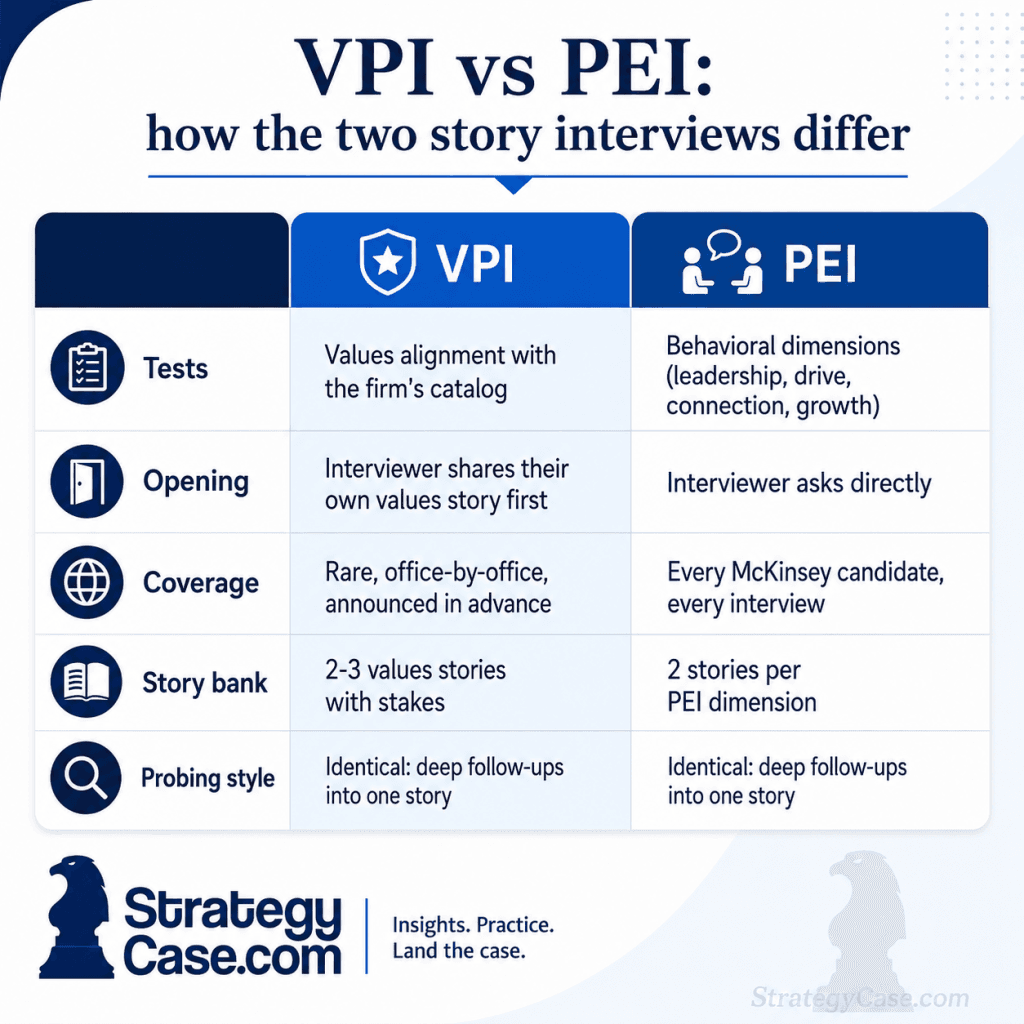
The same story can serve both interviews if it genuinely contains a values dimension. However, do not recycle one story across both in the same process; interviewers compare notes.
Break into McKinsey with StrategyCase
The VPI, the PEI, and your fit questions are all scored on the same thing: structured, authentic stories with stakes. The StrategyCase Fit Interview Masterclass is a 5-hour video course covering exactly what McKinsey interviewers evaluate, with proven answer structures, story templates, and the mistakes that cost candidates offers in the final round.
Frequently asked questions
What are McKinsey’s three core values?
McKinsey’s values are organized under three commitments: adhere to the highest professional standards, improve clients’ performance significantly, and create an unrivaled environment for exceptional people. Seventeen specific values sit under them, from “put client interests ahead of the firm’s” to “uphold the obligation to engage and dissent.”
What is McKinsey’s mission statement?
McKinsey’s mission is to help clients make distinctive, lasting, and substantial improvements in their performance, and to build a great firm that attracts, develops, excites, and retains exceptional people. Its purpose statement is shorter: “to help create positive, enduring change in the world.”
What is McKinsey Values Day?
Values Day is an annual event where McKinsey offices worldwide pause client work for a day to discuss the firm’s values through real cases and debates. It has run for decades and is one of the few rituals the whole firm shares; expect interviewers to take values questions seriously because of it.
Does every McKinsey candidate get a Values and Purpose Interview?
No. The VPI runs office-by-office rather than globally, and McKinsey tells you in advance if it is part of your process. Every candidate faces values-adjacent questions in the PEI and fit conversations, so the preparation pays off either way.
How is the VPI different from the PEI?
Both probe one real story in depth with detailed follow-ups. The PEI tests defined behavioral dimensions like leadership and connection; the VPI tests whether your personal values align with McKinsey’s catalog, and it opens with the interviewer sharing a values story of their own first.
How do I answer McKinsey values questions if I have concerns about the firm’s reputation?
Honestly. Several candidates I coached raised the firm’s controversies in their own decision process. Naming that tension and explaining what convinced you, the firm’s reforms, the people you met, the work you want to do, reads as exactly the independent perspective the values catalog asks for.
Related guides
- McKinsey Technical Expertise Interview (TEI): the technical sibling in the same interview loop
- McKinsey salary and hierarchy: what the roles behind these interviews pay
- McKinsey application process: where each interview sits end to end
- How long to prepare for consulting interviews: realistic timelines by starting point
Final word
McKinsey’s values are public, specific, and taken seriously enough that the firm built an interview around them. Learn the catalog, pick the two or three values you have genuinely lived, and build short stories with real stakes around them. Whether your office runs a formal VPI or folds values into the PEI, that preparation converts directly into offer-relevant evidence.
For the complete system across every McKinsey story interview, start with the StrategyCase Fit Interview Masterclass and turn your values into answers an interviewer can retell in the decision meeting.
About the author: Florian Smeritschnig is a former McKinsey Senior Consultant and the founder of StrategyCase. He spent five years at the firm, evaluated candidates, and has since run more than 2,200 mock interviews and coached hundreds of candidates into McKinsey, BCG, Bain, and other top firms.

