

Last Updated on September 10, 2026
Updated September 2026 · By Florian Smeritschnig, former McKinsey Senior Consultant
If you are an Arabic-speaking student weighing the McKinsey EDAD program, you have probably seen two flatly contradictory claims: that EDAD guarantees a McKinsey interview, and that it guarantees nothing. Getting this wrong costs you, because it changes how hard you should fight to get in. Here is the accurate version, straight from McKinsey’s own program materials and five years of sitting on the other side of the recruiting table.
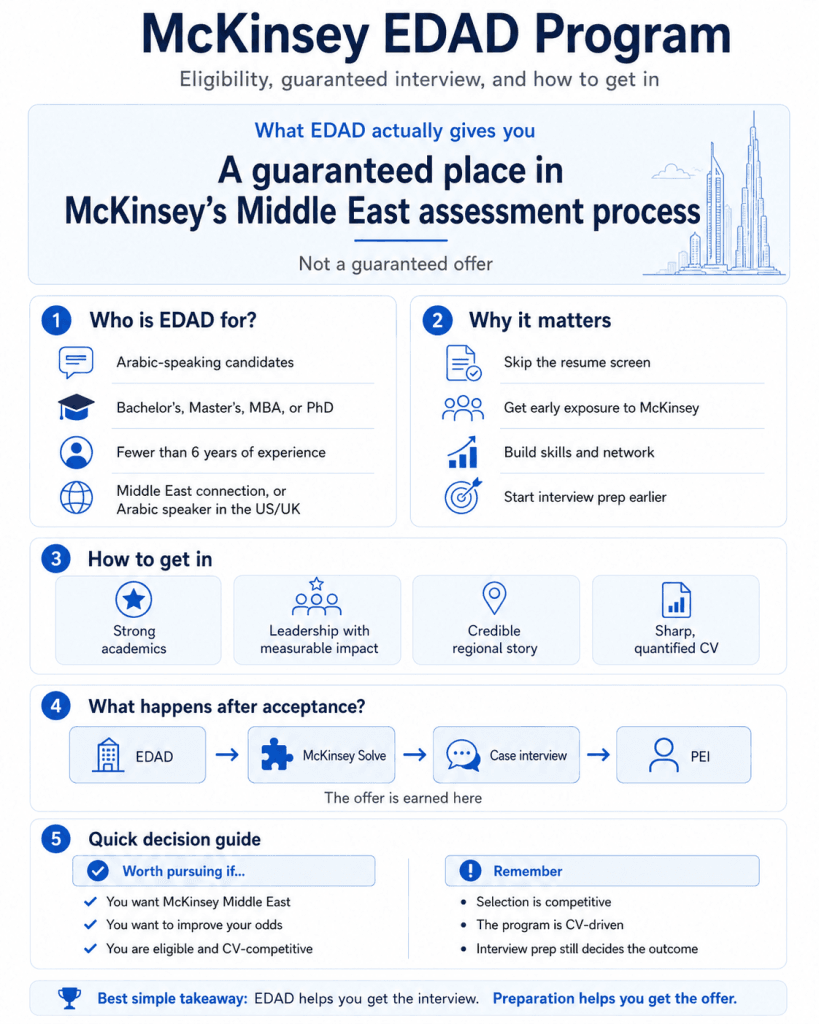
The McKinsey EDAD program guarantees selected participants a place in McKinsey’s Middle East assessment process, which means a guaranteed interview slot. It does not guarantee a job offer. You still have to pass the McKinsey Solve assessment and the case and PEI interviews like everyone else.
Key Takeaways
- EDAD is a multi-day McKinsey pipeline program for Arabic-speaking students and professionals with fewer than 6 years of experience, launched in 2010.
- Acceptance guarantees a place in McKinsey’s Middle East assessment process (a guaranteed interview), per McKinsey’s official EDAD page, but it does not guarantee an offer.
- More than 1,000 people have gone through EDAD; roughly 50% later apply to McKinsey and about 5% start their own businesses.
- Selection is primarily CV-based, so a sharp, quantified, consulting-style resume is the single biggest lever you control.
- The real work starts after you get in: turning a guaranteed interview into an offer means preparing for McKinsey Solve, the case, and the PEI.
What Is the McKinsey EDAD Program?
The McKinsey EDAD program is a multi-day, invitation-based development program for high-potential Arabic-speaking students and early-career professionals who are curious about consulting. “EDAD” means “preparation” in Arabic, and preparation is exactly the point: McKinsey uses it to build a relationship with regional talent years before formal recruiting.
McKinsey launched EDAD in 2010. Since then, more than 1,000 Arab students and young professionals have taken part. They come from top universities across the Middle East, Ivy League schools in the United States, and universities in Europe, according to McKinsey’s own EDAD program coverage. Recent cohorts have run across multiple cities, including a flagship edition held in Boston and London. There is also a dedicated Edad Academy in Riyadh that ends with a full-day case competition and a certificate of completion.
In short, EDAD is half talent-development program and half recruiting funnel. McKinsey gets early access to the strongest Arabic-speaking candidates in the region. You get exposure, skills, a network, and, if selected, a guaranteed seat in the interview process.
Does the EDAD Program Guarantee a McKinsey Interview?
Yes, getting into EDAD guarantees you an interview slot, but not an offer. This is the single most misunderstood fact about the program, so let’s be precise.
McKinsey’s official EDAD page states that those selected to participate “will automatically be guaranteed a place in the assessment process for McKinsey’s Middle East office.” Read that carefully. A guaranteed place in the assessment process means you skip the resume screen that rejects most applicants and go straight into McKinsey’s interview funnel. That is a real, concrete advantage.
It is not the same as a guaranteed offer. Once you are in the assessment process, you face the same bar as every other candidate: the McKinsey Solve assessment, the McKinsey case interviews, and the Personal Experience Interview. EDAD opens the door. Your performance inside the room decides whether you walk through it.
This is why you will see conflicting takes on forums. Some advice says EDAD “does not guarantee an interview,” which conflates two different things: a guaranteed interview, which EDAD selection does provide, and a guaranteed offer, which it does not. The structure mirrors McKinsey Early Access, the firm’s program for incoming MBA students in the US and Canada, which also gives participants a guaranteed McKinsey interview. EDAD is the Arabic-speaking, Middle East equivalent of that pipeline.
Who Is Eligible for the McKinsey EDAD Program?
EDAD eligibility comes down to four filters: language, experience, degree level, and regional connection. McKinsey keeps the criteria deliberately broad at the top of the funnel and lets the CV-based selection do the narrowing.
| Eligibility Filter | Requirement |
|---|---|
| Language | Arabic-speaking (the program is built for Arabic speakers tied to the region) |
| Experience | Fewer than ~6 years of full-time professional experience |
| Degree level | Currently enrolled in a Bachelor’s, Master’s, MBA, or PhD program |
| Regional connection | Middle East students, plus Arabic-speaking students based in the US and UK; Emirati nationals in the UAE are explicitly welcomed |
A few practical notes from coaching candidates through this:
- You do not need to be enrolled at a Middle East university. Arabic-speaking students at top US and European schools are squarely in scope, and McKinsey actively recruits them for EDAD.
- “Fewer than 6 years of experience” is generous. It covers undergrads, master’s students, MBAs, PhDs, and early-career professionals considering a switch into consulting.
- Meeting the criteria gets you considered, not accepted. Eligibility is a floor. Selection is where most of the field gets cut.
What Happens During the Program?
EDAD is built around exposure, skill-building, and access. Across the multi-day format, participants typically:
- Solve case studies in teams, getting a real feel for how consultants break down ambiguous business problems.
- Attend workshops on structured problem-solving, communication, and the skills McKinsey actually evaluates.
- Network with McKinsey consultants and recruiters, including people who work in the Middle East offices you would join.
- Get interview coaching and guidance, including a first look at the case and fit formats you will later face for real.
The Riyadh-based Edad Academy adds a full-day grand finale with a live case competition and a certificate of completion. The event itself is non-evaluative, which means it will not count against you in future applications. You are there to learn and to be seen, not to be scored.
Is the McKinsey EDAD Program Worth It?
For Arabic-speaking candidates targeting McKinsey’s Middle East offices, EDAD is worth pursuing. The guaranteed assessment spot alone clears the hardest, most arbitrary hurdle in consulting recruiting: the resume screen. Add the network and the early skill-building, and the math is straightforward.
Three benefits do the heavy lifting:
- A guaranteed interview. You bypass the CV screen that eliminates the majority of applicants and enter the assessment process directly.
- A CV and network signal that compounds. EDAD on your resume tells every future recruiter that McKinsey flagged you early. You also join an alumni network of 1,000+ people across consulting, industry, and entrepreneurship.
- A head start on the actual interviews. The coaching and case exposure give you a preview of McKinsey Solve, the case, and the PEI months before you would otherwise see them.
Be honest about the trade-offs, though. Roughly 50% of EDAD participants end up applying to McKinsey, while the rest pursue roles elsewhere or, in about 5% of cases, start their own businesses. If you already have a polished profile and you are confident your resume would clear the screen anyway, EDAD is a strong accelerant rather than a necessity. If you are unsure whether your CV would survive McKinsey’s screen, EDAD is one of the highest-impact moves available to you.
How to Get Accepted into EDAD
Because EDAD selection is primarily CV-based, your resume is the product. McKinsey is reading for three signals, and your job is to make all three impossible to miss.
1. Academic excellence
Top-tier academic performance is effectively table stakes. Coaches who work with Middle East candidates generally advise aiming for a GPA above 3.5 on a 4.0 scale. There is no hard cutoff. Strong applicants with lower GPAs do get in when the rest of the profile is excellent. But the higher your GPA, the less the rest of your application has to carry.
2. Leadership with measurable impact
McKinsey wants ownership, not titles. “President of three clubs” is weak. “Led a 12-person team that grew event attendance 40% in one semester” is strong. Every leadership line should show what you did and what changed because you did it.
3. A credible regional connection
EDAD exists to build the Middle East talent pipeline, so your motivation for the region has to be real. Language, where you grew up, family ties, prior work in the region, or concrete career plans there all count. A generic “I’m interested in the Middle East” reads as filler and gets treated as filler.
Then translate those signals into a consulting-grade resume: action-led bullet points, quantified results, and high signal density on every line. A referral from a McKinsey consultant, if you can get one through a coffee chat or campus event, only strengthens an already-sharp application.
How to Convert Your EDAD Spot into an Offer
This is the part almost every other EDAD guide skips, and it is the part that actually decides your outcome. A guaranteed interview is worthless if you are not ready for it. Once you are in the assessment process, you are judged on exactly the same criteria as a candidate who applied cold.
Here is what that means in practice:
- McKinsey Solve. Most Middle East candidates sit the McKinsey Solve assessment, the firm’s gamified problem-solving test. Treat it as a real gate, not a formality.
- The case interview. You need to structure ambiguous problems from first principles, not recite memorized frameworks. This is where most strong-on-paper candidates fall apart. Our McKinsey case interview guide walks through what the firm actually tests.
- The Personal Experience Interview. McKinsey’s PEI probes personal impact, leadership, and drive through your own stories. Vague answers sink candidates who aced the case.
The candidates who convert their EDAD spot into an offer are the ones who start preparing for these three the day they get accepted, not the week before the interview. If you want a structured way to do that, StrategyCase’s Case Interview Academy is built around what actually gets McKinsey offers.
EDAD vs. McKinsey Early Access vs. Standard Recruiting
EDAD is one of several ways into McKinsey, and it helps to see where it sits relative to the alternatives.
| Path | Who it’s for | Key advantage | Guaranteed interview? |
|---|---|---|---|
| EDAD | Arabic-speaking students/early professionals, <6 yrs experience | Early access to Middle East offices + skill-building | Yes, into the Middle East assessment process |
| McKinsey Early Access | Incoming MBA students in the US/Canada | Scholarship support + early MBA pipeline | Yes, a guaranteed McKinsey interview |
| Insight / diversity programs | Broader global student pool | Exposure and networking | Usually no formal guarantee |
| Standard full-time recruiting | Everyone else | Open to all eligible candidates | No; you must clear the CV screen first |
The pattern is clear. McKinsey’s structured pipeline programs (EDAD and Early Access) trade a competitive upfront application for a guaranteed interview later. Standard recruiting is open to everyone but makes you survive the resume screen first. If you qualify for EDAD, it is almost always the stronger route into the Middle East offices.
When Does EDAD Open? Application Timeline
EDAD runs on an annual cycle that tracks the academic year. Exact dates shift by city and cohort, so the official page is the source of truth, but the rhythm is consistent:
- Applications typically open in the late-winter window (around February to March for spring cohorts).
- Deadlines vary by city and edition, so confirm the specific date for the program you are targeting on the official McKinsey EDAD page.
- Programs usually run in spring (commonly April to May), with grand finale events such as the Riyadh case competition closing out the cycle.
The practical takeaway: get your CV consulting-ready before the cycle opens. EDAD selection is fast and CV-driven, so a resume you scramble to fix after applications open is a resume that loses.
Common EDAD Application Mistakes to Avoid
After reviewing many Middle East applications, the same avoidable errors keep showing up:
- A weak regional motivation. “I want global exposure” is not a reason to be in a Middle East talent program. Make the connection specific and credible.
- Generic consulting interest. Saying you “love problem-solving” tells McKinsey nothing. Show that you understand what consultants actually do.
- Leadership claims with no proof. Titles without outcomes read as padding. Quantify the impact.
- Underestimating the field. Limited seats, a global applicant pool, and a heavy skew toward elite academics make EDAD genuinely competitive. Treat the application like it matters, because it does.
- Treating the guaranteed interview as the finish line. It is the starting line. The offer is won in the assessment and interviews, not in the EDAD acceptance email.
Frequently Asked Questions
Does the McKinsey EDAD program guarantee a job offer?
No. EDAD guarantees a place in McKinsey’s Middle East assessment process, which is a guaranteed interview, not a guaranteed offer. You still have to pass the McKinsey Solve assessment and the case and PEI interviews to get hired.
Is the McKinsey EDAD program worth it?
For Arabic-speaking candidates targeting McKinsey’s Middle East offices, yes. The guaranteed interview clears the hardest hurdle in recruiting (the CV screen), and the network and early skill-building compound over time. It is a strong accelerant even if you already have a competitive profile.
What GPA do I need for EDAD?
There is no official cutoff, but aim for a GPA above 3.5 on a 4.0 scale for a competitive application. Strong candidates with lower GPAs do get in when leadership, impact, and regional fit are excellent. But a higher GPA reduces how much the rest of your profile has to carry.
Can non-Arabic speakers apply to EDAD?
EDAD is designed specifically for Arabic-speaking students and professionals connected to the Middle East. If you are not an Arabic speaker, look at McKinsey’s other student programs, such as Early Access for incoming MBA students in the US and Canada.
How competitive is EDAD?
Very. Seats are limited, the applicant pool is global, and selection skews toward top academics with demonstrated leadership and a credible regional connection. Because selection is primarily CV-based, your resume is the main thing you can control.
Will doing EDAD hurt my future McKinsey application if I underperform?
No. The EDAD event itself is non-evaluative, so it will not count against future applications. The risk is opportunity cost, not penalty.
Related Guides
- How to Get Into Consulting: The Complete Application Guide
- McKinsey Keep in Touch Program: A Full Guide
- McKinsey Solve: Sustainable Future Lab Guide
- McKinsey Salary and Hierarchy, Explained
- How to Network in Consulting Applications
The Bottom Line on EDAD
The McKinsey EDAD program is one of the best-kept advantages in Middle East consulting recruiting. Acceptance hands you something most applicants never get: a guaranteed interview that skips the resume screen entirely. What it does not hand you is the offer. That you still have to earn in the assessment and the interviews.
So treat EDAD as a two-stage game. Win the CV-based selection with academic strength, quantified leadership, and a credible regional story. Then win the offer by preparing for McKinsey Solve, the case, and the PEI from the day you are accepted.
If you want a former McKinsey Senior Consultant and top global case coach in your corner for stage two, book a 1-on-1 coaching session with Florian and turn your guaranteed interview into a guaranteed-to-be-ready one.
About the author: Florian Smeritschnig is a former McKinsey Senior Consultant who spent 5 years at the firm, conducted more than 2,200 interviews, and has coached candidates to 700+ offers at McKinsey, BCG, Bain, and other top firms. He is the founder of StrategyCase.com and the author of three prominent consulting interview and career books.
