

Last Updated on September 23, 2026
Updated September 2026 · By Florian Smeritschnig, Former McKinsey Senior Consultant
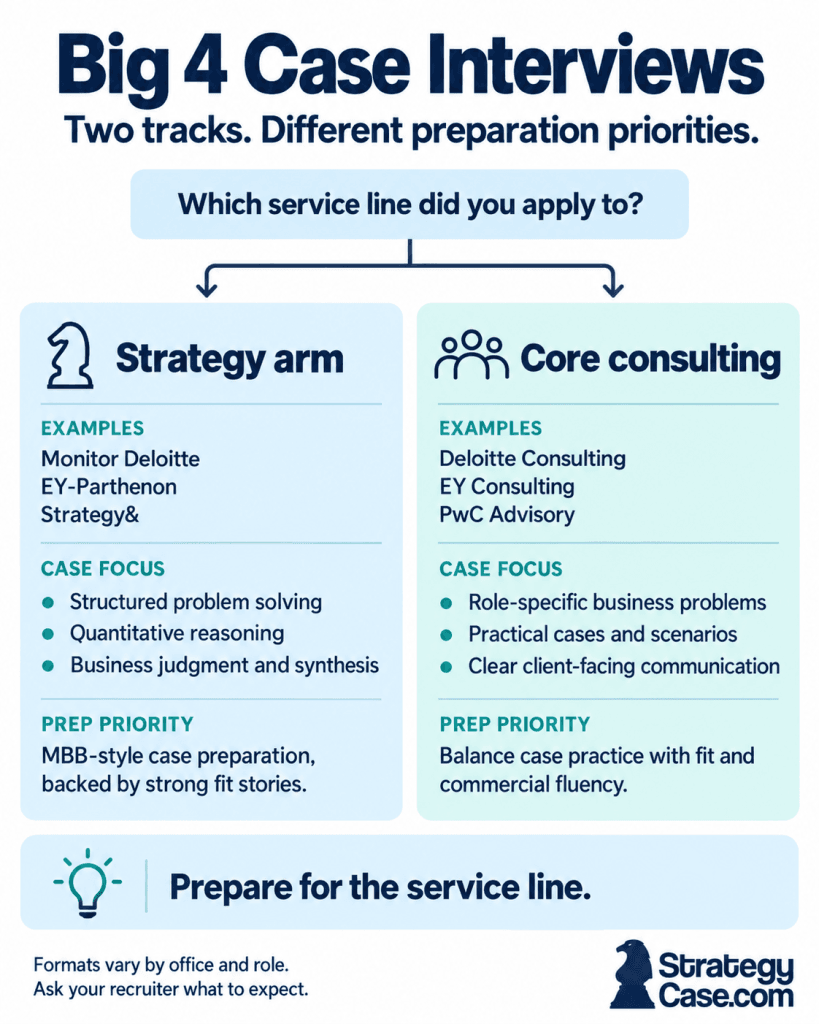
A Big 4 case interview is shorter, less framework-driven, and more conversational than an MBB case. Each of the firms runs two versions of it: a demanding strategy-arm case at Monitor Deloitte, EY-Parthenon, and Strategy&, and a lighter core-consulting case everywhere else. Which one you get is decided by the service line on your application, not by the firm name on the door.
Almost nobody tells candidates this, so it catches them cold. They prepare for the hard version and get the soft one, or the reverse. The mismatch shows up in the room as either stiffness or under-preparation.
I spent five years at McKinsey as a Senior Consultant, where I evaluated candidates. Since then I’ve coached 700+ people into consulting offers. Below is what each firm actually does, sourced to each firm’s own careers pages, and what the difference means for how you prepare.
Key Takeaways
- Deloitte runs two entirely different formats. Its US careers site points entry-level candidates to a case interview tool for Consultative Offerings roles and a separate scenario interview tool for Audit & Assurance roles. If you’re interviewing for audit, you’re not getting a consulting case.
- The bar moves with your level, and Deloitte publishes where. At Analyst and Consultant level, they want basic commercial awareness. At Senior Consultant and above, they want you to name the data that would prove or disprove your own hypothesis.
- The strategy arms are the real case interviews. Monitor Deloitte, EY-Parthenon, and Strategy& run cases close to MBB difficulty. Core consulting at the same firms does not.
- PwC publishes its scoring criteria outright: structured thinking, comfort with ambiguity, communication, business intuition and basic numeracy, and curiosity and coachability.
- EY weights behavioral more heavily than any other Big 4 firm. EY states it leans heavily on behavioral interviewing, scored against whether you gave a relevant example, what action you took, and what it led to.
Big 4 Case Interviews at a Glance: Four Firms, Two Tracks
The verdict: if you’re interviewing with a Big 4 strategy arm, prepare as if it were an MBB interview. If you’re interviewing with core consulting, spend half that time on the case. Put the other half into fit and commercial fluency, because that’s where the decision gets made.
Here is what each firm publishes about its own process.
| Firm | Strategy arm | What the case looks like | What the firm says it scores |
|---|---|---|---|
| Deloitte | Monitor Deloitte | Case or scenario, by service line. Verbal, written, or both | Clear thinking, practical judgment, professional demeanor |
| EY | EY-Parthenon | Mix of behavioral and case-based, several interviewers | Eight named skills, heavy behavioral weighting |
| PwC | Strategy& | Virtual case on a real-world business theme | Structure, ambiguity, communication, numeracy, coachability |
Two things fall out of that table.
The firms don’t agree on what a case interview even is. Deloitte splits it by service line. PwC runs a standardized virtual format with published criteria. EY wraps it in behavioral interviewing. So the phrase “Big 4 case interview” covers different experiences.
None of them are running a McKinsey case. They’re all testing the same underlying skill. But the room, the time, and the interviewer’s background are different, and that changes what good looks like.
Want the common foundation before the firm-specific parts? Start with the comprehensive case interview guide. Everything below assumes you have that base.
The Deloitte Case Interview: Case or Scenario, Depending on Your Service Line
Deloitte’s case and scenario interview tips page sends entry-level candidates to two separate practice tools. One is a case interview tool, for candidates interviewing for entry-level Consultative Offerings positions. The other is a scenario interview tool, for candidates interviewing for entry-level Audit & Assurance positions.
So before you prepare anything, answer one question. Which service line is the job posting in? An audit candidate drilling profitability trees is preparing for an interview they’ll never have.
Deloitte’s Official Five-Step Approach
Deloitte publishes the exact sequence it wants you to follow:
- Understand the issue. Ask clarifying questions until you genuinely have the problem.
- Identify the underlying assumptions. Name what the case is quietly taking for granted.
- Summarize specific issues and findings. Lay out the key issues from the information given.
- State your recommendations. Take a position.
- Outline next steps and expected results or impacts. Say what happens after the recommendation.
Step two is where Deloitte candidates lose ground, and it’s the step many prep material skips. Candidates jump from clarifying questions straight to structure. Deloitte wants the assumptions surfaced out loud first.
Deloitte is also clear that you’re not expected to produce the right answer. Sophia Fanucchi, a campus recruiting specialist at Deloitte Services LP, puts it this way on that page: “The interview is not about getting the right answer, it’s about how well you respond under pressure.”
The Bar Moves With Your Level, and Deloitte Says Where
Deloitte’s New Zealand careers guidance sets two different bars, and the split is useful wherever you are applying.
For Analyst and Consultant roles: apply commercial awareness with a basic working grasp of revenue, profit, market share, customers, competitors, and stakeholders. That’s the whole bar. You don’t need exotic frameworks.
For Senior Analyst, Senior Consultant, and above: suggest the data you would need to prove or disprove any hypothesis you develop. That’s a genuinely higher standard, and it’s the one experienced hires most often miss. They present a conclusion without ever saying what evidence would change their mind.
If you’re applying as an experienced hire, rehearse that move specifically. Every time you state a hypothesis, follow it with the test: “To confirm this, I’d want to see X, and if X came back below Y, I’d drop this branch.”
Monitor Deloitte Runs a Harder Case
Monitor Deloitte is Deloitte’s strategy practice, and its interview is a different animal from core Deloitte Consulting. Expect MBB-adjacent difficulty, more number pressure, and in many offices a written case where you work through a slide pack alone before presenting.
The pay gap between the two tracks is real too, and it tracks the interview difficulty. The Deloitte consulting salary and career guide breaks down Monitor versus core Deloitte at every level.
The Accenture Case Interview: Technology Context, Consulting Logic
Since Accenture is often compared to the Big 4, I have included the firm here too.
Accenture’s case interview is the most conversational, and the most variable. Accenture’s own careers guidance tells candidates to “be prepared to participate in whatever discussion the interviewer has in mind.” That’s an unusually honest way of saying the format isn’t standardized.
The firm’s published case-study interview tips are worth reading in full, but three of them carry real weight:
- Sketch it out. Accenture explicitly invites pen and paper, diagrams, and thinking aloud.
- Inventory first, then go deep. Take stock of the information you have before choosing where to dig.
- Treat every detail as deliberate. In Accenture’s words, “if the interviewer says something, it probably means something.” Throwaway-sounding details are usually load-bearing.
The bigger thing to know about Accenture is that the case is frequently technology-led. Cloud migrations, platform consolidations, AI rollouts, and operating model redesign come up far more often here than classic market entry or profitability. Preparing on the digital transformation and AI strategy case pattern is a better use of your time than another profitability drill.
Accenture also runs a separate online assessment earlier in the funnel for many roles, which is a different exercise from the case. If that is in your process, the Accenture digital assessment guide covers it.
One caution on preparation material: Accenture’s official case workbook still circulates widely, but the version most candidates download is from FY19. The case logic in it is fine. The picture of what Accenture sells is seven years out of date.
Accenture Strategy is the exception to all of the above and runs a tighter, more classical case. It also pays on a different band, which the Accenture Strategy salary guide sets out.
EY and EY-Parthenon: Behavioral Weight Is the Real Difference
EY organizes early careers around four service lines: Assurance, Consulting, EY-Parthenon, and Tax. EY-Parthenon is the strategy arm, and it is a meaningfully harder process than EY Consulting.
For EY-Parthenon, EY says to expect a mix of behavioral and case-based interviews with several EY-Parthenon people. Offer decisions typically come within a week. Case volume is high, and the cases are real strategy problems. Many are commercial due diligence flavored, which is what the practice actually sells.
What separates EY from the other three is how much the behavioral side counts. EY’s interview tips page states plainly that the firm leans heavily on behavioral interviewing, and it publishes the scoring logic:
- Did you provide a relevant experience that answers the question?
- Did you explain what action you took?
- Did you describe what your action led to?
That’s a three-part scoring rubric, published by the firm. Most candidates walk in having rehearsed only the case or some surface-level experiences. If EY is on your list, the consulting fit interview guide deserves as much of your calendar as case practice does.
EY also names eight skills it screens early careers candidates against: proactive, doing the right thing, curious, building relationships, showing agility, thinking critically, embracing technology, and motivated. Those are the words your stories should be able to evidence.
PwC Advisory and Strategy&: The Closest Thing to an MBB Case
PwC is the most transparent of the four about what it is scoring. Its advisory case study prep page lists five criteria outright:
| Criterion | What it means in the room |
|---|---|
| Structured thinking | Can you break the problem down and organize the answer clearly |
| Comfort with ambiguity | How you behave when the prompt deliberately leaves gaps |
| Communication skills | Whether your reasoning lands clearly and concisely |
| Business intuition and basic numeracy | Practical reasoning plus confident arithmetic |
| Curiosity and coachability | Whether you ask good questions and take a steer well |
PwC runs these as virtual cases built on real-world themes. It also publishes two full sample scenarios: a digital transformation at a global bank holding $300 billion in assets, and a healthcare expansion strategy. It also publishes sample responses calibrated to different experience levels. Work through both before your interview. They are the closest thing to a leaked case you will get legitimately.
Strategy&, PwC’s strategy arm, is a step up again. Strategy& Amsterdam publishes its full nine-step recruitment process. Two details in it are worth memorizing.
First, there is an online assessment before interviews, so the case is not your first hurdle.
Second, and more useful: the case discussion makes up about half of the interview time. The rest covers your background, your leadership and team experience, and your motivation for consulting and for Strategy& in particular. Candidates who treat a Strategy& interview as a pure case interview are preparing for half of it.
Strategy& also states what it wants from the case itself. Solve an open problem. Develop a structure and work it hypothesis-based. Draw on different perspectives. And accept that interviewers focus on your approach, not your answer. Their guidance adds one line I would put on a card: “the simpler the framework, the better.”
The Mistake That Costs Big 4 Candidates Offers
Here’s the pattern I see most often in coaching sessions, and it’s the opposite of what candidates expect.
In core consulting interviews, MBB behavior reads as arrogance. At Deloitte Consulting, EY Consulting, PwC Advisory, and Accenture’s core practice, your interviewer is frequently not a strategy consultant. They may be a technology, operations, or audit specialist who runs a handful of interviews a year. When a candidate drives hard on a hypothesis, pushes back on the interviewer’s steer, and treats the conversation like a performance, that interviewer doesn’t see MBB polish. They see someone who will be difficult to work with. Deloitte’s own guidance asks candidates to “engage the interviewer in a business conversation,” and PwC scores coachability explicitly. Those aren’t throwaway phrases.
In strategy-arm interviews, framework-first preparation is too shallow. Monitor Deloitte, EY-Parthenon, and Strategy& ask genuinely hard, open, often industry-specific questions. Candidates who memorized framework shapes instead of building structuring skill run out of road about eight minutes in, once the case stops matching the template.
The same problem sits underneath both failures. Preparation that trains you to reproduce a structure, rather than to think from first principles. It’s why I keep arguing that modern case prep is broken. The fix isn’t more cases. It’s fewer cases, practiced properly, with the underlying skills built separately.
Two skills carry the most weight across all four firms. The first is structuring that starts from the actual problem instead of a stored template, which is what the structuring and brainstorming drills train. The second is arithmetic under mild pressure. PwC names basic numeracy outright, and every Big 4 case involves some, which is what case interview math practice is for.
Not sure which of the two is holding you back? That’s the first thing I diagnose in a coaching session, before you spend four weeks on the wrong one.
How to Prepare for a Big 4 Case Interview in Four Weeks
Four weeks is enough for a Big 4 process if you spend it in the right proportions. This is the plan I give candidates, matched to the track they’re on.
Week 1 and 2 : Work out which interview you’re actually getting + build the underlying skills. Confirm your service line. Check whether your arm is the strategy practice or core consulting. Read your firm’s own careers guidance end to end. All four publish more than candidates realize. Then take one honest baseline case to see where you actually stand. Structuring from first principles, charts, communication, and case math. Not full cases yet. Drilling the parts separately is faster than hoping full cases fix a specific weakness by accident. If you want a structured reference for building frameworks rather than borrowing them, the case interview frameworks guide covers the logic.
Week 3: Full cases, matched to your firm. For Accenture, lean into technology and operating model cases. For EY-Parthenon and Strategy&, lean into commercial due diligence and growth strategy. For Deloitte core, run mid-difficulty cases and drill the five-step sequence. Add market sizing practice regardless of firm, since it shows up in every Big 4 process.
Week 4: Fit, and the half of the interview you were ignoring. Build your stories against your firm’s published criteria. EY’s eight skills, Strategy&’s leadership and motivation blocks, Deloitte’s professional demeanor. Rehearse the recommendation and the next-steps close. All four firms ask for it, and most candidates trail off at the end.
One practical note on timing. Big 4 first and final rounds usually sit closer together than MBB rounds do, and EY-Parthenon says offer decisions typically land within a week. Don’t count on a long gap between rounds to finish your preparation.
Big 4 Case Interview FAQ
Are Deloitte case interviews hard?
They are moderately hard, and harder than most candidates expect from a non-MBB firm. Core Deloitte Consulting cases are less math-heavy than a McKinsey case, and more of a back-and-forth. But Deloitte still wants a clear structure, a stated recommendation, and next steps. Monitor Deloitte is a genuine step up and sits close to MBB difficulty. The most common reason candidates fail is not difficulty, it is preparing for the wrong one of the two.
What are the three rounds of a Deloitte interview?
Deloitte’s process generally runs as an application and screening stage, a first round, and a final round. Many US offices run that final round as a “Super Day” with several back-to-back interviews. The exact structure varies by country, by service line, and by whether you’re a campus or experienced hire. Deloitte doesn’t publish one global round structure. So treat any specific round count you read online as one office’s version, not a rule.
What is the difference between a Deloitte case interview and a scenario interview?
They are two separate formats for two different service lines. Deloitte’s US careers site directs entry-level Consultative Offerings candidates to a case interview tool and entry-level Audit & Assurance candidates to a scenario interview tool. The case interview is a business problem you solve with structure and analysis. The scenario interview gives you a situation and tests judgment, ethics, and professional response instead of structured analysis. Check your requisition before you prepare.
Do Big 4 firms use written case interviews?
Yes, though less consistently than MBB firms. Deloitte states that you may be asked to resolve a case “verbally, in writing, or both.” Written cases are common at Monitor Deloitte and at EY-Parthenon. There, the format matches the commercial due diligence work the practice sells. If a written case is in your process, recruiting will normally tell you in advance. The format needs a longer time slot.
Should I use MBB frameworks in a Big 4 case interview?
Use structured thinking, not memorized frameworks. Strategy&’s own guidance says “the simpler the framework, the better.” Every Big 4 firm scores your reasoning, not your template. A framework you bend to fit the case is more damaging here than at MBB. Big 4 interviewers often come from technology, operations, or audit backgrounds, and they read template-matching as thin business judgment.
Is a Big 4 case interview easier than McKinsey, BCG, or Bain?
For core consulting roles, yes, on the case itself. The cases are shorter, lighter on math, and more collaborative. But the overall process is still challenging. Candidates who assume “easier firm, easier interview” and prepare less are the ones who get rejected.
Which Big 4 firm has the hardest case interview?
Among the strategy arms, Monitor Deloitte, EY-Parthenon, and Strategy& are close to each other and all sit near MBB difficulty. Strategy& adds an online assessment before interviews. Among core consulting practices, Deloitte Consulting runs the most structured case process of the four. Accenture’s is the most variable, which makes it hard to prepare for, even though any single case may be easier.
Related Guides
- What are the Big 4? How the four firms are structured and what each one actually does.
- Big 4 salaries What Deloitte, PwC, EY, and KPMG pay at every level.
- Switching from Big 4 to MBB How the move works and what the interview bar becomes.
- Consulting interview questions The full question set across case and fit rounds.
- Case interview examples Real cases to practice against.
What to Do Before Your Interview
Three things decide most Big 4 case interviews, and none of them is how many practice cases you did.
Know which interview you’re getting. Strategy arm or core consulting. Case or scenario. That single question changes your preparation more than anything else you could do. Deloitte, PwC, and Strategy& all publish enough on their own sites to answer it.
Prepare for the half of the interview that is not the case. Strategy& gives roughly half the time to background and motivation. EY publishes a behavioral scoring rubric. Deloitte asks for professional demeanor by name. Case practice alone leaves points on the table at all four firms.
Build the skills, not the templates. Structure from the actual problem. Do the arithmetic confidently. Take a position, and say what would change your mind. That’s what all four firms say they’re scoring, in their own words, on their own sites.
Want the free foundation first? The free StrategyCase library has 250+ guides covering every case type and every major firm process, starting with the comprehensive case interview guide linked above.
And if you already have an interview scheduled, book a diagnostic session with Florian. I find your binding constraint in the first hour, so you don’t spend four weeks guessing at it.
The Big 4 process is winnable. Just make sure you’re preparing for the interview you’re actually going to have.
About the author: Florian Smeritschnig spent five years at McKinsey as a Senior Consultant, where he evaluated real candidates, and has since delivered 2,200+ mock interviews and coaching sessions leading to 700+ offers at McKinsey, BCG, Bain, and other top firms
