
Updated November 2026 · By Florian Smeritschnig, Former McKinsey Senior Consultant
Cappfinity is a UK assessment company that builds employer-branded online tests: workplace scenarios you rank, rate, or answer on video, plus numerical, verbal, critical, and diagrammatic reasoning questions. Most of its assessments have no overall time limit, but some questions record your time, and that time can count toward your score.
Search for Cappfinity and you’ll read that Deloitte and EY use it. Neither firm says so. Their UK careers pages describe their tests in detail without naming a provider. The evidence does exist, but you have to know where to look, and most guides repeat the claim without showing any of it.
I recruited candidates at McKinsey, and StrategyCase builds practice tests for firms’ online screens, so I don’t take vendor claims on trust. Everything below comes from Cappfinity’s own website, help center, and Preparation Hub, and from employers’ own pages, read on November 23, 2026. You’ll get the company’s 12 question formats, how timing and scoring work, which employers are confirmed, what Deloitte and EY do and don’t say, and how to prepare.
Key Takeaways
- Cappfinity documents 12 question formats: seven behavioral (rank, select, scale, sort, rate, written, video) and five cognitive (numerical, verbal, critical, diagrammatic, coding potential). Each employer picks its own mix.
- No countdown doesn’t mean time doesn’t count. Behavioral questions are untimed apart from written and video answers, but some cognitive questions are time recorded, and your time may count toward your score.
- Deloitte and EY don’t name Cappfinity. Deloitte’s free Candidate Zone says it runs on systems operated for Deloitte by Cappfinity Limited, and EY’s UK FAQ reuses the vendor’s help-center wording.
- KPMG UK and PwC UK point candidates to SHL, even though AI search answers still list KPMG as a Cappfinity client.
- Free practice comes first: Cappfinity’s Preparation Hub (its results never go to employers) and your employer’s own Candidate Zone or practice hub.
What Is Cappfinity?
Definition: Cappfinity is a UK talent assessment company that designs online assessments, video interviews, and virtual assessment centers, mostly for graduate and early-careers hiring. Its tests measure what you can do and how much you enjoy doing it, which it calls your strengths. Each employer brands and configures its own version.
| Fact | Detail | Source |
|---|---|---|
| Company | Cappfinity Limited, a UK company registered in 2009; named Capp & Co Limited until November 2019 | Companies House |
| Working with employers since | 2005, per the company; co-founded by Dr. Alex Linley | Press release, 2021 |
| Scale | Says 200+ employers use it to assess and develop early-careers talent | Emerging talent page |
| Assessment platform | Capptivate, its immersive assessment platform | Credera case study |
| Employer settings | Thresholds, branding, and modules are configured per employer | Emerging talent page |
| Free practice | The Preparation Hub, with behavioral and cognitive practice questions | Preparation Hub |
| Employer prep sites | Branded “candidate zones” built for each employer | Preparation page |
The old name still matters. Many practice sites call it the “Capp” test, so a “CAPP numerical reasoning test” is the same company’s product.
The word “strengths” matters too. On its Preparation Hub, the company scores each skill on three things: how well you perform it, how energized you feel using it, and how often you use it. A skill that scores well on all three is a strength. That’s why some questions ask how much you’d enjoy a task, not only whether you can do it.
Not sure which provider your target firm uses? StrategyCase’s consulting assessment tests guide maps the online screen at every major firm.
The 12 Cappfinity Question Formats
The Preparation Hub lists the question types Cappfinity builds. You won’t see all of them: the employer decides which ones you get.
| # | Format | What you do | Timing |
|---|---|---|---|
| 1 | Order | Rank responses from the one you’d be most likely to take to the least likely (or most to least like you) | Untimed |
| 2 | Select | Pick the most appropriate response to a scenario | Untimed |
| 3 | Scale | Place your likely action or view on a scale | Untimed |
| 4 | Sort | Sort several responses into categories | Untimed |
| 5 | Rate | Rate statements by how well you do something and how much you love doing it | Untimed |
| 6 | Written response | Type a short answer to a scenario | Can be timed |
| 7 | Video response | Record an answer on camera after a set prep time | Timed prep and answer |
| 8 | Numerical reasoning | Solve job-based problems from tables and charts, with a calculator, pen, and paper | Sometimes time recorded |
| 9 | Verbal reasoning | Evaluate passages of text and draw conclusions | Sometimes time recorded |
| 10 | Critical reasoning | Answer problem-solving and decision questions in several styles | Sometimes time recorded |
| 11 | Diagrammatic reasoning | Find the rule in a sequence of shapes and pick what comes next | Sometimes time recorded |
| 12 | Coding potential | Show aptitude for learning code; no programming knowledge needed | Sometimes time recorded |
Sources: Cappfinity’s Preparation Hub (explore and prepare pages) and candidate help center, read November 23, 2026.
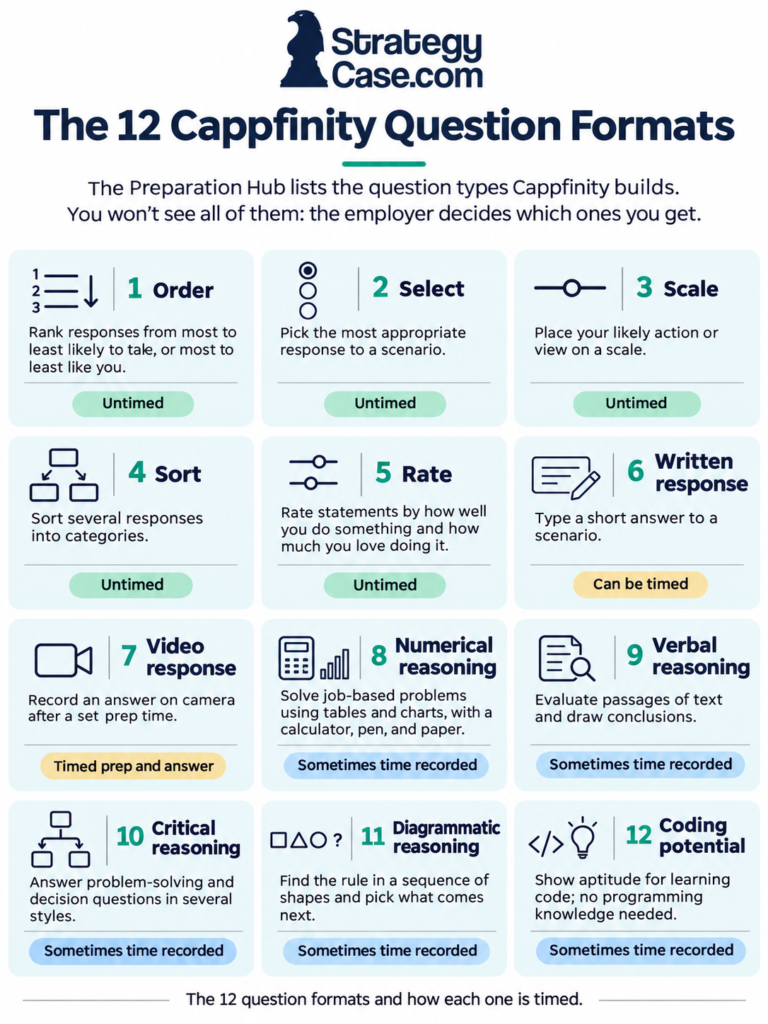
Figure: The 12 question formats and how each one is timed.
Two timing rules cause most of the confusion. First, the company says that apart from video and written questions, its behavioral assessments aren’t timed. Take the time to read each scenario properly.
Second, cognitive questions are sometimes “time recorded.” There’s no clock counting down, but the time you take may count toward your score, and the instructions tell you when that applies. Guides that call these tests “untimed” miss this. If your instructions say time is recorded, work quickly and accurately, as you would on a timed test.
You’ll also see the behavioral section called a “situational strengths test” on prep sites. The company’s own pages call it a behavioral assessment.
Do Deloitte and EY Use Cappfinity?
Short answer: the evidence points that way for Deloitte UK and suggests it for EY UK, but neither firm names a provider on its careers pages. Here’s what each firm says and what the evidence shows:
| Firm (UK) | Names a provider? | What the evidence shows | Our guide |
|---|---|---|---|
| Deloitte | No | Its free Candidate Zone says it runs on systems operated for Deloitte by Cappfinity Limited, and its test formats match the vendor’s | Deloitte online assessment |
| EY | No | Its student FAQ reuses three answers from Cappfinity’s help center; the vendor’s own news names past EY projects | EY online assessment |
| KPMG | Points to SHL practice tests | No Cappfinity link on KPMG UK’s pages | KPMG online assessment |
| PwC | Describes an SHL-hosted test | No Cappfinity link on PwC UK’s pages | PwC online assessment |
Deloitte: The Candidate Zone Runs on Cappfinity
Deloitte UK’s early careers assessment page describes the Immersive Online Assessment and the Job Simulation without naming a provider. It does link to Deloitte’s free Candidate Zone at deloitte.preparationplus.com, the same domain as Cappfinity’s own Preparation Hub. The Candidate Zone’s registration notice, the first thing you see, says your details are held on systems operated on behalf of Deloitte by Cappfinity Limited.
The test descriptions line up too:
| Deloitte UK describes | Cappfinity documents |
|---|---|
| Ranking actions by how likely you’d be to take them | Order responses from most to least likely |
| Numerical and verbal reasoning questions | Numerical, verbal, critical, and diagrammatic reasoning |
| No overall time limit, but some questions timed, with speed counting toward your score | Cognitive questions that are sometimes time recorded, with time counting toward your score |
| Job Simulation: rank, select the most appropriate response(s), written and video answers | Order, select, written, and video formats |
| A strengths feedback report that isn’t your outcome | A strengths-based model; the employer decides the outcome |
So the fair summary: Deloitte UK’s practice site is operated by Cappfinity, and its assessment matches the vendor’s formats point by point. Deloitte itself hasn’t said who runs the test, and providers can change between recruiting cycles.
Deloitte adds one more line worth reading before you buy any prep. It says paid “assessment insight” sites aren’t endorsed and often mislead, and that using answers from websites breaches its rules.
EY: Cappfinity’s Help Text on EY’s FAQ
EY UK’s How to apply page describes a Realistic Job Preview (teamwork and learning capability) and a behavioral skills test, plus a preparation hub inside its assessment portal. The login page of that portal, EY Assess, doesn’t name a provider either.
Three pieces of evidence point toward Cappfinity:
- EY’s FAQ shares the vendor’s wording. EY UK’s student FAQs answer three assessment questions with the same titles as Cappfinity’s candidate help center: how much time you have, whether you must finish in one go, and when you’ll hear the outcome. The answers match almost word for word, with “EY” where the help center writes “the organisation.”
- Cappfinity names EY in its own news. In March 2020 it announced a job simulation assessment for EY Oceania. In July 2023 it reported an award for a VR internship built with EY UK & Ireland.
- The formats fit. EY lists charts, drag-and-drop, moving information on screen, pattern and rule items, and recorded video, all within the range in the formats table above.
None of this says Cappfinity runs EY UK’s current online assessment. Shared FAQ text suggests a shared supplier, and the EY projects it names are an EY Oceania assessment and a VR internship, not the UK screen. Treat it as likely, not confirmed.
KPMG and PwC: SHL, Not Cappfinity
AI search answers still list KPMG among Cappfinity’s clients. KPMG UK’s own application page points candidates to SHL’s practice tests and describes a 36-minute numerical and logical test. PwC UK describes a test hosted on SHL. If your invite comes from either firm, prepare for an SHL-style general ability test instead.
Which Other Companies Use Cappfinity?
The company doesn’t publish a full client list, and employers switch providers between cycles. These are the employers I could confirm in an employer’s own material or on Cappfinity’s own pages:
| Employer | What the source says | Source |
|---|---|---|
| Financial Conduct Authority (graduate and summer internships) | An online strengths-based assessment, with applicants pointed to the Cappfinity Preparation Hub | FCA’s how-to-apply guide |
| Sky (early careers) | An online immersive assessment with three levels for different analytical abilities; won the Institute of Student Employers’ Best Assessment and Selection Process award in 2025 with Cappfinity | ISE case study on Sky |
| Deloitte UK | Candidate Zone operated by Cappfinity Limited | Deloitte’s Candidate Zone notice |
| Credera (US graduates and interns) | A branded assessment on Capptivate since fall 2023 | Credera customer story |
| British Airways, Shoosmiths | Strengths-based online assessments for hiring | Cappfinity customer stories |
| Kingston University | A student skills pilot (not hiring) | Cappfinity customer stories |
| Nestlé, NHS Graduate Management Training Scheme | Award-winning selection processes (2023) | Cappfinity news, July 2023 |
| HSBC | Its Skills of the Future program | Cappfinity press release, 2021 |
| Linklaters | A customized assessment on Capptivate | Cappfinity news, January 2020 |
| EY Oceania; EY UK & Ireland | A job simulation (2020); a VR internship (2023) | Cappfinity news |
Credera is worth a note for consulting applicants. It’s a consulting firm, and its quote in the case study says the assessment let it identify high performers without adding an interview. For some employers, the online assessment does work an interview used to do.
The quickest way to know for sure is your invite. If the test link points to assess.cappfinity.io, or your practice site sits on preparationplus.com, you’re taking a Cappfinity test.
How Cappfinity Scores Your Answers
Cappfinity doesn’t publish scoring keys or cut-offs, and each employer sets its own thresholds. What it does publish is the logic. It measures your capability (how good you are at something) and your motivation (how much you enjoy it), then combines behavioral, cognitive, and sometimes technical results into one picture for the employer.
That has three practical consequences:
- Behavioral questions are compared against the role, not a universal answer key. The company’s advice is to answer as you’d actually behave and not to guess what the organization wants to hear.
- Cognitive questions reward accuracy, and sometimes speed. Where time is recorded, a slow correct answer can score below a fast correct one.
- The report you see isn’t the decision. Deloitte says its strengths feedback report isn’t your outcome, and the vendor says the outcome comes from the employer. EY says it shortlists using your online assessment scores together with your A-level results (or equivalent).
Ranking questions are where most candidates second-guess themselves. When we created the ranking keys for StrategyCase’s Big 4 practice tests, one rule settled more orders than any other: an action that guesses, or changes something without checking, ranks last. The vendor doesn’t publish its keys, so treat that as reasoning, not inside knowledge. But it reflects how most workplace scenarios are written: check before you act, and tell the people affected what you found.
How to Prepare for a Cappfinity Assessment
Preparation works here, within limits. The cognitive questions have right answers, so practice changes your score. The behavioral questions reward clear, consistent judgment more than memorized answers, and our situational judgment test guide shows how to reason through ranked and rated scenarios.
In order of value:
- Confirm the provider. Check the invite email and the domain of the test link.
- Use the free practice first. Cappfinity’s Preparation Hub has behavioral and cognitive practice questions, and its help center says those results are never shared with employers. Then use your employer’s own Candidate Zone or practice hub, which shows the exact controls.
- Train the reasoning skills against a soft clock. Time-recorded questions punish slow methods. Practice percentage changes, ratios, and chart reading with a calculator and scrap paper beside you.
- Practice ranking from the ends. Pick the best and the worst options first, then place the middle two.
- Rehearse one-take video answers. You can’t re-record assessed video answers, but you get a practice recording first and a set prep time per question. The HireVue interview guide covers one-way video technique that transfers directly.
- Set up your device. The help center recommends a laptop or desktop, Chrome on Windows (or Firefox), the latest Safari on a Mac, and no browser extensions, especially translation tools. Use a stable connection and a quiet room.
- Arrange adjustments before you start. Requests go to the employer’s recruitment team, not to Cappfinity.
If something breaks mid-test, reload: saved answers and submitted videos are kept. If a timed section is cut short, screenshot the problem with the page address visible and email the employer, which decides whether to reset it.
Two Practice Questions in Cappfinity’s Formats
These two questions are our own, written to match the documented formats. They aren’t Cappfinity, Deloitte, or EY questions.
Question 1 (order, behavioral). You’re preparing a spreadsheet that must reach a client by 5 p.m. At 2 p.m., you notice that totals in a tab built by a colleague do not match the source data. Your manager is in meetings until 4 p.m.
Rank these actions from most to least likely to take:
- A. Replace the totals with figures that look plausible, without checking them against the source data, and send the spreadsheet without mentioning the discrepancy.
- B. Ask your colleague to investigate and correct the discrepancy with you now. Send your manager a brief message explaining the issue and its possible impact on the deadline.
- C. Leave the totals unchanged and send the spreadsheet to the client at 5 p.m., noting that some figures have not yet been verified.
- D. Wait until your manager is available at 4 p.m. before taking any action, then ask how to proceed.
Our suggested order: B, D, C, A.
B is strongest: you start resolving the problem immediately, involve the colleague who built the tab, and alert your manager to the risk.
D comes second: you seek guidance before releasing the spreadsheet, but unnecessarily lose two hours that could have been spent investigating.
C comes third: you disclose the uncertainty, but still give the client figures you have reason to doubt.
A is weakest: you replace evidence with guesswork and conceal the unresolved discrepancy. The spreadsheet may look complete, but its figures cannot be trusted.
Question 2 (numerical, time recorded). A team spent £48,000 on travel last year. This year’s budget is 15% lower. First-quarter spending was £13,800. If spending continues at that rate, by how much will the team exceed its annual budget?
- A. £3,600
- B. £7,200
- C. £14,400
- D. £40,800
Answer: C. The budget is £48,000 × 0.85 = £40,800. At the first-quarter rate, the year costs £13,800 × 4 = £55,200, so the overrun is £55,200 − £40,800 = £14,400. A is the overrun for one quarter only, B forgets the 15% cut, and D is the budget itself. The fast path: annualize first, then subtract.
Practice for Deloitte’s online assessment with our
Big 4 Online Assessment Practice Tests
- 45 behavioral ranking scenarios, every order explained
- 5 Deloitte-style mocks: 12 numerical and 12 verbal questions each, on practice timers
- Numerical and verbal practice sets with worked solutions, plus a video interview bank
Follows the firms’ published UK formats. One-time payment, 1 year of access, full refund within 24 hours.
Cappfinity Assessment FAQ
Does Cappfinity record your screen?
Cappfinity’s candidate help center doesn’t mention screen recording. What it does confirm is camera use for video questions: you test your camera first, you can’t hide the camera feed while recording, and you can’t record if your face isn’t in view. Some cognitive questions also record how long you take. Check your employer’s own rules too, since Deloitte, for example, bans AI tools in its online assessments.
Is the Cappfinity test timed?
Partly. Cappfinity says its behavioral questions are untimed apart from written and video answers. Some cognitive questions are time recorded, which means there’s no countdown but your speed can count toward your score. Any time limits appear in your invite and in the instructions, so read both before you start.
How do you pass a Cappfinity assessment?
There’s no published pass mark; each employer sets its own threshold. Do the free practice on Cappfinity’s Preparation Hub and your employer’s Candidate Zone, train numerical and verbal reasoning until you’re accurate at speed, and answer behavioral questions the way you’d actually act. Consistent, well-judged answers beat guessing what the employer wants.
Which companies use Cappfinity?
Employers that name it in their own material include the FCA, and Sky won a 2025 award for the assessment it built with Cappfinity. The company’s case studies and news add Credera, British Airways, Shoosmiths, Nestlé, the NHS Graduate Management Training Scheme, HSBC, Linklaters, and past EY projects. Deloitte UK’s Candidate Zone is operated by Cappfinity. KPMG UK and PwC UK point candidates to SHL instead.
Can I re-record a Cappfinity video answer?
No. Cappfinity’s help center says assessed video responses can’t be re-recorded. You get a practice recording to check your camera and sound first, sometimes an unassessed practice question, and a set prep time before each assessed answer. Plan your first sentence during the prep time so the one take starts cleanly.
Is Cappfinity the same as Capp?
Yes. Companies House lists Cappfinity Limited’s previous name as Capp & Co Limited, used until November 2019, and before that Centre of Applied Positive Psychology Limited. Many practice sites still call it the Capp test or Capp assessment.
Related Guides
- Arctic Shores assessment: the game-based screen some UK graduate employers use instead
- Free GMAT quant questions: free numerical practice for time-recorded reasoning questions
- Big 4 salaries: what Deloitte, PwC, EY, and KPMG pay at each level
- What are the Big 4?: how the Big 4 compare with each other and with MBB
Before You Start Your Cappfinity Assessment
A Cappfinity assessment is learnable once you know what’s being measured:
- Know your formats. Twelve are possible, your employer picks the mix, and the instructions say which questions record your time.
- Practice free first. Use Cappfinity’s Preparation Hub and your employer’s own practice site before anything paid.
- Train the cognitive skills, not answers. Numerical and verbal reasoning respond to practice; behavioral questions respond to clear judgment.
- Set up properly. Laptop, supported browser, no extensions, adjustments arranged before you start.
If your invite is from Deloitte or EY and you want more timed practice than their free sites offer, get StrategyCase’s Big 4 Online Assessment Practice Tests. It has 45 behavioral ranking scenarios with every order explained, 5 Deloitte-style mocks of 12 numerical and 12 verbal questions, numerical and verbal practice sets with a worked solution for every question, and a video interview bank with model answers and timed drills.
Its reasoning questions are multiple choice, so learn Cappfinity’s scales, sorting, and drag-and-drop controls on the free sites. It costs $29 one-time with 1 year of access, and you get a full refund within 24 hours of purchase. All questions are original. StrategyCase isn’t affiliated with Deloitte, PwC, EY, KPMG, SHL or Cappfinity.
If the job is in consulting, the case interview comes after the screen, and it tests skills no online assessment does. The Deloitte case interview guide shows what that round looks like, and StrategyCase’s free Case Interview Foundations course teaches the method from the ground up: 40+ videos, 7+ hours of instruction, and 200+ pages of reading.
About the author: Dr. Florian Smeritschnig is the founder of StrategyCase.com and a former McKinsey Senior Consultant who recruited candidates for the firm. Since 2020 he has delivered 2,300+ mock interviews and coaching sessions, and his clients have secured 700+ consulting offers, 340 of them at McKinsey, BCG, and Bain. He is the author of three books on consulting interviews and careers, including The 1%: Conquer Your Consulting Case Interview.
