
Last Updated on June 10, 2026
The Bain TestGorilla assessment is a roughly 45-minute, multiple-choice online aptitude test Bain uses to screen applicants between the resume stage and interviews, testing numerical reasoning, critical thinking, data interpretation, and business judgment under tight time pressure.
Bain began using the TestGorilla assessment in 2024. If you are applying today, there is a real chance you will receive it instead of the SOVA test that dominated Bain’s screening process for years. Some offices use TestGorilla, others still use SOVA, and in some cases even candidates within the same office may receive different assessments. You will not know which test you have until the link arrives.
This unpredictability is deliberate. Bain is testing how you think, not how well you have memorized a specific test format. The core skills that matter, rapid quantitative reasoning, structured problem-solving, and sound business judgment, transfer across both formats. The upside is clear: you can prepare effectively for both SOVA and TestGorilla using largely the same materials.
Below is what the test actually looks like and how to prepare efficiently without wasting time.
Bain TestGorilla: Quick Facts
- What it is: an online aptitude assessment Bain has used since 2024 to screen applicants, in place of or alongside the SOVA test.
- Length: about 45 minutes, all multiple-choice, with your webcam on.
- Sections: usually 3 to 4, always including numerical reasoning, plus a mix of critical thinking, data, problem-solving, business judgment, or leadership.
- Calculator: assume you cannot use one unless the assessment explicitly says so; practice fast mental and paper math.
- Window: you typically get about 3 days to complete it once the link arrives.
- Who gets it: not everyone. Some Bain offices use TestGorilla, others use SOVA, and it can vary within an office. You will not know which you have until the link arrives.
- Timeline: most candidates hear back in about two weeks.
Where TestGorilla Fits in Bain’s Hiring Process
If you receive TestGorilla, it will almost always sit between resume screening and first-round interviews. In practice, the sequence typically looks like this:
- Submit your application.
- Pass the resume screen. In many cases this is purely automated or recruiter-led, though some candidates also have a brief screening call.
- Receive your TestGorilla link. You are usually given a three-day window to complete it.
- Complete a 45 minute online assessment with your webcam on. The setup is similar to other consulting screening tests, but the format and question mix can feel different from other assessments.
- Advance to interviews if you pass. Candidates who perform well move on to case and fit interviews.
In most offices, you will hear back within about two weeks, though timing can vary depending on hiring volume and the office you applied to.
Variations Are Part of the Game
Bain does not administer a single, uniform version of TestGorilla to all applicants. The exact structure can vary from candidate to candidate and even between applicants to the same office. In practice, this means that some candidates complete three sections, while others are given four.
What is consistent across almost all versions is the presence of a numerical reasoning section, which remains a core screening element. This reflects Bain’s continued emphasis on fast, accurate quantitative thinking, regardless of the assessment format.
Overall, the test typically lasts about 45 minutes and is delivered entirely as multiple-choice questions. Across its different versions, TestGorilla is designed to evaluate four main capabilities:
- Logical reasoning: your ability to identify patterns, draw valid conclusions, and avoid faulty assumptions.
- Numerical reasoning: your speed and accuracy when working with data, charts, and calculations.
- Business acumen: your understanding of basic commercial concepts such as profitability, trade-offs, and performance metrics.
- Situational decision-making: your judgment when faced with realistic workplace or project scenarios.
While the exact mix and number of sections can differ, these four skill areas form the backbone of Bain’s TestGorilla assessment.
What Is Different from the SOVA Test
The biggest distinction between Bain SOVA and TestGorilla is how the questions are framed. They assess similar thinking skills, but they feel very different in practice.
SOVA is more abstract. The test leans heavily on pattern recognition, spatial reasoning, and logic-based puzzles with little real-world context. Many questions resemble classic IQ-style problems where you manipulate shapes, sequences, or rules rather than business situations. Candidates often describe it as “pure reasoning under pressure.”
TestGorilla is more business-grounded. Instead of abstract sequences, you typically work with sales tables, charts, or operational data. Instead of standalone logic puzzles, you might prioritize resources, interpret performance metrics, or evaluate trade-offs in realistic scenarios. The questions are not easier, but they feel closer to what consultants actually encounter on projects.
What stays the same. Both assessments are timed, cognitively demanding, and designed to see how you think under pressure. You still need fast numerical reasoning, clear logic, and sound judgment. The difference is that TestGorilla embeds these skills in business situations, whereas SOVA tests them in a more abstract way.
In practical terms, this means your preparation should focus less on memorizing specific question types and more on building transferable reasoning skills that work across both formats.
The Sections of the TestGorilla Assessment
We have seen the following sections in the assessment so far. Each block typically runs 8 to 15 minutes under a hard time limit, with roughly 6 to 10 multiple-choice questions.
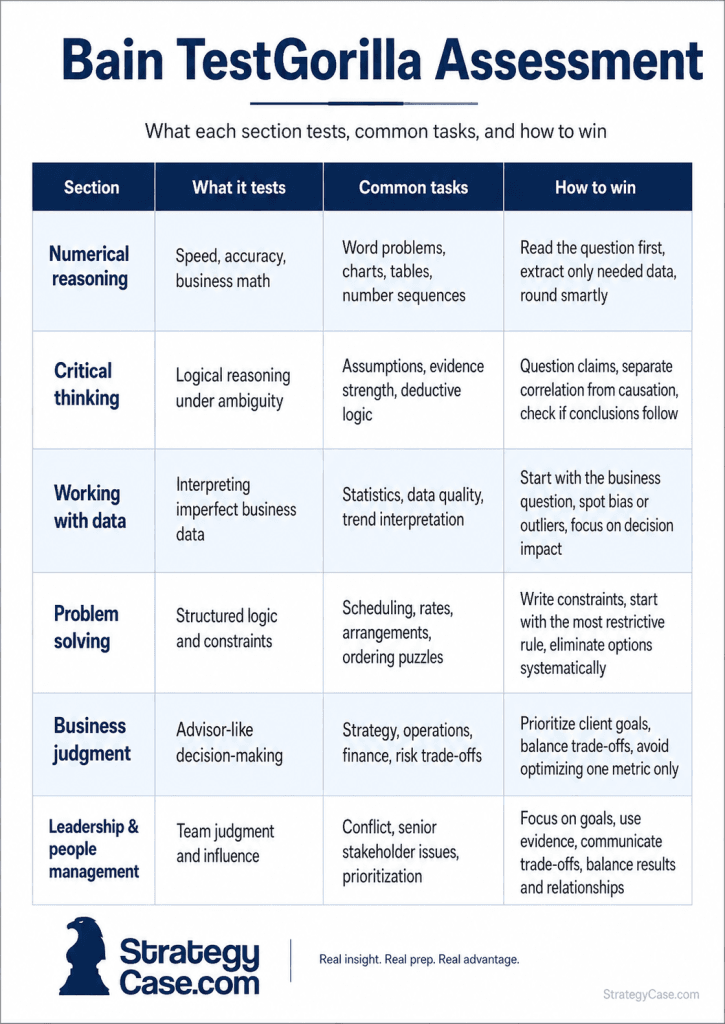
Numerical reasoning
Most versions of Bain’s TestGorilla include a dedicated numerical reasoning section, and in our experience it is usually the most decisive part of the assessment.
Although the mathematics itself is not advanced (similar to case math), the challenge lies in speed, accuracy, and selective reading. Candidates who approach the section like a school math test tend to struggle. Candidates who think like consultants perform much better.
Across different test versions, three question types appear most frequently.
1. Word problems with business context
These questions embed calculations inside a short business scenario. A typical example might look like this:
“A company’s revenue grew by 15% to $2.3M. Operating costs increased from 40% of revenue to 45%. What happened to operating profit in dollar terms?”
To solve this efficiently, you need to combine three skills:
- Percentage calculations: translating percentages into absolute numbers quickly.
- Basic algebra: working backwards from totals when needed.
- Multi-step reasoning: linking revenue, cost structure, and profit.
A strong candidate would think as follows, rather than calculating mechanically:
- Start from the new revenue: $2.3M.
- Recognize that this already reflects a 15% increase, so original revenue was $2.3M / 1.15 ≈ $2.0M.
- Compute original operating profit: 60% of $2.0M = $1.2M.
- Compute new operating profit: 55% of $2.3M ≈ $1.265M.
- Conclude that operating profit increased by roughly $65,000.
The math is not complex. The difficulty comes from time pressure. You typically have around 90 seconds per question, and simply reading the prompt can consume 30 to 40 seconds if you are not careful.
How to be good at this:
- Practice doing multi-step calculations mentally or with minimal notes.
- Read the question first, then scan the data.
- Write down only what you actually need.
- Round intelligently where allowed.
2. Chart and table interpretation
Here you will see bar charts, line graphs, or tables containing financial or operational data. The questions rarely ask you to calculate everything. Instead, they test whether you can extract the right insight fast.
Typical tasks include:
- Identifying trends over time.
- Comparing performance across regions or products.
- Spotting anomalies or outliers.
- Determining which scenario best fits the data.
Good candidates follow a structured approach:
- Look at the axes and labels first.
- Ask: “What is the question really asking?”
- Then go straight to the specific bars, lines, or cells that matter.
Weak candidates make the opposite mistake. They try to absorb the entire chart from left to right, top to bottom, treating it like a textbook page. This almost guarantees that they will run out of time.
How to be good at this:
- Get comfortable comparing magnitudes visually before calculating.
- Train yourself to read charts with purpose, not curiosity.
- Practice answering questions using only the minimum data required.
3. Number sequences
These questions feel closer to classic brainteasers or IQ tests. A typical example might be:
2, 5, 11, 23, 47, ?
To solve this, you need to detect the underlying pattern. In this case, the sequence doubles and then adds one each time:
- 2 × 2 + 1 = 5
- 5 × 2 + 1 = 11
- 11 × 2 + 1 = 23
- 23 × 2 + 1 = 47
So the next number is 47 × 2 + 1 = 95.
Sometimes the rule is simple addition or multiplication. Other times:
- Numbers alternate between two patterns.
- Multiple operations are combined.
- The pattern changes after a few steps.
These questions are less about business and more about pure pattern recognition under time pressure.
How to be good at this:
- Practice with standard IQ-style sequences.
- Look first for simple rules before assuming something complex.
- Check your hypothesis against at least two steps in the sequence.
Across all three question types, success depends less on math knowledge and more on consulting-style thinking:
- Be fast, not perfect.
- Be selective, not exhaustive.
- Think in steps, not formulas.
- Prioritize understanding over calculation.
Critical Thinking
This section assesses whether you can analyze arguments rigorously, question claims, and reason with incomplete information. The problems feel less mathematical and more conceptual, but they are just as time-pressured as numerical questions.
You are not being tested on knowledge of business facts, but on how you think when information is messy, ambiguous, or potentially misleading, which closely mirrors real consulting work.
Three types of reasoning appear most often.
1. Identifying hidden assumptions
A typical question presents a short argument and asks you to identify what must be true for the conclusion to hold.
Example:
“Sales increased after we launched the new website. Therefore, the website redesign was successful.”
At first glance, this sounds reasonable. A strong candidate immediately asks: What is being taken for granted here?
The argument assumes:
- The website was the primary driver of the sales increase.
- No other major factors influenced sales.
- The timing of the launch and the sales increase are causally linked, not just correlated.
In reality, alternative explanations could include:
- Seasonal demand increases.
- A competitor exiting the market.
- A new marketing campaign.
- Improved sales team performance.
Your job is to spot the critical assumption that, if false, breaks the argument.
How to be good at this:
- Get into the habit of asking “What else could explain this?”
- Separate correlation from causation.
- Look for missing variables or alternative drivers.
- Practice with standard critical reasoning prompts outside of TestGorilla.
2. Evaluating evidence
Here you are given an argument and then presented with additional information. You must decide whether this new information strengthens, weakens, or is irrelevant to the claim.
Example structure:
- Original claim: “The new website caused higher sales.”
- New information: “A major competitor filed for bankruptcy the same month.”
A strong candidate would recognize that this weakens the original claim, because it introduces a plausible alternative explanation for the sales increase.
This style of question is very similar to what consultants do with clients. Executives often present confident conclusions, and your role is to assess whether the evidence actually supports them.
How to be good at this:
- Always restate the core claim in your own words.
- Ask: “If this new fact is true, does it make the claim more or less likely?”
- Avoid being persuaded by tone or confidence, focus purely on logic.
3. Finding logical relationships and deductive reasoning
Some questions test your ability to draw valid conclusions from a set of premises.
For example:
- All consultants in Team A work late.
- Maria works in Team A.
- Therefore, Maria works late.
Here, the conclusion follows logically from the premises.
Other questions intentionally include flawed logic, such as:
- Some consultants work late.
- Maria is a consultant.
- Therefore, Maria works late.
This conclusion is invalid, because “some” does not imply “all.”
These problems assess whether you can reason precisely rather than intuitively.
How to be good at this:
- Pay attention to words like “all,” “some,” “none,” and “only.”
- Check whether the conclusion truly follows from the premises.
- Resist jumping to conclusions based on plausibility rather than logic.
Success in this section comes from thinking like a consultant, not a test-taker:
- Question every claim, even if it sounds reasonable.
- Separate evidence from opinion.
- Distinguish correlation from causation.
- Be precise with logic, not emotional or intuitive.
Working with Data
This section tests whether you can make sense of imperfect, real-world data rather than just compute formulas. The problems resemble what junior consultants actually do in early project work: interpreting datasets, spotting flaws, and judging whether a conclusion is justified. The questions mix analysis and judgment.
Across most versions of Bain’s TestGorilla, three types of tasks appear most often.
1. Statistical interpretation
Here you are given a dataset, chart, or summary statistics and asked to draw conclusions about it. The goal is not advanced statistics, but solid intuition about what data does and does not show.
Typical concepts you may encounter include:
- Mean vs. median: understanding when averages are misleading.
- Outliers: recognizing when one extreme value distorts the picture.
- Correlation vs. causation: identifying relationships without assuming cause.
- Variability: noticing whether performance is consistent or highly volatile.
Example:
A table shows monthly sales for a retail store over 12 months. One month is dramatically higher than all others. A statement claims: “The store’s average monthly performance is excellent.”
A strong candidate would question this conclusion because the mean may be inflated by a single outlier, whereas the median might paint a more realistic picture.
How to be good at this:
- Always ask: What does this statistic really represent?
- Check whether one extreme value is skewing results.
- Think about whether a single metric tells the whole story.
- Practice interpreting simple datasets without calculating everything.
2. Data cleaning and reliability
Some questions test whether you can recognize problematic data before drawing conclusions. This mirrors real consulting work, where data is often messy, incomplete, or inconsistent.
You might be asked to judge whether:
- A dataset is reliable enough to support a decision.
- Certain data points should be excluded.
- Missing data creates bias.
- Measurement methods are flawed.
Example:
A company surveys only its most loyal customers to assess satisfaction and concludes that “overall customer satisfaction is 95%.”
A strong candidate would flag this as biased because the sample is not representative of all customers.
How to be good at this:
- Ask: “Who was included, and who was excluded?”
- Look for sampling bias, missing values, or inconsistent definitions.
- Be skeptical of perfectly clean data in business settings.
3. Data interpretation and insight extraction
This is less about calculations and more about reading between the lines of data.
You may need to:
- Identify trends over time.
- Compare performance across regions, products, or teams.
- Decide which metric best answers a business question.
- Choose which data point is most relevant to a decision.
Example:
Two regions show similar total revenue, but one has far higher variability month to month. A question asks: “Which region is more predictable for planning?”
The correct answer is the region with lower variability, even if total revenue is the same.
How to be good at this:
- Start with the business question, not the dataset.
- Ask: “Which metric actually matters here?”
- Ignore irrelevant details, focus on what drives the decision.
Top performers treat data as evidence, not truth. They:
- Question how the data was generated.
- Look for distortions before drawing conclusions.
- Focus on what the data implies for decisions, not just what it shows.
- Balance speed with careful reasoning under time pressure.
Problem Solving
This section tests your ability to apply logic to structured but realistic constraints. The questions often look like classic reasoning puzzles, but they are wrapped in business-style scenarios such as scheduling, operations, or resource planning.
The multiple-choice questions reward clarity of thinking more than raw calculation ability.
Across most versions of Bain’s TestGorilla, three problem types appear most frequently.
1. Scheduling and constraint satisfaction
These questions give you a set of rules and ask whether you can construct a valid plan that satisfies all of them.
Example:
“Five meetings must take place between 9am and 5pm.
- Meeting A must occur before Meeting B.
- Meeting C cannot overlap with Meeting D.
- Meeting E requires a participant who is only available from 2–4pm.
What is a valid schedule?”
This is not about calendar knowledge. It is about managing multiple constraints simultaneously without losing track of them.
A strong candidate approaches this systematically rather than guessing:
- Place the most restrictive event first, in this case Meeting E between 2–4pm.
- Then layer in the sequencing rule (A before B).
- Finally, test possible placements for C and D that avoid overlap.
What is being tested:
- Can you track several rules at once?
- Can you reason step by step instead of jumping to conclusions?
- Can you eliminate impossible options quickly?
How to be good at this:
- Write down constraints clearly before trying answers.
- Start with the most restrictive rule.
- Test options logically instead of trial-and-error guessing.
- Practice with basic scheduling or logic grid problems in advance.
2. Rate and productivity problems
These look mathematical but are really about problem setup rather than computation.
Example:
“Machine A produces 50 units per hour.
Machine B produces 80 units per hour but requires 30 minutes of setup time.
For a 200-unit job, which machine is faster?”
The math is straightforward once framed correctly, but many candidates fail because they misinterpret the problem.
A clean way to think through it:
- Machine A: 200 units ÷ 50 units/hour = 4 hours total.
- Machine B: 200 ÷ 80 = 2.5 hours of production plus 0.5 hours setup = 3 hours total.
Therefore, Machine B is faster, despite the setup delay.
What makes this hard:
- You must recognize that setup time counts toward total duration.
- You must convert rates into total time correctly under pressure.
How to be good at this:
- Always write the formula first: time = output ÷ rate + setup.
- Avoid mental shortcuts that ignore setup, downtime, or switching costs.
- Practice turning word problems into simple equations before calculating.
3. Arrangement and ordering puzzles
These are pure logic problems that resemble LSAT or GMAT reasoning games.
Example:
“Six people sit in a row.
- A must sit next to B.
- C must sit two seats away from D.
- E must sit at one end.
Where does each person sit?”
Here, there is no business context at all. The challenge is structured deduction.
A strong approach:
- Draw six seats as blanks:
_ _ _ _ _ _. - Fix E at one end.
- Group A and B as a pair that must be adjacent.
- Test placements for C and D that are exactly two seats apart.
- Eliminate impossible configurations until one valid arrangement remains.
What is being tested:
- Logical consistency.
- Ability to visualize constraints.
- Willingness to iterate methodically rather than guess.
How to be good at this:
- Get comfortable sketching simple diagrams quickly.
- Look for pairs or groups that must stick together.
- Try to reduce possibilities before calculating anything.
High performers treat this section like a mini consulting case in logic form:
- They clarify constraints before acting.
- They structure the problem rather than diving into numbers.
- They eliminate bad options systematically.
- They stay calm under time pressure instead of rushing.
Business Judgment
This is the most “consulting-like” part of Bain’s TestGorilla. Instead of pure logic or math, you are placed inside realistic business situations and asked to make or evaluate decisions. There is rarely a single correct answer. What Bain is really testing is how you think about trade-offs, constraints, and real-world complexity under time pressure.
This block typically includes multiple-choice questions that simulate the kind of judgement calls junior consultants encounter on projects.
Across most versions, four types of scenarios appear most often.
1. Strategy decisions
These questions put you in the role of a consultant advising a client on a strategic choice.
Example:
“Your client wants to enter a new market.
- Option A has higher long-term revenue potential but requires a $10M investment and will take three years to break even.
- Option B has lower revenue potential, requires only $2M, and breaks even in nine months.
The client has $15M in cash and investors who prioritize growth.
What do you recommend?”
There is no objectively “right” answer. What Bain cares about is whether you weigh the relevant factors, such as:
- Available cash and financial flexibility.
- Investor expectations for growth versus stability.
- Risk tolerance and downside exposure.
- Time horizon for returns.
- Execution complexity.
A strong candidate does not just pick the highest-revenue option or the safest one. Instead, they articulate a clear rationale, for example:
- If the client is growth-oriented and financially stable, Option A may make sense despite the longer payback.
- If the client is risk-averse or might face liquidity pressure, Option B could be the better choice.
How to be good at this:
- Always identify the client’s priorities first.
- Think in terms of trade-offs, not maximization.
- Ask: “What would make this a bad decision?”
- Avoid one-dimensional thinking based on a single metric.
2. Operational problem solving
These questions test whether you understand systems and bottlenecks, not just individual issues.
Example:
“A factory has three bottlenecks:
- Raw material delivery
- Machine capacity
- Quality inspection
Fixing each would cost $100K. Which should you address first?”
A weak candidate might pick the bottleneck that “sounds most important.” A strong candidate asks a more precise question: Which constraint actually limits total output?
If raw materials are often delayed but machines sit idle waiting, fixing delivery may unlock the biggest improvement. If machines are constantly overloaded but materials arrive on time, machine capacity is likely the real bottleneck.
This mirrors real operations consulting: you do not fix everything at once, you fix the binding constraint first.
How to be good at this:
- Think in systems, not isolated problems.
- Ask: “If I fix this, what actually changes?”
- Look for the constraint that currently caps performance.
- Resist the temptation to solve the most visible issue instead of the most impactful one.
3. Financial judgement
Here you must interpret financial trade-offs rather than just compute returns.
Example:
“Project A has a 20% IRR but negative cash flow for two years.
Project B has a 12% IRR but generates positive cash flow from month one.
The company is cash-constrained.
Which project makes more sense?”
Again, there is no universally correct answer. The key is whether you recognize that cash constraints can outweigh higher theoretical returns.
A thoughtful candidate might argue:
- If liquidity is tight, Project B may be safer because it does not strain cash.
- If the company can survive two years of negative cash flow, Project A could be more attractive long term.
What matters is that you consider:
- Cash flow timing, not just IRR.
- Risk of running out of funds.
- Strategic importance of each project.
How to be good at this:
- Never optimize only one metric.
- Distinguish profitability from liquidity.
- Ask: “Can the company realistically afford this?”
- Think about short-term survival versus long-term value.
4. Risk assessment and trade-offs
These questions assess whether you can reason about uncertainty, probability, and timing.
Example:
“Launching now captures first-mover advantage but means releasing a product with limited testing. Waiting three months allows more testing, but a competitor might launch first.
What factors would influence your recommendation?”
A strong answer does not just say “launch now” or “wait.” Instead, it identifies the key variables, such as:
- How likely is a competitor to launch first?
- How severe would product failures be if you launch early?
- How valuable is first-mover advantage in this market?
- Can issues be fixed after launch?
- What is customer tolerance for bugs or imperfections?
This mirrors real strategy work: decisions are rarely about certainty, they are about managing risk.
How to be good at this:
- Think in probabilities, not absolutes.
- Identify best-case and worst-case outcomes.
- Consider reputational risk, not just financial risk.
- Frame your reasoning clearly instead of guessing.
Top performers in this section share four traits:
- They think like advisors, not test-takers.
- They balance multiple factors instead of optimizing one.
- They are comfortable with ambiguity.
- They justify their choices logically rather than emotionally.
Leadership and People Management
This section assesses how you think about influence, teamwork, conflict, and decision-making in real workplaces, rather than your formal authority. The scenarios are designed to mirror situations that junior consultants regularly face: tight deadlines, mixed incentives, difficult stakeholders, and imperfect information.
You are not being judged on your personality, but on the quality of your judgement in people situations.
Across most versions, three types of challenges appear most frequently.
1. Managing conflict and difficult stakeholders
These questions test whether you can navigate tension without escalating it or avoiding the real issue.
Example:
“Two team members disagree sharply about how to approach an analysis. One wants a quick, high-level model; the other insists on a detailed bottom-up build. The deadline is in two days. What do you do?”
A weak candidate might:
- Side with the more senior person automatically, or
- Try to avoid the conflict altogether.
A strong candidate would instead:
- Clarify the objective first: what decision does the client actually need?
- Identify what each approach contributes.
- Propose a compromise, for example: start with a quick model, then refine only the most critical pieces.
What Bain is really testing is whether you can de-escalate, structure the problem, and keep the team aligned on outcomes rather than egos.
How to be good at this:
- Focus on goals, not personalities.
- Separate facts from emotions.
- Look for integrative solutions instead of binary choices.
- Show that you value input from multiple perspectives.
2. Influence without authority
Many scenarios assume you are not the formal leader, but still need to shape outcomes.
Example:
“You discover that a senior team member’s analysis contains a significant error, but they are confident in their work and under time pressure. How do you handle it?”
Poor responses would:
- Stay silent to avoid confrontation, or
- Publicly challenge them in front of the client.
A strong response would:
- Raise the issue privately and respectfully.
- Frame it as a shared problem, not a personal failure.
- Present evidence clearly and suggest a quick way to validate the correct answer.
This reflects real consulting dynamics: impact often depends on how effectively you influence others, not just how smart you are.
How to be good at this:
- Use evidence, not opinion.
- Be respectful but firm about facts.
- Make it safe for others to change their mind.
- Position your intervention as helping the team succeed.
3. Prioritization and team leadership under pressure
These questions simulate high-stakes situations where you must allocate time, resources, or attention.
Example:
“Your team is overloaded. You have three urgent requests:
- A client deliverable due tomorrow.
- A manager asking for an internal update.
- A junior team member needing help with an analysis.
What do you do first?”
A strong candidate would:
- Prioritize the client deliverable as the highest impact task.
- Set expectations with the manager about timing.
- Provide targeted help to the junior team member that unblocks them quickly, rather than taking over their work.
This tests whether you can:
- Distinguish urgent from important.
- Protect team morale while delivering results.
- Delegate intelligently rather than doing everything yourself.
How to be good at this:
- Anchor decisions in impact, not convenience.
- Communicate clearly about trade-offs.
- Enable others instead of micromanaging or abandoning them.
- Think about both outcomes and relationships.
Top performers in this section consistently demonstrate that they can:
- Handle conflict constructively rather than avoid it.
- Influence others even without formal power.
- Balance results with relationships.
- Make clear, structured decisions under pressure.
- Act in a way that would make others want to work with them again.
How the Assessment is Scored
Unlike many standardized tests that grade purely on the number of correct answers, Bain’s TestGorilla scoring is structured around competencies and skill areas across each section. Sections are broken down into multiple sub-skills, each individually scored on a 1 to 3 scale:
- 1: Below what Bain needs
- 2: Acceptable
- 3: Strong
Bain then averages those sub-skill scores to produce an overall performance rating for each section. Time taken is recorded, but accuracy and quality of reasoning appear to matter more than sheer speed.
The takeaway here is that Bain looks at what you demonstrate, not just how many answers you get right. You are being assessed on distinct competencies such as analytical reasoning, judgment, leadership instincts, and logical consistency rather than on a simple numerical total of correct responses.
What this Means for You
There are two key implications for candidates:
1. Consistency across sections matters more than asymmetrical performance
Scoring uniformly well across sections tends to be viewed more favorably than performing extremely well in one section and poorly in another. For example, getting 80% correct in one section and 40% in another could produce an uneven competency profile that averages out less favorably than scoring a solid 65% across both. Bain seems to prefer balanced reasoning strengths over narrow excellence, since consulting work requires a blend of skills rather than one standout area.
This means you should aim to raise your weaker areas even if you are already strong in one aspect. Treat sections like Leadership and Business Judgement with the same preparation effort as Numerical Reasoning, even if the latter feels more familiar.
2. Accuracy is more important than completing every question
Because sub-skills are individually evaluated, correct reasoning on fewer questions can be preferable to rushing to complete an entire section and making avoidable mistakes. Candidates who take careful, structured approaches that lead to clear correct answers (e.g., thoughtful elimination of weak options, structured logic, accurate interpretation of data) may score higher on the averaged skill ratings than those who simply attempt all questions and accumulate shallow or incorrect reasoning.
In practice, this means:
- Don’t guess wildly; use elimination and logic to maximize correct responses.
- Avoid rushing early questions just to get through the set. Mistakes can disproportionately drag competency ratings down.
- If you’re stuck, prioritize writing things down briefly and moving with clarity rather than speed.
Most TestGorilla platforms (though not necessarily Bain’s proprietary scoring) also support percentile rankings, which compare a candidate’s performance to others who took the same test. A high percentile means you outperform most other test-takers, regardless of raw score difficulty.
While Bain does not publicly disclose exact cutoffs, candidate reports suggest that extremely low performance in multiple sections is unlikely to lead to an interview invite. At the same time, having solid performance in most areas and a strong overall profile (including academics and experience) can still lead to progression even if one section is weaker.
Where Candidates Typically Struggle
The difficulty of Bain’s TestGorilla is not primarily the content. Most strong applicants could answer the majority of questions correctly if they had unlimited time. The real challenge is performing accurately under tight time pressure, cognitive load, and uncertainty about what type of question comes next.
In other words, TestGorilla is less about what you know and more about how you think when stressed, rushed, and incomplete information is on the screen. This is very intentional: it mirrors real consulting work, where good answers rarely come with perfect information or generous timelines.
Different candidates tend to stumble in different ways.
1. Numerical Reasoning: Speed Over Accuracy Traps Slow Calculators
Many capable candidates struggle here not because they lack math ability, but because they are too slow with mental calculations.
With roughly 90 seconds per question, you do not have time to:
- Rewrite every number neatly,
- Calculate everything to the last decimal, or
- Rely heavily on written computation.
You can often see the pattern:
- They would be flawless with a calculator.
- Under time pressure, they make small arithmetic errors or run out of time.
How to overcome this:
- Practice doing rough, fast calculations instead of exact ones.
- Train yourself to round intelligently.
- Read the question first, then pull only the data you need.
- Build comfort with back-of-the-envelope math.
If you prepare properly, this section becomes less about raw intelligence and more about rhythm and confidence with numbers.
2. Critical Thinking: Overthinking Simple Arguments
A different trap appears in Critical Thinking.
Some candidates are too skeptical for their own good. They:
- Overanalyze straightforward questions,
- Invent hidden complexity that is not there,
- Or spend too long debating multiple interpretations.
This leads to paralysis: they could answer correctly, but they burn too much time unpacking every possibility.
How to overcome this:
- Focus on the core claim, not every side detail.
- Ask one disciplined question: “What would clearly strengthen or weaken this?”
- Avoid speculative explanations unless the question explicitly invites them.
- Practice distinguishing “interesting but irrelevant” from “decisive evidence.”
The goal is not to think less, but to think cleanly and efficiently.
3. Problem Solving: Diving in Without Structure
Many candidates treat logic puzzles like riddles instead of structured problems. They:
- Start guessing placements or numbers immediately,
- Try random approaches,
- And end up stuck in dead ends.
This wastes precious time and increases error rates.
How to overcome this:
- Always spend the first 20 to 30 seconds setting up the problem:
- Write down constraints clearly,
- Identify the most restrictive rule,
- Sketch a simple diagram if needed.
Strong candidates look slower at first, but finish faster overall because they avoid false starts.
4. Business Judgment: Searching for “the Right Answer”
Many applicants struggle because they assume there must be a single correct solution.
They hesitate, second-guess themselves, or freeze because:
- They want certainty,
- But the test is designed around trade-offs, not perfection.
In consulting, decisions are rarely black and white. TestGorilla reflects this reality.
How to overcome this:
- Shift your mindset from “What is correct?” to “What is most defensible?”
- Anchor your answer in client priorities, constraints, and risks.
- Be comfortable recommending a path with a clear rationale, even if it is not perfect.
If you can justify your reasoning clearly, you are doing exactly what Bain wants.
5. Leadership and People Management: Lack of Lived Experience
Candidates with limited leadership exposure often feel lost here.
They may:
- Default to being overly agreeable,
- Avoid conflict in their answers, or
- Choose options that sound “nice” rather than effective.
They are not bad candidates; they simply lack mental models for managing people under pressure.
How to overcome this:
- Think less about being liked and more about being constructive and outcome-focused.
- Ask yourself:
- What moves the team forward?
- What keeps relationships intact?
- What prevents the same problem from happening again?
Even if you have not managed teams formally, you can reason through these scenarios like a consultant.
The Common Thread Across all Sections
Despite their differences, most struggles come from the same root issue:
Candidates focus on getting answers rather than managing their thinking under pressure.
Those who perform best:
- Stay calm,
- Structure before solving,
- Make reasonable approximations,
- And accept that speed and clarity matter as much as brilliance.
If you train for this mindset rather than just memorizing question types, you will consistently outperform other applicants.
How to Prepare Effectively
Three preparation approaches reliably work. Most other strategies either overtrain the wrong skills or fail to simulate the real challenge of the test.
1. Understand the Questions under Realistic Conditions
Your first step is not content mastery, but experience with the environment. You need to feel the pressure, the pacing, and the cognitive load.
Instead of taking a generic full-length test, practice with assessments that closely resemble Bain’s format, such as our SOVA Test package, which includes a structured guidebook and 560+ practice questions. This gives you exposure to the kinds of reasoning patterns, timing constraints, and mixed question styles you will actually face.
When you practice, do it under conditions that mirror the real test as closely as possible:
- Webcam on
- Strict timers
- No calculator unless explicitly allowed
Pay attention not just to your score, but to where you slow down.
For example:
- If numerical reasoning consistently takes you 18 minutes instead of 12, you need to accelerate your mental math.
- If you finish problem-solving comfortably but rush through business judgment, you need to spend more time reading scenarios carefully before answering.
The goal is to diagnose your personal bottlenecks, not just practice randomly.
2. Build Skills in a Targeted Way
Once you know your weak spots, train them deliberately rather than broadly.
For numerical reasoning:
- Practice fast mental math with percentages, ratios, and fractional calculations.
- Do regular chart and table interpretation drills, such as those found in GMAT quantitative practice.
- Work through number sequence puzzles to sharpen pattern recognition.
For critical thinking:
- Practice LSAT-style logical reasoning questions.
- Train yourself to identify unstated assumptions in short arguments.
- Repeatedly analyze flawed cause-and-effect claims until you can spot them instantly.
For problem solving:
- Work through scheduling and constraint puzzles.
- Practice LSAT logic games that require structured deduction.
- Repeatedly solve rate and productivity problems until setting them up becomes automatic.
For business judgment:
- Read short case studies and actively decide what you would recommend.
- When you read business news, pause and ask: “If I were advising this company, what would I suggest?”
- Refresh basic financial concepts such as P&L, cash flow, and return on investment.
For leadership and people management:
- Reflect on how you would handle common team conflicts and trade-offs.
- Think about examples of good and bad management you have observed.
- Be realistic about your actual behavior in group settings, not your idealized version of yourself.
3. Train under Real Time Pressure
Knowing how to solve a question is only half the battle. You must be able to solve it in roughly 90 seconds while staying calm and accurate.
When you practice:
- Use a timer for every question.
- When time expires, force yourself to move on, even if you are not fully confident.
This trains one of the most critical skills for TestGorilla: making a reasonable decision with incomplete certainty. That is exactly what Bain expects from consultants on real projects.
Over time, you will develop:
- Faster pattern recognition,
- Better instinct for which details matter, and
- Greater comfort making high-quality calls under pressure.
What Happens if You Don’t Pass
If you do not clear Bain’s TestGorilla, most offices require you to wait approximately 12 months before reapplying to the same role or office. This cooling-off period is fairly standard across top consulting firms and is meant to prevent repeated short-cycle retakes.
The important point is that the door is not permanently closed. Candidates do pass on their second attempt, especially when they use the intervening time to build sharper reasoning skills, improve their pacing, or strengthen weaker areas such as mental math or structured problem solving.
However, Bain does not provide diagnostic feedback on your performance. You will typically receive only a binary outcome: “pass” or “not selected to advance.” You will not be told:
- your numerical score,
- your percentile, or
- which sections were strong or weak.
This means you must self-diagnose based on how the test felt to you: where you ran out of time, which question types were uncomfortable, and where you made careless errors.
In practice, the best response after a rejection is not to wait passively, but to treat the 12 months as deliberate preparation time:
- refine your quantitative speed,
- practice structured reasoning under strict timers, and
- get more comfortable making defensible judgments in ambiguous scenarios.
Candidates who approach their second attempt this way are far more likely to clear the screen.
Which Bain Offices Use TestGorilla
There is no stable, office-by-office rule for whether Bain uses TestGorilla or SOVA. The format can shift from cycle to cycle, and sometimes even within the same recruiting season.
In practice, you will see all of the following patterns:
- Some offices run TestGorilla in one recruiting round and SOVA in the next.
- A few offices have switched back and forth within a single year.
- Occasionally, candidates applying to the same office at the same time have received different tests.
- In some cases, the invitation email does not clearly state which assessment you will take until you open the link.
Because of this variability, historical reports are only weak signals, not reliable predictors. Broadly speaking:
- Many U.S. offices have recently leaned toward TestGorilla, typically a ~45-minute assessment with four sections.
- In Europe, usage has been mixed: some offices have used TestGorilla, others SOVA, and a few have experimented with different tools.
- In Asia-Pacific, some offices have adopted TestGorilla while others still rely on different platforms.
You should still ask your recruiter which test you are likely to receive. However, treat their answer as directional rather than guaranteed. The format can change after you apply, between recruiting cycles, or even mid-cycle.
What This Means for Candidates
Because you cannot confidently predict the test in advance, the most rational strategy is to prepare in a way that works for both SOVA and TestGorilla: focus on transferable skills such as fast quantitative reasoning, structured logic, business judgment, and clear decision-making under time pressure.
What Matters Most
Bain’s TestGorilla is fundamentally a test of how you think under pressure, not how much you know about consulting. Speed, accuracy, and clear reasoning matter far more than frameworks, jargon, or prior work experience.
Candidates who perform well tend to share several behaviors:
- They stay composed when an answer is not immediately obvious.
- They make decisions efficiently instead of second-guessing themselves.
- They read questions carefully without getting lost in unnecessary detail.
- They manage their time proactively rather than hoping they will finish.
- They accept that some questions will be difficult and move on quickly.
By contrast, candidates who struggle often fall into predictable traps:
- They panic when the content feels unfamiliar.
- They spend three minutes on questions that should take about 90 seconds.
- They rush at the beginning and end up guessing later.
- They aim for perfection on every question instead of maximizing their overall score.
- They practice without realistic time pressure.
The test is entirely passable if you prepare the right way. Most candidates who fail do so not because they lack ability, but because they either did not practice enough or practiced incorrectly, for example by doing hundreds of random questions instead of building core reasoning skills.
You have roughly 45 minutes to demonstrate that you can think like a consultant: structured, fast, and sensible under uncertainty. If you train specifically for that, you put yourself in a strong position to pass.
To learn more about Bain, the following articles could be helpful:
FAQ Bain TestGorilla
Can you use a calculator on the Bain TestGorilla assessment?
Assume not. Unless the assessment explicitly provides or allows one, plan to do every calculation mentally or on paper. The math itself is not advanced, but the time pressure is real, so the candidates who pass are the ones who have practiced fast mental arithmetic, not the ones relying on a calculator.
Does everyone who applies to Bain get TestGorilla?
No. Some Bain offices use TestGorilla, others still use the SOVA test, and the assessment can even vary between candidates applying to the same office. You will not know which one you have until the link arrives, which is why it is smart to prepare for both; the underlying skills are the same.
Is the Bain TestGorilla assessment difficult?
The content is not advanced; the difficulty is the clock. Most candidates who fail do so because they run out of time or make careless errors under pressure, not because the questions are conceptually hard. If you can reason quickly and stay accurate when rushed, the test is very manageable.
What is the difference between Bain’s SOVA and TestGorilla?
SOVA is more abstract, leaning on IQ-style pattern, sequence, and logic puzzles with little business context. TestGorilla is more business-grounded, wrapping the same reasoning skills in sales tables, charts, and realistic scenarios. They test the same core abilities, so your preparation is largely identical. The full SOVA breakdown is in the Bain SOVA test guide.
How long is the Bain TestGorilla assessment?
About 45 minutes in total, delivered as multiple-choice questions across usually 3 to 4 timed sections, with your webcam on. You generally have a window of about three days to complete it after you receive the invitation.
What happens if you fail the Bain TestGorilla assessment?
Falling short usually ends your application for that recruiting cycle, but it is not permanent. You can reapply in a future cycle, ideally after closing the gaps that tripped you up, so long as you respect any re-application waiting period.
How do you prepare for the Bain TestGorilla assessment?
Practice timed numerical, data, and logical-reasoning questions under realistic conditions until speed and accuracy become automatic. Drill fast mental math and structured chart reading in particular, since the numerical section is the most decisive. The section-by-section breakdown above shows exactly what to practice.
